Germane examples from Ottoman and British history
February 17, 2012
You may or may not find the following two historical nuggets useful when considering the modern-day Turkish situation.
The reign of Sultan Abdülhamit II (1880-1909)
I came upon the first in Norman Stone’s recently published history of Turkey. It follows thus: Ottoman Sultan Abdülhamit II’s reign was characterised in Europe at the time as tyrannical, authoritarian, and paranoid. Prompted by wider events gripping the Ottoman Empire, Abdülhamit attempted to reassert the Islamic character of the empire and reemphasise the Ottoman Caliphate, suspending the liberal constitution almost as soon as it was passed in 1876. He himself retired from the open, European-style Dolmabahçe Palace on the banks of the Bosphorus to the secluded Yıldız Palace in the forest just up the hill, where he weaved an elaborate network of spy cells and state informants. However, at the same time Abdülhamit made important reforms to the civil service and significantly modernised the army. He also did much for education, introducing the first girls’ schools and setting up numerous technical institutions, schools of engineering, medicine, and even business foundations. His great achievement was perhaps the Hejaz railway, a fine metaphor for the paradoxical combination of religion and modernity symbolised by his reign: a fine logistical feat and the first Muslim-built railway, designed to take pilgrims securely from Damascus to the holy places of Mecca and Medina.
Abdülhamit’s authoritarian nature, his reemphasis of the Islamic character of Ottoman lands, and his simultaneous modernising reforms have their obvious parallels in contemporary Turkish politics. He was ultimately deposed in the Young Turk Revolution of 1909, which reintroduced liberal constitutional rule to the empire in a last attempt at preserving the withering Ottoman state. Norman Stone argues that the impetus for this revolution came, ironically enough, from the same technical, military intelligentsia that Abdülhamit had in fact helped create. He goes on to suggest that “modern Turkey is undergoing a smudgy version of what happened in the later nineteenth century”, and though he refrains from making any concrete predictions, there is a rather Whiggish suggestion that something like the model that ultimately led to the Young Turk revolution may well be repeated.
The “Glorious” Revolution (1688)
The second example is more fanciful, perhaps even “maverick”. It was suggested on my long commute to work as I listened to Melvyn Bragg (described by Will Self as a “handsome walnut”) discussing the “Glorious” Revolution of 1688 with his guests on BBC Radio 4’s In Our Time. Consider the following landmark in the development of English parliamentary democracy in the murky light of modern-day Turkish politics:
The Revolution of 1688 saw the Catholic King James II of England overthrown, to be replaced by his Protestant Dutch nephew and son-in-law, William of Orange (William III). The revolution was effectively organised by a union of Whig and Tory parliamentarians: an elite who had run the country and who between them had agreed that there was only one group of people who should be frozen out of politics and office (Catholics). James came to the throne in 1685 intent on removing the barriers that prevented Catholics from accessing office, and tried to get restrictive rules repealed. When he couldn’t do so, he effectively tried to subvert the law by dispensing members of the old order from office and replacing them with his own sympathisers in the army, the court, and in local government. He manipulated parliament, packing with MPs that would be favourable to his policies; he built up an alternative standing army that was feared could be used to impose his personal will; he revoked charters signed by previous monarchs. What started out as a seemingly innocent attempt to extend religious liberties to Catholics soon began to be seen as threatening authoritarianism. James seemed to be giving an extra twist to the policy of toleration that the English monarchy had been pursuing since the restoration of 1660.
The Orangist conspirators who eventually facilitated the revolution of 1688 comprised of the Protestant aristocracy and gentry, a far from representative group of individuals. They increasingly felt that their liberty and their parliament was under threat, and that if that Catholics were allowed equal freedom with Protestants, they would only use it as a first step to eventually subvert the toleration achieved and become the dominant power. Wherever Popery first arrives, so they thought, arbitrary or authoritarian government inevitably comes in its wake. Historians have discussed in some detail what James’ reign actually represented. Some say he was in fact never intent on absolutism, but was simply trying to achieve toleration for Catholics, in an age when the formal practice of Catholicism was still officially banned. Others believe that the authoritarian Catholic Louis XIV was his model, citing the growing links between the English monarchy and the French court. Absolutism was his ultimate goal, which he initially sought to achieve through liberal steps.
Esoteric though they may be, the parallels with modern Turkey should be fairly clear to anyone with even a sketchy knowledge of the contemporary Turkish political situation. For ‘Catholics’ read pious Sunni Muslims, for ‘Whigs and Tories’ read Turkey’s traditional secular order. To stretch the comparison ad absurdum: 1688 in England has its parallel in the failed attempted military coup of 2007 in Turkey. Imagine if the revolution of 1688 hadn’t happened, and that James II had stayed on the throne – that’s where Turkey stands today with the AKP government, with Recep Tayyip Erdoğan as the Jacobite potential despot. However, while James II faced organised, energised and rising resistance in the Whigs and Tories, today’s ruling AKP has effectively pursued the remnants of the old order out of their traditional centres of power, and is blessed to be faced with an inchoate, haggered, and backward-looking opposition.
It’s up to you whether you find the above examples absurd, or enlightening, or both. What’s undoubtedly true is that if anyone says that they know what’s eventually going to happen to the political system in Turkey, they’re wrong.
The ‘anti-Armenian Genocide denial’ bill & Franco-Turkish cynicism
February 2, 2012
On Jan. 24 the French Senate passed a bill to criminalise denial that the killings of Armenians by the Ottoman Turks in 1915-16 amounted to genocide. The law has caused Franco-Turkish relations to plunge to an unprecedented nadir. The car crash was obvious long in advance, which only made it – and the predictable reaction that followed – all the more painful to watch. France had already officially “recognised” the genocide in 2001, but the new law goes one step further, making it illegal for a French citizen to publicly question the events. The signatures of enough French lawmakers have since been collected to challenge the bill in the French constitutional court, which is where it sits now. But if it ends up passing that test and going into the statute books, those found guilty will be landed with a maximum 45,000 euro fine and one year in jail. In the days leading up to the vote, thousands of French-Turks demonstrated in the streets of Paris to protest the law, and on the day of the vote rival groups of Turks and Armenians – separated by police – gathered outside the French Senate, waving flags and blowing whistles.
Some expressed quiet surprise at the apparent “moderation” of the Turkish response, although if that was “moderate” one wonders what the “extreme” reaction would look like. Prime Minister Recep Tayyip Erdoğan railed furiously against the bill and threatened strong concrete measures – including economic sanctions and recalling the Turkish ambassador from Paris – if it wasn’t revoked: “This is politics based on racism, discrimination and xenophobia. This is using Turkophobia and Islamophobia to gain votes, and it raises concerns regarding these issues not only in Francebut all Europe.” According to Erdoğan, the vote disturbingly echoes the “footsteps of fascism.” “The votes in the French Parliament and the proposal that has been adopted are an open demonstration of discrimination and racism and amount to a massacre of free thought,” he said. “This bill has removed the atmosphere of free discussion [inFrance]. The principles of liberty, fraternity and equality, which form the basis of the French Revolution, have been trampled on.” Other Turkish politicians and diplomats have also revelled in casting themselves as defenders of the liberal European ideal. Vice chairman of the ruling Justice and Development Party (AKP), Ömer Çelik, took to twitter to claim: “Sarkozy is turningFranceinto Bastille Prison step by step.” Chief Turkish EU negotiator, Egeman Bagis, similarly tweeted: “I celebrate 40,000 Turks marching against the bill to defend the French Revolution’s values.”
The prospect of Turkish politicians posing as modern day Voltaires, protesting in defence of the principles of the French Revolution must be irresistible for the satirist. Such a stance might appear more sincere if Article 301 of Turkey’s own constitution didn’t make it punishable by law to “insult Turkishness.” It might also if there weren’t currently more journalists locked up in Turkish jails than there are in China (95 at the last count); or if Turkey didn’t rank 148th out of 178 countries in the Reporters Without Borders (RSF) World Press Freedom Index; or if Turkey wasn’t by far the worst violator of human rights among the 47 signatory states of the European Convention on Human Rights; or if that same court hadn’t received nearly 9,500 complaints against Turkey for breaches of press freedom and freedom of expression in 2011 (compared with 6,500 in 2009). A distinct tendency towards authoritarianism has been unmistakably creeping into the AKP’s rule of late, perhaps giving some perspective to this most recent outburst in defence of European liberalism.
And the French defence? There isn’t much to be said. Before the vote, President Sarkozy claimed: “The genocide of Armenians is a historic reality that was recognised by France. Collective denial is even worse than individual denial […] We are always stronger when we look our history in the face, and denial is not acceptable.” Nevertheless, the law is widely understood to be a cynical piece of electioneering, the ruling Union for a Popular Movement (UMP) having bowed to the active and well-organised Armenian lobby in Paris, and seeking to secure the 500,000 French-Armenian votes ahead of this spring’s French Presidential election. The move will also doubtless serve to further paralyse Turkey’s already-moribund EU accession bid, which Sarkozy repeatedly makes clear he opposes. There may also be some truth in the accusation that the UMP is seeking to curry favour with France’s populist right-wing, with a move targeted at a Muslim minority.
The question of whether national governments should legislate on how historical events are remembered is probably an unanswerable one. But that won’t stop both sides attempting an answer to fit their own national political agendas. Do you think those 40,000 angry Turks were protesting on the streets of Paris out of earnest concern for Enlightenment values and in sincere defence of free speech? Such lofty protestations are mere fig leaves. Whether it’s Sarkozy opportunistically chasing votes in return for laws, or the Turks spuriously invoking the French Revolution and defending some destructive, nebulous idea of “national honour,” both sides are cynically invoking the high-minded language of moral righteousness to pursue squalid political ends.
“Turkey”, Andre Falk (1963)
January 7, 2012
A little while ago I came upon one of those old, forgotten, po-faced, unintentionally hilarious English-language travel guidebooks on Turkey. Simply called “Turkey”, it was published in 1963, written by a splendidly-named “Andre Falk”, surely one of the great travellers of Anatolia. I can only say that I wish today’s Lonely Planet guides were written like this.
Falk on Istanbul:
What is one to think of the local mosques, shapeless, dull and unimaginative, looking like asthmatic tortoises decorated by what might be pencils, rockets or phallic symbols?
The Golden Horn is not and probably never has been anything but a stagnant backwater, a sump full of floating vegetable waste at the foot of bare mounds.
The Grand Bazaar remains the biggest in the world, and probably was once the most exciting. But after numerous fires (its last layout dates from 1889 – the worst of periods) it is now the ugliest junk market to be found between East and West […] Let us move on. Everybody knows that the only places for decent shopping are in Rome and Paris…
On Ankara:
It takes an effort of the imagination to realise that this ultra-modern city was created from nothing. You take it for granted that you can live there without contracting malaria.
A gypsy caravan rotting in the backyard of an air-conditioned government building: that is more or less the picture of Ankara.
There is little life in public places, nothing to invite you to stroll about after office hours. Severe, ill-paid officials lock up files of state secrets in their briefcases and hurry off along avenues named after flowers for a game of loto with a colleague from the next department. Suffering diplomats stifle a yawn over the bridge table while the ladies are eagerly engaged in gossip. At the municipal restaurant the din of the musical medleys annoys the secret service agents who are straining their ears to listen to the diners’ conversations. A city you must see, of course, but a brief visit is enough.
On Anatolia:
It is a harsh, even brutal land, where nature and man combine to form a scene of extraordinary harshness.
From north to south you find carelessness, absence of style and no attempt at elegance […] Concrete, disinfectant, prison smells, grey buildings with the paint peeling off, such are the provincial hotels revealing the bad workmanship put into them. The restaurants are like canteens and the dining rooms like feeding troughs.
On Turks:
When a Turk says no, he raises his eyebrow, throws his head back and gives you a stony stare, as if he would like to see you fall dead at his feet. Such behaviour does not make for easy relations between men, but at least it is clear.
His endurance and his lack of imagination make the Turkish infantryman a redoubtable soldier: ‘the most reliable and the most obedient in the world’, wrote T.E. Lawrence, who had fought him in Arabia […] To tell the truth, it is rather a terrifying sight meeting Turkish soldiers.
Fortunately rugby is unknown in Turkey, for it would turn to a massacre.
The higher reaches of Turkish society are probably, man for man, more brilliant than their western counterparts, and this is all to their credit, for the intellectual professions are meanly rewarded […] When you meet a professor, a librarian or a hospital doctor, you are greatly touched when you learn the real incomes of these disinterested men.
The humble folk of the Anatolian mountains and plains are capable of generous and sometimes touching hospitality toward those who know how to behave properly, or towards those in genuine distress. But such a welcome is always tinged with suspicion. The foreigner is no longer the undesirable he was, but they still do not want him and he is automatically suspect […] There is no doubt ample historical justification for this distrustful turn of mind. We will merely add that it does not ease the task of the traveller, who bears no responsibility for the Ottoman Debt and cannot tiptoe about for weeks on end, hoping to make people forget about the Treaty of Sevres.
On politics:
A democratic politician speaks in different tones when addressing the Council of Europe to when in his constituency accusing the republican opponent of being uncircumcised.
On republican reforms:
Atatürk wanted to dress his Turks like Westerners. Apart from a slender few, all he did was to turn them into a lot of old tramps.
If revolutions have their necessities and progress has its demands, beauty still has its claims which one would like to see less disregarded by modern Turkey.
The effort to effect a complete revolution was asked for from the most conservative and static of peoples […] Left to himself, it seems, the Turk would only want to do one thing: remake his bed and go to sleep on it. Perhaps this is why, as soon as he gets home, the first thing he does is to don his house pyjamas.
On minibuses:
They say quite rightly that the drivers of these boneshakers are good; the reason is simple, the others are all dead.
On travel:
A plague on those archaists who dip their mandarins’ brushes in the pot of local colour and go off to the banks of the Ganges or the Nile to utter literary bleatings over the photogenic qualities of the squalid.
It is a frequent misfortune that when you reach your destination on a pilgrimage into the past all you find is fragments of pillars buried under weeds. The ideal journey is one which leaves you with the illusions of your imagination unbroken and arrives at no destination.
Travel notes – Ayvalık
November 3, 2011
[Published by Today’s Zaman (28th Nov 2011): http://www.todayszaman.com/news-264185-a-town-attesting-to-history-along-the-aegean-ayvalik.html]
Not many trips can be traced back to the reading of one book, but that is the case with my recent hop down the Aegean coast of Turkey. I’ve always taken a passive interest in the near-history of this part of the world, and upon reading Bruce Clark’s Twice a Stranger – a fine account of the human effects of the Greek-Turkish population exchanges of the 1920s – I couldn’t resist visiting some of the areas described. Whilst one book inspired me to embark on the trip, one was also nearly responsible for making me pack up my bags to return home. I was accompanied most of the way by Robert Byron’s thrilling The Road to Oxiana, in which he describes marauding around the Persia and Afghanistan of the 1930s: wild horse chases across the central Asian steppe, the discovery of little-known ancient architectural treasures, dodging the Persian secret police, dysentry – it all rather put me to shame. Whilst I had nothing to rival these adventures, described below are my own peregrinations around a different, no less fascinating part of the world.
I arrived in Ayvalık exhausted after a day-long bus journey from Istanbul, which included an unexpected ferry crossing of a choppy Marmara Sea. The town is situated on the craggy north-western Aegean coast of Turkey, and for hundreds of years it was overwhelmingly home to Greeks, at the time subjects of the Ottoman Empire. After the First World War, the Greek armed forces used this western coast – with Izmir as unofficial capital – as a base to push as far into Asia Minor as possible. The reconquest by Turkish national resistance forces became one of the central, triumphant narratives of the Turkish War of Independence, and after the declaration of the Turkish Republic in 1923 the Greeks of Turkey and the Turks of Greece were swapped wholesale and sent to their ‘natural’ homelands. In Ayvalık, the entire Greek population was resettled on the nearby Greek island of Lesvos, and the many Turks of Lesvos went in the opposite direction. I have fond memories of childhood holidays in the small towns of Petra and Mytilene on Lesvos, which were favourite summer spots of my family. Of course, I knew little of this turbulent history at the time; all I really remember is the faint outline of the Anatolian coast high above the horizon on clear days, and the Sunday afternoon military parades on the waterfront, which I now realize carried far more significance than I could have understood then.
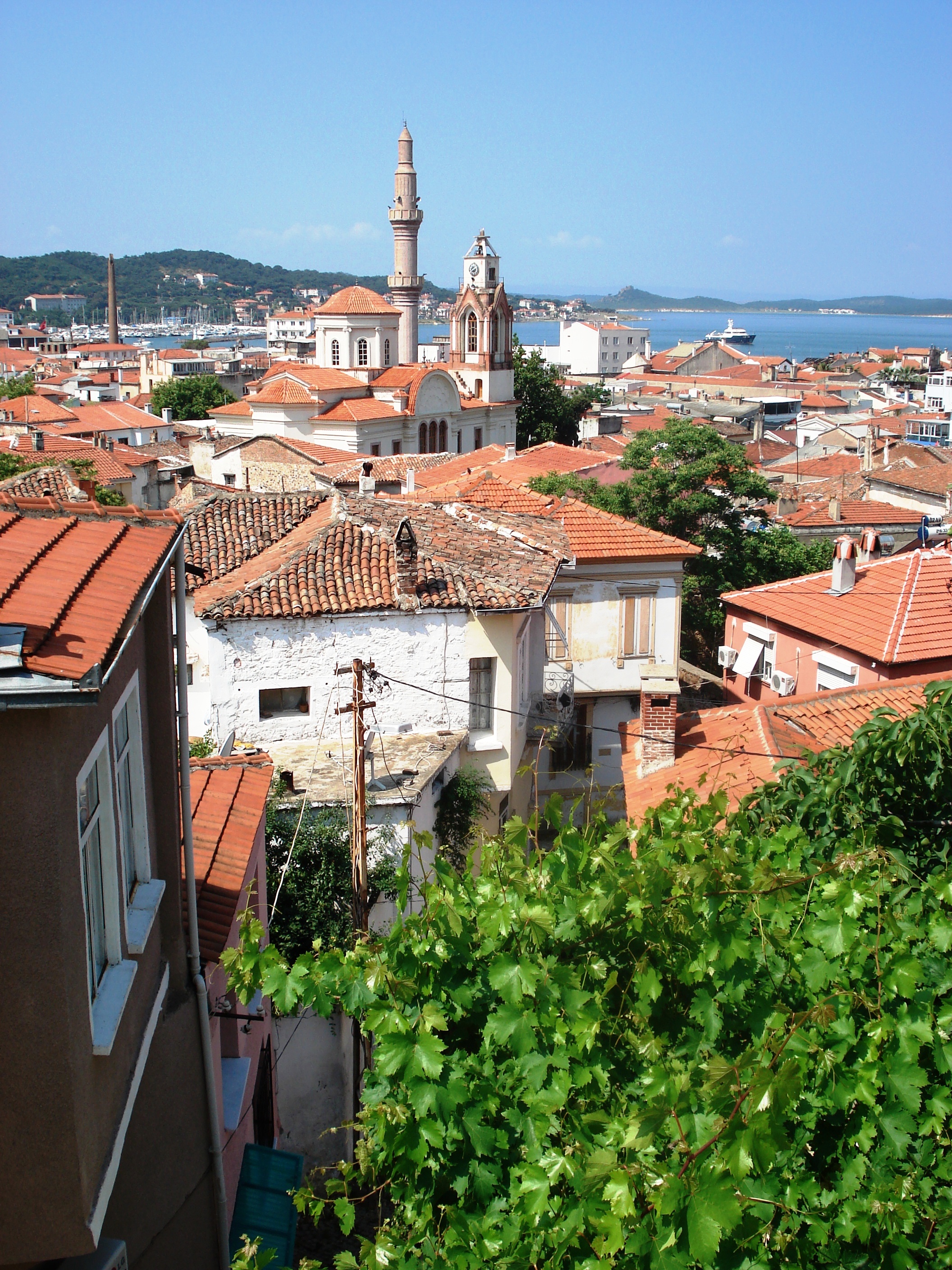
Two large mosques command Ayvalık, and – despite the minarets that have been put up alongside them – it’s impossible not to recognise them as Orthodox churches, as indeed they were originally intended. When the Greeks disappeared and the Turkish population swelled it was decided to simply convert these two churches (and many elsewhere) into mosques, like miniature Hagia Sophias. From the inside it’s difficult to imagine the now whitewashed walls covered in iconography, but from the outside (aside from the minaret) they obviously follow all the typical architectural conventions of a large Greek Orthodox church. They’re a magnificent sight, silently commanding the town, unavoidable once you rise to any kind of elevation. Evidence of Greek heritage is hard to miss elsewhere too, and most immediately obvious in the enigmatic backstreets behind the harbour. Roads evidently not designed for the modern vehicle wind past old wooden houses in various stages of disrepair. At night
they become even more deserted than in the day, and seem to suggest even more
secrets. Occasionally you come across a house with carved Greek lettering dating back to the 19th century, as often as not practically caving in on itself. Life goes on furtively above your head: muffled sounds behind open windows and closed curtains, from protruding bay windows that lean out and seem to touch each other across the street.
The island of Cunda is a siren call audible from the Ayvalık waterfront, and I yielded to it, postponing my onward journey by a day. Cunda has a refined air about it: the harbour is smarter than Ayvalık’s, people give the impression of being even more horizontally relaxed. On arrival I followed the instinct that I always try to satisfy upon landing on a new island: walk back and upwards as high as possible to get an idea of the place from above. Following the winding old streets, I came across the derelict old Greek cathedral on the hillside, forgotten in a kind of scrubland, unused for almost a century. Disappointingly, (but unsurprisingly), I couldn’t get in as I’d hoped, but I did manage to peer inside through the now-empty windows. It’s been so badly damaged over time – by earthquakes and neglect – that it now looks as though the whole thing is only held up by the wood scaffolding that now fills the interior: to what end one can only guess. Nearby, another old church has almost entirely collapsed into rubble, only a crumbling apse remaining – battered and open to the elements, apparently waiting to be put out of its misery. I left it forgotten and forlorn, and climbed the rest of the short way up to the top, from which, looking west, I could make out the faint outline of Lesvos.

One of the paradoxes in this corner of the world is the contrast between its surface picturesqueness and its bloody, conflicted history. The residue of the latter is evident in the thundering nationalism of the politics, a taste of which I got as I was waiting to catch the boat to take me back from Cunda to Ayvalık. It was late afternoon and I was sitting in a café by the harbour, when a loud and apparently stirring recording of the Istiklal Marşı (the Turkish national anthem) struck up entirely unannounced from somewhere nearby. Exactly who was playing it, and why, I’ve no idea, but those around me weren’t splitting any hairs. All conversation immediately stopped; I looked around and within seconds only one person (apart from me) wasn’t standing silently, hand clutching breast, eyes staring grimly into the middle distance. I thought this lone sitter must have been a Greek, but he spotted me from across the restaurant and gestured for me to stand and do the same as everyone else: puzzling as he himself remained sitting. When it had finished everybody sat back down and returned to their tea or games of tavla; I looked back and realised that the only reason the man hadn’t stood was because he was disabled.
Cunda is about as secular as you get in Turkey (the two churches here weren’t even converted symbolically – just left to go to seed), the call to prayer from the single, isolated, mosque on the peninsula doesn’t even make it to the harbour. If you measure by the nauseatingly quaint image of old men playing tavla outside backstreet tea houses, or the loquacious women holding court on the steps in front of their houses, the Greeks and Turks on either side of the Aegean are irrefutably similar. The Turks of the Aegean wave the flag as enthusiastically as anywhere, and whilst elsewhere in Turkey these days you can easily forget that the Greeks were once bitter enemies, (there are others to point the finger at now), here the older enmity is still tangible – the narcissism of small differences.
Gentrification in Tarlabaşı, Istanbul
September 28, 2011
The noise of Tarlabaşı never stops. Street cats cry incessantly during the day and fight each other at night; street hawkers struggle with creaky wooden carts around the winding alleyways, crying out their wares of breakfast poğaças or carrying wooden boards full of fresh simits on their head; housewives call out of windows to the nearest greengrocer and lower baskets on string for goods, in summer groups of them in floral headscarves sit out all day gossiping on the pavement; children don’t sleep until the early hours, screaming as they play hop-scotch or kick footballs around; during Ramadan traditional drummers and singers pass every building, waking everyone up to break the fast before sunrise; for me, the chaotic street market each Sunday is one of the most colourful parades of human activity Istanbul has to offer. Taksim Square – with its shiny malls, modern cinemas, and thronging restaurants and bars – is considered the commercial and cultural “heart” of the city, but it takes just two minutes to pass down from the smart pedestrian boulevard of Istiklal Caddesi, cross the six-lane duel-carriageway Tarlabaşı Boulevard, and arrive in the impoverished backstreets of Tarlabaşı itself. In two minutes it feels like you’ve crossed into a different world. With the Turkish economy booming and Istanbul developing at such a rapid pace, it’s a world coming under serious threat.
Tracing the history of Tarlabaşı illustrates the fluctuating fortunes of Istanbul’s minorities over the past 200 years. Situated on the European side of the city, across the Golden Horn from the old town, the area was originally home to prosperous non-Muslims. The sturdy stone houses were built for Greeks and Armenians – lower-middle class artisans, small tradesmen, and merchants – whose economic prospects waxed even as the Ottoman Empire’s waned over the course of the nineteenth century. Istanbul’s Armenians were largely untouched by the tragedy engulfing their eastern Anatolian kin during the First World War, and its Greeks were exempt from the wholesale population exchanges that took place between the states of Greece and Turkey during the 1920s, but the situation of minorities became increasingly precarious during the republican years of the twentieth century. Official discouragement found expression in the punitive “Varlık Vergisi” (Wealth Tax) aimed at Turkey’s minority groups in 1942, and in the 1950s pogroms were organised against the Greeks of Istanbul, after which the vast majority moved swiftly away. Many of Tarlabaşı’s grand buildings were left empty and unaccounted for, and an area that was already going to seed went into accelerated decline. At the same time, rapid industrialization meant that significant numbers of Turks were moving into urban areas, and many found homes in the unoccupied but decaying townhouses of Tarlabaşı. In 1990, further waves of migration took place, this time of Kurds from eastern Anatolia – fleeing economic deprivation and the intensifying civil war in Turkey’s south-east. Thus, right in the centre of Istanbul, something of the atmosphere of an Anatolian village has been recreated in Tarlabaşı. But that isn’t the whole of it – alongside Kurdish migrants can be found Arab and African refugees, Roma (gypsies), Zaza-speaking Kurds, itinerant foreign language teachers living on the cheap, and even pockets of transsexuals (many of whom ply a trade in the seedy brothels along Tarlabaşı Boulevard). At a time when most of Turkey has become a state-sponsored monoculture, Tarlabaşı seems to reclaim something of the anarchically multicultural heritage of Anatolia.
“Gentrification” has taken place in all major cities striving to modernise, (it seems as inevitable as the carbon-copy Starbucks cafes popping up everywhere), and it’s already happened in many areas of Istanbul. Hard to believe now, but thirty years ago Istiklal Caddesi itself was a down-at-heel backwater; only relatively recently has it been pedestrianised, tidied up, reintroduced to its picturesque “nostalgic” tram line, and lined with the gleaming chain stores. There have been murmurings of tension in nearby Tophane, where the traditional inhabitants find themselves surrounded by growing numbers of small art gallerys, boutiques, and fashionable bars. Cihangir, on the opposite side of Istiklal, has become a chic enclave for expats and young professionals. Such examples follow a more typical, ‘organic’ process of gentrification; that planned for Tarlabaşı, however, is exactly that – planned. In 2005, an ‘Urban Renewal Act’ (Law 5366) passed through the Turkish parliament authorizing municipalities to work with private building companies to ‘regenerate’ areas of Istanbul. The historic Roma district of Sulukule, also on the European side, was one of the first declared an ‘Urban Renewal Area’. Eventually almost 1000 families were evicted from their homes and given new – unaffordable for most – apartments 45km away. The majority of these people have since become homeless and the area’s historic fabric has been ripped out, gradually replaced by more faceless modern apartment blocks. In 2006 Tarlabaşı was also chosen as a renewal area, and the contract for the project was awarded to GAP Inşaat, a subsidiary of Çalık Holding, the CEO of which is the son-in-law of the Turkish Prime Minister. Plans were soon released for the redevelopment of a 20,000 m2 area, a total of nine “building islands”. The website for the project (www.tarlabasiyenileniyor.com) is full of “before” and “after” pictures: photos of out-at-elbows back streets teeming with scruffy children and shady-looking men (the present Tarlabaşı), are contrasted with digitally-generated images of urbane, be-suited couples strolling down spotless, wholesome avenues (the projected Tarlabaşı). It must all look rather seductive to the prospective flat-buyer, but two major concerns persist: will the area’s historical character be preserved? and – perhaps more pressingly – will current residents go the way of Sulukule’s?
Tarlabaşı is an incredibly charismatic place. Its buildings are unique examples of late nineteenth century Ottoman Levantine architecture, elegant four and five storey stone townhouses with slim bay windows jutting out above the street. Clearly most haven’t been touched since being built – the majority are filthy, stained black with dirt, and some are now nothing more than shells, thick carpets of weeds and stumps of struggling trees behind a crumbling façade. Sanitary conditions in many places are primitive. It’s obvious that the area desperately needs improvement, but GAP Inşaat’s project goes beyond simple renovation, to what looks like a radical reimagining of the entire area’s fabric. A four-storey underground car park is planned, and whilst the developers insist that most buildings will be preserved, questions remain about what form this preservation will take. Many fear that Tarlabaşı’s unique historical character will be irredeemably destroyed by the changes. Mücella Yapıcı, from the Union of Chambers of Turkish Engineers and Architects, claims that “the cultural and historical heritages of Tarlabaşı are going to be sacrificed to financial benefits of some people or companies.” Appeals have been made to UNESCO and the European Court of Human Rights, but look unlikely to halt developments that are, ultimately, in the hands of the elected municipality. Whatever happens, current residents will undoubtedly be priced out by the new plans. In August 2010 the holding company claimed that agreements for purchase had been reached with 70% of the owners of houses in the area, and that apartments are being offered in a brand new suburban development to those evicted from Tarlabaşı. This development is almost two hours away by public transport in a little–known satellite city, Kayabaşı. Aside from the cultural jolt of having to move from Tarlabaşı to alien high-rise apartment blocks, miles away from where some have worked for years, it’s unlikely that many could afford the 1000TL upfront price and 309TL monthly mortgage payments for the cheapest apartments anyway, (let alone commuter costs).
It’s easy to sentimentalise from a distance. The fact is that amongst Istanbullus, Tarlabaşı is a no-go area, notorious for crime, poverty, violence, illiteracy, and overcrowding. At night the women leave their spots on the pavement and organized gangs move in. These problems won’t be solved by the municipality’s plans, but they will be moved elsewhere, which is probably what is wanted. My neighbour, Ozan, has lived with his family in the same building (which he owns) for 40 years and is under no illusions, “you have to be careful,” he says, “there are thieves all around here at night, life isn’t perfect.” But he’s tied to the area, working twelve hours a day, six days a week in a cheap restaurant just a five minute walk away, “our life is here, where else could we go?” Many people have already left, and a lot of the seedy bars, shops and brothels along Tarlabaşı Bulvarı have already closed down, making it look even more forlorn than before. Significant numbers have decided to stay on anyway, despite their houses being sold and expropriation procedures being threatened. The municipality has given no clear updates since last year, and a project that was due to be completed in 2010 rolls on without any end in sight. Threat of eviction hangs over the area like the sword of Damocles, but right now it’s difficult to see how it could be entirely vacated without the use of force, as – make no mistake – Tarlabaşı still teems. I’ve lived there for over a year, and if anything the population has increased in that time. I write this on a sultry weekday afternoon and the street outside my flat is as raucous as it has ever been. As Ozan says simply: “we don’t want to go anywhere.” Whether they want to or not, the decision may well be out of their hands, but – for the time being at least – Tarlabaşı remains stubbornly defiant.


 Turkey Book Talk