Europe, Turkey and historical amnesia
April 2, 2012
[Published on openDemocracy (27th March 2012): http://www.opendemocracy.net/william-armstrong/europe-turkey-and-historical-amnesia]
“In the first years after the war … Europeans took shelter behind a collective amnesia.” – Hans-Magnus Enzensberger.
In his robust case for a liberal Euro-scepticism, ‘A Grand Illusion?’ (1996), Tony Judt robustly debunked an oft-repeated myth about the post-war rebuilding project in western Europe. From the very start, rather than being part of a carefully planned attempt to reshape the continent by deliberately sabotaging nation-states from above, (with the eventual goal being to unite the entire continent under one umbrella European super-state), initial moves after the Second World War towards greater European cohesion were, in fact, the logical result of quite distinct national concerns. These concerns only converged in shared European projects by force of convenience. As Judt points out, post-war European cooperation was “a fortuitous outcome of separate and distinctive electoral concerns, economic interests, and national political cultures, it was made necessary by circumstance and rendered possible by prosperity.” In particular, the war of 1939-45 had the lasting consequence of giving the continent something else in common: “a shared recent memory of war, civil war, occupation, and defeat […] The shared experience of defeat points to another common European wartime experience: the memory of things best forgotten […] Hitler’s lasting gift to Europe was thus the degree to which he and his collaborators made it impossible henceforth to dwell with comfort on the past.”
Almost every European participant emerged from the Second World War having lost. The shared perception of a necessity for deliberate historical amnesia in post-war Europe, for forgetting the traumatic recent past, was thus one of the most significant points of convergence between nation states that helped legitimate the new European project. Cooperation was imperative, and part of this cooperation was the tacit agreement between nations as to the importance of ignoring their own roles in the madness of the war that had just ended. At the very most, if not forcibly ignoring, countries tended (or still tend) to absolve themselves of as much responsibility as possible, to trumpet exaggerated national myths of resistance to fascism. The phenomenon is observable in France, (formerly West) Germany, Belgium, Poland, Italy: such methods were considered something like an existential necessity, necessary in order for states to get over the Second World War as cohesive units. It is only since 1989 and the end of the Cold War that a more complex, honestly realistic picture of the European inheritance has emerged, and even now it’s clear that many countries are still far from willing to look their own troubled histories directly in the eye. The official French line, for example, shared by a majority of the French people, continues to exaggerate the significance and size of the French Resistance, and underestimate the completeness of Vichy France’s submission to fascism, and its horrendous consequences. There’s a salutary lesson to be taken from a charmed visit to Paris: its state of flawless architectural continuity was paid for at the price of submission to the Nazis.
In its capacity as a candidate country of the European Union, Turkey’s apparent refusal to come to terms with the Armenian “events” of 1915 is often cited as a clear example of why the country is unsuitable for membership. However, the opposite could well be true. Far from having to recognise these events as “genocide” in order to adhere to established European norms of historical account-settling, Turkey’s continued denial of the Armenian “events” should rather be seen as an advantage, recommending it as an entirely suitable European candidate. Following classic post-war European form, perhaps Turkey’s historical amnesia should be seen as one of the key criteria that it fulfils in its wish to be defined as an authentic European state!
Turkish Islam & Turkish Nationalism: A New Balance (Turkish Policy Quarterly, Winter 2012)
March 2, 2012
[This is an extended and elaborated version of a piece I posted on here some time ago. It is published in the latest, Winter 2012 edition of Turkish Policy Quarterly, which is available for purchase now. You can read the piece below or, along with a slightly anaemic abstract, in its original habitat here: http://www.turkishpolicy.com/article/674/turkish-nationalism-and-turkish-islam-a-new-balance/ ]
Since the establishment of the Republic of Turkey in 1923, received wisdom has tended to consider nationalism and Islam as mutually incompatible forces in the Turkish context. Turkish nationalism – so this narrative goes – is defined by the secularizing, modernizing example of Mustafa Kemal Atatürk, a positivist, military man with an almost religious faith in the ability of science to reshape society. Islam, with its appeals to multinational, multiracial unity, inevitably stood in the way of the “pure”, homogenous nation-state. Such an understanding was propagated by those early secularizing elites within Turkey itself, and largely accepted by observers outside the country for the better part of the past hundred years. However, the fact is that religion has always been a crucial motivating force behind popular expressions of nationalism in Turkey. What makes the current Justice and Development Party (AKP) government’s position unique is its wedding of a popular religious nationalism to real political power. Recent developments – in particular the ongoing recent spat between Turkey and Israel – demonstrate to outsiders what has been observable within Turkey for a long time: that Islam and Turkish nationalism are far from irreconcilable on the political, as well as social, level.
Popular Religion
A singular irony of the founding of the Turkish republic is the fact that for all the talk of institutional secularism, the new nation was, in fact, fundamentally defined on religious grounds. Significant numbers of those resettled on Turkish land during the Greek-Turkish population exchanges, for example, were Greek-speaking Muslims, who, in many cases, could not even speak the Turkish language. The Kurds (and other non-Turkish Muslim minorities) were also included on religious – rather than linguistic – grounds. Whether you spoke a dialect of Laz, Kurdish, Zazaki, or Turkish, religion was the most important category to fulfill in order to be included in the new Turkish state. Even Atatürk himself recognized the increased importance of religious sentiment, and was not averse – particularly in the early years of his leadership – to appealing to the emotional religious feelings of the people when seeking to unite the nation behind his resistance forces. He led the War of Independence as a Gazi, (meaning “Warrior of the Faith” in it’s original Arabic form), repeatedly invoked the name of God and the spiritual dimension of the liberation struggle in public pronouncements, and established Sunni Islam as the state religion in 1924.
Such an approach was seen as necessary following the religious retrenchment experienced by the Ottoman Empire during the late -19th and early -20th century. The loss of almost all Ottoman territory in the Balkans prior to the First World War resulted in the flight of around 400,000 Muslim migrants from hostile regions, to re-settle in Istanbul and Anatolia. Similarly, around the same number of Circassian Muslims from the north coast of the Black Sea also migrated to Ottoman territories in the 1860s, escaping from the increasingly aggressive practices of the Russian Empire. These migrants, or muhajir, had learnt to wear their religion as the singular mark of identity, and saw in the Ottoman Empire (and subsequently the Turkish Republic) a protective confessional motherland. Anatolia went through enormous demographic changes during the later years of the Ottoman Empire. Erik J. Zürcher estimates that immediately prior to the First World War, Anatolia was 80 percent Muslim, whilst ten years later, this figure had risen to 98 percent.[1] This more narrowly Muslim composition inevitably had a large impact on the policies and attitudes of the late-Ottoman and early republican eras. The decision to empty Anatolia of Christian Greeks, Armenians, and Syriacs – both before and after the establishment of the Republic – clearly illustrates how the new nation’s identity had become inseparable from its Muslim identity.
Elite Secularist Nationalism
This religious definition was emphasized even as Turkey’s new elites were preparing to systematically cleanse Islam from state institutions. The newly independent Turkish republic was not just neutral to religion; it actively subordinated it to the state, establishing a rigid and doctrinaire form of laicite in a country that until recently had been the seat of the Islamic Caliphate. All expression of Islam was to be tightly regulated by the new Diyanet İşleri Başkanlığı (Department of Religious Affairs) to ensure compliance with the new secular order. The Caliphate was abolished; independent religious establishments were closed down; imams were appointed and their Friday sermons were written by the state; women were discouraged from wearing the veil. Myriad other cultural and political reforms were initiated, aiming at faster and more effective Westernization. All of this was imposed from above, and all was done in the name of modernization, secularization and – crucially – nationalism: to oppose the changes or the way they were implemented was to risk vilification as an irtıcacı (reactionary), against the modern, independent Turkish nation. The military became the symbol of the secular order, and the four (if we include the “post-modern” coup of 1997) coup d’états that the country experienced during the 20th century were all – at least in part – military responses to perceived religious incursions into political and social life.
Thus, it is clear that there was a tension – even predating the declaration of the Republic – between the technocratic, secular nationalism of the reforming elites and the religious character that was essentially the defining feature of the new nation. In his fine assessment of modern Turkish history, Perry Anderson has described Kemalism as an “ideological code in two registers. One was secular and applied to the elite. The other was crypto-religious and accessible to the masses. Common to both was the integrity of the nation, as supreme political value.”[2] Atatürk’s secularizing reforms have too often been accepted as the defining features of Turkish nationalism but it is clear that such dry, technocratic reforms could not possibly constitute the sole emotional appeal influencing such an aggressive and deeply-felt nationalism. It is significant, for example, that the extreme nationalists of the far-right Nationalist Movement Party (MHP) – which won 13 percent of the votes in the parliamentary election of June 2011 – responded to the reopening of the historic Armenian Surp Haç Church in Ani with reactiveFriday prayers, which they organized two weeks later in the same location.[3] Likewise, it is striking that Turkish soldiers, felled in counter-insurgency conflict with the PKK, are uniformly referred to as şehitler, or “martyrs”, by the Turkish media.
The AKP and Post-nationalism?
The spectacular electoral successes of the AKP, an Islamically-oriented party, starting in 2002, seemed to challenge the assumptions of the secular-nationalist paradigm even further. Here at last, it was thought, was a way out of the monocultural impasse, a tonic to divisive and destructive Turkish nationalism. Many optimistically hoped that the AKP would take the country to a post-nationalist state of peace, respect for human rights, and economic prosperity, and a series of symbolic ‘openings’ helped warm up relations with minority communities within the Turkish borders. In particular, the government was expected to attempt a solution to the “Kurdish Question” by re-emphasizing common religious bonds between Turks and Kurds. More progress was made in the European Union accession process by the AKP than any previous government. It also defanged the Turkish military – that bastion of unreconstructed secular nationalism – which it accuses of plotting a coup to overthrow the elected government in the Balyoz, or “Sledgehammer”, case.
The AKP’s Marriage of Nationalism and Religion
It is becoming clear, however, that the government’s struggle against the generals was in fact only a strike against one, narrowly defined, type of nationalism. Another has become evident, and this form can be said to constitute the new ideological bedrock of the AKP government. Campaigning during the parliamentary election of June 2011, Prime Minister Tayyip Erdoğan adopted a much harder note on the Kurdish question than ever before, and – the AKP having won almost 50 percent of the popular vote – he has continued this tendency since. In response to the Kurdistan Workers Party (PKK) attacks on Turkish forces stationed near the Iraqi border in October, the government retreated back into the full scale military solution that has failed to solve the problem thus far. The feeble “apology on behalf of the state” that Erdoğan offered in November for the Dersim Massacres of 1937-39 can be summarily disregarded, representing nothing more than the government’s latest attempt to score cheap political points against the opposition Republican People’s Party (CHP). The EU process is effectively dead, and the government has wasted no time laying the blame squarely at the door of the EU itself. The United States – and “the West” more generally – comes in for increasingly strident criticism, sanctioned by rising anti-American sentiments in Turkish society (a recent poll found that 64.8 percent of Turks have a “negative” opinion of Americans).[4] Despite evident deficiencies in the “Turkish model”, Erdoğan obviously relishes being idolized across the Arab world and, emboldened by a booming economy, he flexes his muscles on the world stage as no Turkish leader has before. Appealing to the collective libido dominandi, such behavior wins him ever more support back home. Boorish populism is prosecuted in the name of greater and deeper democracy.
The equation of Turkish with Muslim identity was always tacitly understood; now it is explicit. Whilst previous Turkish administrations have, at times, won support by appealing to both nationalist and religious sentiments as well, none have done so as successfully as the AKP. Erdoğan differs from Turgut Özal in degree, organization and success, having become the first leader in Turkish history to win three consecutive elections, with a consistently rising share of the vote. The AKP’s real innovation lies in its ability to achieve what no other government has before: wedding populist religious nationalism to the levers of government and remaining in power whilst doing so.
The New Paradigm and the Turkey-Israel Dispute
As with all nationalist movements, the AKP’s needs outside foes against which to define itself, and perhaps the most significant of these today is Israel. The raid by the Israeli Defense Force (IDF) on the Turkish “Mavi Marmara” aid ship bound for Gaza in 2010 caused widespread public and political outrage, and the Turkish-Israeli diplomatic relationship has since deteriorated to such a degree that Turkey has almost entirely suspended political, military and economic ties with Israel. Owing to the widespread popular support for the government on this issue, the AKP has no motivation to desist; indeed one could argue that it may even have an interest in prolonging, even escalating the dispute. The spat brings into sharp focus the elision that has occurred between nationalism and religion: a hitherto unheard-of instance of secular nationalism and emotional religious indignation uniting in a common cause.
Nationalism and religion have been the two primary energizing forces in Turkish society for almost a hundred years, even if one has always dictated to the other. The current Turkish government’s rhetoric manages to appeal to both impulses, and that is why it is such a powerful brew.
[1] Erik J. Zürcher, Turkey: A Modern History, (London: I.B. Tauris, 2004), p.164.
[2] Perry Anderson, “Kemalism: After the Ottomans,” London Review of Books, 11 September 2008, http://www.lrb.co.uk/v30/n17/perry-anderson/kemalism
[3] “Turkish nationalist party holds Friday prayers at Ani ruins,” Hürriyet Daily News, 1 October 2010, http://web.hurriyetdailynews.com/n.php?n=mhp-prayed-at-ani-ruins-2010-10-01
[4] Talip Küçükcan, “Arab Image in Turkey,” Foundation for Political, Economic and Social Research (SETA) Research Report, June 2010, p.25, http://www.setav.org/ups/dosya/35086.pdf
Travel notes – Ayvalık
November 3, 2011
[Published by Today’s Zaman (28th Nov 2011): http://www.todayszaman.com/news-264185-a-town-attesting-to-history-along-the-aegean-ayvalik.html]
Not many trips can be traced back to the reading of one book, but that is the case with my recent hop down the Aegean coast of Turkey. I’ve always taken a passive interest in the near-history of this part of the world, and upon reading Bruce Clark’s Twice a Stranger – a fine account of the human effects of the Greek-Turkish population exchanges of the 1920s – I couldn’t resist visiting some of the areas described. Whilst one book inspired me to embark on the trip, one was also nearly responsible for making me pack up my bags to return home. I was accompanied most of the way by Robert Byron’s thrilling The Road to Oxiana, in which he describes marauding around the Persia and Afghanistan of the 1930s: wild horse chases across the central Asian steppe, the discovery of little-known ancient architectural treasures, dodging the Persian secret police, dysentry – it all rather put me to shame. Whilst I had nothing to rival these adventures, described below are my own peregrinations around a different, no less fascinating part of the world.
I arrived in Ayvalık exhausted after a day-long bus journey from Istanbul, which included an unexpected ferry crossing of a choppy Marmara Sea. The town is situated on the craggy north-western Aegean coast of Turkey, and for hundreds of years it was overwhelmingly home to Greeks, at the time subjects of the Ottoman Empire. After the First World War, the Greek armed forces used this western coast – with Izmir as unofficial capital – as a base to push as far into Asia Minor as possible. The reconquest by Turkish national resistance forces became one of the central, triumphant narratives of the Turkish War of Independence, and after the declaration of the Turkish Republic in 1923 the Greeks of Turkey and the Turks of Greece were swapped wholesale and sent to their ‘natural’ homelands. In Ayvalık, the entire Greek population was resettled on the nearby Greek island of Lesvos, and the many Turks of Lesvos went in the opposite direction. I have fond memories of childhood holidays in the small towns of Petra and Mytilene on Lesvos, which were favourite summer spots of my family. Of course, I knew little of this turbulent history at the time; all I really remember is the faint outline of the Anatolian coast high above the horizon on clear days, and the Sunday afternoon military parades on the waterfront, which I now realize carried far more significance than I could have understood then.
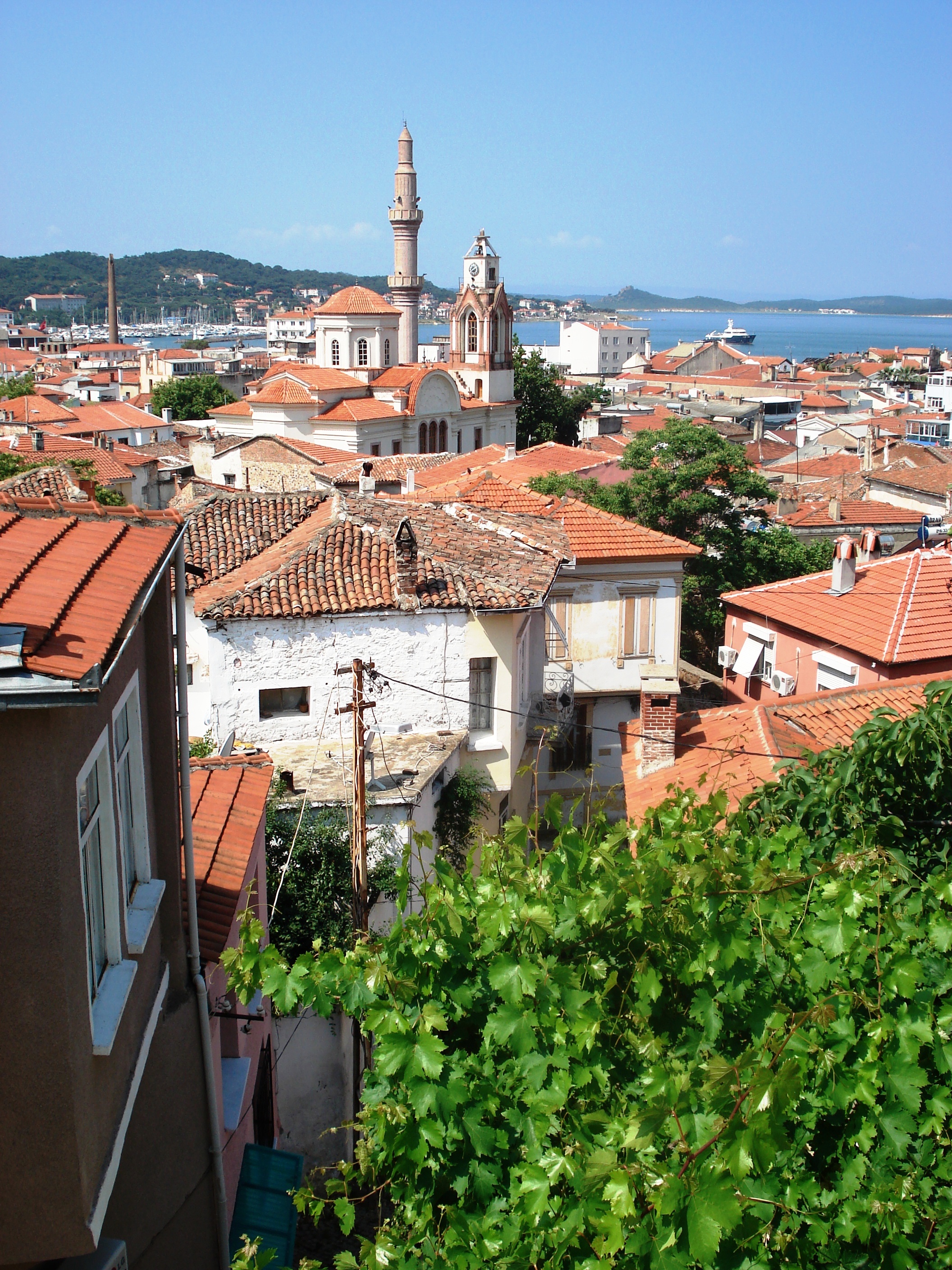
Two large mosques command Ayvalık, and – despite the minarets that have been put up alongside them – it’s impossible not to recognise them as Orthodox churches, as indeed they were originally intended. When the Greeks disappeared and the Turkish population swelled it was decided to simply convert these two churches (and many elsewhere) into mosques, like miniature Hagia Sophias. From the inside it’s difficult to imagine the now whitewashed walls covered in iconography, but from the outside (aside from the minaret) they obviously follow all the typical architectural conventions of a large Greek Orthodox church. They’re a magnificent sight, silently commanding the town, unavoidable once you rise to any kind of elevation. Evidence of Greek heritage is hard to miss elsewhere too, and most immediately obvious in the enigmatic backstreets behind the harbour. Roads evidently not designed for the modern vehicle wind past old wooden houses in various stages of disrepair. At night
they become even more deserted than in the day, and seem to suggest even more
secrets. Occasionally you come across a house with carved Greek lettering dating back to the 19th century, as often as not practically caving in on itself. Life goes on furtively above your head: muffled sounds behind open windows and closed curtains, from protruding bay windows that lean out and seem to touch each other across the street.
The island of Cunda is a siren call audible from the Ayvalık waterfront, and I yielded to it, postponing my onward journey by a day. Cunda has a refined air about it: the harbour is smarter than Ayvalık’s, people give the impression of being even more horizontally relaxed. On arrival I followed the instinct that I always try to satisfy upon landing on a new island: walk back and upwards as high as possible to get an idea of the place from above. Following the winding old streets, I came across the derelict old Greek cathedral on the hillside, forgotten in a kind of scrubland, unused for almost a century. Disappointingly, (but unsurprisingly), I couldn’t get in as I’d hoped, but I did manage to peer inside through the now-empty windows. It’s been so badly damaged over time – by earthquakes and neglect – that it now looks as though the whole thing is only held up by the wood scaffolding that now fills the interior: to what end one can only guess. Nearby, another old church has almost entirely collapsed into rubble, only a crumbling apse remaining – battered and open to the elements, apparently waiting to be put out of its misery. I left it forgotten and forlorn, and climbed the rest of the short way up to the top, from which, looking west, I could make out the faint outline of Lesvos.

One of the paradoxes in this corner of the world is the contrast between its surface picturesqueness and its bloody, conflicted history. The residue of the latter is evident in the thundering nationalism of the politics, a taste of which I got as I was waiting to catch the boat to take me back from Cunda to Ayvalık. It was late afternoon and I was sitting in a café by the harbour, when a loud and apparently stirring recording of the Istiklal Marşı (the Turkish national anthem) struck up entirely unannounced from somewhere nearby. Exactly who was playing it, and why, I’ve no idea, but those around me weren’t splitting any hairs. All conversation immediately stopped; I looked around and within seconds only one person (apart from me) wasn’t standing silently, hand clutching breast, eyes staring grimly into the middle distance. I thought this lone sitter must have been a Greek, but he spotted me from across the restaurant and gestured for me to stand and do the same as everyone else: puzzling as he himself remained sitting. When it had finished everybody sat back down and returned to their tea or games of tavla; I looked back and realised that the only reason the man hadn’t stood was because he was disabled.
Cunda is about as secular as you get in Turkey (the two churches here weren’t even converted symbolically – just left to go to seed), the call to prayer from the single, isolated, mosque on the peninsula doesn’t even make it to the harbour. If you measure by the nauseatingly quaint image of old men playing tavla outside backstreet tea houses, or the loquacious women holding court on the steps in front of their houses, the Greeks and Turks on either side of the Aegean are irrefutably similar. The Turks of the Aegean wave the flag as enthusiastically as anywhere, and whilst elsewhere in Turkey these days you can easily forget that the Greeks were once bitter enemies, (there are others to point the finger at now), here the older enmity is still tangible – the narcissism of small differences.


