Şakir Dinçşahin on the life and times of Niyazi Berkes, 1908-1988
February 20, 2016
Here’s my conversation with Şakir Dinçşahin about his book on the life and times of Turkish intellectual Niyazi Berkes.
Download the podcast, or listen below:
You can also now subscribe to the Turkey Book Talk podcast on Stitcher. Alternatively subscribe via iTunes or via PodBean.
Here’s my review of “State and Intellectuals: The Life and Times of Niyazi Berkes” (Rowman) at the Hürriyet Daily News.

If the issues discussed are your thing, check out this interview from last year with Andros Lamprou, who wrote an interesting book on the People’s Houses.
Also worth plugging this piece I wrote a couple of years ago on Mahmut Makal and his book “Bizim Köy” (Our Village), on his experiences as a teacher at a Village Institute in the 1940s.
Ryan Gingeras on ‘Atatürk: Heir to an Empire’
January 23, 2016
This week I spoke to author Ryan Gingeras on his new biography of Turkey’s founding father, “Mustafa Kemal Atatürk: Heir to an Empire” (Oxford University Press).
Or just listen here:
Here’s an edited transcript of the interview.
And here’s my review of the book (which is highly recommended).
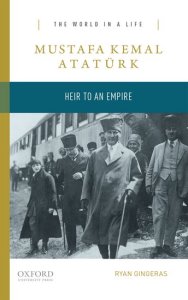
As I mentioned in the podcast, here’s a link to an interview I did with Ryan last year about another of his books, “Heroin, Organized Crime, and the Making of Modern Turkey.”
Subscribe to the Turkish Book Talk Podcast via PodBean, or via iTunes.
Markus Dressler on the ‘making of Turkish Alevi Islam’
November 28, 2015
This week’s interview/podcast is with Markus Dressler, author of the book “Writing Religion: The Making of Turkish Alevi Islam.” The book examines how the idea of Alevism is an almost entirely modern concept, formed towards the end of the Ottoman Empire as part of efforts to integrate disparate Anatolian religious groups into the Turkish and Muslim nation.
Download a podcast of our conversation.
Here’s a transcript of the interview at the Hürriyet Daily News.
Here’s my review of the book.
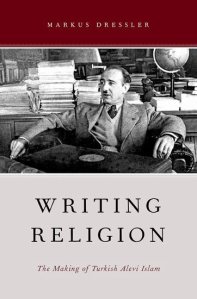
Subscribe to the Turkey Book Talk podcast via iTunes, PodBean, or Soundcloud.
NB – I’ve also just created a Facebook page for the podcast, where I’ll be posting new episodes. Check it out here.
Ozan Özavcı on liberalism in Turkey
October 10, 2015
This week I spoke to Ozan Özavcı about his book “Ahmet Ağaoğlu and the Genealogy of Liberalism in Turkey” (Brill), on the life of one of the most prominent intellectuals bridging the late Ottoman/early republican years.
Download the podcast of the interview here.
Subscribe to the Turkey Book Talk Podcast via iTunes, via Podbean, or via Soundcloud.
Here’s an edited version of the interview at HDN.
And here’s my review of the book.
If you’re interested in the subject, here’s my interview with Ankara University’s Alexandros Lamprou from earlier this year, discussing social engineering in the early Turkish Republic.

Finally, a shout out to my brother James Armstrong, who has designed the terrific icon for my podcast above. Follow him on Twitter and check out his great work at his website.
On Monday (Oct. 22), the Committee to Protect Journalists (CPJ) released a detailed report on the state of press freedom in Turkey, under the gloomy title: “Turkey’s Press Freedom Crisis – The Dark Days of Jailing Journalists and Criminalizing Dissent.” Although it seems like reports on the subject are released every month, this one received a huge amount of attention, both domestically and internationally. It describes the numerous instances of restrictions on media freedom, citing the familiar examples of the Ergenekon case, the endless prosecutions of journalists writing on Kurdish matters, the increasingly widespread practices of intimidation and self-censorship, as well as the ruling Justice and Development Party (AKP) government’s rising intolerance of dissent.
Bloomberg published a sensible commentary on the same day that the CPJ report was released:
“The committee had come under fire for reporting lower estimates of the number of jailed journalists than other human rights organizations. Turkey’s government has long maintained that only a handful of the journalists were charged with offenses related to their jobs, and because the CPJ hadn’t read all the indictments, it had erred on the side of caution.
“Now it has read the indictments and determined that 61 of the reporters and editors in detention are there because of things they wrote or said in the course of their work. In letters accompanying the report, the Turkish government disputes that characterization and asserts that it is striving to balance the need to prevent ‘the praising of violence and terrorist propaganda, and the need to expand freedom of speech.’
“What’s becoming all too clear during the Justice and Development Party’s third term in office is that despite its claims that the government is now liberalizing press laws and continuing the country’s march toward a European-style democracy, the opposite is happening. …
“Instead of fixing the legal system, the government has used it to repress opponents and intimidate the media. The “insult” laws, as well as the special anti-terrorism courts and laws, should be repealed. They are not worthy of a modern democracy, and they shouldn’t be a model for anyone.”
The report was widely covered in the Turkish media. The Oct. 23 edition of daily Taraf featured the report as its front page headline. It included an interview with Ragıp Zarakolu, a legendary figure in Turkish publishing, who has long written and published bravely on subjects that many others wouldn’t touch. He has spent a significant amount of time in prison over the years for things written or published, and he had some predictably doleful things to say:
“The fact that Turkey is found on these kinds of lists saddens me greatly. Turkey has to go beyond this, but in order to do this a change in mentality is necessary … In the existing system the state’s interests are always seen as more important than the citizen’s interests. For this reason, I don’t believe any changes can come in the end without a process of change in mentality. …
“I’ve been writing in the Kurdish press for 20 years. I witnessed the killing of a 72-year-old editor. Such things aren’t experienced any more. But should we be thankful simply for the fact that we’re not killed, or like Uğur Mumcu we’re not assassinated? Turkey is currently at the end of a 10 year process. But despite constant reforms and improvements being spoken of for 10 years, journalists are still in jail for political reasons, and there are still people who have been in prison for 30 years for political reasons. We have to examine this.”
While it’s imperative to identify the areas in which the current government has attacked press freedom, it’s also important to identify the deeper structural problems undermining freedom of expression in Turkey, too. (I touched on the issue a couple of months ago on this blog.) Also included in the CPJ report is an interview with journalist Yavuz Baydar, in which he discusses some of these problems:
“While the rules of the game in the media landscape remain unchanged, unreformed, what changes are the actors, new proprietors. Turkey’s media owners are – like drug addicts – dependent on the powers in Ankara because they are in all sorts of businesses, need approvals for growth and investments, etc., and therefore keep their media outlets either as weapons for extortion or, at best, at the service of governments. …
“The media owners of these outlets acting as ‘the coalition of the willing’ that openly act submissively to the government and security bureaucracy. I can only refer to a key meeting between the PM and all the media proprietors last autumn, during which media owners went as far as proposing themselves to the PM that they can build a “censor commission” among themselves, to be chaired by a cabinet minister. The PM declined the offer, but the message was taken well. In the case of Uludere, where 34 Kurdish smugglers were bombed to death due to a tragic mistake, there was a full blackout in that media for 17 hours while the news flow was instant and heavy in social media. This pattern of blocking is now the norm.”
A related piece by Baydar, called “Another Gloomy Report,” was published in Today’s Zaman on Oct. 21:
“The greatest source of censorship and increasing self-censorship today [is] the ‘unholy alliance’ between the proprietors of big media groups and the powers in Ankara – a deal that connects mutual greed in terms of money and propaganda. This [will] continue to pollute the climate of good journalism, and even if the government resolved the issue of ‘jailed journalists’ it would leave journalism under huge pressure …
“Turkey’s media, vibrant, diverse, still bold, keen on struggling for its independence, will remain easy prey for those with money and political power.”
Nevertheless, the most immediate threat to freedom of expression still comes directly from the government. Ali Özkaya, a lawyer for Prime Minister Recep Tayyip Erdoğan, was quoted in daily Akşam on Oct. 23, and his words should be alarming to any sentient observer:
“We have to underline that cases we’ve opened against press have been quite a deterrent; the wording of columnists has noticeably changed especially since 2003. Reporters and columnists do not exceed the dose when making criticisms anymore; insulting comments or columns have been reduced to minimum.”
(Some) Turkish newspapers report on the AKP Congress
October 2, 2012
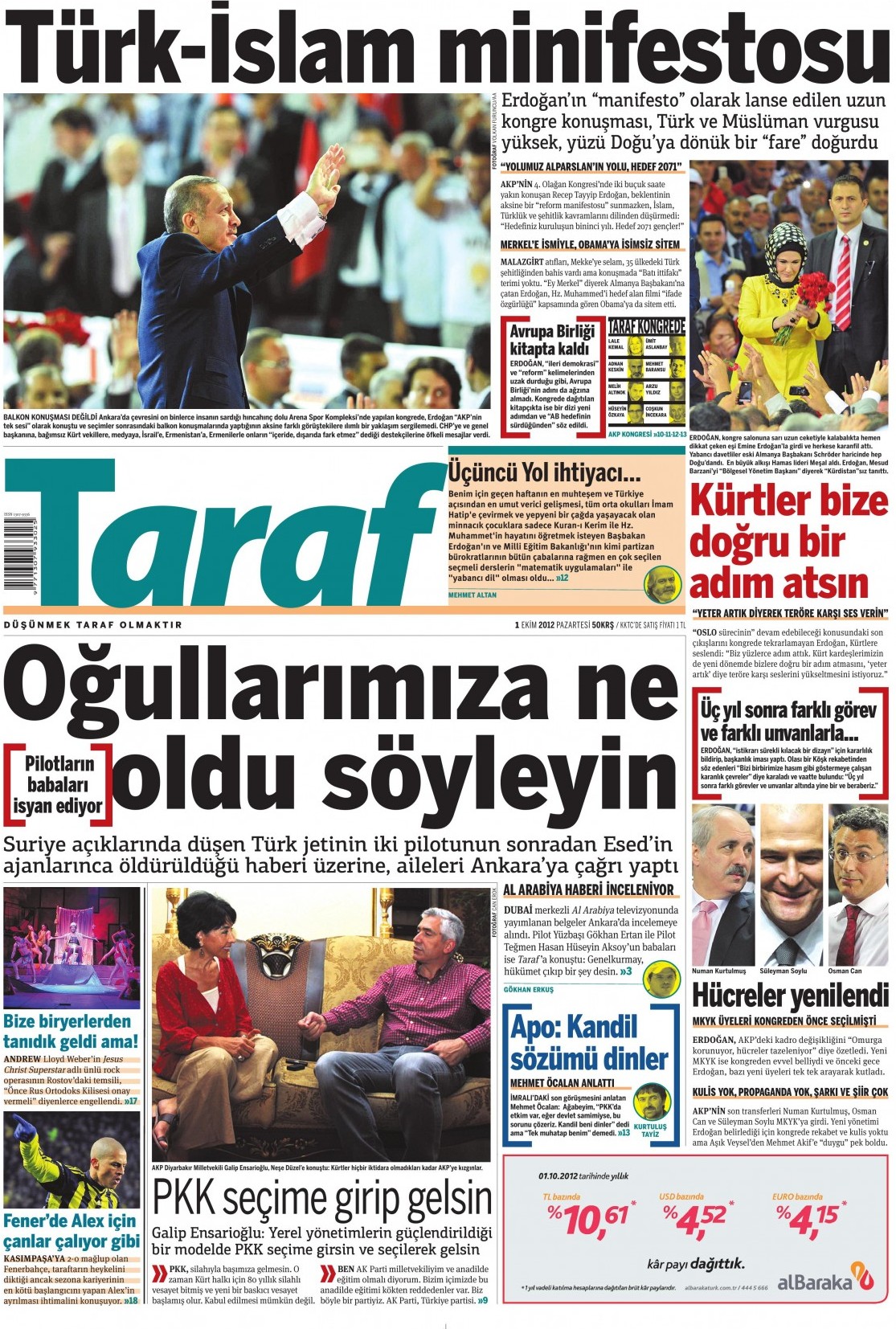
The ruling Justice and Development Party (AKP) held its key congress on Sunday (Sept. 30), the slogan of which was “Büyük Millet, Büyük Güç, Hedef 2023” (Great Nation, Great Strength, Target 2023). Throughout his emotional two-and-a-half hour speech, Prime Minister Recep Tayyip Erdoğan was in full neo-Ottoman mode. He told the 10,000 delegates packed into the Ankara arena that the government was following the same path as Sultan Mehmet II (the conqueror of Constantinople) and Selim I (“The Grim,” who expanded Ottoman territories to the east during the 16th century). He even went so far as to declare – tongue only half in cheek – that the AKP’s new target was 2071, linking the party back to the first Turkish Anatolian state-builders of the 11th century, 2071 being the 1,000th anniversary of Seljuk Turkish leader Alp Arslan’s entry into Anatolia.
It was a speech high in stirring rhetoric. The day after, government supporting newspapers fawned over the “renewal” and “refreshing” emphasis of a new “ustalık” (mastership) era. Daily Sabah focused on what it called the embracing, inclusive nature of Erdoğan’s speech and his words on the Kurdish issue: “Let’s draw a new roadmap together.” Zaman’s front page headline enthusiastically quoted a line from Erdoğan’s speech: “Come, let’s open a new page, let’s say ‘no to terror.’”

The contentious presence of Iraqi Kurdistan Regional leader Massoud Barzani at the congress was rather less trumpeted by Sabah and Zaman. He even gave a speech to the delegates, but the announcer in the arena refrained from using the word “Kurdistan” when introducing him. Indeed, rather than Barzani, it was Erdoğan’s words on the Kurds that received most attention in the pro-government press. This reminded me of one of Nuray Mert’s recent columns in the Hürriyet Daily News:
“The idea of the Ottoman Empire has induced a nostalgic longing for the days when Turkish sultans ruled diverse people in vast lands. For Ottomanists, the idea of the Ottoman Empire as a multi-ethnic haven for diverse cultures and populations is rather misleading, since the basic idea has always been to recall the times when diverse populations lived under ‘Turkish rule.’”
The conspicuously Islamic nature of the congress was also much discussed in the Turkish press – both by those approving and those dissenting. Beside its headline declaring “Great Strength Manifesto,” Islamist daily Yeni Şafak featured an admiring front page box quoting Hamas leader Khaled Meshaal, controversially (or perhaps not) invited to speak at the event: “‘You are not just the leader of Turkey, but also the leader of the Islamic world,’ Meshaal said, receiving extended applause from the crowd.” Indeed, when announced to the audience Mashaal received some of the loudest cheers of the day, (the EU dignitary who was introduced after him didn’t stand a chance!)
Liberal daily Taraf agreed that the congress constituted a Turkish-Islamic “minifesto,” but struck a rather more sceptical tone: “There was a strong Turkish and Muslim emphasis, a mouse with its face turned to the East was born,” (in Turkish, “a mouse was born” means that something underwhelming took place). The paper also noted plaintively that Erdoğan had failed to mention the European Union even once during his speech.
Meanwhile, seven national newspapers were refused accreditation to attend: Cumhuriyet, Sözcü, Evrensel, Birgün, Aydınlık, Yeniçağ, and Özgür Gündem. These publications have diverse sympathies: from left to right wing, from Turkish to Kurdish nationalism. The only thing shared by all is antipathy towards the government.
In response, Monday’s Cumhuriyet included a front page editorial titled “From Cumhuriyet to Public Opinion,” which said some unsurprisingly harsh things:
“Established six months after the founding of the Turkish Republic, our newspaper has been published for 88 years. During periods in the past when democracy has been suspended by the ruling powers our newspaper has been closed down, but outside of this we have always published under the principles of freedom of the press, in the name of people’s right to know. In 21st century Turkey, our newspaper is now exposed to censorship by the ruling powers.
“We will not stay quiet in the face of the anti-democratic implementations applied against us that violate both the constitution and the law.”
The piece went on to detail two constitutional and legal articles that it alleges the congress ban violated: Article no. 69 of the Turkish constitution, which states that internal political party activities, arrangements, and workings must not run counter to the principles of democracy; and Article no. 93 of the Law on Political Parties, which states that decisions taken and actions performed by party central administrations and affiliated groups must not run counter to the principles of democracy.
The International Press Institute’s Turkish National Committee issued a statement about the issue on the day of the AKP Congress, on behalf of the Freedom for Journalists Platform, an umbrella group representing local and national media organisations in Turkey:
“The news that reporters and journalists from some press organs are not allowed to enter the AK Party’s Congress is very worrying.
“Monitoring this historical event of the ruling government party on the spot and transferring it to its readers and viewers are primary duties of news media.
“We have previously protested the accreditation limitations at other institutions. But now, it is very disappointing that the same accreditation is being applied by a political party whose existence depends on democracy.”
Taraf newspaper and liberal disillusionment
July 15, 2012
On July 14, leftist daily BirGün included a piece discussing liberal daily Taraf’s recent turn away from the ruling Justice and Development Party (AKP) government. Prompted by Ahmet Altan’s July 13 editorial bemoaning the AKP’s departure from its earlier EU-minded liberal-reformist impulses – the latest in a series of articles critical of the government – BirGün described the shift with some incredulity. Taraf, the piece said, used to label government critics anti-democratic nationalists in thrall to regressive military tutelage, strongly supported a “yes” vote in the September 2010 constitutional referendum, hailed Prime Minister Recep Tayyip Erdoğan as a saviour of the Kurds, and openly recognised the “Armenian Genocide” on its front page. Recently, however, the paper’s criticism of the AKP’s authoritarian turn has increased significantly. Taraf’s move against the government could be seen as representative of disillusioned liberal Turkish opinion these days, but the apparent non-effect this has on opinion polls indicates just how tiny that liberal constituency actually is.
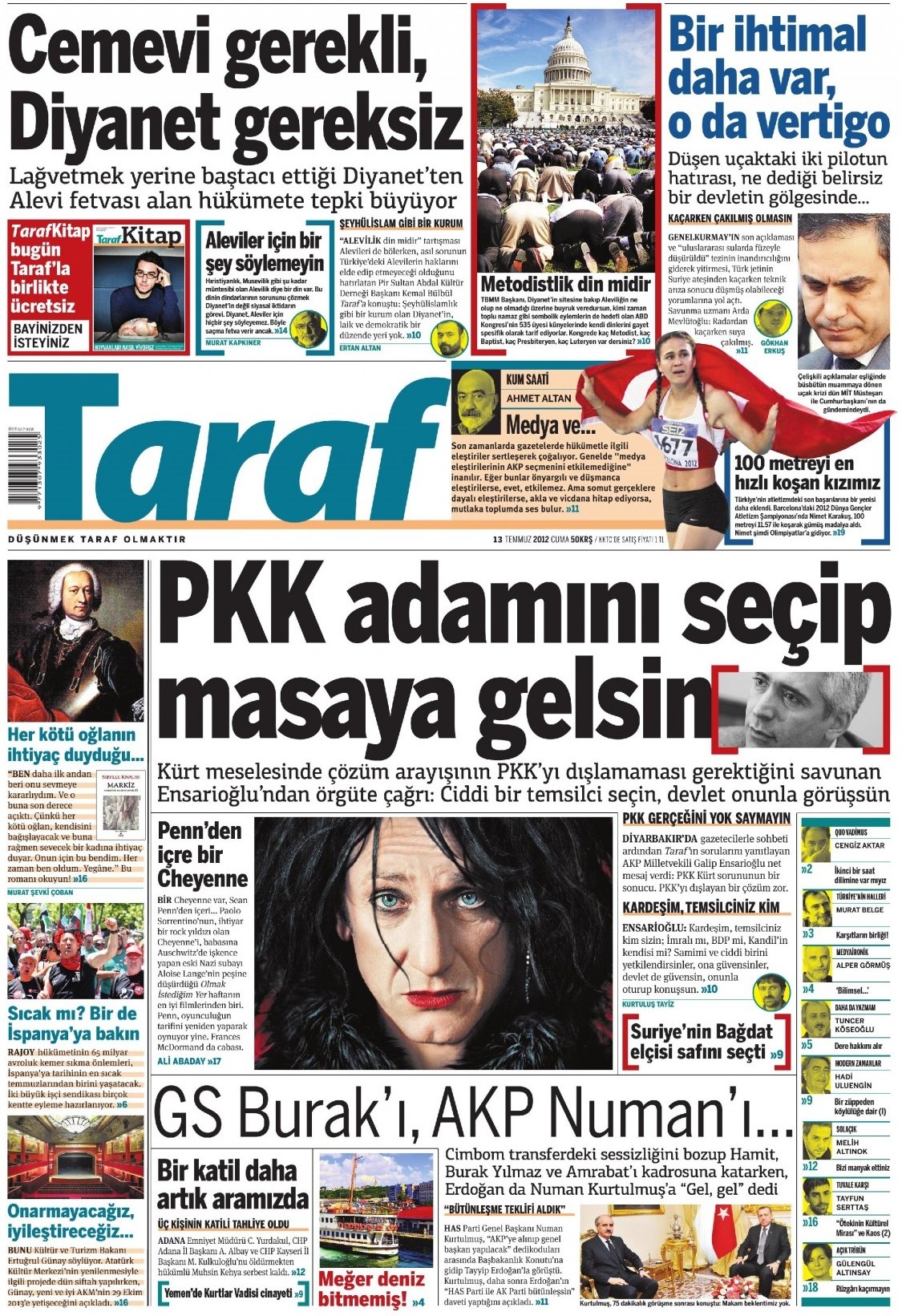
Taraf started printing in 2007 and primarily made a name for itself for its tough anti-military stance. For Turkish liberals at the time, this seemed like the most important battle to be won, and foreign observers routinely used adjectives like “courageous,” “plucky,” and “brave” to describe the paper’s anti-militarist crusade. Domestic critics denigrated it as the AKP’s convenient attack dog, something akin to the “useful idiot” liberal apologists who denied the existence of Lenin’s Soviet police-state terror in the 1910s and 20s. Taraf has been particularly instrumental in the Ergenekon and Balyoz coup plot investigations, claiming numerous scoops against the military in that case, (no matter that most of its anti-military material is widely understood to have been fed to it directly by the AKP government). As Jim Meyer described in a 2009 piece:
“Particularly with regard to the Ergenekon trial, Taraf has managed to frequently scoop the competition with reports (often leaked by the largely AK Party controlled national police force) which have embarrassed military officials […] ‘I don’t see journalistic achievement,’ said one experienced Turkish journalist. ‘They just gobbled up what the police intelligence was leaking them regarding Ergenekon.’”
Meyer’s analysis was written three and a half years ago, and since then the contradictions and evident absurdities in the coup plot cases – as well as the growing anti-democratic practices of the AKP government – have become more and more apparent. While Taraf still maintains its strong anti-military position, it has begun to abandon its previously timid approach to the ruling party and is now voicing tough criticism of various government tendencies. This became particularly clear in January, when lawyers for Prime Minister Erdoğan sued the paper’s editor Ahmet Altan for allegedly “[making] extremely deep insults with the intention of assaulting Erdoğan’s personal rights,” and pressed for 50,000 Turkish Liras in compensation. Evidently, the AKP government wants to keep Taraf on a short leash, but the paper’s continued criticism since then would suggest it has not yet been successful.
Meanwhile, on the same day as BirGün was observing Taraf’s apparent shift against the government, all media outlets were reporting on an upcoming AKP proposal to the Turkish parliament’s Constitution Conciliation Commission (which is currently attempting to put together a new national constitution). The Hürriyet Daily News reports that the proposed changes would “allow the government to limit press freedom in a variety of scenarios that include cases of ‘national security’ and ‘public morals.’”
Referring to the moves, Taraf’s July 14 front page headline story harshly criticised the AKP government for its “prohibitionist mentality.” It cited a 1976 European Court of Human Rights ruling, which stated that: “Freedom of expression […] is applicable not only to “information” or “ideas” that are favourably received or regarded as inoffensive or as a matter of indifference, but also to those that offend, shock or disturb the State or any sector of the population.” Underneath the main headline, the article pointedly said: “we hope this ruling inspires the AKP.”
[Hürriyet Daily News (15th June 2012): http://www.hurriyetdailynews.com/ataturk-an-intellectual-biography.aspx?pageID=500&eid=101]
M. Şükrü Hanioğlu – Atatürk: An Intellectual Biography, Princeton University Press, 2011, 280pp
One of the first things guaranteed to strike any newcomer to Turkey is the inescapability of Mustafa Kemal Atatürk – the statues, the portraits in every shop, the street names, the fact that every bookshop has an “Atatürk section,” the fact that every classroom has an “Atatürk Corner.” Whatever truth there is in the concern amongst secular Turks that the founder of the Turkish Republic’s memory is being eroded by a new religious order, it certainly – at least superficially – doesn’t feel that way to the Turkey neophyte.

Of course though, if that neophyte is going to stay for a longer stretch of time, he or she will sooner or later have to get a firmer handle on the Atatürk fundamentals, and Professor M. Şükrü Hanioğlu of Princeton University is the latest to take on the daunting task of producing a biography on the man. As Hanioğlu himself says in the preface to the book, it’s daunting because in Turkey: “For many years, the scholar who aspired to portray Atatürk as he really was resembled the pre-modern historian rash enough to attempt a depiction of the historical Jesus.” Though restricted in scope to the influences that shaped the “intellectual” character of its subject, (rather than filling in details of the personal life story), “Atatürk: An Intellectual Biography” is a sane, fair-minded primer to the ideological forces that shaped the “Father of the Turks.” Unlike so many titles in that “Atatürk section” of the local bookshops, it is resolutely a biography – not a hagiography.
The first step to challenging any holy text is to read it as a product of its historical context. The major objective of this book is to do the same with Atatürk, presenting him as an intellectual and social product of the late nineteenth and early twentieth century Ottoman Empire. The influences affecting the elites of the late Ottoman period are thus given ample space, demonstrating the essential continuity that Mustafa Kemal represented. Even though politically he was to become the symbolic figurehead of the sudden rupture between the old imperial order and the new republic, in crucial respects Atatürk was simply the inheritor of the late Ottoman reformist legacy. This historical continuity is one of the central themes that emerges from almost all serious contemporary historical writing on the period. Hanioğlu summarises:
“it is imperative to realize that Mustafa Kemal emerged from within a specific social milieu … many of the radical ideas destined to become central planks in his reform program were widely held in intellectual circles at the turn of the century … Despite the radical changes that it brought about, the Turkish transformation led by Atatürk was not a rupture with the Late Ottoman past but, in important respects, its continuation.”
While official Turkish historiography considers the founder of the TurkishRepublica kind of omniscient leader for all times, untrammelled by the age in which he emerged, this book paints a convincing alternative picture.
In this respect, the discussion of nineteenth century German military theorist Colmar van der Goltz’s idea of “the Nation in Arms” is particularly illuminating. Goltz held that a state’s military elite should be afforded an exalted role as the ultimate guide of society, a “superior position” being “the natural due of officers as a class.” Such ideas found fertile ground in the lateOttoman Empire, and Goltz was chosen to lead a restructuring of the Ottoman Royal Military in 1883-84. His theories had an obvious effect on the Committee of Union and Progress, (the group of military officers later known as the Young Turks), which swept to power in 1908, and were clearly significant in justifying the military’s later elite position in the Turkish Republic. Equally important to Ottoman thinking of the time – and consequently to Atatürk – was another German import, the concept of Vulgarmaterialismus:
“a vulgarized version of the doctrine of materialism, fusing popular notions of materialism, scientism, and Darwinism into a simplistic creed that upheld the role of science in society. The late Ottoman version of this materialism was a further simplification of the German original and a medley of highly disparate ideas.”
Hanioğlu remarks on the inherent irony of the self-contradictory, one-dimensional worship of scientific materialism by the era’s elites, a secular creed held on to with as much unquestioning zeal as the most pious of religious believers. The early republican fetish for the all-encompassing power of science was clearly a direct inheritance from this late Ottoman tendency.
Such oversimplification also gave rise to some of the more eccentric, often troubling republican intellectual predilections. The scientistic cult logically led to scientific racism and theories of exclusivist Turkish racial superiority, (the body of 16th century imperial Ottoman architect Mimar Sinan was exhumed in 1925 to confirm the brachycephalic shape of his skull, in order to prove beyond all doubt that he was, indeed, an ethnic Turk). It also fed into the aberration of the various Turkist language theories – which resulted in the brutal purging of all “foreign elements” in order to form a new “purified” Turkish language, with artificial replacements dredged up from ancient Turkic languages. In the words of Geoffrey Lewis, the reforms were a “catastrophic success,” and meant that Atatürk’s famous 36-hour speech of 1926 had already become unintelligible and had to be rendered into modern usage by 1963. There was also the new Turkish history thesis that found its way into official Turkish textbooks, which involved a comprehensive effort to prove that all ancient civilisations, including Greece and Rome, came from a central Asian Turkish wellspring. Despite obviously being nonsense, this revisionist interpretation of human history was seductive because it served a number of practical purposes. Firstly, it helped bypass the awkwardly religious Ottoman past; secondly, it helped pre-empt claims by rival nationalisms that Turks were latecomers to Anatolia; and thirdly, in the Turks’ mission civilisatrice, it also sought to solidify Turkey’s position as an integral part of the West, (although even this may have been a step down for some, with one contemporary text claiming that “Turks lived clothed during the stone age in 12000 BC, while Europeans reached that stage 5,000 years later.”) Atatürk never feels further from the figure of the high Enlightenment – and closer to his own, authoritarian age – than when we read of these quixotic social engineering projects. (I was struck recently when my neighbourhood plumber, Ali, while repairing some piping in my bathroom, began expounding something that sounded suspiciously close to the “Sun Language Theory.” I used to think of such things as being not much more than an eccentric footnote, representing the lunatic fringe of the early republican age, but perhaps I was being too generous.)
Nevertheless, despite the fact that it was personally one of his central intellectual pillars, Atatürk tended not to emphasise the more esoteric expressions of his Turkism until the future of the republic had been properly secured. Until this time, Hanioğlu stresses, Atatürk displayed an often underappreciated pragmatism as a politician. This is especially the case with regard to religion, which is far from the black and white picture that is often assumed. Atatürk was never averse to invoking Islam, particularly early on, when seeking to mobilise the masses in the struggle against the Allies and the non-Muslim populations, which were seen as a mortal threat to the very independence of the nation. Despite his contempt for communism, he also made use of a “purely rhetorical Socialism,” largely aiming to maintain the young republic’s alliance of convenience with theSoviet Union. “This pattern of dissimulation,” Hanioğlu writes:
“was undoubtedly part of a deliberate strategy to align the nationalists with the most powerful and broad-based ideologies of resistance, while obfuscating the exclusionary objectives of the movement. This ideological mishmash was crucial to Mustafa Kemal as he performed his difficult role as political leader, diplomat, and supreme military commander.”
Although he was the leading figure behind the abolition of the Ottoman Sultanate and, soon after, the Islamic Caliphate, this too was achieved in an extremely careful, gradualist way. As is often the case, what seems now like a sudden jolt and break with the past can, in many senses, be seen as merely the logical culmination of tendencies that had been developing for decades.
Westerners tend to view the Turkish adoration of Atatürk in rather narrow, technocratic terms, without understanding that the emotional resonance his image has across Turkish society couldn’t possibly be accounted for by his intellectual convictions alone. Like all icons, his image is still powerful in today’s Turkey because it has been effectively divested of all meaning, and the viewer can invest it with whatever symbolism he or she wishes to. As in any personality cult, Atatürk’s image must necessarily mean different things to different people. Depending on the context, Hanioğlu says, Atatürk “may be invoked in support of ideas that are étatist or liberal, nationalist or socialist, religious or scientistic, elitist or populist.” A westernised Turk on the Aegean coast might revere him for his secularizing, modernising vision, whilst a religious conservative in Central Anatolia can selectively ignore this, and instead place the emphasis elsewhere – perhaps instead respecting the strongman who successfully defended his homeland and gave the West a bloody nose. He probably sees no contradiction at all in praying five times a day while also passionately admiring Atatürk.
Shared by both caricatures is a veneration for the redeemer of the nation, and it is this aspect more than anything else that lends Atatürk the emotional impact needed to endure. This is the reason why detached and technical books like this, while welcome, can really only ever have a minor impact. The majority are guided by impulses rather less rational and rather more emotional. Atatürk himself understood that, even though it is this paradox that perhaps ultimately illustrates the limits of his ultra-rational, positivist intellectual convictions.
[Published on openDemocracy (20th June 2012): http://www.opendemocracy.net/william-armstrong/turkey-as-test-case-in-multipolar-post-cold-war-order]
Much is made of Turkey’s ‘difference’ in the Middle East. Why is it being identified an inspiration to the region? Why is there talk of Turkey as a model for Egypt, and not the other way around? In a recent interview with Turkish Policy Quarterly, historian Bernard Lewis makes much of Turkey’s republican history of independence and self-criticism since the Ottoman era, which he says accounts for the country’s regional pre-eminence today. Whilst these differences are indeed significant, a reasonable case can be made that they were not nearly so pronounced as Lewis claims. In fact, after the Second World War, Turkey was no more immune to the hard choices that had to be made in a bipolar world order than other Eastern European and Middle Eastern states. As such, like many others, it was only ever nominally independent.The difference between Turkey and the other countries in the region, however, is that it was able to emerge much more quickly in the post-Cold War era, when states previously under Soviet influence became independent, and the ‘protection’ of those under U.S. sway was rendered unnecessary. This emergence can be ascribed to Turkey’s higher economic, educational, industrial and institutional development, as well as its important narrative of national sovereignty and proud republican history. Its regional pre-eminence today is therefore closely linked to its status as a pioneer of the new, multi-polar post-Cold War era. The sense that the country is now defining itself, as opposed to being defined by outsiders, is a crucial psychological hurdle.
For the duration of the Cold War, the Middle East was an object region acted upon by outside forces, rather than a subject acting for itself. In practice, this meant states being pulled into the influence of either the U.S. or the Soviet Union. Turkey was no different in this sense, and was considered by Washingtonan essential bulwark against communism on the south-eastern fringe of Europe. In order to anchor Turkey to the west, the U.S. bankrolled the Turkish military through the Truman Doctrine in the post-war era, and it was made a full member of NATO in 1952 (at the same time as Greece, the other subject state of the Truman Doctrine). U.S. support – tacit or otherwise – was crucial in the three military coups of 1960, 1971, and 1980, all of which helped to maintain the status quo order. Like so many others, during the Cold War period Turkey was barely democratic, with its western allies preferring a stable, reliable partner to one that genuinely reflected its people’s unpredictable wishes. The 1980 coup is particularly instructive, being seen by the U.S. at the time as necessary to prevent any danger of the country sliding towards communism, as the Turkish left was extremely mobilised throughout the 1970s. CIA Ankara station chief at the time, Paul Henze, is on record as saying that he cabled Washington – shortly after the coup had been carried out by the Turkish military – to say ‘our boys did it’. Gossip perhaps, but illuminating gossip.
The 1980 coup therefore illustrates the old Turkish model, and its similarities with the systems that have also characterised the Arab world in the recent past: U.S./western support for an essentially non-democratic state, in return for the guarantee of stability. Turgut Özal, who became Prime Minister in 1982, could therefore be seen as a kind of non-military Turkish version of General Pinochet. Coming to power shortly after an American-backed coup, Özal was pro-U.S., anti-communist, and neo-liberal – significantly opening up the Turkish economy to international market forces with U.S. support. It’s an interesting irony that in many ways it was these very reforms that helped prepare Turkey to develop economically in the post-Cold War era.
After the Soviet Union collapsed, it also – perhaps paradoxically – became increasingly clear that the old U.S.-dominant model had also become redundant, with much of the previous justification for U.S. support to stable but undemocratic regimes having been lost. Slowly, it became possible for new, popular movements to emerge in the region, and this goes some way to explaining both the revolts sweeping across the Arab world today as well as Turkey’s (less violent) development of a strongly independent government representing popular will. There are, however, significant differences that may legislate against post-Cold War Arab countries following the same trajectory as Turkey. Not least of these is the multi-ethnic, multi-linguistic, multi-confessional nature of most of these countries – none can really be considered ‘nation states’ in anything like the organically-evolving western European sense of the world. Turkey’s own early 20th century nation-building project relied on an enormous amount of violently imposed state-directed social reorganisation, essentially imitating the western model, (in terms of the uniform cultural, ethnic, linguistic, religious cohesiveness that was stressed). On its own terms, the Turkish model of modernisation was successful – taking a multi-linguistic, multi-ethnic population and forging out of it a unitary, monolingual, officially mono-cultural state. In the modern nation states of the Arab world, with their fragmented and multifarious social, ethnic, religious, linguistic, sectarian structures, it is difficult to see how the same results can be achieved in the early 21st century – or even how such results would be desirable. The new Middle East is perhaps more likely to be one where – instead of two great outside powers seeking to impose their influence and maintain an unthreatening stability – a regional struggle will play out between multiple competing local forces. This struggle will be based on old fissures that the old Cold War order had previously kept an uneasy lid on.
Norman Stone – Turkey: A Short History (book review)
April 18, 2012
[A slightly shorter version of this review is published in the latest issue of ‘Insight Turkey’ (Vol. 14 No. 2): http://www.insightturkey.com/insight-turkey-volume-14-no-2/issues/168]
Norman Stone – Turkey: A Short History, Thames & Hudson, pp 192

A new title seems to be landing on the “Ottoman and Turkish History” shelves of Istanbul’s book shops every week. Norman Stone, formerly Professor of History at Oxford and Cambridge, is the latest heavyweight to step into the ring with this volume, an almost recklessly slim account of 1300 years’ history. The Turks’ nomadic central Asian origins, their 10th century arrival in Anatolia, the rise and fall of the Seljuk and Ottoman Empires, and the establishment of the modern Turkish Republic are all covered in just 165 pages. Though obviously thin on real detail in most places, the book nevertheless represents both a decent primer for the interested novice (with some important provisos), and an entertaining, elegantly-written frisk for the more jaded expert.
Early on, Stone suggests: “If you are Turkish you have to ask what you owe to: (1) the ancient native Turkish tradition; (2) Persia; (3) Byzantium; (4) Islam; (5) what sort of Islam; and (6) conscious westernization”. Of course, it would be far-fetched to imagine that every modern Turk self-consciously ratiocinates these things and comes up with their own credit-debit account of historical heritage. It’s this book’s major strength, however, to demonstrate the lesser-appreciated continuities – as well as sudden changes – that do make up so much of Turkish history. The Ottoman Empire, Stone tells us, initially saw itself as an inheritor of both the Seljuk Turk and Byzantine Greek traditions. Until the conquest of Constantinople in 1453, for example, the Ottomans had thrived as a cavalry-based nomadic “military empire” in the Seljuk tradition; indeed, the plan of the Topkapı Palace they built soon after the conquest – with its modest, low-rise pavilions and courtyards – deliberately imitates the tented headquarters of a nomadic Turkish chieftain. On the other hand, Mehmet II (the conqueror of Constantinople) spoke fluent Greek and was “in effect set upon retaking the eastern Roman Empire that Justinian had made great in the sixth century”. Sultans often made dynastic marriages of convenience with Byzantine princesses; and even the harem eunuch, an idea so beloved of the orientalist western European, was originally a Byzantine phenomenon, originating in the early Christian understanding that sex was the work of the Devil. There’s also the little-appreciated fact that, at the time of the conquest of Constantinople, the population of the Ottoman lands was still 75% Christian.
A more self-confidently “Ottoman” identity developed in the 15th century, particularly under Selim I (known to us rather unflatteringly as “the Grim”, though a more accurate translation of the Turkish “Yavuz” is “stern” or “tough”). His capture of much of the Arab peninsula – in particular the Holy Places of Mecca and Medina – inevitably made the Ottoman Empire more overtly Islamic, and it was during his reign that the Ottomans claimed the Islamic Caliphate from the withering Mameluke state in Egypt, (the Mamelukes themselves descended from Turks, brought to Egypt as slaves by the Ayyubid dynasty). It was also around this time that the Ottoman sultans would begin to emphasise splendour and grandiosity as their distinctive characteristic, adopting titles such as – amongst many others – “Marcher Lord of the Horizon” and “Shadow of God on Earth”. We associate this grandiosity with the apogee of Ottoman power, especially the long rule of Süleyman I (the Magnificent), which stretched from 1520-66. During Süleyman’s reign the empire won a series of blistering military victories, and the Ottoman territories reached their largest extent: it could be argued that the Ottomans were, for a time, the most powerful force on the globe. Süleyman wasn’t just a charismatic general of genius, however, but also a formidable organiser of the state machine, and he is known in Turkey to this day as “Kanuni”, or “law-maker”. “Süleyman’s reign”, Stone writes admiringly, “mark[s] a synthesis of empire: Rome for the law and organization, Islam for the inspiration, Central Asia for the military”. Nevertheless, things were set to change. It’s true that a light burns brightest in the moments before it becomes extinguished, but what happened to the Ottoman Empire after the age of Süleyman wasn’t so much a swift extinguishing, but rather an extraordinarily drawn-out decline, lasting until the 20th century. This decline is usually claimed to start at the disastrous siege of Vienna in 1683, which not only resulted in defeat but also prompted an enormous Christian counter-offensive in the European Ottoman territories. Symbolic though the siege may be, in reality the rot had started long before.
Stone poses a central question at the beginning of the book, which any historian of the Ottoman Empire must take seriously: “To what extent was the success of the Ottomans based on Islam, or would you read this the other way round, and just say that the Ottomans were successful when their Islam was not taken too seriously?” You needn’t necessarily answer this question entirely one way or the other. It is true, however, that hand in hand with the long decline of the Ottoman Empire went an Islamic intellectual retrogression, symbolised by the 18th century closure of mathematics and engineering schools and the broader atrophying of scientific enquiry. It’s also true that, throughout its existence, the Ottoman Empire depended not only on taxes levied on non-Muslim minorities to maintain its impressive bureaucratic machine, but also on minorities for the bulk of those conscripted into the elite Janissary guards, and even for Grand Viziers (who often held the real power, as opposed to their often ineffective sultans). The tolerance that the Ottoman Empire extended to its religious minorities, however imperfect, was truly remarkable, and certainly compares favourably with the record of contemporary European regimes. Indeed, when the Jews were expelled from the Iberian Peninsula in the early 16th century as part of the Inquisition in Spain, most were welcomed and resettled on Ottoman lands by then-sultan, Bayezid II, who dryly reflected: “You venture to call Ferdinand a wise ruler, he who has impoverished his own country and enriched mine!” It’s a good thing that he did too, as Christians and Jews increasingly kept the Ottoman economy going over the 18th and 19th centuries, inevitable when Islam forbade the earning of interest on debts. The “capitulations” – favourable terms offered to foreigners (enterprising Europeans) to do business in Ottoman territory – also gradually came to symbolise the increasing stranglehold in which the western European powers began to hold the Ottomans. Initially intended as a sensible method to stimulate trade with outsiders (the product of a self-confident and outward-looking state machine), they eventually came to be seen as humiliating terms which the Europeans exploited to gain further leverage over the declining eastern power. The Ottomans didn’t feel able to abolish the capitulations until the First World War, when their empire became as reckless and destructive as great empires tend to do when staring down the barrel of extinction. (As an interesting footnote, Stone describes the abolition of the capitulations as coming from the same impulse that led to the notorious Wealth Tax on minorities of 1942, and the anti-Greek pogroms of 1955: the necessity of creating a “national bourgeoisie”, or functioning “Muslim commercial class”.)
Before publishing this book, Stone had already gained some notoriety for his contrarian views on the Armenian “incidents” of 1915-17, and there is no Damascene moment to report here. He characterises what happened to the Armenians as just one strand of a theme that was common throughout the Ottoman lands in the late-19th and early-20th centuries. At around the same time as the Turks were massacring Armenians, for example, Muslims were themselves being forcibly expelled and subject to atrocities in the Balkans and the Caucasus. For their part, Greeks and Armenians were each also committing their own crimes against Muslim Turks. Framing the matter this way, and puzzling over how the Christian minorities have so monopolised historical sympathy, Stone seems think that the Turks’ only problem is one of PR. It was the same story, he argues, during the 19th century, when Greeks and Turks traded barbarities on the Aegean and liberal British sympathy – dazzled by the fashionable romantic Hellenism of the time – sided with the Greeks. “Genocide” is an unsuitable word for something that was, in reality, a far more ambiguous shade of grey. If what happened to the Armenians is genocide – Stone says – then so too is what was visited upon the Muslim population of the Balkans and in the territories of the Russian Empire.
It’s true that crimes against the Muslims of the Ottoman Empire receive comparatively little attention from western historians, and Stone is right to highlight them. But what happened to the Armenians really was something altogether different, and of an altogether different magnitude. Comparisons with Nazi Germany won’t do, but it’s an indisputable fact that hundreds of thousands of Armenians did die. “Deportations” is a suitably vague term to describe the deliberate massacre of many, the accidental death of some, and the forced resettlement of many others. The debate will continue (perhaps “rage on” is a more suitable term) as to the motives and effects of Ottoman policy in eastern Anatolia. There’s surely no doubt, however, that the emptying of all significant Christian minorities from Turkish lands was indeed considered convenient by the Young Turk regime – whether all the killings were deliberate or not – and it set about achieving this by whatever means necessary. Does Stone honestly believe that what happened was a legitimate response to Armenian terrorist activity, as he suggests here? Nationalism gripped all sections of Ottoman society during the 19th and 20th centuries. Perhaps the greatest mistake of the Armenians was in embracing their own with such enthusiasm, despite the fact that in no Ottoman province did the Armenian population ever constitute a majority.
Stone, in his enthusiasm to testify as witness for the Turkish defence against the genocide allegations, no doubt goes much too far; and he does the same elsewhere. In the preface he makes the bizarre assertion that it’s “not really for an outsider to comment” on the state of contemporary Turkish politics. Perhaps this argument makes more sense when you’re Professor in the History department of Ankara’s Bilkent University, as Stone currently is. Would he say the same about the United States, I wonder? If not, would he not then be guilty of the same kind of relativism that he’s doubtless (correctly) critical of elsewhere? The claim seems doubly odd, when – despite professing to “resolutely refrain from doing so” – Stone does, in fact, go on to make a number of extremely contentious pronouncements about modern Turkey. Shorn of the Kurds, we’re blithely told, the country would become “a Greece and perhaps even a sort of late Byzantium”, whatever that means. Almost as bafflingly, the military coup of 1980 – as a result of which 650,000 were arrested, countless tortured or killed, and the seeds sown for the future bloody Kurdish conflict – is limply presented to us as “the most interesting of all Turkey’s coups” in which “the casualties were very few in number”.
The chapters on the modern Turkish Republic thus make for a curiously hollow read. Perhaps what Stone meant when suggesting that “it’s not for an outsider to comment” was really “it’s not really for an outsider to criticise”. In which case, more’s the pity. As Kant rightly observed, you show a friend most respect by adopting a policy of sensitive but unswerving honesty, trusting that they are mature enough to respond to such honesty with dignity and equanimity. If Stone had recognised this, his observations on Turkish history – particularly the more recent – would have carried more weight.
The neo-Ottoman view of history
April 10, 2012
As the modern vogue for neo-Ottomanism lurches on in Turkey, the contrasts between the contemporary Turkish and British approaches to national history are for me becoming ever clearer. Neither is particularly encouraging, but both are the understandable result of respective historical inheritances.
Ever since the French Revolution, the British have defined themselves against that chaotic pole across the channel: reform rather than revolution has been the rule. Moments of crisis or turmoil have been home grown, not imposed from outside, and the country has always felt able to define itself on its own terms. For all its trauma, even the Second World War only served to confirm Britain in its sense of historical and moral righteousness; no awkward compromises had to be made, and the good ship sailed confidently on. Over time, however, this serene progression has engendered its own problems. Never having been forced to reflect upon it, the general population of modern Britain has slipped into complacent somnambulism about the past. Despite its importance, a dangerous ignorance surrounds the effect and significance – for better or for worse – of the British Empire, which is barely spoken of in today’s Britain and poorly understood by the general public. I recently took one of the example practice ‘citizenship tests’ on the British foreign office website, and while there are plenty of questions about the role of county council representatives or the frequency of local rubbish collections, there is almost nothing on the most fundamental episodes of national history. Compare this with other, similar western states – many of whose own citizenship tests I also had a look at (an exhilarating couple of hours) – and the contrast is far from flattering. Perhaps the crowning symptom of this malaise was the previous Labour government’s decision to remove history as a compulsory subject for students up to 16: an unforgivable sin.
Turkey’s relationship with its past is a lot more fraught with traumatic ruptures, conscious jolts forward, and moments of forced amnesia. Since the founding of the Turkish Republic in 1923, state policy has dictated that to look back on Turkey’s Ottoman past is backward and reactionary – somehow a betrayal of the modern Turkish nation state. The recent ‘neo-Ottoman’ challenge to this stultifying official diktat should therefore be welcome, but it’s so hollow and uneven as to be almost as problematic as what went before. Turkey’s newfound obsession with the past – evident in seductively-costumed films and T.V. series’; architecture; foreign policy; even fashion and interior design – shows no serious attempt to consider anything other than the most flattering, least challenging aspects of national history. A recent post on the Tarlabaşı Istanbul blog quotes Prof. Dr. Uğur Tanyeli on the subject, discussing the architectural example of the tawdry wedding cake confection of the “historically recreated” Demirören shopping mall on Istanbul’s İstiklal Caddesi:
“The fewer traces of the past [an object] carries, the more successful a preservation [is believed] to be … there is not only the Demiören shopping centre, but there are hundreds of buildings along the Bosporus like that. There are ‘renovated’ buildings dating back to the 13th century that look like they have been built yesterday and where not a single screw is historically justified … In Turkey, the historical has to be brand-new and squeaky clean. So what is actually wanted is the illusion of history – It has to be historical, but it is not allowed to carry any baggage of the past, or any of history’s patina, there can’t be anything about it that creates unease.”
The ongoing renovation project in Istanbul’s central Tarlabaşı district is also instructive. Having finally been vacated, most of the historical houses have been mercilessly gutted and left pray to looters and rubbish dumpers. As their sinking bay windows morosely cave in on themselves, it’s hard to see how many of these shells even remain standing. It looks depressingly likely that they are simply going to be demolished, to be replaced by historically empty ‘imitation’ replacements. The so-called ‘regeneration’ of Tarlabaşı’s old buildings thus symbolises the modern, neo-Ottoman view of history: a facile attempt to reclaim the past, without the inconvenience of the antiquated plumbing systems of a truly authentic picture. As Prof. Tanyeli says, it’s “an interesting dilemma … they want the historical, but they do not want anything old”.
Oscillating from queasy shame about the past to shallow glorification of it does not indicate a country at particular ease with its history. Freedom from such jolts, however, can result in the complacent amnesia about the past exemplified in modern Britain. It’s difficult to know which is less healthy.
Europe, Turkey and historical amnesia
April 2, 2012
[Published on openDemocracy (27th March 2012): http://www.opendemocracy.net/william-armstrong/europe-turkey-and-historical-amnesia]
“In the first years after the war … Europeans took shelter behind a collective amnesia.” – Hans-Magnus Enzensberger.
In his robust case for a liberal Euro-scepticism, ‘A Grand Illusion?’ (1996), Tony Judt robustly debunked an oft-repeated myth about the post-war rebuilding project in western Europe. From the very start, rather than being part of a carefully planned attempt to reshape the continent by deliberately sabotaging nation-states from above, (with the eventual goal being to unite the entire continent under one umbrella European super-state), initial moves after the Second World War towards greater European cohesion were, in fact, the logical result of quite distinct national concerns. These concerns only converged in shared European projects by force of convenience. As Judt points out, post-war European cooperation was “a fortuitous outcome of separate and distinctive electoral concerns, economic interests, and national political cultures, it was made necessary by circumstance and rendered possible by prosperity.” In particular, the war of 1939-45 had the lasting consequence of giving the continent something else in common: “a shared recent memory of war, civil war, occupation, and defeat […] The shared experience of defeat points to another common European wartime experience: the memory of things best forgotten […] Hitler’s lasting gift to Europe was thus the degree to which he and his collaborators made it impossible henceforth to dwell with comfort on the past.”
Almost every European participant emerged from the Second World War having lost. The shared perception of a necessity for deliberate historical amnesia in post-war Europe, for forgetting the traumatic recent past, was thus one of the most significant points of convergence between nation states that helped legitimate the new European project. Cooperation was imperative, and part of this cooperation was the tacit agreement between nations as to the importance of ignoring their own roles in the madness of the war that had just ended. At the very most, if not forcibly ignoring, countries tended (or still tend) to absolve themselves of as much responsibility as possible, to trumpet exaggerated national myths of resistance to fascism. The phenomenon is observable in France, (formerly West) Germany, Belgium, Poland, Italy: such methods were considered something like an existential necessity, necessary in order for states to get over the Second World War as cohesive units. It is only since 1989 and the end of the Cold War that a more complex, honestly realistic picture of the European inheritance has emerged, and even now it’s clear that many countries are still far from willing to look their own troubled histories directly in the eye. The official French line, for example, shared by a majority of the French people, continues to exaggerate the significance and size of the French Resistance, and underestimate the completeness of Vichy France’s submission to fascism, and its horrendous consequences. There’s a salutary lesson to be taken from a charmed visit to Paris: its state of flawless architectural continuity was paid for at the price of submission to the Nazis.
In its capacity as a candidate country of the European Union, Turkey’s apparent refusal to come to terms with the Armenian “events” of 1915 is often cited as a clear example of why the country is unsuitable for membership. However, the opposite could well be true. Far from having to recognise these events as “genocide” in order to adhere to established European norms of historical account-settling, Turkey’s continued denial of the Armenian “events” should rather be seen as an advantage, recommending it as an entirely suitable European candidate. Following classic post-war European form, perhaps Turkey’s historical amnesia should be seen as one of the key criteria that it fulfils in its wish to be defined as an authentic European state!


