Özge Samancı on ‘Dare to Disappoint: Growing up in Turkey’
October 12, 2016
Özge Samancı talks to Turkey Book Talk about her bestselling graphic memoir “Dare to Disappoint: Growing up in Turkey” (Farrar Straux Giroux). It’s a charming book and everyone I know who has read it raves about it.
Download the podcast episode or listen below.
Subscribe to Turkey Book Talk : iTunes / PodBean / Stitcher / Facebook / RSS
Here’s my review of the book from a few months ago.

Many thanks to current supporters Özlem Beyarslan, Steve Bryant, Andrew Cruickshank and Aaron Ataman.
Post-coup attempt
August 6, 2016
I’m currently on holiday, but posted below are a couple of things I wrote on the coup attempt and its aftermath.
The view from Taksim Square – Times Literary Supplement.
I also spoke on the TLS podcast about that piece. Listen here (my bit is from 30.22). I wouldn’t have framed the whole thing as the presenters do, but they’re not the only ones who got the balance wrong in the aftermath of the coup, as I describe here:
Turkey and the West are heading for a breakup – War on the Rocks.

I took this photo in Taksim Square at around midnight on the night of July 15/16, just before anti-coup protesters started to amass.
I’ll be posting the next Turkey Book Talk podcast in two weeks. Thanks for your patience.
Kaya Genç talks Istanbul writing
January 9, 2016
Happy New Year!
First Turkey Book Talk pod of the year is with novelist Kaya Genç, the editor of “An Istanbul Anthology” (AUC Press), a new selection of classic writing on Istanbul by classic names including Mark Twain, Ernest Hemingway, and Lady Mary Wortley Montagu.
Happily, I’ve finally picked up a decent mic so the podcasts should now be more listenable. Hooray!
Here’s text of interview at the Hürriyet Daily News.
And here’s my review of the book.
Subscribe to the Turkey Book Talk podcast via iTunes or PodBean.
Discussing the life of Zabel Yessayan with translator Jennifer Manoukian
February 14, 2015
My review this week was of “The Gardens of Silihdar,” Armenian feminist Zabel Yessayan’s (1878-1943) memoir of growing up in Ottoman Istanbul. Yessayan fled the city in 1915 after being included as the only woman on the Young Turk regime’s list of Armenian intellectuals targeted for detention and deportation. The book was first published in Soviet Armenia in the 1930s, shortly before Yessayan was arrested in Stalin’s purges and exiled to Siberia.
I caught up with translator Jennifer Manoukian to discuss Yessayan’s remarkable life and work. You can read the interview at the Hürriyet Daily News here.
Read my review of “The Gardens of Silihdar” here.

For those interested, both “The Gardens of Silihdar” and Yessayan’s novel “My Soul in Exile” were recently published in English translations by the small press of the Armenian International Women’s Association.
‘Gezi Park protests fuelled by foreign media’
June 13, 2013
One of the saddest aspects of the Turkish government’s response to the Gezi Park protests has been its line that the demonstrations are all a part of a “foreign plot” to bring down Turkey. As with everything else, Prime Minister Recep Tayyip Erdoğan fired the starting pistol, singling out the phantom international “interest rate lobby” as being behind the unrest. Since then, leading government figures have been falling over themselves to slander the protests as part of a “foreign conspiracy” by forces “jealous of Turkey’s economic success.” Economy Minister Zafer Çağlayan said “foreign circles” were trying to “undermine the country’s progress” through the protests: “This is totally an attempt to create a foreign hegemony on Turkey, but we are no fools.” EU Minister Egemen Bağış stated: “It is interesting to have such incidents in Turkey when … economic and development figures are at their best levels. The interest rate lobby and several financial institutions are disturbed by the growth and development of Turkey.” Foreign Minister Ahmet Davutoğlu said a deliberate propaganda operation was being conducted by the international media to tarnish Turkey’s image. Delusional? Yes. Seductive for a sizable portion of the Turkish electorate? Undoubtedly.
Overturning every stone only to find a nefarious foreign plot hidden underneath is one of Turkey’s less attractive national pastimes. Considering the past 200 years of the country’s history, it’s understandable, if not excusable. The current government was supposed to have broken with this paradigm. It had opened the country out to its region – both Europe and the Middle East – and was open-minded about doing business abroad and attracting investment for domestic infrastructure projects. The old embattled Turkish borders seemed to be opening to the world. However, the government’s reaction to the Gezi protests has laid bare all its latent insecurity and resentment, which has been most clear in the verbal attacks on the international coverage of the events. While mainstream domestic media has been brought (almost) completely under the thumb of the authorities, one gets the impression that the AKP’s open anger at the international media is now a kind of reflex action, indicating its frustrated inability to control what is being reported. The BBC must have been exaggerating the scale of the protests, as it wasn’t showing a penguin documentary.
Pro-government news outlets have been keen to assist in framing this paranoid narrative. While it was certainly no secret before, the Gezi protests have exposed the full extent of AKP control over the state news agency, Anadolu Ajansı, which has carried some utterly ridiculous The Onion-like headlines about foreign plots and jealous foreign powers. Pro-government newspapers have also loyally joined in, here’s daily Sabah applauding the aforementioned Anatolia for “sending a missile” to Reuters and CNN, by tweeting that 3G services had been cut in London, preventing them from broadcasting coverage of the police operation on the anti-G8 protests. Which to believe: Reuters or Anadolu Ajansı?
I also feel that this embattled sense is probably compounded by the shock of having international media ask genuinely tough questions of Turkish government representatives. Not only does this surprise AKP figures conditioned to having it easy with domestic journalists, but it also reinforces the sense among many government supporters that the international media is now “out to get” it (and, by extension, bring Turkey down). CNN International’s Christiane Amanpour was criticised by many pro-government Turks, (and praised by many protesters), simply for asking (not unusually) tough questions of Erdoğan’s advisor İbrahim Kalın. In fact, she did nothing out of the ordinary, but it must have been striking for anyone accustomed to toothless “interviews” such as the one conducted by Fatih Altaylı with Erdoğan on June 2.
Still, although they may make no logical sense, countering conspiracy theories with rational facts is a fool’s errand. David Aaronovitch wrote in a recent book on the subject that conspiracists tend to be on the “losing side” and conspiracy theories are mostly an expression of their insecurity; it’s therefore both strange and sad that rumours of “foreign plots” behind Turkey’s protests are being spread by a government that won 50% in the last election.
By now, the basics are well known. The mainstream Turkish media was found to be woefully inadequate when it came to reporting the enormous anti-government protests that recently erupted across the country. As Turks took to the streets to confront ruthless security forces armed with gallons of tear gas, pressurized water, tanks and batons, those still at home turned to TV news stations only to find nature documentaries and panel shows discussing liposuction.
It’s fair to say that the protests still ongoing across Turkey have not been the Turkish media’s finest hour. In fact, these events – perhaps more than any previously – have exposed for domestic and international observers just how compromised the Turkish media has become. (As many have observed, this comes with a bitter taste for Kurds, who ask why many now protesting did little when the Kurds were complaining about scant media coverage of their own troubles.) Ironically enough, the lack of TV coverage appears only to have inspired more protests. According to a Bilgi University survey among 3,000 young Gezi Park protesters, 84% cited muted media coverage as one of the main reasons for taking to the streets. This also explains the graffiti around Istanbul lambasting the “sold-out” media, the satirical memes circulating like wildfire on the internet, and the NTV broadcast van trashed and overturned in the middle of Taksim Square.
As is now well documented, where mainstream media failed, social media stepped in. It is estimated that more than 3,000 tweets per minute were sent about the protests after midnight on May 31; Twitter hashtags telling the Turkish media to do its job were trending worldwide, while CNN Türk was airing a documentary about penguins. This also resulted in large demonstrations being organised outside the Habertürk and NTV offices in the following days, which, in a grim irony, NTV ended up reporting on.
Indeed, Twitter became the only place to go to for information (and disinformation) as events unfolded; exposing the enormous chasm that now exists between independent new media and the toothless media corporations in Turkey. While this was no real revelation, (the same happened after the Uludere/Roboski massacre in December 2011, when live tweeters at the scene bypassed and shamed the established media groups), the scale of the awareness that the latest events stirred is unprecedented. Reflecting the government’s frustration at being unable to do much about what gets posted online, Erdoğan described social media as a “trouble” full of “unmitigated lies” (if he was referring to the deluded Twitter ramblings of Ankara Mayor Melih Gökçek he may have had a point). One day later, Deputy Prime Minister Bulent Arınç declared that the government “could have shut down Internet access, but didn’t.” Still, there were other ways for the government to make its point, as 33 protesters were detained in the western city of İzmir for tweets they had posted.
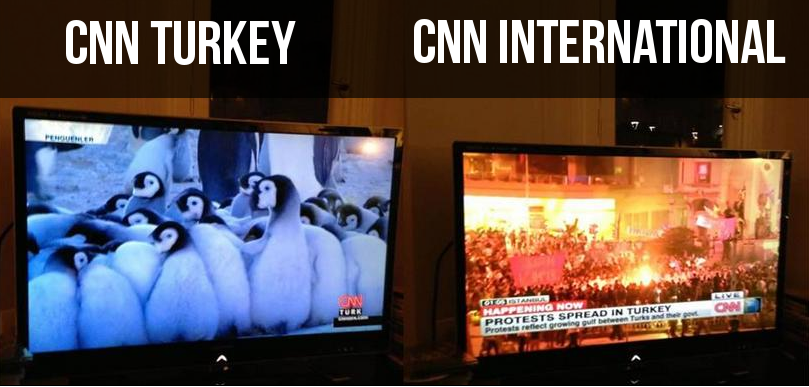
CNN International shows live coverage of the demonstrations in Taksim Square, while CNN Türk airs a penguin documentary.
Turkey-watchers are familiar with the country’s chronic press freedom problems. One of the root causes is related to the ownership structures of Turkish media companies, which opens them up to political pressure, an issue that Yavuz Baydar repeatedly – and convincingly – returns to. One small example of this which I didn’t see anyone else pick up on came with a report, released in April, by respected think-tank the Turkish Economic and Social Studies Foundation (TESEV), titled “Policy Suggestions for Free and Independent Media in Turkey.” The report was thorough and fair, particularly focusing on the crippling conflict of interest that comes when major media outlets are owned by large holding companies involved in other sectors. Although the report was covered by the Gülen-affiliated Zaman newspapers, no newspapers from the Doğan Media Group (owned by billionaire Aydın Doğan – perhaps Exhibit A of the above problem) – Hürriyet, its English language arm Hürriyet Daily News, or Radikal – mentioned it.
With the large media companies so obviously unfit to perform their Fourth Estate function, the focus is shifting to new online independent media. Along with the agenda-setting Twitter, the website T24 has also developed quite a reputation in providing brave, reliable, independent reporting. Veteran journalist Hasan Cemal, for example, after being controversially fired by daily Milliyet, was taken on by T24 and has since written a series of articles based on time spent with the retreating Kurdistan Workers’ Party (PKK) rebels in southeast Turkey, including an interview with military head of the PKK, Murat Karayılan. The Demirören Holding-owned Milliyet would not touch such a daring project. Freely-available online and with little advertising, I’m not sure how T24 is actually funded (if anybody does, please do let me know), or whether it’s a viable long-term model for more serious journalism in Turkey, bypassing the established news organisations. Still, with mainstream media having so thoroughly discredited itself throughout the Gezi Park protests, the void will have to be filled by something if Turkey is to become more democratic.
A competition for the ‘giant’ Çamlıca Mosque
August 1, 2012
In May, Prime Minister Recep Tayyip Erdoğan announced to the Turkish media his desire to see a “giant” mosque built on Istanbul’s Çamlıca Hill. In his latest “crazy plan” for the city, Erdoğan said he wanted it to be a mosque that could “be seen from everywhere,” and declared that construction would begin within two months. Çamlıca is situated on the Asian side of the city, and despite currently being the site of a number of enormous television and radio reception towers, the hill is one of Istanbul’s few remaining green, unpopulated spaces. On June 8 the Environment and City Planning Ministry announced that a 250,000 square metre area on Çamlıca Hill had been identified for the project.
The Turkish press is predictably divided along secular/religious lines on the issue. There are, however, a few voices amongst government-supporting newspapers questioning the necessity of a mosque when there are no residents nearby for it to serve. Such objections miss the point that a new mosque on Çamlıca would undoubtedly afford TOKİ developers a golden opportunity to roll up their sleeves in the area(!)

An appropriately crude impression of how a mosque on Çamlıca Hill might look.
Late in June, liberal daily Radikal featured an interview with Ahmet Turan Köksal, professor of architecture at Gaziantep’s Zirve University, to discuss modern tendencies in mosque-building and his thoughts on the Çamlıca plans. He is skeptical: “A mosque should be for the community, not for show. For me, being a mosque architect means only doing work that has a function for the community …. If they want to make a mosque like an Olympic stadium on Çamlıca Hill and want to show off to their friends and rivals, then I’m against this,” he said.
Nevertheless, at the beginning of July, Milliyet included an interview with architect “Hacı” Mehmet Güler, who said he had been charged by the prime minister to make preparations for the new mosque. Güler said it would be designed in a “classical style,” and – in a fine example of “Muslim modesty” – that plans were being drawn up to have it feature the world’s tallest minarets, even surpassing those of the Mosque of the Prophet in Medina.
Following this interview, the issue seemed to fall off the agenda. It was thus quite a surprise to find a number of Turkey’s religion-friendly newspapers recently carrying advertisements announcing: “Çamlıca is searching for its architect!” The advertisements appeal to architects to submit their design ideas, in a competition to find an architect for the new mosque.

The competition opened on July 23, and will be accepting submissions until Sept. 3. According to the website of the organization in charge of the project – the rather clumsily named “Association to Build and Maintain Istanbul Mosques and Educational-Cultural Services” – the winning design will be “suitable for Istanbul’s silhouette and texture, reflect the Ottoman-Turkish style, extend traditions to the future, add value to Istanbul, and become one of Istanbul’s symbols.” The winner, the association has announced, will be awarded the honour of designing the ‘Recep Tayyip Erdoğan’ as yet unnamed mosque, as well as 300,000 Turkish Liras in prize money.
As declared in advertisements for the ruling AKP at the last parliamentary elections, alongside a picture of a vatic looking Erdoğan: “It was a dream, it came true!”
[Hürriyet Daily News (21st May 2012): http://www.hurriyetdailynews.com/the-bridge-a-journey-between-orient-and-occident-.aspx?pageID=500&eid=53]
Geert Mak – The Bridge: A Journey Between Orient and Occident, Random House UK, 2010, 160pp
The Galata Bridge is one of the more obvious metaphors for all those oppositions that Istanbul is famously caught between: Occident and Orient; east and west; tradition and modernity. The half-kilometre stretch across the Golden Horn connects the “historic” old Stamboul – with the imperial mosques, palaces and bazaars – to the “modern” Galata and Pera – originally settled by Genoese merchants and later the quarter of European ambassadors, diplomats, traders and artists. Geert Mak roamed the entire European continent for his impressionistic 2004 travelogue “In Europe,” but this book offers a complete contrast in terms of scale.
As Mak himself wryly states, “The Bridge” is “a travelogue covering 490 metres,” his focus having infinitely narrowed to one bridge, in one corner of the old continent. The book is subtitled “A Journey Between Orient and Occident,” but I suspect that’s a marketing decision from the publisher, rather than from the author. Mak is wise to the cliché, and he makes sure not to labour it. Instead, his book mainly focuses on the vicissitudes of today’s bridge-dwellers, and in this it is a triumph of understated sensitivity.

Over the years a total of five bridges have been built on the site: two wooden, two iron, and one (today’s) concrete (“not a pretty sight”, Mak laconically observes). Istanbul, he says, “is a classic city […] poverty has pitched its tent in the heart of the old city, the middle classes, ring after ring, live further and further away from [it].” As the city’s breakneck modernisation continues apace, this old arrangement is coming under increasing pressure, but it still largely holds true. In a sense, the Galata Bridge is the centre of this pitched tent, so much of the book concerns itself with giving the reader a vivid sense of the consequences that an urban hand-to-mouth existence, (“an economy of spare change”), has on those who spend their lives on the bridge. “The lives of the tea seller, the cigarette boys and the insole vendor are set against the backdrop of a remarkable corner of the globe, but precious little good that does them,” Mak suggests.
To anyone who has crossed the Galata Bridge recently, or got trapped in one of those underground shopping tunnels that take you across the roads on either side, the sights described in the book will be familiar. Those knock-off children’s action figurines crawling mechanically in the lids of cardboard boxes; the fake perfumes; the fake mobile phones; the cheap sets of pens; the cheap tea; cheap shoes; jeans; umbrellas; insoles; shoelaces; smuggled cigarettes; condoms. However, I doubt anyone has stopped to take such an interest in the people behind these items as Mak, and this is where “The Bridge” is a revelation. We are introduced to the drifters selling those petty goods, as well as the indefatigable fishermen dangling rods (with steadily diminishing returns) over the bridge’s rails, the lottery ticket sellers, glue-sniffers, and pickpockets. Most are displaced migrants, having come to Istanbul from somewhere in eastern Anatolia, perhaps from a village now deserted, or one that simply can’t support them anymore. This mass of rootless internal migrants makes up an ever increasing proportion of Istanbul’s uncontrollably booming population, and Mak gets most of his material by simply mining them for stories, painting an authentic picture of the bridge’s unique fauna. He lets the people he meets on the bridge talk about their backgrounds, their daily routine, the starkness of their prospects, the financial knife-edge that a living scraped by selling cheap plastic umbrellas from a cardboard box entails, the psychological contortions required to maintain some sense of personal dignity or honor. As one man (and this is a resolutely male landscape) says: “Everyone here, almost all of us come from the back of beyond […] But there’s nothing there for us. Unless you want to go into the mountains, to join the terrorists. If you don’t want to do that, you have no choice but to make the best of things here, to sell tea, or flog pirated CDs, or shift stolen mobile phones, or sell fake perfume…” Almost all harbor dreams of migrating to Europe. One of the umbrella sellers once tried to smuggle himself into London, but was detected by the immigration authorities at Heathrow and sent back to Turkey, and now dreams of suing Britain.
The narrative is divided between these personal ruminations and more widescreen historical vignettes, which elegantly sketch the background that has shaped the way the bridge – and the city itself – have come to be the way they are today. Mak vividly describes the historical, Ottoman Istanbul, a city of all creeds of Christians, Jews and Muslims. It was, he says, “perhaps the most multicultural city of all time,” but at the same time it was run according to strictly defined lines of demarcation: Istanbul “consisted of communities that worked and did business together, but were otherwise imprisoned in their own compartments of neighbourhood, house, family, gender, rank and standing […] all these peoples and cultures inhabited worlds of their own. The city’s tolerance depended on looking the other way; contact with those other worlds was devoid of all curiosity.” Interestingly – and perhaps a little fancifully – Mak finds some kind of continuity between those historical hidden lines of division and modern ones constructed by the displaced internal migrant drifters. The bridge has its own intricate sociology of “economic compartmentalisation.” “Countless tightly knit immigrant communities exist in this way, all of them operating in isolation from the others and within the strict borders allotted them […] The fishmongers all hail from the eastern city of Erzincan. Most of the professional anglers come from Trabzon, on the Black Sea. The rods and tackle, on the other hand, are sold generally by immigrants from Kastamonu […] And if you’re Kurdish there is no sense in trying to rent a space and fry fish, for that monopoly is in the hands of another group.”
Mak is never boring, but he is on less sure ground when trying to chart a course through the choppy waters of the city’s modern political situation. One pages-long section in particular – attempting to unknot the delicate “headscarf question” with little more than platitudinous observations – feels too deliberate, like a hunk of meat thrown only because he knows the audience back in western Europe is interested in these things.
Describing the brutal realities of a life spent in perpetual, unbreakable poverty, it would be easy to slip into mawkishness, but “The Bridge” never does. This is an admirably warm-spirited, well-judged book. It’s occasionally lyrical, but never patronises or succumbs to sentimentality. Mak spent his time on the bridge wisely, observing and talking to the people he found, always with an eye on the history that has formed the city. It is this dual vision that makes the book a success. He pulls off a smart trick: by focussing on a small geographical area and a limited cast of characters, he is able to give us a convincing, holistic portrait of a wider society and its conflicted place in history.
The neo-Ottoman view of history
April 10, 2012
As the modern vogue for neo-Ottomanism lurches on in Turkey, the contrasts between the contemporary Turkish and British approaches to national history are for me becoming ever clearer. Neither is particularly encouraging, but both are the understandable result of respective historical inheritances.
Ever since the French Revolution, the British have defined themselves against that chaotic pole across the channel: reform rather than revolution has been the rule. Moments of crisis or turmoil have been home grown, not imposed from outside, and the country has always felt able to define itself on its own terms. For all its trauma, even the Second World War only served to confirm Britain in its sense of historical and moral righteousness; no awkward compromises had to be made, and the good ship sailed confidently on. Over time, however, this serene progression has engendered its own problems. Never having been forced to reflect upon it, the general population of modern Britain has slipped into complacent somnambulism about the past. Despite its importance, a dangerous ignorance surrounds the effect and significance – for better or for worse – of the British Empire, which is barely spoken of in today’s Britain and poorly understood by the general public. I recently took one of the example practice ‘citizenship tests’ on the British foreign office website, and while there are plenty of questions about the role of county council representatives or the frequency of local rubbish collections, there is almost nothing on the most fundamental episodes of national history. Compare this with other, similar western states – many of whose own citizenship tests I also had a look at (an exhilarating couple of hours) – and the contrast is far from flattering. Perhaps the crowning symptom of this malaise was the previous Labour government’s decision to remove history as a compulsory subject for students up to 16: an unforgivable sin.
Turkey’s relationship with its past is a lot more fraught with traumatic ruptures, conscious jolts forward, and moments of forced amnesia. Since the founding of the Turkish Republic in 1923, state policy has dictated that to look back on Turkey’s Ottoman past is backward and reactionary – somehow a betrayal of the modern Turkish nation state. The recent ‘neo-Ottoman’ challenge to this stultifying official diktat should therefore be welcome, but it’s so hollow and uneven as to be almost as problematic as what went before. Turkey’s newfound obsession with the past – evident in seductively-costumed films and T.V. series’; architecture; foreign policy; even fashion and interior design – shows no serious attempt to consider anything other than the most flattering, least challenging aspects of national history. A recent post on the Tarlabaşı Istanbul blog quotes Prof. Dr. Uğur Tanyeli on the subject, discussing the architectural example of the tawdry wedding cake confection of the “historically recreated” Demirören shopping mall on Istanbul’s İstiklal Caddesi:
“The fewer traces of the past [an object] carries, the more successful a preservation [is believed] to be … there is not only the Demiören shopping centre, but there are hundreds of buildings along the Bosporus like that. There are ‘renovated’ buildings dating back to the 13th century that look like they have been built yesterday and where not a single screw is historically justified … In Turkey, the historical has to be brand-new and squeaky clean. So what is actually wanted is the illusion of history – It has to be historical, but it is not allowed to carry any baggage of the past, or any of history’s patina, there can’t be anything about it that creates unease.”
The ongoing renovation project in Istanbul’s central Tarlabaşı district is also instructive. Having finally been vacated, most of the historical houses have been mercilessly gutted and left pray to looters and rubbish dumpers. As their sinking bay windows morosely cave in on themselves, it’s hard to see how many of these shells even remain standing. It looks depressingly likely that they are simply going to be demolished, to be replaced by historically empty ‘imitation’ replacements. The so-called ‘regeneration’ of Tarlabaşı’s old buildings thus symbolises the modern, neo-Ottoman view of history: a facile attempt to reclaim the past, without the inconvenience of the antiquated plumbing systems of a truly authentic picture. As Prof. Tanyeli says, it’s “an interesting dilemma … they want the historical, but they do not want anything old”.
Oscillating from queasy shame about the past to shallow glorification of it does not indicate a country at particular ease with its history. Freedom from such jolts, however, can result in the complacent amnesia about the past exemplified in modern Britain. It’s difficult to know which is less healthy.
Tarlabaşı’s “Hürriyet Hamamı”
December 17, 2011
[Published in Today’s Zaman (19th Jan 2012): http://www.todayszaman.com/news-269046-tarlabasis-getaway-hurriyet-hamami.html ]
It might come as a surprise to know, but after two years of living in Turkey I had yet to visit a Turkish bath until very recently. The fact is that hamams don’t really figure in the everyday lived experience of most Turks these days, so perhaps it isn’t strange that they also haven’t figured much in mine. During the Ottoman period hamams were considered important social centres, where the men got themselves washed and the women spent hours meeting friends and gossiping about the latest social news. Since this heyday they’ve been steadily closing down. Now only a fraction remain open, and those – particularly around the tawdry touristic theme park district of Sultanahmet – cater largely for foreign tourists. Number one in all the guidebooks is the Çemberlitaş Hamamı, an impeccably-restored historical hamam, built by Mimar Sinan in 1584, featuring in D.K. Publishing’s 1000 Places To See Before You Die. The price is the highest in the city, and I wouldn’t be surprised if its employees wore quaint period dress as they went about their work – you want the “authentic experience”, don’t you?
I certainly did, but was in the market for something a little earthier, something – to my own prejudiced mind – a little more “authentic”. I’ve always been intrigued by an imposing-but-exhausted-looking red building near my apartment on Kapanca Sokak, in the central district of Tarlabaşı, on the European side of Istanbul. This is the “Hürriyet Hamamı”, (or “Freedom Bath”), and if you try to find it in your guidebook you’ll be disappointed. Where better to have one’s first hamam experience? For that authentic historical deal there can’t be many more suitable places – the entrance is sandwiched between two bay windows protruding out into the street, underneath which outside are original signboards written in the Greek, Armenian and Ottoman Turkish that were once common currency around Tarlabaşı. If, however, it’s the authentic experience that I got, it’s certainly not one experienced by many locals these days, as the place was almost entirely deserted during my visit. With the planned “renewal” of Tarlabaşı continuing apace, it’s difficult to see how the place could survive. I’d put a regretful 10 lira on it not being there in a year’s time.

I walked in from a chilly December afternoon, and was greeted by the sight of a corpulent, grey-haired old man facing the entrance, snoozing on a bench. He lay horizontally on his side, his head propped up on a pile of white rags, a stained polo shirt barely stretching over a rotund paunch. He gave off a stale pong as he stood to welcome me in – not the greatest advertisement for a public bath you might think. Hasan was his name and, from the moment I handed over the 25TL for a bath and massage (“everything”, he said), he was fishing for a tip. I resisted, telling him: let’s see how it goes first.
Not being particularly well-versed in hamam etiquette, I was pretty tentative throughout my visit. I’m glad I took the time to sit in the “sauna” just before entering the bath though, as this was something unique. Despite the tray of hot stones sitting atop a dog-eared metal box in one corner (just for appearances), the only heat was produced by three industrial radiators, hidden underneath each bench and turned up to their fullest. Surprisingly enough the room didn’t smell too bad, although ominous patches of mossy dampness hung from the roof and down the walls.
The main bathing area however, (known as the sıcaklık), was splendid. A wide dome stretches above your head, studded with tiny windows like the diamond-encrusted lid of a jewellery-box. Of course – like Istanbul itself – they’re rough diamonds, but – also like Istanbul – that’s mostly where the charm comes from. The room is bathed in a half-light cast from these windows, and the tinkling of water drips steadily from the sink basins that surround the heated göbek taşı, or “‘belly’ stone”, in the centre. I stepped inside – still wearing my red shroud and sandals – and saw just one, solitary bather. That timeless image of the lithe, naked male, sitting bent-legged, bent-backed and dripping in soap, remained indistinct as it emerged through the steam from across the room. Whether out of arrogance, or absorption in his own toilette – this stranger didn’t so much as look at me throughout my entire stay. Brazen male nudity always comes as a shock, even when it is in a bathing context. I get exactly the same feeling of surprise in the changing rooms of a public swimming pool back in the UK. Nevertheless, off came my shroud, and my sandals: when in (new) Rome and all.
After washing myself once over with the sink, soap and bowl, Hasan emerged through the entrance and waddled over to my section to begin the service. He started by soaping me up and rinsing me down, before bringing out the dead skin remover. I may have been a neophyte in hamam procedure, but I’d heard rumours about this implement, and here I can only corroborate what I’d been told before: it was brutal. He scrubbed the infernal thing all over my skin, my whole body, over and over the same parts, hammering each before moving on to the next tender area. I closed my eyes in silent agony. It felt less like he was removing dead skin, more like he was ripping off layers and layers of quite healthy, quite live skin.
I dare say this torment lasted for rather less time than it felt, and once it was over Hasan rinsed the flakes of newly-dead skin from my red-raw body, before struggling across to the göbek taşı, and beckoning me over for my massage. I followed, gingerly lay myself face down on the edge, and tried to find the most comfortable position on the hard stone for my head. Things started fairly pleasantly: some gentle prodding here, some cautious probing there. Predictably enough though, things soon got rather more robust and rather less comfortable. All over my back, my legs, every pressure point was hammered relentlessly. Make no mistake: no concession was made to the inexperienced foreigner. I tried as best I could to stop myself wriggling around in discomfort, and found myself sliding uncontrollably around the göbek taşı, almost slipping off the edge because of the soap that was being slapped all over my body. Hasan manoeuvred me around like a helpless children’s toy: onto my back, seated, standing, arms up, arms down, legs crossed, arms crossed. At one point my face was squeezed against his own beefy göbek as he pushed his fingers mercilessly and methodically into the small between my shoulders, cracking my neck in both directions.
After drying off and cooling down, I sat down to talk with Hasan and one of his friends over tea in the lobby. I tried to draw them out on the history of the place, but I couldn’t get far. Apparently it was built in 1908, and from the look of it I can’t imagine the building having ever been anything other than a hamam. Hasan couldn’t tell me, as despite appearances he’s only been working there for 11 years: a relative greenhorn. He certainly felt like a confident, authoritative old hand though, and had well-earned the tip that he’d previously been fishing for. As with all massages, it wasn’t until an hour or two later that I really began to feel the benefit. I also felt a lot cleaner than I did before I went in, which itself couldn’t be taken for granted as I considered the “Hürriyet Hamamı” from outside.
Gentrification in Tarlabaşı, Istanbul
September 28, 2011
The noise of Tarlabaşı never stops. Street cats cry incessantly during the day and fight each other at night; street hawkers struggle with creaky wooden carts around the winding alleyways, crying out their wares of breakfast poğaças or carrying wooden boards full of fresh simits on their head; housewives call out of windows to the nearest greengrocer and lower baskets on string for goods, in summer groups of them in floral headscarves sit out all day gossiping on the pavement; children don’t sleep until the early hours, screaming as they play hop-scotch or kick footballs around; during Ramadan traditional drummers and singers pass every building, waking everyone up to break the fast before sunrise; for me, the chaotic street market each Sunday is one of the most colourful parades of human activity Istanbul has to offer. Taksim Square – with its shiny malls, modern cinemas, and thronging restaurants and bars – is considered the commercial and cultural “heart” of the city, but it takes just two minutes to pass down from the smart pedestrian boulevard of Istiklal Caddesi, cross the six-lane duel-carriageway Tarlabaşı Boulevard, and arrive in the impoverished backstreets of Tarlabaşı itself. In two minutes it feels like you’ve crossed into a different world. With the Turkish economy booming and Istanbul developing at such a rapid pace, it’s a world coming under serious threat.
Tracing the history of Tarlabaşı illustrates the fluctuating fortunes of Istanbul’s minorities over the past 200 years. Situated on the European side of the city, across the Golden Horn from the old town, the area was originally home to prosperous non-Muslims. The sturdy stone houses were built for Greeks and Armenians – lower-middle class artisans, small tradesmen, and merchants – whose economic prospects waxed even as the Ottoman Empire’s waned over the course of the nineteenth century. Istanbul’s Armenians were largely untouched by the tragedy engulfing their eastern Anatolian kin during the First World War, and its Greeks were exempt from the wholesale population exchanges that took place between the states of Greece and Turkey during the 1920s, but the situation of minorities became increasingly precarious during the republican years of the twentieth century. Official discouragement found expression in the punitive “Varlık Vergisi” (Wealth Tax) aimed at Turkey’s minority groups in 1942, and in the 1950s pogroms were organised against the Greeks of Istanbul, after which the vast majority moved swiftly away. Many of Tarlabaşı’s grand buildings were left empty and unaccounted for, and an area that was already going to seed went into accelerated decline. At the same time, rapid industrialization meant that significant numbers of Turks were moving into urban areas, and many found homes in the unoccupied but decaying townhouses of Tarlabaşı. In 1990, further waves of migration took place, this time of Kurds from eastern Anatolia – fleeing economic deprivation and the intensifying civil war in Turkey’s south-east. Thus, right in the centre of Istanbul, something of the atmosphere of an Anatolian village has been recreated in Tarlabaşı. But that isn’t the whole of it – alongside Kurdish migrants can be found Arab and African refugees, Roma (gypsies), Zaza-speaking Kurds, itinerant foreign language teachers living on the cheap, and even pockets of transsexuals (many of whom ply a trade in the seedy brothels along Tarlabaşı Boulevard). At a time when most of Turkey has become a state-sponsored monoculture, Tarlabaşı seems to reclaim something of the anarchically multicultural heritage of Anatolia.
“Gentrification” has taken place in all major cities striving to modernise, (it seems as inevitable as the carbon-copy Starbucks cafes popping up everywhere), and it’s already happened in many areas of Istanbul. Hard to believe now, but thirty years ago Istiklal Caddesi itself was a down-at-heel backwater; only relatively recently has it been pedestrianised, tidied up, reintroduced to its picturesque “nostalgic” tram line, and lined with the gleaming chain stores. There have been murmurings of tension in nearby Tophane, where the traditional inhabitants find themselves surrounded by growing numbers of small art gallerys, boutiques, and fashionable bars. Cihangir, on the opposite side of Istiklal, has become a chic enclave for expats and young professionals. Such examples follow a more typical, ‘organic’ process of gentrification; that planned for Tarlabaşı, however, is exactly that – planned. In 2005, an ‘Urban Renewal Act’ (Law 5366) passed through the Turkish parliament authorizing municipalities to work with private building companies to ‘regenerate’ areas of Istanbul. The historic Roma district of Sulukule, also on the European side, was one of the first declared an ‘Urban Renewal Area’. Eventually almost 1000 families were evicted from their homes and given new – unaffordable for most – apartments 45km away. The majority of these people have since become homeless and the area’s historic fabric has been ripped out, gradually replaced by more faceless modern apartment blocks. In 2006 Tarlabaşı was also chosen as a renewal area, and the contract for the project was awarded to GAP Inşaat, a subsidiary of Çalık Holding, the CEO of which is the son-in-law of the Turkish Prime Minister. Plans were soon released for the redevelopment of a 20,000 m2 area, a total of nine “building islands”. The website for the project (www.tarlabasiyenileniyor.com) is full of “before” and “after” pictures: photos of out-at-elbows back streets teeming with scruffy children and shady-looking men (the present Tarlabaşı), are contrasted with digitally-generated images of urbane, be-suited couples strolling down spotless, wholesome avenues (the projected Tarlabaşı). It must all look rather seductive to the prospective flat-buyer, but two major concerns persist: will the area’s historical character be preserved? and – perhaps more pressingly – will current residents go the way of Sulukule’s?
Tarlabaşı is an incredibly charismatic place. Its buildings are unique examples of late nineteenth century Ottoman Levantine architecture, elegant four and five storey stone townhouses with slim bay windows jutting out above the street. Clearly most haven’t been touched since being built – the majority are filthy, stained black with dirt, and some are now nothing more than shells, thick carpets of weeds and stumps of struggling trees behind a crumbling façade. Sanitary conditions in many places are primitive. It’s obvious that the area desperately needs improvement, but GAP Inşaat’s project goes beyond simple renovation, to what looks like a radical reimagining of the entire area’s fabric. A four-storey underground car park is planned, and whilst the developers insist that most buildings will be preserved, questions remain about what form this preservation will take. Many fear that Tarlabaşı’s unique historical character will be irredeemably destroyed by the changes. Mücella Yapıcı, from the Union of Chambers of Turkish Engineers and Architects, claims that “the cultural and historical heritages of Tarlabaşı are going to be sacrificed to financial benefits of some people or companies.” Appeals have been made to UNESCO and the European Court of Human Rights, but look unlikely to halt developments that are, ultimately, in the hands of the elected municipality. Whatever happens, current residents will undoubtedly be priced out by the new plans. In August 2010 the holding company claimed that agreements for purchase had been reached with 70% of the owners of houses in the area, and that apartments are being offered in a brand new suburban development to those evicted from Tarlabaşı. This development is almost two hours away by public transport in a little–known satellite city, Kayabaşı. Aside from the cultural jolt of having to move from Tarlabaşı to alien high-rise apartment blocks, miles away from where some have worked for years, it’s unlikely that many could afford the 1000TL upfront price and 309TL monthly mortgage payments for the cheapest apartments anyway, (let alone commuter costs).
It’s easy to sentimentalise from a distance. The fact is that amongst Istanbullus, Tarlabaşı is a no-go area, notorious for crime, poverty, violence, illiteracy, and overcrowding. At night the women leave their spots on the pavement and organized gangs move in. These problems won’t be solved by the municipality’s plans, but they will be moved elsewhere, which is probably what is wanted. My neighbour, Ozan, has lived with his family in the same building (which he owns) for 40 years and is under no illusions, “you have to be careful,” he says, “there are thieves all around here at night, life isn’t perfect.” But he’s tied to the area, working twelve hours a day, six days a week in a cheap restaurant just a five minute walk away, “our life is here, where else could we go?” Many people have already left, and a lot of the seedy bars, shops and brothels along Tarlabaşı Bulvarı have already closed down, making it look even more forlorn than before. Significant numbers have decided to stay on anyway, despite their houses being sold and expropriation procedures being threatened. The municipality has given no clear updates since last year, and a project that was due to be completed in 2010 rolls on without any end in sight. Threat of eviction hangs over the area like the sword of Damocles, but right now it’s difficult to see how it could be entirely vacated without the use of force, as – make no mistake – Tarlabaşı still teems. I’ve lived there for over a year, and if anything the population has increased in that time. I write this on a sultry weekday afternoon and the street outside my flat is as raucous as it has ever been. As Ozan says simply: “we don’t want to go anywhere.” Whether they want to or not, the decision may well be out of their hands, but – for the time being at least – Tarlabaşı remains stubbornly defiant.


 Turkey Book Talk