When Erdoğan speaks, the media follows
January 31, 2013
Prime Minister Recep Tayyip Erdoğan’s recent comments that Turkey could give up its EU membership bid and instead pursue membership of the Shanghai Cooperation Organisation (SCO) are still reverberating in much of the Turkish media. Speaking Jan. 25 on TV station 24TV, Erdoğan said: “The EU does not want to include a Muslim country … Of course, if things go so poorly then, as a prime minister of 75 million people, you seek other paths … The Shanghai Five is better, much stronger.” Last year, Erdoğan had said something similar after a diplomatic visit to Moscow: “I said to [Russian President Vladimir] Putin, ‘You tease us, saying “What is Turkey doing in the EU?” Now I’m teasing you: include us in the Shanghai Five, and we’ll forget about the EU.’”
The “Shanghai Five” was created by Russia, China, Kazakhstan, Kyrgyzstan and Tajikistan in 1996 in an attempt to counter U.S. influence in Asia, and was later joined by Uzbekistan and renamed the SCO in 2001. It has been described as “a vehicle for human rights violations” by the International Federation for Human Rights. Erdoğan’s latest pronouncements on the group were immediately picked up by much of the Turkish commentariat as significant indications of Turkey’s shifting priorities. In Radikal, columnist Cengiz Candar wrote that the prime minister had dropped a “geopolitical bomb.” Hürriyet’s Sedat Ergin has so far spent three days worrying over the remarks, writing that Erdoğan’s words amounted to “one of the most significant foreign policy moves since he took office 10 years ago, maybe the most important.”
For me, the way these latest statements were reported merely highlighted once again the unhealthy intensity with which the Turkish media hangs on every single word uttered by the prime minister. The smallest pronouncement can be seized upon to set the agenda and send the media into a tailspin. It’s a little discussed symptom of a wider (and more discussed) problem – the increasing concentration of power in one pair of hands.
This is the pattern of how an address or press conference given by Erdoğan is typically reflected in the Turkish media: it is broadcast uninterrupted by every major television news station; the words are transcribed and posted immediately on internet news portals, with the only journalistic interjection in each paragraph being “the prime minister said”; the next day’s newspapers feature prominent news stories on the speech, perhaps as the front page headline; finally, the chorus of daily columnists set to work dissecting whatever the prime minister has decided should be the subject of the moment. As Fehmi Koru wrote in Star on Jan. 29: “Erdoğan is a master at forcing an issue, bluffing and occupying others with his own agenda … We have not yet seen one of the opposition parties able to force the country to debate a single topic. They jump into the agendas set by the head or members of the ruling party.” The prime minister is a master at manipulating how news is covered, and the producers of that news coverage are often more than happy to be manipulated.
This week’s episode of the BBC’s Start the Week, where the discussion centred around George Orwell’s 1946 essay “Politics and the English Language,” brought the issue into even sharper relief for me. In the programme, Phil Collins, one time speechwriter for former British Prime Minister Tony Blair, spoke about how he was always acutely aware when writing speeches of the low level of coverage that any public address by a prime minister could today expect to receive in the U.K. press. “Once upon a time your whole speech would be printed verbatim in The Times the next day, but that’s not the case anymore … You’re talking into an atmosphere in which you’re only going to get six seconds on the evening news, whether you like it or not,” he said. This seems to be the inverse of the Turkish problem: symptomatic of a corrosively cynical British public, disengaged from the political process and instinctively suspicious about the public utterances of any elected official.
Of course, there are many such cynics in Turkey, but they are little represented in the conventional large media corporations.
Yeni Akit shaping the debate?(!)
December 6, 2012
It’s been a while since I last wrote about my favourite hard-line Islamic newspaper, Yeni Akit. It would be wrong to overemphasize Akit’s significance in the overall scheme of things, but a couple of its recent news items are certainly worth mentioning, and indicate that it might have rather more influence than many give it credit for(!)
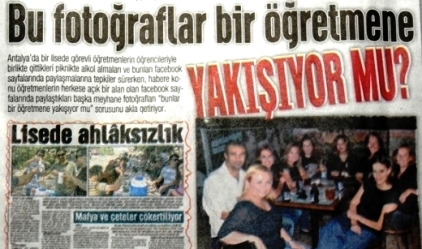
On Nov. 22, Akit published a story headlined, “Immorality at High School,” containing photographs that it said showed teachers drinking alcohol with their students at a picnic. This photos were taken in the southern province of Antalya, (“known as a castle of the secularists,” according to the article), and were apparently uploaded to Facebook by one of the teachers. “It has been claimed that the teachers are members of the ‘Eğitim Sen’ union, which opposes the headscarf as well as classes on the Quran and the life of the Prophet,” Akit helpfully stated. The Antalya branch of the National Education Directorate opened an investigation into the 11 teachers upon the publishing of the story, but this was quickly dropped after it was established that the photos were in fact taken by a teacher at a family picnic three years ago, and that no students were present. Unbowed, on Dec. 2 Akit went on to publish a photo of a female teacher at the same Antalya school, part of a group at a bar celebrating a friends’ birthday (with glasses of beer on the table). “Do these photographs suit a teacher?” said the headline. However, rather than the Education Directorate setting up an inquiry, the teacher in question is now opening a legal case against Akit.
It’s worth mentioning these “photo scandals” because very recently Prime Minister Recep Tayyip Erdoğan used similarly tendentious photographs published in Akit to attack his political opponents. The pictures used by Erdoğan showed deputies of the pro-Kurdish Peace and Democracy Party (BDP) sitting around a table eating kebab, despite the fact that over 600 Kurdish prisoners were entering their 49th day on hunger fasts: “Lamb kebab for us, death fasts for you,” read Akit’s headline. On the same day (Oct. 30) Erdoğan told a meeting of his parliamentary party: “On one hand [they] are eating lamb kebab, on the other [they] are telling those in prison, ‘Die on hunger strike.’” In fact, it soon emerged that the photos had been taken two months before at the wedding of a BDP member in the southeastern province of Mardin.
Erdoğan’s harsh words got a lot of coverage at the time, (here’s the Reuters story on it), but the fact that his source was Yeni Akit obviously received rather less attention. Commentary suggesting that the prime minister is turning Turkey into an “Islamic state” is simplistic and misguided, (a piece in the Wall Street Journal last month claimed that he was “ramming Shariah law into practice.”), but it can’t be a good sign that he’s turning to Yeni Akit for rhetorical fodder to use against his opponents.
‘Bring back capital punishment, end this business’
November 14, 2012
Recently, Turkish Prime Minister Recep Tayyip Erdoğan has repeatedly expressed his opinion that Turkey should consider reinstating capital punishment “in certain situations.” He first brought the issue up at a meeting of his Justice and Development Party’s (AKP) deputies on Nov. 3, in reference to Abdullah Öcalan, the convicted leader of the outlawed Kurdistan Workers’ Party (PKK), and has returned to it on a number of occasions since. “Right now a lot of people in public surveys say that capital punishment should be reintroduced … It is legitimate in certain situations,” Erdoğan said. “Yes, the death penalty was removed from Europe, but has it left America, Japan and China? Then there is a justified cause for the death penalty to remain.”
Capital punishment was abolished by Turkey in 2002, just prior to the AKP’s accession to power in the general elections of that year. Although no execution had been carried out by the Turkish state since 1984, an official end to the practice on the Turkish law books was seen as one of the key steps in Turkey’s EU accession process, which was then entering its most energetic period. The decision was fairly controversial at the time, as PKK leader Öcalan was captured and sentenced to death by the Turkish authorities in 1999. With the abolition of capital punishment, this sentence was commuted to life imprisonment, and Öcalan has since been held in a remote prison on İmralı Island in the Marmara Sea. With the recent spike in clashes between the Turkish security forces and the PKK, Erdoğan’s words on capital punishment should be interpreted in terms of the government’s failure to solve the Kurdish question – populist sentiments aiming to deflect nationalist criticism that he has made too many concessions to Kurdish rights with little to show in return.
The most striking newspaper coverage of the issue I saw came from popular pro-government daily Sabah, the newspaper with the fourth highest circulation nationally. Its Nov. 13 front page carried the bold headline “Bring back capital punishment, end this business.” These were the words of Fatma Çınar, the mother of one of the 17 soldiers killed in the recent helicopter crash in the southeastern province of Siirt, speaking at her son’s funeral. The crash was not a result of direct clashes with the PKK, but it was enough for PM Erdoğan to frame it as taking place within “much intensified, multi-dimensional” military operations in the region.

The return of the issue to the national debate has predictably raised eyebrows among those parts of the media who retain forlorn hopes that Turkey’s EU accession process can still be revived from its current moribund state. Opposition Republican People’s Party (CHP) deputy Rıza Türmen, who worked for 10 years at the European Court of Human Rights, wrote in Milliyet on Nov. 13: “Capital punishment is banned according to the third section of the European Union’s founding principles, and the lifting of capital punishment is a precondition for membership of the EU and the European Council … Is leaving the EU process what the prime minister actually wants?” Meanwhile, Taraf editor Ahmet Altan’s disillusionment continued on the same day: “We’ve gone from a country that celebrated with enthusiasm the opening of ‘full EU membership negotiations,’ to one with a prime minister – like a funeral undertaker – shouting ‘hang them, hang them’ at every opportunity.” A response even came from the murky corridors of the EU itself, with Peter Stano, the spokesman for Enlargement Commissioner Stefan Füle, stating: “Our position on this is quite clear. Countries wishing to be a member of the EU cannot practice capital punishment. If capital punishment comes, the EU goes.”
Meanwhile, the hunger strikes of 700 Kurdish prisoners today entered their 64th day. Despite the increasing urgency of the situation, Erdoğan has so far ignored calls to directly engage in finding a solution. He even spent Nov. 12 in his hometown of Rize, receiving an honorary doctorate from the newly-established “Recep Tayyip Erdoğan University” (it’s sometimes difficult to tell in Turkey that you’re not reading The Onion). His words on capital punishment have certainly been an effective tactic distracting some attention away from the critical situation of the strikers. However, like the Peace and Democracy Party’s (BDP) recent remarks about erecting a statue of Öcalan, they have hardly done much to help create an atmosphere congenial to a solution.
(Some) Turkish newspapers report on the AKP Congress
October 2, 2012
The ruling Justice and Development Party (AKP) held its key congress on Sunday (Sept. 30), the slogan of which was “Büyük Millet, Büyük Güç, Hedef 2023” (Great Nation, Great Strength, Target 2023). Throughout his emotional two-and-a-half hour speech, Prime Minister Recep Tayyip Erdoğan was in full neo-Ottoman mode. He told the 10,000 delegates packed into the Ankara arena that the government was following the same path as Sultan Mehmet II (the conqueror of Constantinople) and Selim I (“The Grim,” who expanded Ottoman territories to the east during the 16th century). He even went so far as to declare – tongue only half in cheek – that the AKP’s new target was 2071, linking the party back to the first Turkish Anatolian state-builders of the 11th century, 2071 being the 1,000th anniversary of Seljuk Turkish leader Alp Arslan’s entry into Anatolia.
It was a speech high in stirring rhetoric. The day after, government supporting newspapers fawned over the “renewal” and “refreshing” emphasis of a new “ustalık” (mastership) era. Daily Sabah focused on what it called the embracing, inclusive nature of Erdoğan’s speech and his words on the Kurdish issue: “Let’s draw a new roadmap together.” Zaman’s front page headline enthusiastically quoted a line from Erdoğan’s speech: “Come, let’s open a new page, let’s say ‘no to terror.’”

The contentious presence of Iraqi Kurdistan Regional leader Massoud Barzani at the congress was rather less trumpeted by Sabah and Zaman. He even gave a speech to the delegates, but the announcer in the arena refrained from using the word “Kurdistan” when introducing him. Indeed, rather than Barzani, it was Erdoğan’s words on the Kurds that received most attention in the pro-government press. This reminded me of one of Nuray Mert’s recent columns in the Hürriyet Daily News:
“The idea of the Ottoman Empire has induced a nostalgic longing for the days when Turkish sultans ruled diverse people in vast lands. For Ottomanists, the idea of the Ottoman Empire as a multi-ethnic haven for diverse cultures and populations is rather misleading, since the basic idea has always been to recall the times when diverse populations lived under ‘Turkish rule.’”
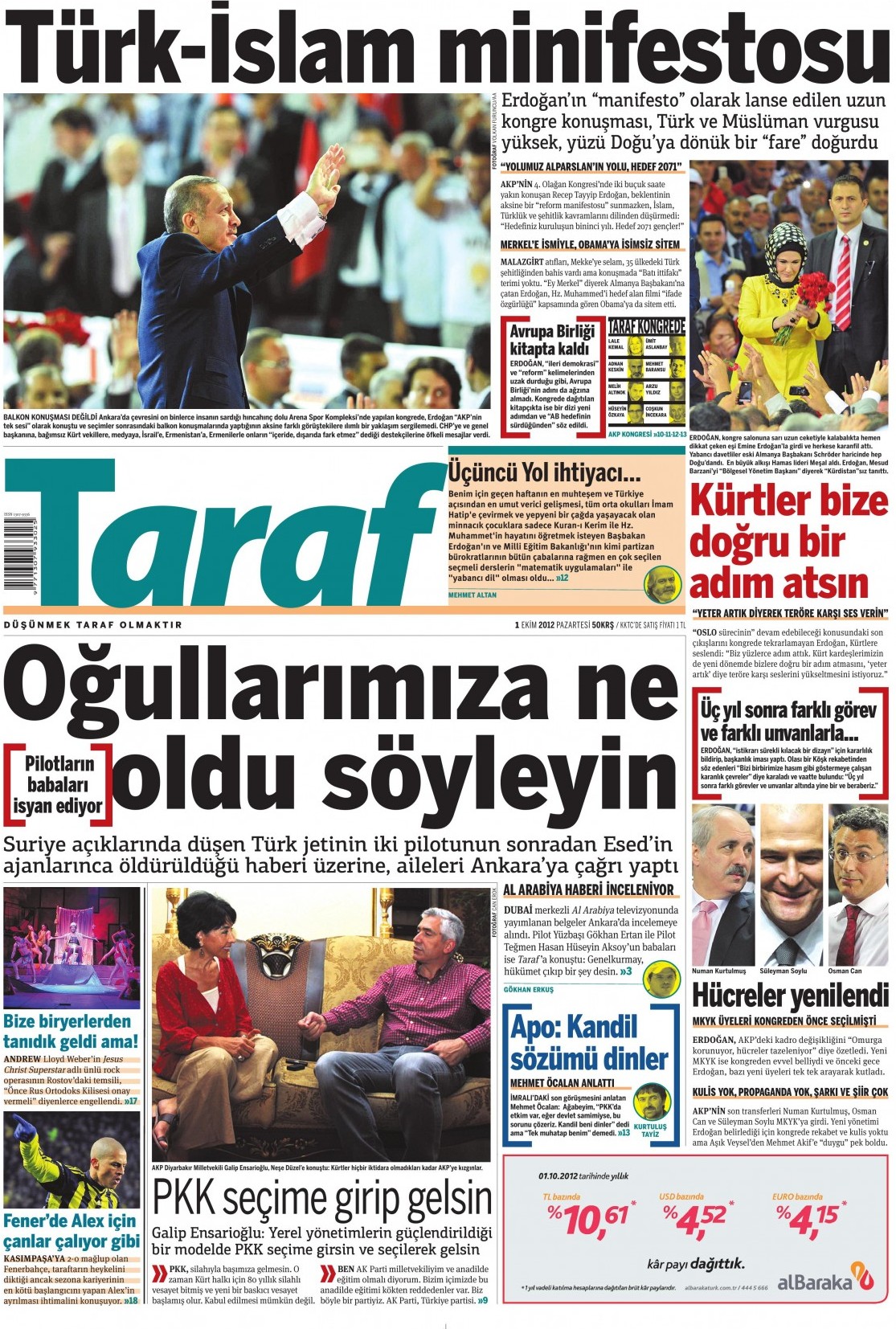
The conspicuously Islamic nature of the congress was also much discussed in the Turkish press – both by those approving and those dissenting. Beside its headline declaring “Great Strength Manifesto,” Islamist daily Yeni Şafak featured an admiring front page box quoting Hamas leader Khaled Meshaal, controversially (or perhaps not) invited to speak at the event: “‘You are not just the leader of Turkey, but also the leader of the Islamic world,’ Meshaal said, receiving extended applause from the crowd.” Indeed, when announced to the audience Mashaal received some of the loudest cheers of the day, (the EU dignitary who was introduced after him didn’t stand a chance!)
Liberal daily Taraf agreed that the congress constituted a Turkish-Islamic “minifesto,” but struck a rather more sceptical tone: “There was a strong Turkish and Muslim emphasis, a mouse with its face turned to the East was born,” (in Turkish, “a mouse was born” means that something underwhelming took place). The paper also noted plaintively that Erdoğan had failed to mention the European Union even once during his speech.
Meanwhile, seven national newspapers were refused accreditation to attend: Cumhuriyet, Sözcü, Evrensel, Birgün, Aydınlık, Yeniçağ, and Özgür Gündem. These publications have diverse sympathies: from left to right wing, from Turkish to Kurdish nationalism. The only thing shared by all is antipathy towards the government.
In response, Monday’s Cumhuriyet included a front page editorial titled “From Cumhuriyet to Public Opinion,” which said some unsurprisingly harsh things:
“Established six months after the founding of the Turkish Republic, our newspaper has been published for 88 years. During periods in the past when democracy has been suspended by the ruling powers our newspaper has been closed down, but outside of this we have always published under the principles of freedom of the press, in the name of people’s right to know. In 21st century Turkey, our newspaper is now exposed to censorship by the ruling powers.
“We will not stay quiet in the face of the anti-democratic implementations applied against us that violate both the constitution and the law.”
The piece went on to detail two constitutional and legal articles that it alleges the congress ban violated: Article no. 69 of the Turkish constitution, which states that internal political party activities, arrangements, and workings must not run counter to the principles of democracy; and Article no. 93 of the Law on Political Parties, which states that decisions taken and actions performed by party central administrations and affiliated groups must not run counter to the principles of democracy.
The International Press Institute’s Turkish National Committee issued a statement about the issue on the day of the AKP Congress, on behalf of the Freedom for Journalists Platform, an umbrella group representing local and national media organisations in Turkey:
“The news that reporters and journalists from some press organs are not allowed to enter the AK Party’s Congress is very worrying.
“Monitoring this historical event of the ruling government party on the spot and transferring it to its readers and viewers are primary duties of news media.
“We have previously protested the accreditation limitations at other institutions. But now, it is very disappointing that the same accreditation is being applied by a political party whose existence depends on democracy.”
A competition for the ‘giant’ Çamlıca Mosque
August 1, 2012
In May, Prime Minister Recep Tayyip Erdoğan announced to the Turkish media his desire to see a “giant” mosque built on Istanbul’s Çamlıca Hill. In his latest “crazy plan” for the city, Erdoğan said he wanted it to be a mosque that could “be seen from everywhere,” and declared that construction would begin within two months. Çamlıca is situated on the Asian side of the city, and despite currently being the site of a number of enormous television and radio reception towers, the hill is one of Istanbul’s few remaining green, unpopulated spaces. On June 8 the Environment and City Planning Ministry announced that a 250,000 square metre area on Çamlıca Hill had been identified for the project.
The Turkish press is predictably divided along secular/religious lines on the issue. There are, however, a few voices amongst government-supporting newspapers questioning the necessity of a mosque when there are no residents nearby for it to serve. Such objections miss the point that a new mosque on Çamlıca would undoubtedly afford TOKİ developers a golden opportunity to roll up their sleeves in the area(!)

An appropriately crude impression of how a mosque on Çamlıca Hill might look.
Late in June, liberal daily Radikal featured an interview with Ahmet Turan Köksal, professor of architecture at Gaziantep’s Zirve University, to discuss modern tendencies in mosque-building and his thoughts on the Çamlıca plans. He is skeptical: “A mosque should be for the community, not for show. For me, being a mosque architect means only doing work that has a function for the community …. If they want to make a mosque like an Olympic stadium on Çamlıca Hill and want to show off to their friends and rivals, then I’m against this,” he said.
Nevertheless, at the beginning of July, Milliyet included an interview with architect “Hacı” Mehmet Güler, who said he had been charged by the prime minister to make preparations for the new mosque. Güler said it would be designed in a “classical style,” and – in a fine example of “Muslim modesty” – that plans were being drawn up to have it feature the world’s tallest minarets, even surpassing those of the Mosque of the Prophet in Medina.
Following this interview, the issue seemed to fall off the agenda. It was thus quite a surprise to find a number of Turkey’s religion-friendly newspapers recently carrying advertisements announcing: “Çamlıca is searching for its architect!” The advertisements appeal to architects to submit their design ideas, in a competition to find an architect for the new mosque.

The competition opened on July 23, and will be accepting submissions until Sept. 3. According to the website of the organization in charge of the project – the rather clumsily named “Association to Build and Maintain Istanbul Mosques and Educational-Cultural Services” – the winning design will be “suitable for Istanbul’s silhouette and texture, reflect the Ottoman-Turkish style, extend traditions to the future, add value to Istanbul, and become one of Istanbul’s symbols.” The winner, the association has announced, will be awarded the honour of designing the ‘Recep Tayyip Erdoğan’ as yet unnamed mosque, as well as 300,000 Turkish Liras in prize money.
As declared in advertisements for the ruling AKP at the last parliamentary elections, alongside a picture of a vatic looking Erdoğan: “It was a dream, it came true!”
Taraf newspaper and liberal disillusionment
July 15, 2012
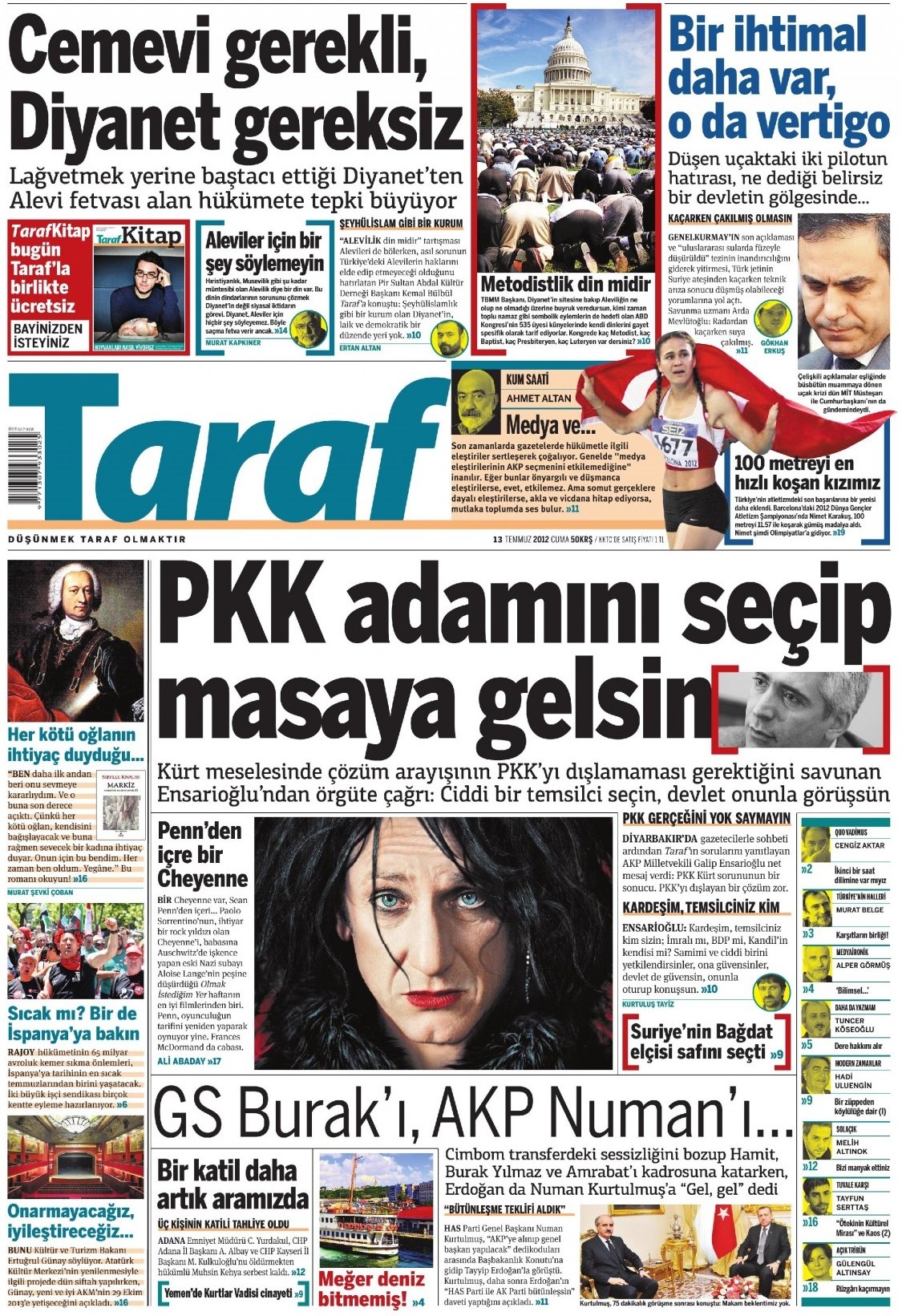
On July 14, leftist daily BirGün included a piece discussing liberal daily Taraf’s recent turn away from the ruling Justice and Development Party (AKP) government. Prompted by Ahmet Altan’s July 13 editorial bemoaning the AKP’s departure from its earlier EU-minded liberal-reformist impulses – the latest in a series of articles critical of the government – BirGün described the shift with some incredulity. Taraf, the piece said, used to label government critics anti-democratic nationalists in thrall to regressive military tutelage, strongly supported a “yes” vote in the September 2010 constitutional referendum, hailed Prime Minister Recep Tayyip Erdoğan as a saviour of the Kurds, and openly recognised the “Armenian Genocide” on its front page. Recently, however, the paper’s criticism of the AKP’s authoritarian turn has increased significantly. Taraf’s move against the government could be seen as representative of disillusioned liberal Turkish opinion these days, but the apparent non-effect this has on opinion polls indicates just how tiny that liberal constituency actually is.
Taraf started printing in 2007 and primarily made a name for itself for its tough anti-military stance. For Turkish liberals at the time, this seemed like the most important battle to be won, and foreign observers routinely used adjectives like “courageous,” “plucky,” and “brave” to describe the paper’s anti-militarist crusade. Domestic critics denigrated it as the AKP’s convenient attack dog, something akin to the “useful idiot” liberal apologists who denied the existence of Lenin’s Soviet police-state terror in the 1910s and 20s. Taraf has been particularly instrumental in the Ergenekon and Balyoz coup plot investigations, claiming numerous scoops against the military in that case, (no matter that most of its anti-military material is widely understood to have been fed to it directly by the AKP government). As Jim Meyer described in a 2009 piece:
“Particularly with regard to the Ergenekon trial, Taraf has managed to frequently scoop the competition with reports (often leaked by the largely AK Party controlled national police force) which have embarrassed military officials […] ‘I don’t see journalistic achievement,’ said one experienced Turkish journalist. ‘They just gobbled up what the police intelligence was leaking them regarding Ergenekon.’”
Meyer’s analysis was written three and a half years ago, and since then the contradictions and evident absurdities in the coup plot cases – as well as the growing anti-democratic practices of the AKP government – have become more and more apparent. While Taraf still maintains its strong anti-military position, it has begun to abandon its previously timid approach to the ruling party and is now voicing tough criticism of various government tendencies. This became particularly clear in January, when lawyers for Prime Minister Erdoğan sued the paper’s editor Ahmet Altan for allegedly “[making] extremely deep insults with the intention of assaulting Erdoğan’s personal rights,” and pressed for 50,000 Turkish Liras in compensation. Evidently, the AKP government wants to keep Taraf on a short leash, but the paper’s continued criticism since then would suggest it has not yet been successful.
Meanwhile, on the same day as BirGün was observing Taraf’s apparent shift against the government, all media outlets were reporting on an upcoming AKP proposal to the Turkish parliament’s Constitution Conciliation Commission (which is currently attempting to put together a new national constitution). The Hürriyet Daily News reports that the proposed changes would “allow the government to limit press freedom in a variety of scenarios that include cases of ‘national security’ and ‘public morals.’”
Referring to the moves, Taraf’s July 14 front page headline story harshly criticised the AKP government for its “prohibitionist mentality.” It cited a 1976 European Court of Human Rights ruling, which stated that: “Freedom of expression […] is applicable not only to “information” or “ideas” that are favourably received or regarded as inoffensive or as a matter of indifference, but also to those that offend, shock or disturb the State or any sector of the population.” Underneath the main headline, the article pointedly said: “we hope this ruling inspires the AKP.”
The ‘anti-Armenian Genocide denial’ bill & Franco-Turkish cynicism
February 2, 2012
On Jan. 24 the French Senate passed a bill to criminalise denial that the killings of Armenians by the Ottoman Turks in 1915-16 amounted to genocide. The law has caused Franco-Turkish relations to plunge to an unprecedented nadir. The car crash was obvious long in advance, which only made it – and the predictable reaction that followed – all the more painful to watch. France had already officially “recognised” the genocide in 2001, but the new law goes one step further, making it illegal for a French citizen to publicly question the events. The signatures of enough French lawmakers have since been collected to challenge the bill in the French constitutional court, which is where it sits now. But if it ends up passing that test and going into the statute books, those found guilty will be landed with a maximum 45,000 euro fine and one year in jail. In the days leading up to the vote, thousands of French-Turks demonstrated in the streets of Paris to protest the law, and on the day of the vote rival groups of Turks and Armenians – separated by police – gathered outside the French Senate, waving flags and blowing whistles.
Some expressed quiet surprise at the apparent “moderation” of the Turkish response, although if that was “moderate” one wonders what the “extreme” reaction would look like. Prime Minister Recep Tayyip Erdoğan railed furiously against the bill and threatened strong concrete measures – including economic sanctions and recalling the Turkish ambassador from Paris – if it wasn’t revoked: “This is politics based on racism, discrimination and xenophobia. This is using Turkophobia and Islamophobia to gain votes, and it raises concerns regarding these issues not only in Francebut all Europe.” According to Erdoğan, the vote disturbingly echoes the “footsteps of fascism.” “The votes in the French Parliament and the proposal that has been adopted are an open demonstration of discrimination and racism and amount to a massacre of free thought,” he said. “This bill has removed the atmosphere of free discussion [inFrance]. The principles of liberty, fraternity and equality, which form the basis of the French Revolution, have been trampled on.” Other Turkish politicians and diplomats have also revelled in casting themselves as defenders of the liberal European ideal. Vice chairman of the ruling Justice and Development Party (AKP), Ömer Çelik, took to twitter to claim: “Sarkozy is turningFranceinto Bastille Prison step by step.” Chief Turkish EU negotiator, Egeman Bagis, similarly tweeted: “I celebrate 40,000 Turks marching against the bill to defend the French Revolution’s values.”
The prospect of Turkish politicians posing as modern day Voltaires, protesting in defence of the principles of the French Revolution must be irresistible for the satirist. Such a stance might appear more sincere if Article 301 of Turkey’s own constitution didn’t make it punishable by law to “insult Turkishness.” It might also if there weren’t currently more journalists locked up in Turkish jails than there are in China (95 at the last count); or if Turkey didn’t rank 148th out of 178 countries in the Reporters Without Borders (RSF) World Press Freedom Index; or if Turkey wasn’t by far the worst violator of human rights among the 47 signatory states of the European Convention on Human Rights; or if that same court hadn’t received nearly 9,500 complaints against Turkey for breaches of press freedom and freedom of expression in 2011 (compared with 6,500 in 2009). A distinct tendency towards authoritarianism has been unmistakably creeping into the AKP’s rule of late, perhaps giving some perspective to this most recent outburst in defence of European liberalism.
And the French defence? There isn’t much to be said. Before the vote, President Sarkozy claimed: “The genocide of Armenians is a historic reality that was recognised by France. Collective denial is even worse than individual denial […] We are always stronger when we look our history in the face, and denial is not acceptable.” Nevertheless, the law is widely understood to be a cynical piece of electioneering, the ruling Union for a Popular Movement (UMP) having bowed to the active and well-organised Armenian lobby in Paris, and seeking to secure the 500,000 French-Armenian votes ahead of this spring’s French Presidential election. The move will also doubtless serve to further paralyse Turkey’s already-moribund EU accession bid, which Sarkozy repeatedly makes clear he opposes. There may also be some truth in the accusation that the UMP is seeking to curry favour with France’s populist right-wing, with a move targeted at a Muslim minority.
The question of whether national governments should legislate on how historical events are remembered is probably an unanswerable one. But that won’t stop both sides attempting an answer to fit their own national political agendas. Do you think those 40,000 angry Turks were protesting on the streets of Paris out of earnest concern for Enlightenment values and in sincere defence of free speech? Such lofty protestations are mere fig leaves. Whether it’s Sarkozy opportunistically chasing votes in return for laws, or the Turks spuriously invoking the French Revolution and defending some destructive, nebulous idea of “national honour,” both sides are cynically invoking the high-minded language of moral righteousness to pursue squalid political ends.


