I’ve written a piece for Politico about Turkey’s critical general election. Specifically, the article looks at the shift by President Erdoğan and the government in recent months from emphasising economic competence to peddling bombastic conspiracy theories:
“While signs of this paranoiac shift have long been evident, the AKP’s earlier years in power mostly focused on making an economy-based pitch to voters. Economic competence and extending services to the poorer sections of society – along with an appeal to the conservative religious values held by many Turkish citizens – proved a winning combination for a string of crushing election victories. But while the party still pledges to spur development, its rhetoric leading up to Sunday’s election has tilted decisively in favor of a combination of conspiracy theories laced with historic posturing about reconnecting Turkey with the glory of the Ottoman Empire. When you’re on a glorious path, the AKP’s leaders suggest, you will inevitably have enemies.”
Read the whole thing over at Politico.

A brief history of Central Bank independence in Turkey
March 19, 2015
I’ve written a short piece taking a longer view of the ongoing tug-of-war between the government and Turkey’s Central Bank.
The piece argues that current speculation about the Bank’s independence should not be seen in isolation, but considered within the context of the government’s long-flagging enthusiasm for the economic reforms passed after the meltdown of Turkey’s financial sector in 2000-01. The jettisoning of long-term economic planning is one side effect of President Erdoğan’s bid to centralise all power in his own hands, and could herald a period of severe economic turbulence in the country.
Click here to read the whole thing on the Hürriyet Daily News.
The Turkish gov’t takes on the foreign media
December 10, 2014
I’ve written a piece for Foreign Policy on the deterioration of the Turkish government’s image in the international media, and Turkey’s aggressive response:
The foreign media image of President Recep Tayyip Erdoğan and the Turkish government has shattered over the past 18 months, and in response Turkey has ramped up an international information blitzkrieg.
The tone is becoming increasingly bitter, motivated by a conviction that the foreign media is a propaganda weapon deployed by the West to attack the ruling Justice and Development Party (AKP). Patriotic Turks are called on to rally behind their government in the name of national sovereignty.
This sense of embattled defiance is important to understand, and reveals much about the resentful mindset gripping the state. Suspicion about the foreign press is hardly new in Turkey, but it’s unfortunate to see the worst of such sentiments returning – openly sponsored by Erdoğan and the AKP’s top brass. The president himself is even managing to turn international criticism to his own advantage, as evidence that the West is implacably hostile to Turkey and its fearless, truth-telling leader — a useful populist line ahead of next June’s crucial parliamentary elections.
Read the full article here.
PM Erdoğan’s jet
July 24, 2014
As Prime Minister Recep Tayyip Erdoğan flies around on his apparently never-ending election campaign, the symbolism of “Erdoğan’s jet” and who he invites onboard is coming under increasing scrutiny. These days, only reporters from the most craven pro-government media outlets – the usual suspects of Sabah, Yeni Şafak, Star, Akşam, Türkiye, Yeni Akit – tend to be given the golden ticket to fly on Erdoğan’s private “ANA” jet; a place on board is almost used as a carrot to reward docile behaviour. As daily Hürriyet’s ombudsman Faruk Bildirici wrote in a piece last month, the reporters accepted onto the plane are guaranteed not to ask difficult questions, choosing to do little more substantial than perform as the AKP’s media arm, “as assistants to help Erdoğan comfortably transmit whatever message he wants to the public.”
An increasingly narrow coterie of trusted media figures is being granted access to the prime minister. The effect isn’t only seen in who Erdoğan accepts onto his plane; it is also there in the TV stations and newspapers that he and other prominent government figures choose to grant interviews to, and in the hand-picking of interlocutors during these exchanges. Of course, democratic governments across the world have media groups to which they are closer and which, to some extent, they rely on; indeed, the opposition parties in Turkey also have their own “reliable” media camps. But there’s something blatantly unfair about the mutually supportive state-private network that is reinforcing the AKP government in power today. The cosiness of the prime minister and the media accepted onto his jet is just one of the most obvious examples of this favouritism.

A familiar scene: Erdoğan surrounded by loyal scribes on his private jet. (Photo credit: Milliyet)
Last week, the Nielsen Company’s AdEx advertising information report caused quite a stir in Turkey, revealing how advertising provided by state companies was weighted heavily in favour of government-friendly media groups. According to the report, of the 18 national newspapers examined, the three that received the most public advertising slots in the first six months of 2014 were the pro-government Sabah, Star and Milliyet dailies. The bottom five, meanwhile, were all broadly AKP sceptics, despite two of them – Posta and Zaman – having the highest circulation figures in the country. The two newspapers known as being close to the movement of ally-turned-bête noir Fethullah Gülen – Bugün and Zaman – received almost zero advertising from state institutions. Similarly, TV stations that are known to be closer to the government received far more advertising from public bodies in the first half of the year. Two pro-Gülen television channels – Samanyolu and Bugün TV – received no advertising revenue whatsoever from state companies. While much of the recent focus has been on public broadcaster TRT’s hugely imbalanced coverage in favour of Erdoğan ahead of next month’s presidential election, the way that state institutions are marching in lock-step with government-friendly private companies also has perilous consequences.
The issue of who gets to travel on the prime minister’s private jet is only one symptom of a Turkish media stuck in a broader partisan malaise. Indeed, while those who get invited onto the PM’s plane see their role as only being to transmit whatever the prime minister says, the myopic fixation on every word uttered by Erdoğan is unfortunately shared across pro- and anti-government outlets (as I have previously written). With important exceptions, all sides are sucked into an endless, meaningless argument about where they stand on whatever Erdoğan’s latest utterances and positions are – those positions are the fuel motoring 80 percent of Turkish media’s shallow news agenda. “Important Statements from the Prime Minister” stories are only becoming more common as power becomes more centralized around one man, and the situation isn’t likely to improve after Erdoğan is elected president next month.
Germany becomes pro-AKP media’s latest bête noire
May 28, 2014
The Justice and Development Party (AKP) government’s recent tactic to feed its supporters a steady diet of enemies has turned its focus on Germany over the last few weeks. The green light came with the verbal joust between German President Joachim Gauck and Turkish Prime Minister Recep Tayyip Erdoğan, during the former’s visit to Ankara at the end of April. After Gauck sharply criticised the state of press freedom and freedom of expression in Turkey, Erdoğan responded in reliably pugnacious style, declaring that the Lutheran Gauck “still thinks of himself as a pastor” and “cannot interfere in our country’s internal affairs.”
Equally reliably, the pro-government media has zealously taken up Erdoğan’s cause, gorging itself on anti-German material over the last couple of weeks including moronic, depressingly predictable Nazi analogies. Germany has thus taken its place alongside Jews, Masons, Atheists, Britain, the U.S., the “interest rate lobby,” the “parallel state,” and assorted domestic collaborators, in a “dirty alliance” to bring down Erdoğan and his government. This media campaign has been thrown a fair amount of red meat by a few ill-advised stories and headlines in Germany. Ahead of the prime minister’s much-anticipated rally in Cologne on May 24, for example, popular tabloid Bild carried a front page headline addressed to Erdoğan, declaring: “You’re not welcome.” The AKP-friendly media took full advantage, describing this as the latest evidence that Germany is frightened of Turkey’s unstoppable rise and is trying to sabotage Erdoğan’s political career (and thus Turkey’s path to a glorious future). Some of this stuff has been harmless tabloid fare, while some of it has been more worrying. Last week, German news magazine Der Speigel announced that it was withdrawing its Turkey correspondent, Hasnain Kazim, after he received over 10,000 threatening messages from online pro-government trolls, including death threats. His crime was to quote in a headline the reaction of a protesting miner in the disaster-struck town of Soma, who reportedly said, “Go to hell, Erdoğan.”

Akşam newspaper claims that “Turkish-Europe” lobbies in Germany – including Turkish media tycoon Aydın Doğan – are working in partnership in a slander campaign against the AKP government.
One of the more thoughtful interventions in this sad state of affairs came in the short interview given to T24 by Cem Özdemir, the Turkish-origin co-leader of Germany’s Green Party, on May 26. Putting aside his questionable sideburns, Özdemir had some eminently reasonable things to say, but PM Erdoğan still found things to object to. During his typically tub-thumping weekly AKP parliamentary group speech on Tuesday, he slammed Özdemir as a “so-called Turk, a co-head of a political party over there. The words he used before and after our meeting were very ugly. How are you a democrat? … Are you so disturbed by the prime minister of the Turkish Republic going there? You have no right to talk to the prime minister of your country of origin, of which you are a member, in this way. It doesn’t matter where you are an MP, first you will know your place.” You can decide for yourself whether that was a proportional response to Özdemir’s measured words to T24, which I’ve translated below:
How do you assess Prime Minister Erdoğan’s speech in Cologne?
From now on, no matter what he does, unfortunately we’ve come to the point where it can’t really change anything … The Soma mine disaster and his earlier speeches have formed such a bad picture. From now on, Erdoğan won’t easily be able to change this image. He’s also negatively affecting Turkey’s image. In recent years here, there was a positive image. But that has completely collapsed, it has reversed and a negative image of Turkey has been formed. Erdoğan has become a symbol of this negative image.
Isn’t the German public’s reaction to Erdoğan very exaggerated?
Both his supporters and his critics are exaggerating. His supporters completely idolize him, and see him as a completely faultless, flawless person; while a section of his critics are making a big mistake by comparing him to Hitler. The comparison with Vladimir Putin is better because Erdoğan really is transforming Turkey into an authoritarian regime. But the Hitler comparison is very excessive. So, without generalizing, both sides are making mistakes. These exaggerated approaches are having a very negative effect on the perception of Turkey here in Germany.
In Erdoğan’s speech, Angela Merkel was booed in the hall.
This booing of Merkel’s name leaves a very bad impression. It was very ugly, and it will stay in people’s minds. We will be the ones to pay the price for this. It gives the message: You’re living here, you’re eating its bread, your taxes are paid here, your children are going to school here, you’re benefiting from the welfare state. At the same time, you are booing this country’s prime minister and worshipping another country’s prime minister. It brings the question of loyalty back onto the agenda. We have been struggling for 50 years. “We are loyal citizens,” we say. “Trust us, there’s no need to worry.” This is brought down by the image left by those who went to that rally.
Erdoğan actually had a lot of different groups booed in the rally.
The crowd was transformed as if it was living on enemy soil. There is no such partisanship in German politics; they support politicians but they don’t worship. In the end we are just people; all of us will depart this world one day. To worship someone in such a way both amazes and scares people. In addition, those German Turks who were demonstrating against Erdoğan’s visit pumped up fears about whether “Turkey’s internal problems are being brought here.” In the past there was polarisation between Turk and Kurd, right and left; now the worry is spreading about whether the new polarisation is between Erdoğan’s supporters and his opponents.
Erdoğan’s image in Europe was very positive for many years. How is it now after this speech?
He’s destroying his own successes.
As a Turkish-origin politician, what do you say to the German public?
In the past, we used to say things like, “Probably he meant to say this; if he knew the details he would have spoken differently.” But we’ve gone beyond that, there’s nothing we can defend anymore. Even those ministers in Germany who were previously most positive [about Turkey] are now saying, “This is more than enough.” Erdoğan has 100 percent lost Germany.
Yiğit Bulut: PM Erdoğan’s Flavor Flav
April 16, 2014
Prime Minister Recep Tayyip Erdoğan’s chief economic advisor, Yiğit Bulut, is both the Flavor Flav to his Chuck D, and the Aristotle to his Alexander the Great; both the “hype man” on stage and “theorist” behind the throne. His appointment to the PM’s inner circle caused mirth last July, amid his suggestion that foreign powers were seeking to kill Erdoğan using telekinesis, but that was just one of many odd theories he has come up with since last summer’s Gezi Park protests. He recently made headlines by declaring that the EU, (Turkey’s number one trading partner), was “finished” and would be superseded by the “new world order” of the “Turkey-Eurasia/Russia-Middle East equation”; while last year he told a TV programme that he would “die for Erdoğan if necessary.” Bulut’s rise is both a symptom and a cause of Erdoğan’s gradual departure from reality, and the Justice and Development Party’s (AKP) steady descent into paranoia.
People often speculate about whether Erdoğan “really believes” the conspiracy theories that he comes out with, or whether they are just a cynical way of playing to his electoral base in tough times. In fact, both can be true, and insisting only on the latter ignores the deep traces of such currents through the history of Turkey’s Islamist movements, (not least in Necmettin Erbakan’s Refah Party, where Erdoğan cut his political teeth). When times were easier during the AKP’s first couple of terms, such rhetoric generally remained latent; but it was always ready to surface again when things took a turn for the worse. This was clearly the case after last year’s Gezi protests and the Dec. 17 corruption probe. Erdoğan did indeed play to his base out of electoral calculation, but when the stakes were so high and the alternative was political disaster (and possibly jail), those conspiracies must also have been a lot more convincing to him. It’s probably significant that Bulut was named advisor to Erdoğan shortly after the Gezi protests erupted. It was in those difficult circumstances that his warnings of a Turkey besieged by foreign powers and his political vision of fantasy neo-Ottomanism must have made the most sense to the prime minister.
Bulut was actually once a staunch, nationalist-flavoured critic of the AKP, critical of privatisations, its inability to deal with the Kurdistan Workers’ Party (PKK), and Turkey’s growing debt stock. The Damascus moment came some time before his 2010 divorce from former wife Şule Zeybek, the niece of secularist media tycoon Aydın Doğan, and ever since he has defended Erdoğan with the zeal of a true convert. In June 2012 he became the editor of pro-government 24TV, after which he was rewarded for his now-unswerving loyalty with an appointment to the prime minister’s brain trust. He now juggles his new role with his regular column in daily Star and political talk show appearances on pro-government TV. Indeed, Bulut was at the centre of one of the more amusing episodes from the wiretap leaks released before Turkey’s March 30 local elections: A conversation between the editor of private broadcaster NTV, Nermin Yurteri, and PM Erdoğan’s chief political advisor, Yalçın Akdoğan. In it, Akdoğan demands that Bulut be included as a guest on a news discussion programme, which is desperately resisted by Yurteri, who says her station is willing to accept any other pro-government figure but not the widely ridiculed Bulut.

Advert for Yiğit Bulut’s pre-election “National Will” lecture tour, arriving in Istanbul’s Esenler district.
The crude populism of Bulut’s thrice weekly Star column is reminiscent of Erdoğan’s bombastic public speeches, but the wild adolescent theorising about the “NEW WORLD ORDER” may be less familiar. It’s chilling to think that it’s not the ranting of a frustrated teenage shop assistant in Yozgat, but that of the Turkish prime minister’s chief economic confidant, who has a personal office in Istanbul’s Dolmabahçe Palace.
Translated below is one of Bulut’s columns in Star. Hard to believe, it isn’t one of his most spectacular pieces, but it does give a good idea of his surreal intellectual hinterland. It appeared on March 28, as Turkey’s political atmosphere was at fever pitch just two days before the critical local election. In it, we see Aristotle turning his attention to the future challenges facing the “New Turkey” and how the government’s defense policies can best meet these new challenges:
What is the biggest danger for the ‘new great Turkey’?
In the days before 2003, when Turkey was still covered up, the question that was asked was this: Which is the biggest threat for Turkey, “fundamentalism” or “separatist terrorism”?
My dear friends, today the question is different: What is the biggest threat for a Turkey that is making peace with itself and expanding? Is it possible to ignore or even destroy the National Will? I repeat: Is it possible to ignore or even destroy the National Will?
This country had many days, months and years of viewing and being forced to view its own values as a threat. The way we looked at issues was mistaken, and so were the solutions we put forward! Until 2003 we lived in this “blind well,” and with our “mistaken entrances” we always produced “mistaken results”!
Dear friends, today the situation is very different, and when is to be done is clear: Turkey is establishing a new threat perception, appropriate to its understanding of the “new world order”; as a necessity it is forming a “national defense-military technology-production” strategy. It’s not difficult to detail this: Turkey is advancing to become a country capable of reaching the maximum fire power with minimal “human resources,” conducting operations in all areas and – most importantly – meeting its “defense needs” with indigenous technology and even producing “concepts.”
Dear friends, there were once built-in internal and external focuses were imposed on us for years, and the “built-in media” vehicle didn’t even allow us to question this! We even helplessly believed that our own Muslim citizens could be our biggest threat, that our Kurdish-origin citizens could want to divide us… It wasn’t right, it was never right, but we could never remove “this sack from our heads” and realise the true “threat definition”! Today we have ripped off the sacks, and the path we will now embrace is apparent!
Result 1: As Turkey grows, it will see; enemies are not just internal and external. As Turkey GROWS, it will see that its enemies are not only inside the nation, but they also hide and focus in the twists in the path of Turkey’s expansion.
Result 2: Our minds must be very sharp and our thesis must be very clear: In the last 10 years, Turkey has ripped off the “sacks,” saved itself from the “diseased structure” of previous civil-military relations, and is progressing on the path of “becoming a universal state” in the new world order.
Result 3: Turkey is defining a “new national defense concept suitable for a universal state” and is also detailing the technical aspects! Turkey has now revealed itself and there are those who are uncomfortable about this; therefore, a suitable new “NATIONAL STRATEGY” must be very carefully and quickly developed.
Result 4: The NEW TURKEY’s use of military force in diplomacy is inevitable! Instead of a military focusing its perceptions on vicious internal threats, a country on the path to becoming a global player must have a military that is redefined to deal with global threats.
Result 5: A NEW CONCEPT OF NATIONAL DEFENSE will benefit the Armed Forces in great and strong diplomacy, and can only be revealed with a new political vision.
Result 6: A new concept for the Turkish Armed Forces must be formed. This new concept would replace the one which searched for virtual enemies wanting to drag the country to fundamentalism and which followed its own citizens on suspicion of dividing Turkey. Instead, it would be a concept that would be strong enough to operate in the world arena, to rival America, the EU, Israel, Russia and China. The local defense industry is currently developing, modernisation is increasing, and projects are being realised to build tanks, aircraft, and ships that can operate thousands of miles from Turkish soil. In short, the Turkish military is becoming a world force…
Result 7: All members of the Turkish Armed Forces who can “see the future” are aware that a new concept of the military will suit the concept of a new Turkey. In fact, when you look closely, you see that in this area there is a big clash between the “resisters” and those who want to “open the path.” The BUILT-IN PRESS is working to create the public impression that this is a POLITICAL AUTHORITY-ARMED FORCES clash…
Result 8: The current Global Attack is directly targeting the “national will” and seeks to surrender Turkey’s management to the hands of global governance. What we must do is very clear: Destroy these barriers and continue on our path…
Last word: The whole of Turkey – its people, its government, its state – it currently under a huge attack. Most importantly, it is standing against this attack as a whole and battling to exist. At this point, I ask you: all Turkish citizens must investigate the barriers that stand in the path of the GREAT TURKEY and, in a manner suitable to the new world order, stand as a single body against these attacks! “Fear not, the red flag blowing in the horizon won’t fade.”*
* The opening line of the Turkish national anthem.
Rift with Gülen movement exposes rise of ‘Erdoğanist’ media
December 16, 2013
The spat between Prime Minister Recep Tayyip Erdoğan and the movement of Islamic preacher Fethullah Gülen has seen tension between erstwhile allies in the Turkish media boil over into open hostility. Among many other things, the public drawing of swords – ostensibly over the closure of private examination schools (dershanes) – has exposed the extent to which PM Erdoğan has successfully built himself a support network of personally loyal media outlets. This network was already clear to see, but its guns have never before been so openly turned on the Gülenists.
Of particular note is the staunchly pro-Erdoğan line taken these days by daily Akşam, which was among the assets seized from Çukurova Holding by the state-run Savings Deposit and Insurance Fund (TMSF) over debt issues in May. After the seizing of Akşam, former editor-in-chief İsmail Küçükkaya was fired and the TMSF appointed a former Justice and Development Party (AKP) deputy in his place, while major changes were also made to the paper’s wider editorial team. Its previously centrist tone changed immediately, and Akşam became one of the most reliable supporters of the government throughout the summer’s Gezi Park protests. After the prep school polemic exploded, Akşam again rallied behind Erdoğan, taking its place alongside Sabah, Star, Türkiye, Yeni Şafak, Yeni Akit, Takvim, and Habertürk, in the ranks of pro-government newspapers launching unprecedented attacks on the Gülen movement. As with the others, this is clear simply from the number of front page headlines repeating whatever belligerent words the prime minister said on the subject on the previous day.

Echoing Erdoğan: “No step back from dershane reform”
Although the new editorial board shifted Akşam’s position months ago, it was actually only sold to businessman Ethem Sancak last month, (along with TV station SkyTürk360, also seized from Çukurova Holding). Sancak once described himself as being “lovesick for the prime minister,” and openly declared that he had “entered the media sector to support Erdoğan.” He previously bought daily Star and news station Kanal TV back in 2006, transforming them into firmly pro-AKP voices before selling them on soon afterwards. Both processes resemble the way that Sabah, one of Turkey’s top-selling newspapers, was sold to the prime minister’s son-in-law in 2007, since when it has taken perhaps the most unswervingly pro-Erdoğan line of all mainstream newspapers. Through such moves, Erdoğan has gradually built up a media base completely loyal to himself, without which he would never have been able to achieve a position of such authority in the country. It has been a conscious effort; the bitter power struggles that have marked Erdoğan’s political career have convinced him of the need for a reliant and disciplined media support network, and the intertwining interests of business and political elites in Turkey allowed this network to be cultivated. This new, rigidly “Erdoğan-ist” media base has been more apparent than ever during the row with the Gülen movement.
The AKP government has sought to take the sting out of the dershane issue, announcing that the “transformation” of prep schools into private schools doesn’t have to be completed until September 2015 (conveniently after the three upcoming elections). The electoral effects of the Erdoğan-Gülen rift are still being speculated on, but it’s clear that although a detente has been declared for now, the knives will be even sharper when they inevitably come out again.
‘Important statements from the prime minister’
November 11, 2013
The title will be familiar to any follower of news in Turkish. Every day, “news” stories consisting of unedited transcripts of words spoken by Prime Minister Recep Tayyip Erdoğan are published online under that headline by the major newspapers. The recent storm over Erdoğan’s opposition to mixed-sex student accommodation was only the latest example showing that Turkey’s entire news agenda is increasingly becoming subject to the whims of his unpredictable tongue. He opens his mouth and whichever subject he has chosen then dictates the national conversation. When the media is so completely dependent on politicians, how can be expected to hold those same politicians to account?
This problem cuts across the internet, the television, and the printed press. It almost feels like an act of rebellion when a TV station chooses not to cut to a live broadcast of any public utterances from “The Master.” I only came to Turkey in 2009, so I can’t say whether this has always been the case, but I suspect that the situation has only deteriorated of late. The fact is that you can’t get much safer than a “news” story simply providing a transcript of words spoken by the prime minister. What’s more, depressingly, I’ve been told that these articles usually get the most “hits” for websites. This fixation on Erdoğan’s every word is not only extremely distorting, but also exacerbates the bizarre cult of personality that has developed around him amongst his supporters.
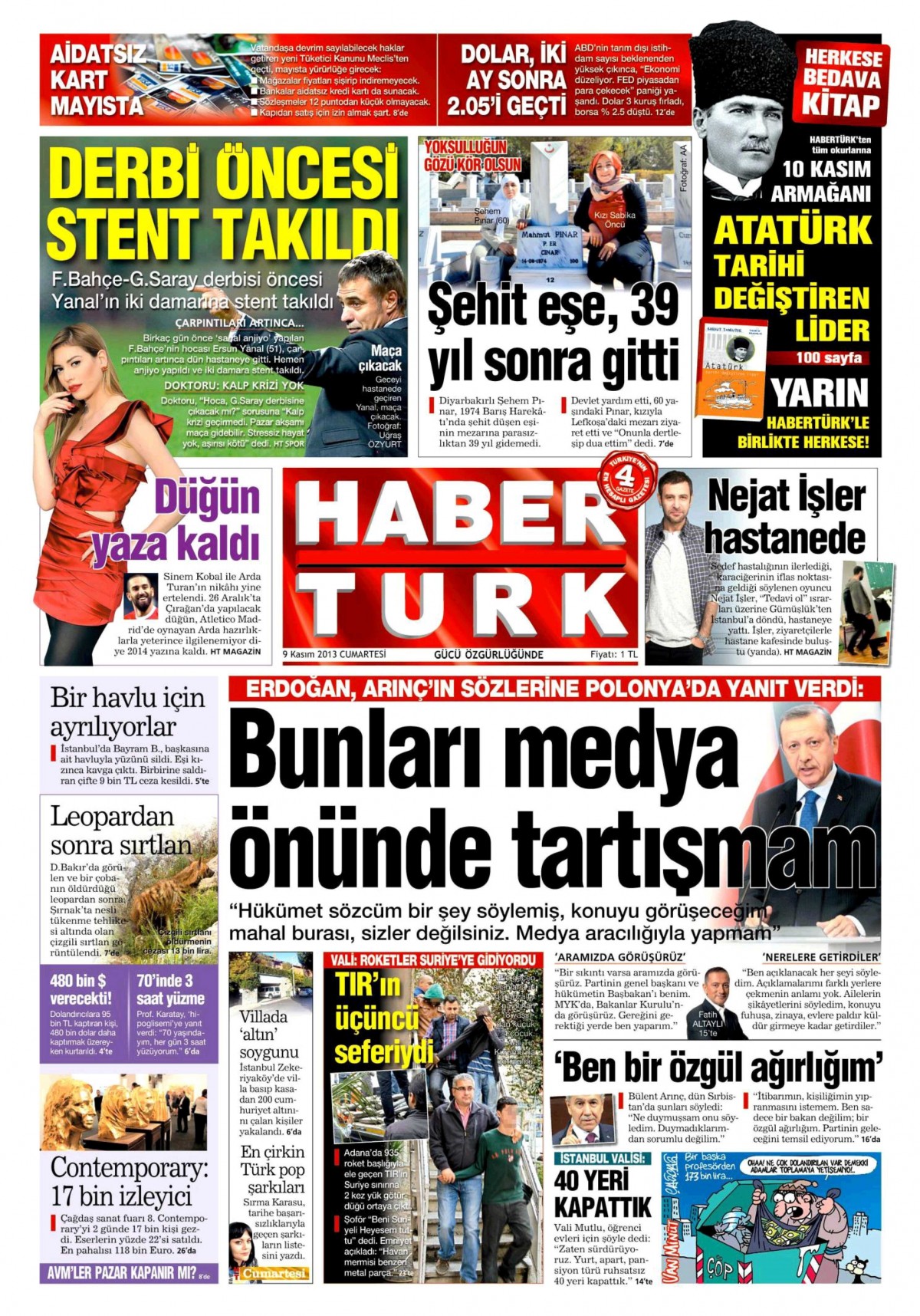
Habertürk parroting the prime minister on Nov. 9. With unintended irony, the headline quotes Erdoğan’s response to Deputy PM Bülent Arınç’s criticism of the mixed-sex student housing debate: ‘I don’t discuss these things in front of the media.’
But while this obsequiousness is lamentable, those official pronouncements in fact are very important. The centralization of decision making is so chronic that Erdoğan’s words, whatever they are, really do have the power to shape the agenda of the country, decide the laws that then get passed, and at what speed. As Adana Governor Hüseyin Avni Coş said shortly after Erdoğan’s utterances on co-ed housing: “We see the prime minister’s words as orders.” Policy is increasingly being shaped on an ad-hoc basis around Erdoğan’s statements; the centralization of power around him now is such that there is a genuine justification for reporters broadcasting and publishing every single thing he says. The vicious cycle is thus reinforced.
That’s why the controversy that is periodically caused by the firing of prominent critical columnists from newspapers often misses the point. Many people’s understanding of news seems to be little deeper than a “who said what?” bish-bash-bosh, responded to by a flood of commentary. As I wrote in my last post, few seem to value deeper investigative reporting, and none ever mention the inherent problem with “stories” consisting of nothing more than an indiscriminate transcript of a minister’s speech. Editors who are encouraging “Important statements from the prime minister” articles are contributing to this dangerous imbalance. Far from the media being a check on power, PM Erdoğan’s tongue is the driving force behind the media.
‘Gezi Park protests fuelled by foreign media’
June 13, 2013
One of the saddest aspects of the Turkish government’s response to the Gezi Park protests has been its line that the demonstrations are all a part of a “foreign plot” to bring down Turkey. As with everything else, Prime Minister Recep Tayyip Erdoğan fired the starting pistol, singling out the phantom international “interest rate lobby” as being behind the unrest. Since then, leading government figures have been falling over themselves to slander the protests as part of a “foreign conspiracy” by forces “jealous of Turkey’s economic success.” Economy Minister Zafer Çağlayan said “foreign circles” were trying to “undermine the country’s progress” through the protests: “This is totally an attempt to create a foreign hegemony on Turkey, but we are no fools.” EU Minister Egemen Bağış stated: “It is interesting to have such incidents in Turkey when … economic and development figures are at their best levels. The interest rate lobby and several financial institutions are disturbed by the growth and development of Turkey.” Foreign Minister Ahmet Davutoğlu said a deliberate propaganda operation was being conducted by the international media to tarnish Turkey’s image. Delusional? Yes. Seductive for a sizable portion of the Turkish electorate? Undoubtedly.
Overturning every stone only to find a nefarious foreign plot hidden underneath is one of Turkey’s less attractive national pastimes. Considering the past 200 years of the country’s history, it’s understandable, if not excusable. The current government was supposed to have broken with this paradigm. It had opened the country out to its region – both Europe and the Middle East – and was open-minded about doing business abroad and attracting investment for domestic infrastructure projects. The old embattled Turkish borders seemed to be opening to the world. However, the government’s reaction to the Gezi protests has laid bare all its latent insecurity and resentment, which has been most clear in the verbal attacks on the international coverage of the events. While mainstream domestic media has been brought (almost) completely under the thumb of the authorities, one gets the impression that the AKP’s open anger at the international media is now a kind of reflex action, indicating its frustrated inability to control what is being reported. The BBC must have been exaggerating the scale of the protests, as it wasn’t showing a penguin documentary.
Pro-government news outlets have been keen to assist in framing this paranoid narrative. While it was certainly no secret before, the Gezi protests have exposed the full extent of AKP control over the state news agency, Anadolu Ajansı, which has carried some utterly ridiculous The Onion-like headlines about foreign plots and jealous foreign powers. Pro-government newspapers have also loyally joined in, here’s daily Sabah applauding the aforementioned Anatolia for “sending a missile” to Reuters and CNN, by tweeting that 3G services had been cut in London, preventing them from broadcasting coverage of the police operation on the anti-G8 protests. Which to believe: Reuters or Anadolu Ajansı?
I also feel that this embattled sense is probably compounded by the shock of having international media ask genuinely tough questions of Turkish government representatives. Not only does this surprise AKP figures conditioned to having it easy with domestic journalists, but it also reinforces the sense among many government supporters that the international media is now “out to get” it (and, by extension, bring Turkey down). CNN International’s Christiane Amanpour was criticised by many pro-government Turks, (and praised by many protesters), simply for asking (not unusually) tough questions of Erdoğan’s advisor İbrahim Kalın. In fact, she did nothing out of the ordinary, but it must have been striking for anyone accustomed to toothless “interviews” such as the one conducted by Fatih Altaylı with Erdoğan on June 2.
Still, although they may make no logical sense, countering conspiracy theories with rational facts is a fool’s errand. David Aaronovitch wrote in a recent book on the subject that conspiracists tend to be on the “losing side” and conspiracy theories are mostly an expression of their insecurity; it’s therefore both strange and sad that rumours of “foreign plots” behind Turkey’s protests are being spread by a government that won 50% in the last election.
Whither Turkey’s fourth estate?
May 1, 2013
Once again, Prime Minister Recep Tayyip Erdoğan managed to single-handedly dictate Turkey’s agenda, this time with comments made last weekend suggesting that ayran, rather than the alcoholic rakı, should be considered Turkey’s “national drink.” It was only the latest in the long list of examples demonstrating the same unfortunate point, which has become increasingly obvious throughout the current peace negotiations. Another little-mentioned illustration of the government’s authority over the media came early last month, when Erdoğan was asked at a press conference to comment on the sentencing of Fazıl Say, a day after the famous pianist was handed a 10-month jail term for tweeting anti-Islamic Omar Khayyam couplets. He simply brushed off the question, responding: “Do not occupy our time with such matters.” With hardly a voice of protest from those reporting the event, the prime minister was thus able to completely avoid answering a question on an awkward issue, despite the fact that it had grabbed headlines in both the domestic and international media. The episode chillingly highlighted not only the complacent mentality of the ruling authorities in Turkey, but also the necessary obsequiousness of the reporters attending the press conference. As fellow Turkey-watcher Aaron Stein has tweeted, Erdoğan “is the sun around which the Turkish media rotates.”
In a column written last December, the late Mehmet Ali Birand admonished his colleagues for asking genuflectory questions to elected officials. The examples he gave were as follows:
“Esteemed Prime Minister, you have an extremely correct Middle East policy. Are you going to take new steps in the next term?
“Esteemed Prime Minister, I also believe that the presidential system will solve Turkey’s problems. I know you also want this. Do you know why the opposition opposes it?
“You want to change the structure of the U.N. It’s true that the U.N. has a very anti-democratic structure. The vetoes of the five countries should be overcome. Do European leaders support you in this democratic demand of yours?”
As Birand went on to write, “Questions of this tone do not suit journalism. You are journalists. You do not need to butter up the PM. Your duty is to ask questions impartially and without losing your manners. Please don’t forget this.” Unfortunately, with a high-profile newspaper firing seeming to come every other week in Turkey, it’s hardly surprising that Birand’s words seem to have gone on deaf ears.

PM Erdoğan cuts a ‘Journalists’ Day’ cake with Turkish reporters aboard his official jet in January. (Photo credit: Anadolu Ajansı)
The situation in Turkey is worth comparing to the one prevailing these days in the U.K. Erdoğan’s casual batting away of the Fazıl Say question immediately contrasted in my mind with a now-infamous interview with London Mayor Boris Johnson that aired on BBC television last month. The interview coincided with the broadcast of an admiring Sunday evening documentary focusing on Johnson, but interviewer Eddie Mair pulled no punches, relentlessly posing uncomfortable questions about the London mayor’s integrity and previous professional misdemeanors. The exchange ended with Mair calling Johnson a “nasty piece of work,” while the latter simply squirmed in his seat opposite and offered barely a word of protest. He seemed to implicitly agree that this is what interviewers are there to do.
Viewed from Turkey, where reporters at news conferences feel obliged to “go soft” on whichever government figure is presented to them, the U.K.’s no-nonsense approach naturally seems healthier. But I’m not sure that either is flattered by the comparison. I really don’t want to be witness for the defense for politicians, but I’m suspicious of the pseudo-robust questioning demonstrated by some in the British media whenever an elected official is placed in front of them. There’s a hysterical, arm-waving phoniness about it, something forced and artificial; as if holding power to account is about little more than treating elected officials with barely concealed contempt, asking reductive yes/no questions, and then not waiting for an answer. I’d suggest that this is simply one unhappy symptom of the dangerous cynicism felt by an increasing number of Brits about the entire political process.
Needless to say, a robust and properly-functioning fourth estate is crucial for the health of any democracy. While the situation in the U.K. on this issue is certainly preferable to that in Turkey, it’s fair to say that neither gets the balance exactly right.
Having lead a government that has spent much of the last 10 years in a bitter tug-of-war for power with the military establishment, it has recently become clear that Prime Minister Recep Tayyip Erdoğan is now attempting to secure rapprochement with the Turkish armed forces. The latest indication came with his visit on Feb. 9 to the hospital bedside of retired general Ergin Saygun, whose 18-year prison sentence in the Balyoz (Sledgehammer) coup plot trial was suspended on Feb. 7 following a medical report. Saygun is now undergoing critical heart treatment in Istanbul.
The hospital visit was just the latest in a series of moves that indicate Erdoğan’s changed approach. In recent months, he has repeatedly expressed frustration at the long detention times of military officers and even at the alleged excesses in the ongoing Ergenekon coup plot investigation. Two weeks ago he complained in a live television interview: “There are currently 400 retired commissioned or non-commissioned officers. Most of them are detained … If the evidence is indisputable, give a verdict. If you consider hundreds of officers and the [former] chief of staff to be members of an illegal organization this would destroy the morale of the armed forces. How will these people be able to fight terrorism?” Indeed, with so many detained or facing trial, there have also been rumours of growing organisational chaos inside the armed forces due to the lack of staff; as many as a fifth of Turkey’s top military chiefs are currently languishing behind bars. (In an unfortunate gaff, one opposition deputy recently bemoaned the lack of serving generals currently available to conduct a military coup.)
The Fethullah Gülen religious movement (cemaat) is the strongest and most powerful advocate of the ongoing coup plot trials. As Dani Rodrik, a fierce critic of the Ergenekon/Balyoz cases, has written: “[Erdoğan’s] Gülenist allies … have been the key driving force behind the sham trials. It is Gülen’s disciples in the police, judiciary and media who have launched and stage-managed these trials and bear the lion’s share of responsibility.” Below the surface, it is therefore becoming clear that Erdoğan’s recent moves to normalise relations with the military constitute the latest steps in the power struggle between himself and the cemaat. As a leader with impeccable political antennae, Erdoğan also probably recognises the political importance of “moving on” with the military. Despite all the reputational damage it has suffered over the last 10 years, the national armed forces still retain considerable loyalty among the Turkish public.
As the newspaper most closely affiliated with the Gülen movement, it is thus interesting to observe how daily Zaman is reporting Erdoğan’s search for a settlement. On the day after Erdoğan’s hospital visit to Saygun, the paper’s front page carried a picture of him standing at the former general’s bedside, with an innocuous story inside titled “Surprising visit to Ergin Saygun.” However, it is also worth noting that Zaman’s front page headline on the same day focused on the recent three-day summit of the (Gülen-affiliated) “Abant Platform,” which came out in strong support for Turkey’s continued EU membership negotiations. The piece mentioned the “hardening attitude” within the EU and unfair visa restrictions, but also included criticism of the recent public declarations of some Turkish officials, which it said “lead the way to opposition to EU membership among the public.” Erdoğan has been leading the charge in negative statements about the EU process in recent weeks, so Zaman’s emphasis was perhaps not without significance, hinting cryptically at the growing Gülen-Erdoğan split.

Zaman headline Feb. 10: ‘Support to EU process from the Abant Platform’


