Norman Stone – Turkey: A Short History (book review)
April 18, 2012
[A slightly shorter version of this review is published in the latest issue of ‘Insight Turkey’ (Vol. 14 No. 2): http://www.insightturkey.com/insight-turkey-volume-14-no-2/issues/168]
Norman Stone – Turkey: A Short History, Thames & Hudson, pp 192

A new title seems to be landing on the “Ottoman and Turkish History” shelves of Istanbul’s book shops every week. Norman Stone, formerly Professor of History at Oxford and Cambridge, is the latest heavyweight to step into the ring with this volume, an almost recklessly slim account of 1300 years’ history. The Turks’ nomadic central Asian origins, their 10th century arrival in Anatolia, the rise and fall of the Seljuk and Ottoman Empires, and the establishment of the modern Turkish Republic are all covered in just 165 pages. Though obviously thin on real detail in most places, the book nevertheless represents both a decent primer for the interested novice (with some important provisos), and an entertaining, elegantly-written frisk for the more jaded expert.
Early on, Stone suggests: “If you are Turkish you have to ask what you owe to: (1) the ancient native Turkish tradition; (2) Persia; (3) Byzantium; (4) Islam; (5) what sort of Islam; and (6) conscious westernization”. Of course, it would be far-fetched to imagine that every modern Turk self-consciously ratiocinates these things and comes up with their own credit-debit account of historical heritage. It’s this book’s major strength, however, to demonstrate the lesser-appreciated continuities – as well as sudden changes – that do make up so much of Turkish history. The Ottoman Empire, Stone tells us, initially saw itself as an inheritor of both the Seljuk Turk and Byzantine Greek traditions. Until the conquest of Constantinople in 1453, for example, the Ottomans had thrived as a cavalry-based nomadic “military empire” in the Seljuk tradition; indeed, the plan of the Topkapı Palace they built soon after the conquest – with its modest, low-rise pavilions and courtyards – deliberately imitates the tented headquarters of a nomadic Turkish chieftain. On the other hand, Mehmet II (the conqueror of Constantinople) spoke fluent Greek and was “in effect set upon retaking the eastern Roman Empire that Justinian had made great in the sixth century”. Sultans often made dynastic marriages of convenience with Byzantine princesses; and even the harem eunuch, an idea so beloved of the orientalist western European, was originally a Byzantine phenomenon, originating in the early Christian understanding that sex was the work of the Devil. There’s also the little-appreciated fact that, at the time of the conquest of Constantinople, the population of the Ottoman lands was still 75% Christian.
A more self-confidently “Ottoman” identity developed in the 15th century, particularly under Selim I (known to us rather unflatteringly as “the Grim”, though a more accurate translation of the Turkish “Yavuz” is “stern” or “tough”). His capture of much of the Arab peninsula – in particular the Holy Places of Mecca and Medina – inevitably made the Ottoman Empire more overtly Islamic, and it was during his reign that the Ottomans claimed the Islamic Caliphate from the withering Mameluke state in Egypt, (the Mamelukes themselves descended from Turks, brought to Egypt as slaves by the Ayyubid dynasty). It was also around this time that the Ottoman sultans would begin to emphasise splendour and grandiosity as their distinctive characteristic, adopting titles such as – amongst many others – “Marcher Lord of the Horizon” and “Shadow of God on Earth”. We associate this grandiosity with the apogee of Ottoman power, especially the long rule of Süleyman I (the Magnificent), which stretched from 1520-66. During Süleyman’s reign the empire won a series of blistering military victories, and the Ottoman territories reached their largest extent: it could be argued that the Ottomans were, for a time, the most powerful force on the globe. Süleyman wasn’t just a charismatic general of genius, however, but also a formidable organiser of the state machine, and he is known in Turkey to this day as “Kanuni”, or “law-maker”. “Süleyman’s reign”, Stone writes admiringly, “mark[s] a synthesis of empire: Rome for the law and organization, Islam for the inspiration, Central Asia for the military”. Nevertheless, things were set to change. It’s true that a light burns brightest in the moments before it becomes extinguished, but what happened to the Ottoman Empire after the age of Süleyman wasn’t so much a swift extinguishing, but rather an extraordinarily drawn-out decline, lasting until the 20th century. This decline is usually claimed to start at the disastrous siege of Vienna in 1683, which not only resulted in defeat but also prompted an enormous Christian counter-offensive in the European Ottoman territories. Symbolic though the siege may be, in reality the rot had started long before.
Stone poses a central question at the beginning of the book, which any historian of the Ottoman Empire must take seriously: “To what extent was the success of the Ottomans based on Islam, or would you read this the other way round, and just say that the Ottomans were successful when their Islam was not taken too seriously?” You needn’t necessarily answer this question entirely one way or the other. It is true, however, that hand in hand with the long decline of the Ottoman Empire went an Islamic intellectual retrogression, symbolised by the 18th century closure of mathematics and engineering schools and the broader atrophying of scientific enquiry. It’s also true that, throughout its existence, the Ottoman Empire depended not only on taxes levied on non-Muslim minorities to maintain its impressive bureaucratic machine, but also on minorities for the bulk of those conscripted into the elite Janissary guards, and even for Grand Viziers (who often held the real power, as opposed to their often ineffective sultans). The tolerance that the Ottoman Empire extended to its religious minorities, however imperfect, was truly remarkable, and certainly compares favourably with the record of contemporary European regimes. Indeed, when the Jews were expelled from the Iberian Peninsula in the early 16th century as part of the Inquisition in Spain, most were welcomed and resettled on Ottoman lands by then-sultan, Bayezid II, who dryly reflected: “You venture to call Ferdinand a wise ruler, he who has impoverished his own country and enriched mine!” It’s a good thing that he did too, as Christians and Jews increasingly kept the Ottoman economy going over the 18th and 19th centuries, inevitable when Islam forbade the earning of interest on debts. The “capitulations” – favourable terms offered to foreigners (enterprising Europeans) to do business in Ottoman territory – also gradually came to symbolise the increasing stranglehold in which the western European powers began to hold the Ottomans. Initially intended as a sensible method to stimulate trade with outsiders (the product of a self-confident and outward-looking state machine), they eventually came to be seen as humiliating terms which the Europeans exploited to gain further leverage over the declining eastern power. The Ottomans didn’t feel able to abolish the capitulations until the First World War, when their empire became as reckless and destructive as great empires tend to do when staring down the barrel of extinction. (As an interesting footnote, Stone describes the abolition of the capitulations as coming from the same impulse that led to the notorious Wealth Tax on minorities of 1942, and the anti-Greek pogroms of 1955: the necessity of creating a “national bourgeoisie”, or functioning “Muslim commercial class”.)
Before publishing this book, Stone had already gained some notoriety for his contrarian views on the Armenian “incidents” of 1915-17, and there is no Damascene moment to report here. He characterises what happened to the Armenians as just one strand of a theme that was common throughout the Ottoman lands in the late-19th and early-20th centuries. At around the same time as the Turks were massacring Armenians, for example, Muslims were themselves being forcibly expelled and subject to atrocities in the Balkans and the Caucasus. For their part, Greeks and Armenians were each also committing their own crimes against Muslim Turks. Framing the matter this way, and puzzling over how the Christian minorities have so monopolised historical sympathy, Stone seems think that the Turks’ only problem is one of PR. It was the same story, he argues, during the 19th century, when Greeks and Turks traded barbarities on the Aegean and liberal British sympathy – dazzled by the fashionable romantic Hellenism of the time – sided with the Greeks. “Genocide” is an unsuitable word for something that was, in reality, a far more ambiguous shade of grey. If what happened to the Armenians is genocide – Stone says – then so too is what was visited upon the Muslim population of the Balkans and in the territories of the Russian Empire.
It’s true that crimes against the Muslims of the Ottoman Empire receive comparatively little attention from western historians, and Stone is right to highlight them. But what happened to the Armenians really was something altogether different, and of an altogether different magnitude. Comparisons with Nazi Germany won’t do, but it’s an indisputable fact that hundreds of thousands of Armenians did die. “Deportations” is a suitably vague term to describe the deliberate massacre of many, the accidental death of some, and the forced resettlement of many others. The debate will continue (perhaps “rage on” is a more suitable term) as to the motives and effects of Ottoman policy in eastern Anatolia. There’s surely no doubt, however, that the emptying of all significant Christian minorities from Turkish lands was indeed considered convenient by the Young Turk regime – whether all the killings were deliberate or not – and it set about achieving this by whatever means necessary. Does Stone honestly believe that what happened was a legitimate response to Armenian terrorist activity, as he suggests here? Nationalism gripped all sections of Ottoman society during the 19th and 20th centuries. Perhaps the greatest mistake of the Armenians was in embracing their own with such enthusiasm, despite the fact that in no Ottoman province did the Armenian population ever constitute a majority.
Stone, in his enthusiasm to testify as witness for the Turkish defence against the genocide allegations, no doubt goes much too far; and he does the same elsewhere. In the preface he makes the bizarre assertion that it’s “not really for an outsider to comment” on the state of contemporary Turkish politics. Perhaps this argument makes more sense when you’re Professor in the History department of Ankara’s Bilkent University, as Stone currently is. Would he say the same about the United States, I wonder? If not, would he not then be guilty of the same kind of relativism that he’s doubtless (correctly) critical of elsewhere? The claim seems doubly odd, when – despite professing to “resolutely refrain from doing so” – Stone does, in fact, go on to make a number of extremely contentious pronouncements about modern Turkey. Shorn of the Kurds, we’re blithely told, the country would become “a Greece and perhaps even a sort of late Byzantium”, whatever that means. Almost as bafflingly, the military coup of 1980 – as a result of which 650,000 were arrested, countless tortured or killed, and the seeds sown for the future bloody Kurdish conflict – is limply presented to us as “the most interesting of all Turkey’s coups” in which “the casualties were very few in number”.
The chapters on the modern Turkish Republic thus make for a curiously hollow read. Perhaps what Stone meant when suggesting that “it’s not for an outsider to comment” was really “it’s not really for an outsider to criticise”. In which case, more’s the pity. As Kant rightly observed, you show a friend most respect by adopting a policy of sensitive but unswerving honesty, trusting that they are mature enough to respond to such honesty with dignity and equanimity. If Stone had recognised this, his observations on Turkish history – particularly the more recent – would have carried more weight.
Germane examples from Ottoman and British history
February 17, 2012
You may or may not find the following two historical nuggets useful when considering the modern-day Turkish situation.
The reign of Sultan Abdülhamit II (1880-1909)
I came upon the first in Norman Stone’s recently published history of Turkey. It follows thus: Ottoman Sultan Abdülhamit II’s reign was characterised in Europe at the time as tyrannical, authoritarian, and paranoid. Prompted by wider events gripping the Ottoman Empire, Abdülhamit attempted to reassert the Islamic character of the empire and reemphasise the Ottoman Caliphate, suspending the liberal constitution almost as soon as it was passed in 1876. He himself retired from the open, European-style Dolmabahçe Palace on the banks of the Bosphorus to the secluded Yıldız Palace in the forest just up the hill, where he weaved an elaborate network of spy cells and state informants. However, at the same time Abdülhamit made important reforms to the civil service and significantly modernised the army. He also did much for education, introducing the first girls’ schools and setting up numerous technical institutions, schools of engineering, medicine, and even business foundations. His great achievement was perhaps the Hejaz railway, a fine metaphor for the paradoxical combination of religion and modernity symbolised by his reign: a fine logistical feat and the first Muslim-built railway, designed to take pilgrims securely from Damascus to the holy places of Mecca and Medina.
Abdülhamit’s authoritarian nature, his reemphasis of the Islamic character of Ottoman lands, and his simultaneous modernising reforms have their obvious parallels in contemporary Turkish politics. He was ultimately deposed in the Young Turk Revolution of 1909, which reintroduced liberal constitutional rule to the empire in a last attempt at preserving the withering Ottoman state. Norman Stone argues that the impetus for this revolution came, ironically enough, from the same technical, military intelligentsia that Abdülhamit had in fact helped create. He goes on to suggest that “modern Turkey is undergoing a smudgy version of what happened in the later nineteenth century”, and though he refrains from making any concrete predictions, there is a rather Whiggish suggestion that something like the model that ultimately led to the Young Turk revolution may well be repeated.
The “Glorious” Revolution (1688)
The second example is more fanciful, perhaps even “maverick”. It was suggested on my long commute to work as I listened to Melvyn Bragg (described by Will Self as a “handsome walnut”) discussing the “Glorious” Revolution of 1688 with his guests on BBC Radio 4’s In Our Time. Consider the following landmark in the development of English parliamentary democracy in the murky light of modern-day Turkish politics:
The Revolution of 1688 saw the Catholic King James II of England overthrown, to be replaced by his Protestant Dutch nephew and son-in-law, William of Orange (William III). The revolution was effectively organised by a union of Whig and Tory parliamentarians: an elite who had run the country and who between them had agreed that there was only one group of people who should be frozen out of politics and office (Catholics). James came to the throne in 1685 intent on removing the barriers that prevented Catholics from accessing office, and tried to get restrictive rules repealed. When he couldn’t do so, he effectively tried to subvert the law by dispensing members of the old order from office and replacing them with his own sympathisers in the army, the court, and in local government. He manipulated parliament, packing with MPs that would be favourable to his policies; he built up an alternative standing army that was feared could be used to impose his personal will; he revoked charters signed by previous monarchs. What started out as a seemingly innocent attempt to extend religious liberties to Catholics soon began to be seen as threatening authoritarianism. James seemed to be giving an extra twist to the policy of toleration that the English monarchy had been pursuing since the restoration of 1660.
The Orangist conspirators who eventually facilitated the revolution of 1688 comprised of the Protestant aristocracy and gentry, a far from representative group of individuals. They increasingly felt that their liberty and their parliament was under threat, and that if that Catholics were allowed equal freedom with Protestants, they would only use it as a first step to eventually subvert the toleration achieved and become the dominant power. Wherever Popery first arrives, so they thought, arbitrary or authoritarian government inevitably comes in its wake. Historians have discussed in some detail what James’ reign actually represented. Some say he was in fact never intent on absolutism, but was simply trying to achieve toleration for Catholics, in an age when the formal practice of Catholicism was still officially banned. Others believe that the authoritarian Catholic Louis XIV was his model, citing the growing links between the English monarchy and the French court. Absolutism was his ultimate goal, which he initially sought to achieve through liberal steps.
Esoteric though they may be, the parallels with modern Turkey should be fairly clear to anyone with even a sketchy knowledge of the contemporary Turkish political situation. For ‘Catholics’ read pious Sunni Muslims, for ‘Whigs and Tories’ read Turkey’s traditional secular order. To stretch the comparison ad absurdum: 1688 in England has its parallel in the failed attempted military coup of 2007 in Turkey. Imagine if the revolution of 1688 hadn’t happened, and that James II had stayed on the throne – that’s where Turkey stands today with the AKP government, with Recep Tayyip Erdoğan as the Jacobite potential despot. However, while James II faced organised, energised and rising resistance in the Whigs and Tories, today’s ruling AKP has effectively pursued the remnants of the old order out of their traditional centres of power, and is blessed to be faced with an inchoate, haggered, and backward-looking opposition.
It’s up to you whether you find the above examples absurd, or enlightening, or both. What’s undoubtedly true is that if anyone says that they know what’s eventually going to happen to the political system in Turkey, they’re wrong.
The ‘anti-Armenian Genocide denial’ bill & Franco-Turkish cynicism
February 2, 2012
On Jan. 24 the French Senate passed a bill to criminalise denial that the killings of Armenians by the Ottoman Turks in 1915-16 amounted to genocide. The law has caused Franco-Turkish relations to plunge to an unprecedented nadir. The car crash was obvious long in advance, which only made it – and the predictable reaction that followed – all the more painful to watch. France had already officially “recognised” the genocide in 2001, but the new law goes one step further, making it illegal for a French citizen to publicly question the events. The signatures of enough French lawmakers have since been collected to challenge the bill in the French constitutional court, which is where it sits now. But if it ends up passing that test and going into the statute books, those found guilty will be landed with a maximum 45,000 euro fine and one year in jail. In the days leading up to the vote, thousands of French-Turks demonstrated in the streets of Paris to protest the law, and on the day of the vote rival groups of Turks and Armenians – separated by police – gathered outside the French Senate, waving flags and blowing whistles.
Some expressed quiet surprise at the apparent “moderation” of the Turkish response, although if that was “moderate” one wonders what the “extreme” reaction would look like. Prime Minister Recep Tayyip Erdoğan railed furiously against the bill and threatened strong concrete measures – including economic sanctions and recalling the Turkish ambassador from Paris – if it wasn’t revoked: “This is politics based on racism, discrimination and xenophobia. This is using Turkophobia and Islamophobia to gain votes, and it raises concerns regarding these issues not only in Francebut all Europe.” According to Erdoğan, the vote disturbingly echoes the “footsteps of fascism.” “The votes in the French Parliament and the proposal that has been adopted are an open demonstration of discrimination and racism and amount to a massacre of free thought,” he said. “This bill has removed the atmosphere of free discussion [inFrance]. The principles of liberty, fraternity and equality, which form the basis of the French Revolution, have been trampled on.” Other Turkish politicians and diplomats have also revelled in casting themselves as defenders of the liberal European ideal. Vice chairman of the ruling Justice and Development Party (AKP), Ömer Çelik, took to twitter to claim: “Sarkozy is turningFranceinto Bastille Prison step by step.” Chief Turkish EU negotiator, Egeman Bagis, similarly tweeted: “I celebrate 40,000 Turks marching against the bill to defend the French Revolution’s values.”
The prospect of Turkish politicians posing as modern day Voltaires, protesting in defence of the principles of the French Revolution must be irresistible for the satirist. Such a stance might appear more sincere if Article 301 of Turkey’s own constitution didn’t make it punishable by law to “insult Turkishness.” It might also if there weren’t currently more journalists locked up in Turkish jails than there are in China (95 at the last count); or if Turkey didn’t rank 148th out of 178 countries in the Reporters Without Borders (RSF) World Press Freedom Index; or if Turkey wasn’t by far the worst violator of human rights among the 47 signatory states of the European Convention on Human Rights; or if that same court hadn’t received nearly 9,500 complaints against Turkey for breaches of press freedom and freedom of expression in 2011 (compared with 6,500 in 2009). A distinct tendency towards authoritarianism has been unmistakably creeping into the AKP’s rule of late, perhaps giving some perspective to this most recent outburst in defence of European liberalism.
And the French defence? There isn’t much to be said. Before the vote, President Sarkozy claimed: “The genocide of Armenians is a historic reality that was recognised by France. Collective denial is even worse than individual denial […] We are always stronger when we look our history in the face, and denial is not acceptable.” Nevertheless, the law is widely understood to be a cynical piece of electioneering, the ruling Union for a Popular Movement (UMP) having bowed to the active and well-organised Armenian lobby in Paris, and seeking to secure the 500,000 French-Armenian votes ahead of this spring’s French Presidential election. The move will also doubtless serve to further paralyse Turkey’s already-moribund EU accession bid, which Sarkozy repeatedly makes clear he opposes. There may also be some truth in the accusation that the UMP is seeking to curry favour with France’s populist right-wing, with a move targeted at a Muslim minority.
The question of whether national governments should legislate on how historical events are remembered is probably an unanswerable one. But that won’t stop both sides attempting an answer to fit their own national political agendas. Do you think those 40,000 angry Turks were protesting on the streets of Paris out of earnest concern for Enlightenment values and in sincere defence of free speech? Such lofty protestations are mere fig leaves. Whether it’s Sarkozy opportunistically chasing votes in return for laws, or the Turks spuriously invoking the French Revolution and defending some destructive, nebulous idea of “national honour,” both sides are cynically invoking the high-minded language of moral righteousness to pursue squalid political ends.
Neo-Ottomanism: hard evidence
October 10, 2011
Spotted in the lift (elevator) at my school, a sticker advertising ‘Ottoman Elevators’, “Istanbul’s fastest, most economic elevator maintenance and repair service”. Ocular proof of ‘neo-Ottomanism’: upholding the noble Ottoman tradition of quality elevator maintenance!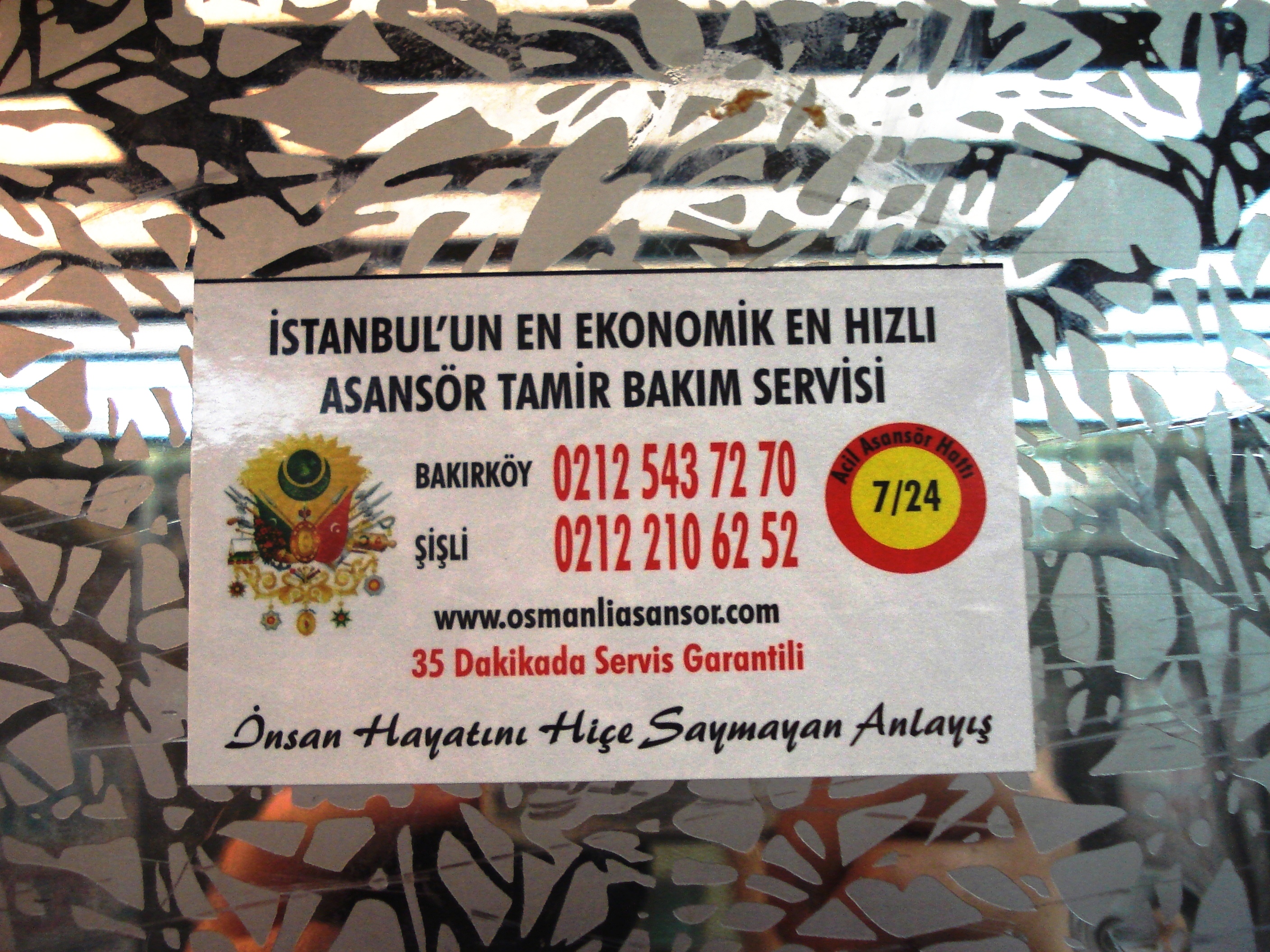


 Turkey Book Talk