The Sultan and the Sultan
November 8, 2017
I’ve written a long-ish article for History Today on historical revisionism in Turkey around the figure of hard-line late Ottoman Sultan Abdülhamid II – who many are keen to imagine as a precursor of President Erdoğan.
Abdülhamid has long been venerated as ‘Ulu Hakan’ (the Supreme Sultan) by conservative ideologues within Turkey, but the reverence has reached fever pitch under Erdoğan. An idealised memory of Abdülhamid, which casts him as the last proudly Islamic Ottoman leader standing up to the West, has become part of the government’s narrative of civilisational ‘restoration’, in which Turkey is once again a great power that shapes history. Abdülhamid is often glorified as a symbolic precursor of Erdoğan – proof that historic forces are at play today. …
When he first became sultan in 1876, Abdülhamid appeared to be an enlightened reformer. He supported the Ottoman constitution, giving the empire its first experience of constitutional democracy. The next year he opened the first session of an elected Ottoman parliament … But the experience of ruling a vast, decaying empire hardened him into an absolutist, and he became convinced that he needed to rule with a stronger hand to protect it from further dismemberment. …
The parallels with Turkey’s current president are obvious. Erdoğan was once lauded in the West as a moderate Muslim reformer, raising the country’s democratic standards and advancing its economy. But his international reputation has since deteriorated badly. Authoritarianism, rent-seeking and demagoguery mark his era. The state administration is subject to the whims of capricious one-man rule. A cult of personality is in full swing, with Erdoğan embodying the frustrations, hopes and grievances of Turkey’s conservative masses, bound by a powerful sense of shared identity. …
Erdoğan’s supporters see the decline in his reputation abroad as part of a dark international plot to halt this forward march. Conspiratorial thinking runs rampant. Orhan Osmanoğlu, a fourth-generation descendent of Abdülhamid, claims that Turkey is today witnessing a ‘repetition of history’: ‘Meddling foreigners now call our president a dictator, just as they used to call Abdülhamid the “Red Sultan.”’ Parliament Speaker İsmail Kahraman compared last year’s coup attempt to the dethroning of Abdülhamid in 1909: ‘They wanted to do the same as they did when they overthrew Abdülhamid, but this time they couldn’t succeed.’
I’ve been meaning to write this article for ages so do go and read the whole thing (there are also some nice visuals).

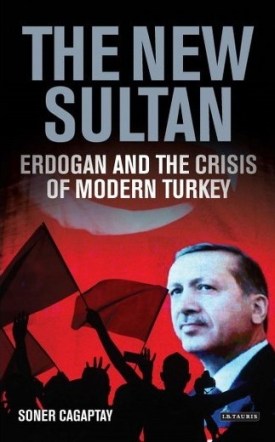
Turkey Book Talk episode #43 – SONER ÇAĞAPTAY on his book “THE NEW SULTAN: ERDOĞAN AND THE CRISIS OF MODERN TURKEY” (IB Tauris).
Download the episode or listen below:
My review of this book is forthcoming in the Times Literary Supplement. Not sure of the publication date so keep your eyes peeled for that.
Subscribe to Turkey Book Talk : iTunes / PodBean / Stitcher / Acast / RSS
*SPECIAL OFFER*
You can support Turkey Book Talk by taking advantage of a 33% discount plus free delivery (cheaper than Amazon) on five different titles, courtesy of Hurst Publishers:
- ‘Jihad and Death: The Global Appeal of Islamic State’ by Olivier Roy
- ‘The Circassian: A Life of Eşref Bey, Late Ottoman Insurgent and Special Agent’ by Benjamin Fortna
- ‘The New Turkey and its Discontents’ by Simon Waldman and Emre Çalışkan
- ‘The Poisoned Well: Empire and its Legacy in the Middle East’ by Roger Hardy
- ‘Out of Nowhere: The Syrian Kurds in Peace and War’ by Michael Gunter
Follow this link to get that discount from Hurst Publishers.
Another way to support the podcast, if you enjoy or benefit from it: Make a donation to Turkey Book Talk via Patreon. Many thanks to current supporters Michelle Zimmer, Steve Bryant, Jan-Markus Vömel, Celia Jocelyn Kerslake, Aaron Ataman and Andrew MacDowall.
Ryan Gingeras on Turkey’s ‘deep state of crisis’
May 19, 2017
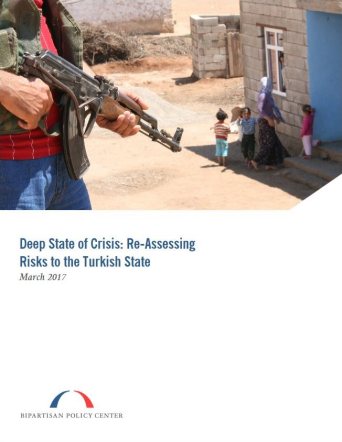
RYAN GINGERAS, associate professor at the Naval Postgraduate School in California, joins Turkey Book Talk once again. This time he is discussing his report, penned for Washington’s Bipartisan Policy Center, “DEEP STATE OF CRISIS: RE-ASSESSING RISKS TO THE TURKISH STATE.”
Download the episode or listen below.
Here’s a link to the PDF of the report we are discussing.
Subscribe to Turkey Book Talk : iTunes / PodBean / Stitcher / Acast / RSS
Ryan previously appeared on the podcast last year to discuss his book “The Fall of the Sultanate: The Great War and the End of the Ottoman Empire, 1908-1922” (Oxford University Press):
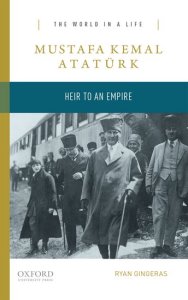
He also joined to discuss his biography of Atatürk: “Mustafa Kemal Atatürk: Heir to an Empire” (Oxford University Press):
*SPECIAL OFFER*
You can support Turkey Book Talk by taking advantage of a 33% discount plus free delivery (cheaper than Amazon) on five different titles, courtesy of Hurst Publishers:
- ‘Jihad and Death: The Global Appeal of Islamic State’ by Olivier Roy
- ‘The Circassian: A Life of Eşref Bey, Late Ottoman Insurgent and Special Agent’ by Benjamin Fortna
- ‘The New Turkey and its Discontents’ by Simon Waldman and Emre Çalışkan
- ‘The Poisoned Well: Empire and its Legacy in the Middle East’ by Roger Hardy
- ‘Out of Nowhere: The Syrian Kurds in Peace and War’ by Michael Gunter
Follow this link to get that discount from Hurst Publishers.
Another way to support the podcast, if you enjoy or benefit from it: Make a donation to Turkey Book Talk via Patreon. Many thanks to current supporters Michelle Zimmer, Steve Bryant, Jan-Markus Vömel, Celia Jocelyn Kerslake and Aaron Ataman.
I’ve written a piece for the New York Times to mark President Erdoğan’s visit to Washington on the blockbuster series “Diriliş: Ertuğrul,” broadcast on Turkish state TV channel TRT.
A few years ago at the height of so-called neo-Ottomanism there were loads of articles published about Turkish TV serials being exported all over the world. It became quite a tired cliche but the popularity of various shows is in fact a good bell-weather for the political mood. And audiences take the messages that these serials pump out seriously. On a visit to Polatlı, a small town outside Ankara a couple of years ago, I vividly remember how a local coffee house arranged its seats in rows at night once a week to screen the latest episode of the ultra-macho action serial “Valley of the Wolves.” In a provincial town with little else to do, it was clearly a major weekly event.
Get a flavour of Diriliş: Ertuğrul by watching the intro:
If you’ve got too much time on your hands you can stream every episode on the TRT website 🍿🍿🍿
If you missed it, here’s an article I wrote about another dubious cultural product: The Erdoğan biopic “Reis” (The Chief), which flopped at box offices in March.
Brand new Turkey Book Talk episode.
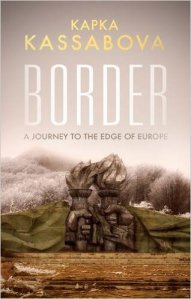
KAPKA KASSABOVA joins the pod to discuss her book “BORDER: A JOURNEY TO THE EDGE OF EUROPE” (Granta), on the troubled past and present of the border between Turkey, Greece and Bulgaria.
Download the episode or listen below.
Listen out for a cameo appearance by my cat at around the 23:09 mark.
Here’s my review of the book at HDN.
Subscribe to Turkey Book Talk : iTunes / PodBean / Stitcher / Acast / RSS
Follow on Facebook or Twitter.
*SPECIAL OFFER*
You can support Turkey Book Talk by taking advantage of a 33% discount plus free delivery (cheaper than Amazon) on five different titles, courtesy of Hurst Publishers:
- ‘Jihad and Death: The Global Appeal of Islamic State’ by Olivier Roy
- ‘The Circassian: A Life of Eşref Bey, Late Ottoman Insurgent and Special Agent’ by Benjamin Fortna
- ‘The New Turkey and its Discontents’ by Simon Waldman and Emre Çalışkan
- ‘The Poisoned Well: Empire and its Legacy in the Middle East’ by Roger Hardy
- ‘Out of Nowhere: The Syrian Kurds in Peace and War’ by Michael Gunter
Follow this link to get that discount from Hurst Publishers.
Another way you can support is by making a donation to Turkey Book Talk via Patreon. Many thanks to current supporters Özlem Beyarslan, Steve Bryant, Celia Jocelyn Kerslake and Aaron Ataman.
Basharat Peer on Turkey, India and ‘the return of strongmen’
March 24, 2017
New Turkey Book Talk episode.
New York Times journalist BASHARAT PEER joins to discuss “A QUESTION OF ORDER: INDIA, TURKEY, AND THE RETURN OF STRONGMEN” (Columbia Global Reports), exploring the parallels between Erdoğan’s Turkey and Narendra Modi’s India.
We spoke about his reporting for the book, modernization and secularism in Turkey and India, and comparisons between the Kashmir and Kurdish issues.
Download the episode or listen below.
Here’s my review of the book at HDN.
Subscribe to Turkey Book Talk : iTunes / PodBean / Stitcher / Acast / RSS
Follow on Facebook or Twitter.

*SPECIAL OFFER*
You can support Turkey Book Talk by taking advantage of a 33% discount plus free delivery (cheaper than Amazon) on five different titles, courtesy of Hurst Publishers:
- ‘Jihad and Death: The Global Appeal of Islamic State’ by Olivier Roy
- ‘The Circassian: A Life of Eşref Bey, Late Ottoman Insurgent and Special Agent’ by Benjamin Fortna
- ‘The New Turkey and its Discontents’ by Simon Waldman and Emre Çalışkan
- ‘The Poisoned Well: Empire and its Legacy in the Middle East’ by Roger Hardy
- ‘Out of Nowhere: The Syrian Kurds in Peace and War’ by Michael Gunter
Follow this link to get that discount from Hurst Publishers.
Finally, if you enjoy or benefit from the podcast and want to support it, make a donation to Turkey Book Talk via Patreon. Many thanks to current supporters Özlem Beyarslan, Steve Bryant, Celia Jocelyn Kerslake and Aaron Ataman.
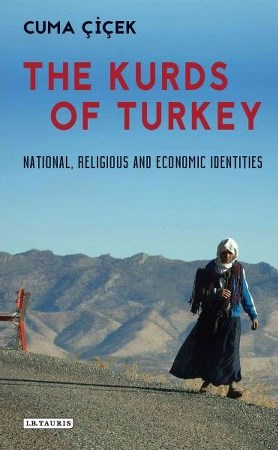
CUMA ÇIÇEK joins to discuss his book “THE KURDS OF TURKEY: NATIONAL, RELIGIOUS AND ECONOMIC IDENTITIES” (IB Tauris).
Download the episode or listen below.
Subscribe to Turkey Book Talk : iTunes / PodBean / Stitcher / Acast / RSS
Follow on Facebook or Twitter.
You may also be interested in an earlier episode with Mustafa Gurbuz discussing his book “Rival Kurdish Movements in Turkey: Transforming Ethnic Conflict” (Amsterdam University Press):
*SPECIAL OFFER* – Turkey Book Talk listeners can get a 33% discount plus free delivery on four titles published by Hurst – “The Circassian: A Life of Eşref Bey, Late Ottoman Insurgent and Special Agent” by Benjamin Fortna, “The New Turkey and its Discontents” by Simon Waldman and Emre Çalışkan, “The Poisoned Well: Empire and its Legacy in the Middle East” by Roger Hardy, and “Out of Nowhere: The Syrian Kurds in Peace and War” by Michael Gunter. Follow this link to get that discount from Hurst Publishers.
Finally, if you enjoy or benefit from the podcast and want to support it, click here to make a donation to Turkey Book Talk via Patreon!
Many thanks to my current supporters Özlem Beyarslan, Steve Bryant, Celia Jocelyn Kerslake and Aaron Ataman.
Mustafa Gurbuz on ‘rival Kurdish movements in Turkey’
March 12, 2016
The latest Turkey Book Talk podcast is with Mustafa Gürbüz, the author of “Rival Kurdish Movements in Turkey: Transforming Ethnic Conflict” (Amsterdam University Press).
Apologies for the delay in dropping this latest pod. I’ve had a technical nightmare.
Download the podcast or listen below.
Subscribe: iTunes / PodBean / Stitcher / Facebook / RSS
Here’s my review of the book at Hürriyet Daily News. Here’s the interview in written form.

Here’s another interview I did with him from last year about his research on the outlawed Kurdish Islamist militant group Hizbullah.
Finally, reposting my recent podcast with Frederike Geerdink discussing the Kurdish issue.
Şakir Dinçşahin on the life and times of Niyazi Berkes, 1908-1988
February 20, 2016
Here’s my conversation with Şakir Dinçşahin about his book on the life and times of Turkish intellectual Niyazi Berkes.
Download the podcast, or listen below:
You can also now subscribe to the Turkey Book Talk podcast on Stitcher. Alternatively subscribe via iTunes or via PodBean.
Here’s my review of “State and Intellectuals: The Life and Times of Niyazi Berkes” (Rowman) at the Hürriyet Daily News.

If the issues discussed are your thing, check out this interview from last year with Andros Lamprou, who wrote an interesting book on the People’s Houses.
Also worth plugging this piece I wrote a couple of years ago on Mahmut Makal and his book “Bizim Köy” (Our Village), on his experiences as a teacher at a Village Institute in the 1940s.
Ryan Gingeras on ‘Atatürk: Heir to an Empire’
January 23, 2016
This week I spoke to author Ryan Gingeras on his new biography of Turkey’s founding father, “Mustafa Kemal Atatürk: Heir to an Empire” (Oxford University Press).
Or just listen here:
Here’s an edited transcript of the interview.
And here’s my review of the book (which is highly recommended).
As I mentioned in the podcast, here’s a link to an interview I did with Ryan last year about another of his books, “Heroin, Organized Crime, and the Making of Modern Turkey.”
Subscribe to the Turkish Book Talk Podcast via PodBean, or via iTunes.
Nilgün Önder on the economic transformation of Turkey since 1980
December 12, 2015
This week’s podcast is with Nilgün Önder of the University of Regina, who joined to discuss her new book “The Economic Transformation of Turkey: Neoliberalism and State Intervention” (IB Tauris).
It’s a great and detailed book on some of the paradoxes of the economic reforms passed after Turkey’s military coup of 1980 – rather than rolling back, the authority of the state was substantially deepened by the reforms.
Download the podcast here. Or listen/subscribe via PodBean.
Here’s a transcript of the interview at Hürriyet Daily News.
And here’s my review of the book.

Subscribe to the Turkey Book Talk podcast via iTunes, PodBean, or Soundcloud.
Thanks for listening!
Lastly, apologies for the dodgy sound quality in these first few podcasts. I’ve got a new mic in the post so that should go some way to sorting it out.
(Some) Turkish newspapers report on the AKP Congress
October 2, 2012
The ruling Justice and Development Party (AKP) held its key congress on Sunday (Sept. 30), the slogan of which was “Büyük Millet, Büyük Güç, Hedef 2023” (Great Nation, Great Strength, Target 2023). Throughout his emotional two-and-a-half hour speech, Prime Minister Recep Tayyip Erdoğan was in full neo-Ottoman mode. He told the 10,000 delegates packed into the Ankara arena that the government was following the same path as Sultan Mehmet II (the conqueror of Constantinople) and Selim I (“The Grim,” who expanded Ottoman territories to the east during the 16th century). He even went so far as to declare – tongue only half in cheek – that the AKP’s new target was 2071, linking the party back to the first Turkish Anatolian state-builders of the 11th century, 2071 being the 1,000th anniversary of Seljuk Turkish leader Alp Arslan’s entry into Anatolia.
It was a speech high in stirring rhetoric. The day after, government supporting newspapers fawned over the “renewal” and “refreshing” emphasis of a new “ustalık” (mastership) era. Daily Sabah focused on what it called the embracing, inclusive nature of Erdoğan’s speech and his words on the Kurdish issue: “Let’s draw a new roadmap together.” Zaman’s front page headline enthusiastically quoted a line from Erdoğan’s speech: “Come, let’s open a new page, let’s say ‘no to terror.’”

The contentious presence of Iraqi Kurdistan Regional leader Massoud Barzani at the congress was rather less trumpeted by Sabah and Zaman. He even gave a speech to the delegates, but the announcer in the arena refrained from using the word “Kurdistan” when introducing him. Indeed, rather than Barzani, it was Erdoğan’s words on the Kurds that received most attention in the pro-government press. This reminded me of one of Nuray Mert’s recent columns in the Hürriyet Daily News:
“The idea of the Ottoman Empire has induced a nostalgic longing for the days when Turkish sultans ruled diverse people in vast lands. For Ottomanists, the idea of the Ottoman Empire as a multi-ethnic haven for diverse cultures and populations is rather misleading, since the basic idea has always been to recall the times when diverse populations lived under ‘Turkish rule.’”
The conspicuously Islamic nature of the congress was also much discussed in the Turkish press – both by those approving and those dissenting. Beside its headline declaring “Great Strength Manifesto,” Islamist daily Yeni Şafak featured an admiring front page box quoting Hamas leader Khaled Meshaal, controversially (or perhaps not) invited to speak at the event: “‘You are not just the leader of Turkey, but also the leader of the Islamic world,’ Meshaal said, receiving extended applause from the crowd.” Indeed, when announced to the audience Mashaal received some of the loudest cheers of the day, (the EU dignitary who was introduced after him didn’t stand a chance!)
Liberal daily Taraf agreed that the congress constituted a Turkish-Islamic “minifesto,” but struck a rather more sceptical tone: “There was a strong Turkish and Muslim emphasis, a mouse with its face turned to the East was born,” (in Turkish, “a mouse was born” means that something underwhelming took place). The paper also noted plaintively that Erdoğan had failed to mention the European Union even once during his speech.
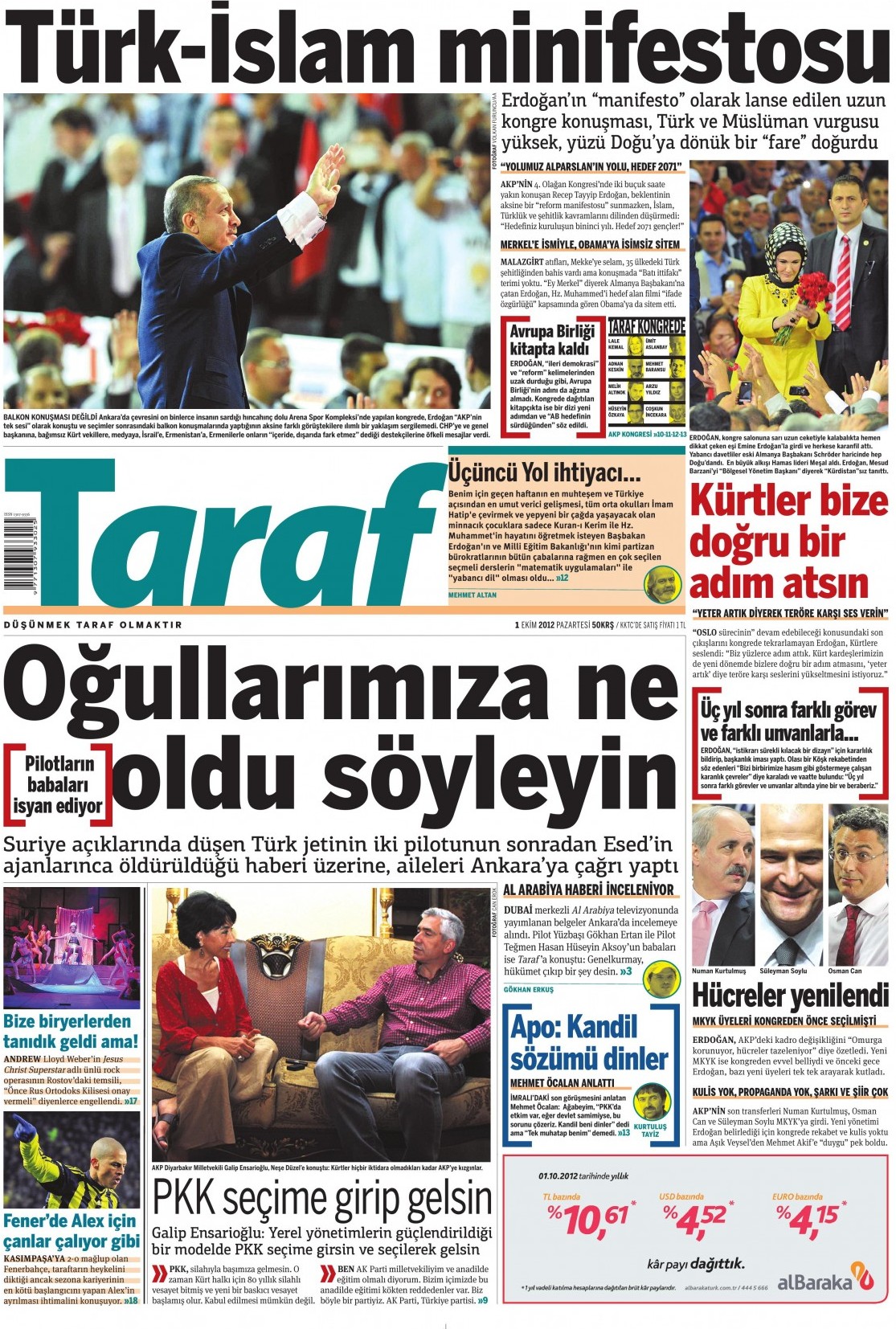
Meanwhile, seven national newspapers were refused accreditation to attend: Cumhuriyet, Sözcü, Evrensel, Birgün, Aydınlık, Yeniçağ, and Özgür Gündem. These publications have diverse sympathies: from left to right wing, from Turkish to Kurdish nationalism. The only thing shared by all is antipathy towards the government.
In response, Monday’s Cumhuriyet included a front page editorial titled “From Cumhuriyet to Public Opinion,” which said some unsurprisingly harsh things:
“Established six months after the founding of the Turkish Republic, our newspaper has been published for 88 years. During periods in the past when democracy has been suspended by the ruling powers our newspaper has been closed down, but outside of this we have always published under the principles of freedom of the press, in the name of people’s right to know. In 21st century Turkey, our newspaper is now exposed to censorship by the ruling powers.
“We will not stay quiet in the face of the anti-democratic implementations applied against us that violate both the constitution and the law.”
The piece went on to detail two constitutional and legal articles that it alleges the congress ban violated: Article no. 69 of the Turkish constitution, which states that internal political party activities, arrangements, and workings must not run counter to the principles of democracy; and Article no. 93 of the Law on Political Parties, which states that decisions taken and actions performed by party central administrations and affiliated groups must not run counter to the principles of democracy.
The International Press Institute’s Turkish National Committee issued a statement about the issue on the day of the AKP Congress, on behalf of the Freedom for Journalists Platform, an umbrella group representing local and national media organisations in Turkey:
“The news that reporters and journalists from some press organs are not allowed to enter the AK Party’s Congress is very worrying.
“Monitoring this historical event of the ruling government party on the spot and transferring it to its readers and viewers are primary duties of news media.
“We have previously protested the accreditation limitations at other institutions. But now, it is very disappointing that the same accreditation is being applied by a political party whose existence depends on democracy.”


