[I’ve started writing book reviews for the Hürriyet Daily News blog. I’ll be able to post them here a couple of weeks after they first appear on there (contractual yawn). This one went up on May 5, and can be found in original form here: http://www.hurriyetdailynews.com/literary-reflections-on-the-armenian-issue.aspx?pageID=500&eid=16]
Ece Temelkuran – Deep Mountain: Across the Turkish-Armenian Divide, Verso, 2010, 288pp
Fethiye Çetin – My Grandmother, Verso, 2008, 144pp
There’s a book, quite easily found in any reasonably-sized Istanbul bookshop, its name written in block capitals along the spine: ‘Ermeni Dosyası’ (The Armenian Dossier). Written by former Turkish diplomat Kamuran Gurun, and ominously subtitled ‘The Myth of Innocence Exposed’, it has been popular amongst Turkish readers ever since first being published in1983. Packed with imposing-looking graphs and statistics, its main thesis can be summarised thus: The numbers claimed by the Armenians as killed in the ‘events’ of 1915 is far too high and, in fact, Ottoman soldiers were themselves also killed in large numbers at the same time. In any case, the Armenian population was far from innocent, with large numbers rebelling against the empire and often colluding with the advancing Russian forces on the eastern Anatolian frontier. Essentially, the book implies, the Armenians got what they had coming to them. If you’re interested, a new English-language print run of the book came out only two months ago. I haven’t read it, nor do I ever intend to make that sacrifice, but – however questionable its scholarship – ‘The Armenian Dossier’ is unquestionably significant, if only because it represents what has been the official Turkish narrative for almost 100 years.
Encouragingly however, this isn’t the only story on the shelves any more. While they still may not attract the sales figures of more flattering histories, voices dissenting from the official line are being increasingly heard in today’s Turkey. Ece Temelkuran was once a columnist with daily newspaper Habertürk (ironically enough one of the mouthpieces of the nationalist establishment) and her ‘Deep Mountain’, published in English in 2010, is part of this new, questioning tendency.

Temelkuran set herself the ostensibly simple task of meeting Armenians, talking to them, listening to them, and reporting back for the Turkish audience. Eschewing the directly political, she preferred ‘to write about Armenians, not necessarily what happened in 1915’, and while this may seem like a modest undertaking to an outsider, in Turkey it was a brave and taboo-shaking exercise. Quite how perilous the path was can be judgedfrom the example ofthe Turkish-Armenian journalist Hrant Dink, to whom Temelkuran dedicates the book. Dink decried the politics of megaphone slogans and foreign parliamentary writs on the issue, and instead spent years trying to get the two sides talking to each other honestly about their shared history and common trauma. He was assassinated for his troubles in 2007 by an ultra-nationalist Turkish gang, outside the Istanbul office of his newspaper. Dink’s killing could have acted as either a spur to writing, or a warning against it, so – first and foremost – ‘Deep Mountain’ should be applauded as an act of bravery.
The book is divided into three parts, the first detailing Temelkuran’s encounters with the Armenians of Armenia itself, and the other two her meetings with the Armenian Diaspora communities in Franceand the United States. The picture painted of Armenian capital Yerevan is of a cultured but impoverished city of feeble opportunities and feeble ambitions, still yet to recover from the end of the Soviet Union and now crippled by the closed (since 1993) border with Turkey. Whilst bitter enmity for Turks exists, the Armenian Armenians are perhaps most concerned with the practical matter of getting the border open again, and with it securing an economic lifeline. The French and American Armenians, however, have come to adopt the genocide as the essential, irreducible feature of what it means to be ‘Armenian’. Meeting numerous community leaders, academics, artists, and businesspeople, Temelkuran describes the trajectory that emerges again and again in the Diaspora: How the first generation of Armenian migrants to Europe and America were most concerned with ‘getting on’ and fitting into the adopted culture, and how it is only with the second and third generation – threatened by the identity-engulfing vortex of a new homeland – that the genocide has been revisited and latched on to as an unshakable, almost pathological core.
As one of the Los Angeles Armenians revealingly says: ‘you need to create an identity, something to hold on to both culturally and individually. Turkey’s refusal to recognise the genocide is what binds those of us in the Diaspora. Were the genocide to be recognized, it would probably be the end of us’. Pain has become ‘the pillar propping up the home’, and to release that pillar means oblivion. Similarly, many Turks – afraid of losing their country and seeing recognition as threatening their own oblivion – cling just as fast to their own selective amnesia. In a striking phrase, the author at one point describes it as a ‘huge industry. Not just politics and money; a psychological industry too, for both sides. An industry of anguish’. The most sympathetic portraits in the book are thus reserved for those who are able to understand this identity paralysis and rise above such acrimony, recognising the absurdity of an official political ‘debate’ that doesn’t go much deeper than one side screaming ‘It was genocide!’ while the other responds ‘No it wasn’t!’
Perhaps inevitably, the book occasionally lapses into worthiness,though not nearly as often as you fear when you read the following meaningless fluff early on: ‘If an Armenian were to lose their way one day anywhere in the world, they’d be able to locate the capital of Armenia by consulting the map of their heart. They would navigate toward it by reference to the coordinates of pride and fear, of mourning and loss’. Worse, when she moves on to Los Angeles, Temelkuran can’t help butoffer a steady stream of unhelpful anti-American swipes. These come off as stale, predictable, and not a little immature (constant sneering about cigars and McDonalds, really?!) But these are minor criticisms, and should not detract from the more important qualities of a book that is sensitive, honest and ‘engaged’ in the best sense of the word.
Another modern voice with little time for the official Turkish narrative is Fethiye Çetin, a human rights lawyer currently representing the deceased’s family in the grimly ongoing Hrant Dink case. Çetin spent her whole youth believing she was of ‘pure’ Turkish stock, until one day her aging grandmother, Seher, took her aside. Seher revealed that she had been born an Armenian Christian, originally named Heranuş, and was plucked from a death march in 1915 by a Turkish gendarme commander, who went on to raise her with his wife as a Muslim Turk. Translated into English in 2008, ‘My Grandmother’ is Çetin’s elegiac description of this story.

The first section of the book contents itself with gentle, sepia-tinged descriptions of a rural upbringing with her family in the eastern Turkish province of Elazığ: her beautiful sisters; her grandfather, whose mood always depended on how full his stomach was; her grandmother, the charismatic matriarch of the family, powerful but taciturn, somehow never able to bring herself to sing, as if always harbouring the secret that would one day be revealed to Fethiye. The central revelation doesn’t come until midway through the book, but when it does Çetin writes that what she heard ‘did not fit with anything I knew. It turned the known world on its head, smashing my values into a thousand pieces’. Seher, or Heranuş, was one of the kılıç artığı, the ‘leftovers of the sword’ of that traumatic period; only one of her sisters was also spared, while the rest of the family – including uncles, aunts, cousins, and her mother – was killed. The second part of the novel consists of Çetin trying to digest this heritage, and also trying to forge a reunion of the two sides of a family which now – like so many Armenian families – is ‘scattered like pomegranate seeds’ across the world.
It’s a quietly powerful book, modest but courageous. There are no unnecessary fireworks or forced emotions. In a way, it could be seen as a manifestation of the very thing Temelkuran advocates in ‘Deep Mountain’, a kind of picking up of the baton. There’s little in the way of direct politics and no recriminations: I don’t think the word ‘genocide’ is mentioned once in the entire book (and that’s not because of Turkish laws against these things). It’s simply a human story, told in an unshowy, humane way.
Both Temelkuran and Çetin manage to address the vexed Armenian issue with admirable clarity, concerning themselves with the personal and the human as a kind of riposte to the debilitating rancour of the official, political dispute. Both try to chart a precipitous course between two entrenched sides that long ago stopped listening to each another; neither condemn anything other than this wilful deafness. In the years to come, one can only hope there are more books published like these two, and less like ‘The Armenian Dossier’.
Travel notes – Mardin
January 21, 2012
You can make out Mardin from far away on the long western approach road, perched as it is on top of a mountain overlooking the Mesopotamian plains. As you get closer the box-like homes become clearer, nestled alongside the pencil-like minarets, towers, and domes, all built of the same pale honey-coloured limestone. It’s a striking, eerily timeless-looking place, but look out to your left and the present comes crashing back into view. Carved ominously into the soil of a smaller hill just outside the town are large white capitals, clearly spelt out for all comers to see, “Ne Mutlu Türküm Diyene” (How Happy to Call Yourself a Turk): a warm welcome from the Turkish military. The dolmuş I was travelling in passed countless army barracks and check points, and we were stopped twice by gendarmes asking for identity papers. A castle, originally Roman, sits on top of the mountain above the town, but whilst most Turkish towns make a landmark of their castle – charging a couple of lira for what is invariably the most spectacular view of a place – Mardin’s castle is absolutely closed. The Turkish army are its current occupants, the latest in a long line trying to establish hegemony in this ancient spot.
Close to the Syrian and Iraqi borders, the area has been a complex mixture of Arabs and Kurds for millennia, and during the 1980s and 1990s it was one of the hottest in the conflict between the Turkish government and the Kurdish rebel group, the PKK. It is also known as the Tur Abdin (“Servants’ Plateau”) plain, the historic motherland of the Syriac people of south-east Anatolia. Syriac Christians have lived in Tur Abdin for 1600 years, originally retreating there to escape Byzantine persecution. They were thus able to maintain their ancient liturgies, still performed in Aramaic (the language Christ would have spoken), and the nearby 5th century monastery of Deyr ul-Zafaran (“Monastery of Saffron”) remained the spiritual centre and seat of the patriarch of the Syriac Orthodox Church until 1932. The 20th century, however, proved to be the most cataclysmic in their history, when the Syriacs became one of the less remembered casualties of the upheavals that erupted in eastern Anatolia at the end of the Ottoman Empire. From 200,000 Anatolian Syriacs in the 19th century, their numbers fell to around 70,000 by 1920. A significant portion of those remaining left the area during the unrest of the 1980s and 1990s, caught in the crossfire between the Turkish government and the PKK. Today the community numbers no more than a few thousand. The landscape is thus scattered with decaying monasteries and deserted villages, and – like most towns in these parts – Mardin is also still home to the obligatory, rotting, untrumpeted Armenian church.
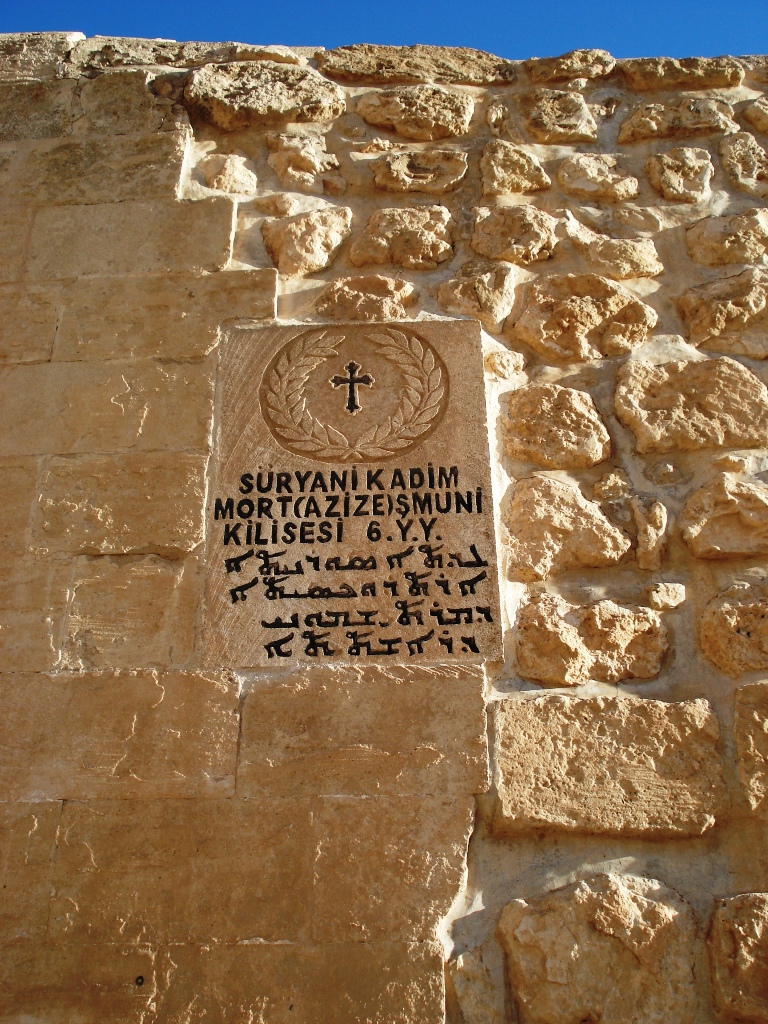
The municipality’s official tourist leaflet carries the headline: “Mardin: where the call to prayer echoes within the sound of church bells.” It’s a nice line, but the only church bell still ringing in the town is that of the 15th century Kırklar Kilisesi, or “The Church of the 40 Martyrs”, and a rusty old bell it was too. A caretaker called Musa rings it to announce prayers at regular intervals throughout the day, and potters around to keep an eye on things and answer questions whilst it’s open to visitors. Of the eleven churches still standing in Mardin, the Kırklar Kilisesi is the only one still open for services, and Musa told me that church numbers have been steadily dwindling, “definitely down from 10 years ago.” The flock now totals “about 80 families, around 400 people.” During my visit a family of three wandered in to the church. The father told me they lived in northern Syria, and that they were in Mardin as tourists, searching for the old family home that had been deserted a hundred years ago “because there was big problem.” Musa himself was of an extremely morose disposition, hardly able to look such comers and goers in the eye, but occasionally bursting out in fits of uncontrollable hysterics. There is in fact an uneasy coyness about most of the Syriacs I met. Put it down to an over-active imagination, but I couldn’t help wondering if it was the weight of such a tormented history weighing down upon them. Amongst all the dry facts and figures recounting seismic demographic change, it’s perhaps easier to ignore the mental effects wrought on those left behind than the physical.
Even one so well travelled as British historian Arnold Toynbee described Mardin in the 1920s as “the most beautiful town in the world,” Indeed, it has been experiencing something like a touristic renaissance more recently, with the (relatively) improved stability of the area helping to stimulate a renewed interest from visitors, mostly Turkish. A florescence of newly renovated boutique hotels can be found tucked away down the rabbit-warren backstreets that tumble down from the main central street. During my visit I stayed in the splendid “Kasrı Abbas”, converted from a large old mansion on the hillside: rooms with ornate carvings and multi-domed roofs opening onto wide open courtyards, offering panoramic views across Mesopotamia to the Syrian border. The backstreets themselves have similarly benefited from the rejuvenation, impossibly evocative and seemingly untouched for hundreds of years (despite their deliberate tidying up). It all feels slightly uncomfortable though, as if many things remain unsaid, much still remains unconfronted. The number of tourists will doubtless continue to rise, but they will probably be condemned to look at dead relics, unresurrectable remnants. Daily Radikal carried a front page story earlier this month about an apparent “return of the Syriacs”, reporting that a number of the families who migrated from Tur Abdin since the 1980s have returned. But the evidence looks pretty slender to me. It seems more than doubtful that anything like a return to the same number as previously lived in the area could ever be possible. The ties have been irreversibly cut.

Mardin perhaps bears comparison with another ancient and contested site, Jerusalem. But whilst I expect Jerusalem would confound because of the sheer intractability of its present day conflicts, Mardin does so because of precisely the opposite. Here, perhaps more than anywhere else in Turkey, (and that’s saying something), one gets the crushing, debilitating impression of lost, dead history. But although dead, it’s history that casts a long shadow. Unlike the myriad remnants of ancient civilisations across Anatolia, Mardin’s sense of lost history is of critical importance to the present: it paints the present day into a corner. You feel that the past has been forcibly forgotten, ignored, at most whispered about uncomfortably. It’s as if a door has slammed shut, but is still creaking uneasily. It all leaves quite an impression, but not a particularly pleasant one.
Travel notes – Ayvalık
November 3, 2011
[Published by Today’s Zaman (28th Nov 2011): http://www.todayszaman.com/news-264185-a-town-attesting-to-history-along-the-aegean-ayvalik.html]
Not many trips can be traced back to the reading of one book, but that is the case with my recent hop down the Aegean coast of Turkey. I’ve always taken a passive interest in the near-history of this part of the world, and upon reading Bruce Clark’s Twice a Stranger – a fine account of the human effects of the Greek-Turkish population exchanges of the 1920s – I couldn’t resist visiting some of the areas described. Whilst one book inspired me to embark on the trip, one was also nearly responsible for making me pack up my bags to return home. I was accompanied most of the way by Robert Byron’s thrilling The Road to Oxiana, in which he describes marauding around the Persia and Afghanistan of the 1930s: wild horse chases across the central Asian steppe, the discovery of little-known ancient architectural treasures, dodging the Persian secret police, dysentry – it all rather put me to shame. Whilst I had nothing to rival these adventures, described below are my own peregrinations around a different, no less fascinating part of the world.
I arrived in Ayvalık exhausted after a day-long bus journey from Istanbul, which included an unexpected ferry crossing of a choppy Marmara Sea. The town is situated on the craggy north-western Aegean coast of Turkey, and for hundreds of years it was overwhelmingly home to Greeks, at the time subjects of the Ottoman Empire. After the First World War, the Greek armed forces used this western coast – with Izmir as unofficial capital – as a base to push as far into Asia Minor as possible. The reconquest by Turkish national resistance forces became one of the central, triumphant narratives of the Turkish War of Independence, and after the declaration of the Turkish Republic in 1923 the Greeks of Turkey and the Turks of Greece were swapped wholesale and sent to their ‘natural’ homelands. In Ayvalık, the entire Greek population was resettled on the nearby Greek island of Lesvos, and the many Turks of Lesvos went in the opposite direction. I have fond memories of childhood holidays in the small towns of Petra and Mytilene on Lesvos, which were favourite summer spots of my family. Of course, I knew little of this turbulent history at the time; all I really remember is the faint outline of the Anatolian coast high above the horizon on clear days, and the Sunday afternoon military parades on the waterfront, which I now realize carried far more significance than I could have understood then.
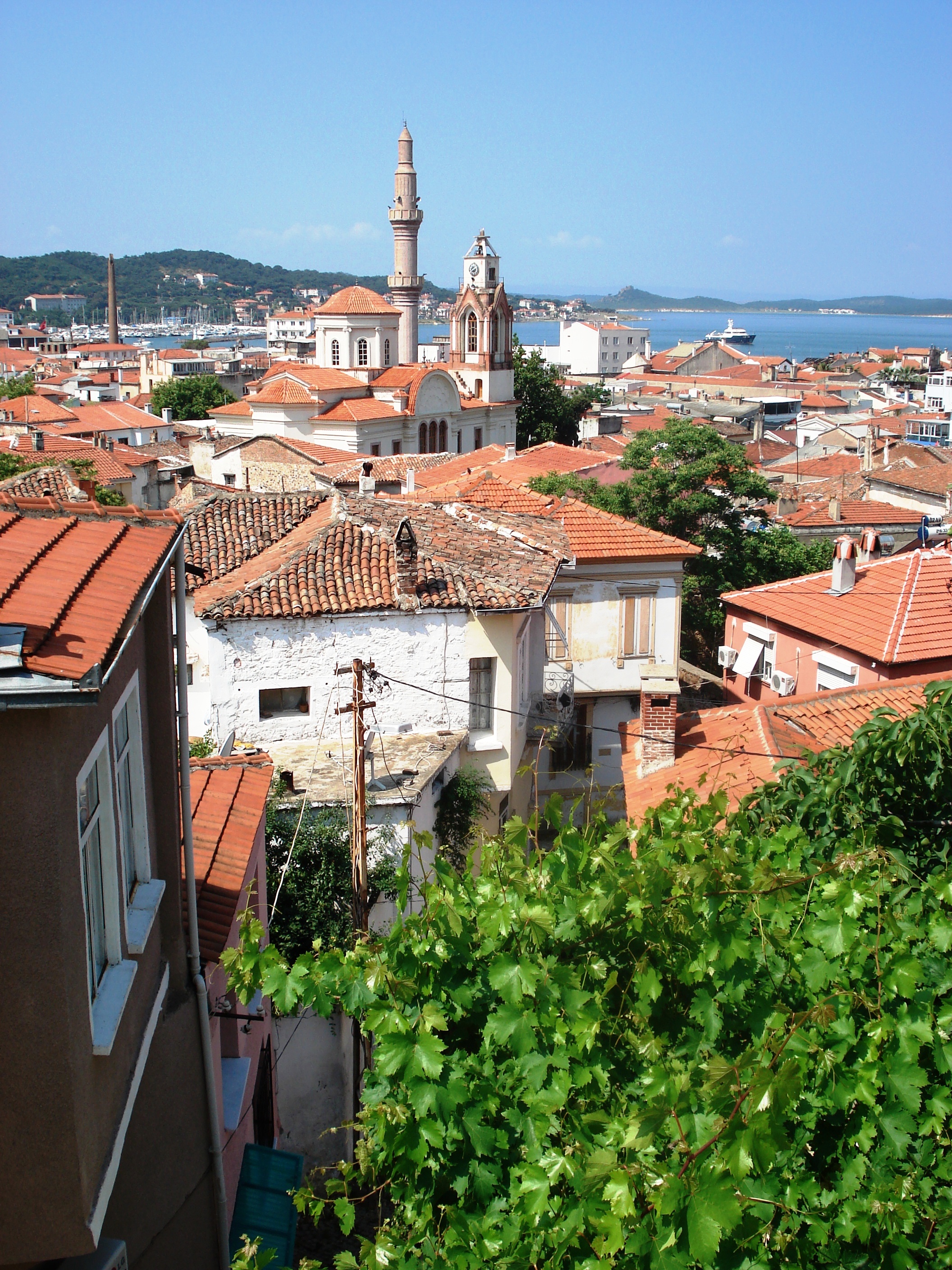
Two large mosques command Ayvalık, and – despite the minarets that have been put up alongside them – it’s impossible not to recognise them as Orthodox churches, as indeed they were originally intended. When the Greeks disappeared and the Turkish population swelled it was decided to simply convert these two churches (and many elsewhere) into mosques, like miniature Hagia Sophias. From the inside it’s difficult to imagine the now whitewashed walls covered in iconography, but from the outside (aside from the minaret) they obviously follow all the typical architectural conventions of a large Greek Orthodox church. They’re a magnificent sight, silently commanding the town, unavoidable once you rise to any kind of elevation. Evidence of Greek heritage is hard to miss elsewhere too, and most immediately obvious in the enigmatic backstreets behind the harbour. Roads evidently not designed for the modern vehicle wind past old wooden houses in various stages of disrepair. At night
they become even more deserted than in the day, and seem to suggest even more
secrets. Occasionally you come across a house with carved Greek lettering dating back to the 19th century, as often as not practically caving in on itself. Life goes on furtively above your head: muffled sounds behind open windows and closed curtains, from protruding bay windows that lean out and seem to touch each other across the street.
The island of Cunda is a siren call audible from the Ayvalık waterfront, and I yielded to it, postponing my onward journey by a day. Cunda has a refined air about it: the harbour is smarter than Ayvalık’s, people give the impression of being even more horizontally relaxed. On arrival I followed the instinct that I always try to satisfy upon landing on a new island: walk back and upwards as high as possible to get an idea of the place from above. Following the winding old streets, I came across the derelict old Greek cathedral on the hillside, forgotten in a kind of scrubland, unused for almost a century. Disappointingly, (but unsurprisingly), I couldn’t get in as I’d hoped, but I did manage to peer inside through the now-empty windows. It’s been so badly damaged over time – by earthquakes and neglect – that it now looks as though the whole thing is only held up by the wood scaffolding that now fills the interior: to what end one can only guess. Nearby, another old church has almost entirely collapsed into rubble, only a crumbling apse remaining – battered and open to the elements, apparently waiting to be put out of its misery. I left it forgotten and forlorn, and climbed the rest of the short way up to the top, from which, looking west, I could make out the faint outline of Lesvos.

One of the paradoxes in this corner of the world is the contrast between its surface picturesqueness and its bloody, conflicted history. The residue of the latter is evident in the thundering nationalism of the politics, a taste of which I got as I was waiting to catch the boat to take me back from Cunda to Ayvalık. It was late afternoon and I was sitting in a café by the harbour, when a loud and apparently stirring recording of the Istiklal Marşı (the Turkish national anthem) struck up entirely unannounced from somewhere nearby. Exactly who was playing it, and why, I’ve no idea, but those around me weren’t splitting any hairs. All conversation immediately stopped; I looked around and within seconds only one person (apart from me) wasn’t standing silently, hand clutching breast, eyes staring grimly into the middle distance. I thought this lone sitter must have been a Greek, but he spotted me from across the restaurant and gestured for me to stand and do the same as everyone else: puzzling as he himself remained sitting. When it had finished everybody sat back down and returned to their tea or games of tavla; I looked back and realised that the only reason the man hadn’t stood was because he was disabled.
Cunda is about as secular as you get in Turkey (the two churches here weren’t even converted symbolically – just left to go to seed), the call to prayer from the single, isolated, mosque on the peninsula doesn’t even make it to the harbour. If you measure by the nauseatingly quaint image of old men playing tavla outside backstreet tea houses, or the loquacious women holding court on the steps in front of their houses, the Greeks and Turks on either side of the Aegean are irrefutably similar. The Turks of the Aegean wave the flag as enthusiastically as anywhere, and whilst elsewhere in Turkey these days you can easily forget that the Greeks were once bitter enemies, (there are others to point the finger at now), here the older enmity is still tangible – the narcissism of small differences.
Gentrification in Tarlabaşı, Istanbul
September 28, 2011
The noise of Tarlabaşı never stops. Street cats cry incessantly during the day and fight each other at night; street hawkers struggle with creaky wooden carts around the winding alleyways, crying out their wares of breakfast poğaças or carrying wooden boards full of fresh simits on their head; housewives call out of windows to the nearest greengrocer and lower baskets on string for goods, in summer groups of them in floral headscarves sit out all day gossiping on the pavement; children don’t sleep until the early hours, screaming as they play hop-scotch or kick footballs around; during Ramadan traditional drummers and singers pass every building, waking everyone up to break the fast before sunrise; for me, the chaotic street market each Sunday is one of the most colourful parades of human activity Istanbul has to offer. Taksim Square – with its shiny malls, modern cinemas, and thronging restaurants and bars – is considered the commercial and cultural “heart” of the city, but it takes just two minutes to pass down from the smart pedestrian boulevard of Istiklal Caddesi, cross the six-lane duel-carriageway Tarlabaşı Boulevard, and arrive in the impoverished backstreets of Tarlabaşı itself. In two minutes it feels like you’ve crossed into a different world. With the Turkish economy booming and Istanbul developing at such a rapid pace, it’s a world coming under serious threat.
Tracing the history of Tarlabaşı illustrates the fluctuating fortunes of Istanbul’s minorities over the past 200 years. Situated on the European side of the city, across the Golden Horn from the old town, the area was originally home to prosperous non-Muslims. The sturdy stone houses were built for Greeks and Armenians – lower-middle class artisans, small tradesmen, and merchants – whose economic prospects waxed even as the Ottoman Empire’s waned over the course of the nineteenth century. Istanbul’s Armenians were largely untouched by the tragedy engulfing their eastern Anatolian kin during the First World War, and its Greeks were exempt from the wholesale population exchanges that took place between the states of Greece and Turkey during the 1920s, but the situation of minorities became increasingly precarious during the republican years of the twentieth century. Official discouragement found expression in the punitive “Varlık Vergisi” (Wealth Tax) aimed at Turkey’s minority groups in 1942, and in the 1950s pogroms were organised against the Greeks of Istanbul, after which the vast majority moved swiftly away. Many of Tarlabaşı’s grand buildings were left empty and unaccounted for, and an area that was already going to seed went into accelerated decline. At the same time, rapid industrialization meant that significant numbers of Turks were moving into urban areas, and many found homes in the unoccupied but decaying townhouses of Tarlabaşı. In 1990, further waves of migration took place, this time of Kurds from eastern Anatolia – fleeing economic deprivation and the intensifying civil war in Turkey’s south-east. Thus, right in the centre of Istanbul, something of the atmosphere of an Anatolian village has been recreated in Tarlabaşı. But that isn’t the whole of it – alongside Kurdish migrants can be found Arab and African refugees, Roma (gypsies), Zaza-speaking Kurds, itinerant foreign language teachers living on the cheap, and even pockets of transsexuals (many of whom ply a trade in the seedy brothels along Tarlabaşı Boulevard). At a time when most of Turkey has become a state-sponsored monoculture, Tarlabaşı seems to reclaim something of the anarchically multicultural heritage of Anatolia.
“Gentrification” has taken place in all major cities striving to modernise, (it seems as inevitable as the carbon-copy Starbucks cafes popping up everywhere), and it’s already happened in many areas of Istanbul. Hard to believe now, but thirty years ago Istiklal Caddesi itself was a down-at-heel backwater; only relatively recently has it been pedestrianised, tidied up, reintroduced to its picturesque “nostalgic” tram line, and lined with the gleaming chain stores. There have been murmurings of tension in nearby Tophane, where the traditional inhabitants find themselves surrounded by growing numbers of small art gallerys, boutiques, and fashionable bars. Cihangir, on the opposite side of Istiklal, has become a chic enclave for expats and young professionals. Such examples follow a more typical, ‘organic’ process of gentrification; that planned for Tarlabaşı, however, is exactly that – planned. In 2005, an ‘Urban Renewal Act’ (Law 5366) passed through the Turkish parliament authorizing municipalities to work with private building companies to ‘regenerate’ areas of Istanbul. The historic Roma district of Sulukule, also on the European side, was one of the first declared an ‘Urban Renewal Area’. Eventually almost 1000 families were evicted from their homes and given new – unaffordable for most – apartments 45km away. The majority of these people have since become homeless and the area’s historic fabric has been ripped out, gradually replaced by more faceless modern apartment blocks. In 2006 Tarlabaşı was also chosen as a renewal area, and the contract for the project was awarded to GAP Inşaat, a subsidiary of Çalık Holding, the CEO of which is the son-in-law of the Turkish Prime Minister. Plans were soon released for the redevelopment of a 20,000 m2 area, a total of nine “building islands”. The website for the project (www.tarlabasiyenileniyor.com) is full of “before” and “after” pictures: photos of out-at-elbows back streets teeming with scruffy children and shady-looking men (the present Tarlabaşı), are contrasted with digitally-generated images of urbane, be-suited couples strolling down spotless, wholesome avenues (the projected Tarlabaşı). It must all look rather seductive to the prospective flat-buyer, but two major concerns persist: will the area’s historical character be preserved? and – perhaps more pressingly – will current residents go the way of Sulukule’s?
Tarlabaşı is an incredibly charismatic place. Its buildings are unique examples of late nineteenth century Ottoman Levantine architecture, elegant four and five storey stone townhouses with slim bay windows jutting out above the street. Clearly most haven’t been touched since being built – the majority are filthy, stained black with dirt, and some are now nothing more than shells, thick carpets of weeds and stumps of struggling trees behind a crumbling façade. Sanitary conditions in many places are primitive. It’s obvious that the area desperately needs improvement, but GAP Inşaat’s project goes beyond simple renovation, to what looks like a radical reimagining of the entire area’s fabric. A four-storey underground car park is planned, and whilst the developers insist that most buildings will be preserved, questions remain about what form this preservation will take. Many fear that Tarlabaşı’s unique historical character will be irredeemably destroyed by the changes. Mücella Yapıcı, from the Union of Chambers of Turkish Engineers and Architects, claims that “the cultural and historical heritages of Tarlabaşı are going to be sacrificed to financial benefits of some people or companies.” Appeals have been made to UNESCO and the European Court of Human Rights, but look unlikely to halt developments that are, ultimately, in the hands of the elected municipality. Whatever happens, current residents will undoubtedly be priced out by the new plans. In August 2010 the holding company claimed that agreements for purchase had been reached with 70% of the owners of houses in the area, and that apartments are being offered in a brand new suburban development to those evicted from Tarlabaşı. This development is almost two hours away by public transport in a little–known satellite city, Kayabaşı. Aside from the cultural jolt of having to move from Tarlabaşı to alien high-rise apartment blocks, miles away from where some have worked for years, it’s unlikely that many could afford the 1000TL upfront price and 309TL monthly mortgage payments for the cheapest apartments anyway, (let alone commuter costs).
It’s easy to sentimentalise from a distance. The fact is that amongst Istanbullus, Tarlabaşı is a no-go area, notorious for crime, poverty, violence, illiteracy, and overcrowding. At night the women leave their spots on the pavement and organized gangs move in. These problems won’t be solved by the municipality’s plans, but they will be moved elsewhere, which is probably what is wanted. My neighbour, Ozan, has lived with his family in the same building (which he owns) for 40 years and is under no illusions, “you have to be careful,” he says, “there are thieves all around here at night, life isn’t perfect.” But he’s tied to the area, working twelve hours a day, six days a week in a cheap restaurant just a five minute walk away, “our life is here, where else could we go?” Many people have already left, and a lot of the seedy bars, shops and brothels along Tarlabaşı Bulvarı have already closed down, making it look even more forlorn than before. Significant numbers have decided to stay on anyway, despite their houses being sold and expropriation procedures being threatened. The municipality has given no clear updates since last year, and a project that was due to be completed in 2010 rolls on without any end in sight. Threat of eviction hangs over the area like the sword of Damocles, but right now it’s difficult to see how it could be entirely vacated without the use of force, as – make no mistake – Tarlabaşı still teems. I’ve lived there for over a year, and if anything the population has increased in that time. I write this on a sultry weekday afternoon and the street outside my flat is as raucous as it has ever been. As Ozan says simply: “we don’t want to go anywhere.” Whether they want to or not, the decision may well be out of their hands, but – for the time being at least – Tarlabaşı remains stubbornly defiant.


 Turkey Book Talk