The rise of political Islam in Turkey
March 7, 2015
My review/interview double-header this week was based on “The Rise of Political Islam in Turkey: Urban Poverty, Grassroots Activism and Islamic Fundamentalism” by Kayhan Delibaş, who works at Kent University and Turkey’s Adnan Menderes University.
The book is well worth reading for anyone looking for a deeper look into the political context of the emergence of Islamist parties in Turkey in the 1980s and 1990s. While it’s true that political Islam is an intrinsically transnational phenomenon, it’s always worth remembering the specific conditions that have facilitated it’s emergence, which of course differ everywhere.
Here’s my review of the book in the Hurriyet Daily News.
And here’s my conversation with its author Kayhan Delibaş.

The Turkish gov’t takes on the foreign media
December 10, 2014
I’ve written a piece for Foreign Policy on the deterioration of the Turkish government’s image in the international media, and Turkey’s aggressive response:
The foreign media image of President Recep Tayyip Erdoğan and the Turkish government has shattered over the past 18 months, and in response Turkey has ramped up an international information blitzkrieg.
The tone is becoming increasingly bitter, motivated by a conviction that the foreign media is a propaganda weapon deployed by the West to attack the ruling Justice and Development Party (AKP). Patriotic Turks are called on to rally behind their government in the name of national sovereignty.
This sense of embattled defiance is important to understand, and reveals much about the resentful mindset gripping the state. Suspicion about the foreign press is hardly new in Turkey, but it’s unfortunate to see the worst of such sentiments returning – openly sponsored by Erdoğan and the AKP’s top brass. The president himself is even managing to turn international criticism to his own advantage, as evidence that the West is implacably hostile to Turkey and its fearless, truth-telling leader — a useful populist line ahead of next June’s crucial parliamentary elections.
Read the full article here.
‘Pan-Islamist PM Davutoğlu’ thesis ruffling feathers
September 3, 2014
Is Turkey’s new Prime Minister Ahmet Davutoğlu a pan-Islamist ideologue, with imperialist ambitions to reshape the Middle East into a post-national order based on Turkish and Sunni religious supremacy? That is the blockbuster thesis currently turning heads both inside and outside Turkey, thanks to a series of recent articles by Marmara University Assistant Professor Behlül Özkan.
Özkan, a one-time student of Davutoğlu’s from the latter’s time as an international relations professor, bases his provocative conclusion on close study of 300 articles penned by Davutoğlu in the 1980s and 90s. He first made his case in an essay for the August-September edition of the International Institute for Strategic Studies’ journal“Survival,” before introducing it to a wider English audience with pieces on Al-Monitor and in the New York Times.
In his NYT op-ed “Turkey’s Imperial Fantasy” published last week, Özkan remembered Professor Davutoğlu as a hard-working and “genial figure” who “enjoyed spending hours conversing with his students.” In contrast with his academic peers, however, he believed that Turkey would “soon emerge as the leader of the Islamic world by taking advantage of its proud heritage and geographical potential … encompass[ing] the Middle East, the Caucasus and Central Asia, and include Albania and Bosnia”:
Mr. Davutoglu’s classroom pronouncements often sounded more like fairy tales than political analysis. He cited the historical precedents of Britain, which created a global empire in the aftermath of its 17th-century civil war, and Germany, a fragmented nation which became a global power following its 19th-century unification. Mr. Davutoglu was confident that his vision could transform what was then an inflation-battered nation, nearly torn apart by a war with Kurdish separatists, into a global power.
He crystallized these ideas in the book ‘Strategic Depth,’ in 2001, a year before the Justice and Development Party, or A.K.P., came to power. In the book, he defined Turkey as a nation that does not study history, but writes it — a nation that is not at the periphery of the West, but at the center of Islamic civilization … Mr. Davutoglu saw himself as a grand theorist at the helm of his country as it navigated what he called the ‘river of history.’ He and his country were not mere pawns in world politics, but the players who moved the pieces.
Özkan rejects that Davutoğlu’s ideas amount to “neo-Ottomanism,” as often accused. Instead, he gives Turkey’s new prime minister the even heftier label of “pan-Islamist”:
The movement known as Ottomanism emerged in the 1830s as the empire’s elites decided to replace existing Islamic institutions with modern European-style ones, in fields from education to politics. By contrast, Mr. Davutoglu believes that Turkey should look to the past and embrace Islamic values and institutions.
But, ironically, he bases his pan-Islamist vision on the political theories that were used to legitimize Western imperial expansion prior to 1945. While purporting to offer Turkey a new foreign policy for the 21st century, his magnum opus draws on the outdated concepts of geopolitical thinkers like the American Alfred Thayer Mahan, the Briton Halford Mackinder and the German Karl Haushofer, who popularized the term “Lebensraum,” or living space, a phrase most famously employed by Germany during the 1920s and 1930s to emphasize the need to expand its borders.
According to Mr. Davutoglu, the nation states established after the breakup of the Ottoman Empire are artificial creations and Turkey must now carve out its own Lebensraum — a phrase he uses unapologetically. Doing so would bring about the cultural and economic integration of the Islamic world, which Turkey would eventually lead. Turkey must either establish economic hegemony over the Caucasus, the Balkans and the Middle East, or remain a conflict-riven nation-state that risks falling apart.
After becoming Turkey’s foreign minister from 2009, Davutoğlu had the opportunity to put these ideas into practice – with disastrous results:
As foreign minister, Mr. Davutoglu fervently believed that the Arab Spring had finally provided Turkey with a historic opportunity to put these ideas into practice. He predicted that the overthrown dictatorships would be replaced with Islamic regimes, thus creating a regional ‘Muslim Brotherhood belt’ under Turkey’s leadership.
He sought Western support by packaging his project as a ‘democratic transformation’ of the Middle East. Yet today, instead of the democratic regimes promised three years ago, Turkey shares a border with ISIS’s self-proclaimed caliphate. Two months ago, its fighters raided the Turkish consulate in the Iraqi city of Mosul, and is still holding 49 Turkish diplomats hostage. Mr. Davutoglu, who has argued that Turkey should create an Islamic Union by abolishing borders, seems to have no idea how to deal with the jihadis in Syria and Iraq, who have made Turkey’s own borders as porous as Swiss cheese.
To repair this dire situation as prime minister, Özkan says Davutoğlu needs to pragmatically reconnect Turkey’s regional policy with reality:
The new prime minister is mistaken in believing that the clock in the Middle East stopped in 1918 — the year the Ottoman Empire was destroyed — or that Turkey can erase the region’s borders and become the leader of an Islamic Union, ignoring an entire century of Arab nationalism and secularism. What Mr. Davutoglu needs to do, above all, is to accept that his pan-Islamist worldview, based on archaic theories of expansionism, is obsolete.
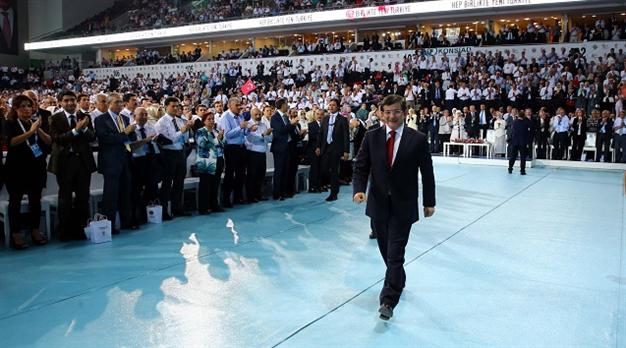
Turkey’s new prime minister, Ahmet Davutoğlu (Photo: Anadolu Agency)
Özkan’s thesis certainly seems to have struck a chord, with plenty of prominent figures declaring their admiration. Still, the reception has not been universally positive. In Radikal, political scientist Fuat Keyman expressed skepticism about the use of any catch-all term such as “pan-Islamist” to accurately describe Davutoğlu’s worldview:
As someone who has read many – if not all – of Davutoğlu’s works, it’s difficult to understand how Dr. Özkan has drawn the conclusion that Davutoğlu is a pan-Islamist (which is problematic as a term anyway).
It shouldn’t be forgotten that such expressions have only recently started to be used for Erdoğan and Davutoğlu. It could be said that irresponsible, anti-Semitic writings and comments made [by others] in Turkey recently have contributed to the increased use of terms like ‘pan-Islamism’ abroad.
Still, I don’t think terms such as ‘neo-Ottoman,’ ‘sectarian,’ or ‘pan-Islamist’ are useful or appropriate when describing Davutoğlu’s worldview, or his approach to foreign and domestic politics … Criticism of Turkish foreign policy should instead focus on the strategic errors that have been made, the exaggeration of Turkey’s power, and recently its distancing from democracy.
In Zaman, meanwhile, Şahin Alpay similarly questioned the validity of any term that sought to place a rigid label on the often multi-dimensional policies of Davutoğlu and the AKP:
The foreign policies pursued by Erdoğan and Davutoğlu do not fit into the mold of ‘neo-Ottoman,’ ‘pan-Islamist,’ or ‘Sunni sectarian.’ It’s difficult to apply a single ideological label for a foreign policy that started negotiations to join the EU, gave NATO permission for its Kürecik bases, received prizes from the Israeli lobby, struck up a personal friendship with Bashar al-Assad, recommended secularism to Egypt, and felt Tehran to be its own home. Rather than being based on certain principles, the policies pursued by the AKP, domestically and abroad, can be said to be either pragmatic, populist, opportunistic, or aimed at securing or protecting power. But if an ideological tag is necessary, Islamic Kemalism or religious nationalism could be used.
A deeper and more academic critique of Özkan’s work that has attracted particular attention was posted on the personal website of Ali Balcı, an associate professor at Sakarya University. Balcı doesn’t take issue with Özkan’s use of such a blanket term as “pan-Islamist,” but voices more substantial reservations about the underlying fundamentals of his work:
Özkan argues that the ‘pan-Islamic’ conclusions and analyses made by Davutoğlu as an academic in the second half of the 1980s and the 1990s can be used to understand Davutoğlu’s later foreign policy. This strongly indicates a ‘once an Islamist always an Islamist’ assumption, suggesting that Davutoğlu’s essential core is unchanging in the face of different times and conditions … The work’s fundamental problem is that despite all of the changes in conditions [since Davutoğlu wrote], it still puts forward that a pan-Islamist is always a pan-Islamist – a reductionist and essentialist reading.
Balcı says it isn’t clear why Özkan searches for proof of Davutoğlu’s “pan-Islamism” in his old academic articles, while he supports the “neo-Ottoman” label for former Turkish President Turgut Özal using evidence from the latter’s period in office:
Examples of Özal’s neo-Ottomanism given by the writer can also be given for the AK Parti’s time in power and in Davutoğlu’s period as foreign minister. As stated by the writer, Özal applied for EU membership in 1987, worked to broaden influence in the Caucasus and the Balkans, tried to solve the Kurdish problem through reforms, and worked to establish control in its relations with Iraq. If all of these practical realities have also emerged during the AK Parti and Davutoğlu eras, how can Özal be considered a neo-Ottoman while Davutoğlu is a pan-Islamist? In answer to this question the writer only presents certain criticisms of Özal made by Davutoğlu. But while proving Özal’s neo-Ottomanism with practical examples, [Özkan] doesn’t answer why he looks for examples of Davutoğlu’s pan-Islamism in articles written while he was an academic.
Some of these criticisms are valid, but some are wide of the mark. It may not be true that “once a pan-Islamist is always a pan-Islamist,” but there is plenty of evidence that today’s Davutoğlu still sympathizes with the views expressed in his old academic work. While he certainly has demonstrated a keen sense of pragmatism and adaptability in the past, there’s can be little doubt that he has steadily moved away from this realism and back to a far more dogmatic and ideological approach in recent years. It may be less articulate than Balcı’s blog post, but the government’s hagiographical short film that accompanied Davutoğlu’s recent nomination as prime minister was equally germane to the issue: “He is the awaited spirit of Abdülhamid,” the lyrics say at one point, referencing the 19th century sultan who deployed Islamism to combat the collapse of the Ottoman Empire. “For the nation, for the ummah, for Allah.”
Now that Davutoğlu is in the prime minister’s chair, the question is whether he will continue to be seduced by his ideological convictions and lose touch with his former pragmatism. If he does, then Özkan’s thesis will look even more prescient.
By now, the basics are well known. The mainstream Turkish media was found to be woefully inadequate when it came to reporting the enormous anti-government protests that recently erupted across the country. As Turks took to the streets to confront ruthless security forces armed with gallons of tear gas, pressurized water, tanks and batons, those still at home turned to TV news stations only to find nature documentaries and panel shows discussing liposuction.
It’s fair to say that the protests still ongoing across Turkey have not been the Turkish media’s finest hour. In fact, these events – perhaps more than any previously – have exposed for domestic and international observers just how compromised the Turkish media has become. (As many have observed, this comes with a bitter taste for Kurds, who ask why many now protesting did little when the Kurds were complaining about scant media coverage of their own troubles.) Ironically enough, the lack of TV coverage appears only to have inspired more protests. According to a Bilgi University survey among 3,000 young Gezi Park protesters, 84% cited muted media coverage as one of the main reasons for taking to the streets. This also explains the graffiti around Istanbul lambasting the “sold-out” media, the satirical memes circulating like wildfire on the internet, and the NTV broadcast van trashed and overturned in the middle of Taksim Square.
As is now well documented, where mainstream media failed, social media stepped in. It is estimated that more than 3,000 tweets per minute were sent about the protests after midnight on May 31; Twitter hashtags telling the Turkish media to do its job were trending worldwide, while CNN Türk was airing a documentary about penguins. This also resulted in large demonstrations being organised outside the Habertürk and NTV offices in the following days, which, in a grim irony, NTV ended up reporting on.
Indeed, Twitter became the only place to go to for information (and disinformation) as events unfolded; exposing the enormous chasm that now exists between independent new media and the toothless media corporations in Turkey. While this was no real revelation, (the same happened after the Uludere/Roboski massacre in December 2011, when live tweeters at the scene bypassed and shamed the established media groups), the scale of the awareness that the latest events stirred is unprecedented. Reflecting the government’s frustration at being unable to do much about what gets posted online, Erdoğan described social media as a “trouble” full of “unmitigated lies” (if he was referring to the deluded Twitter ramblings of Ankara Mayor Melih Gökçek he may have had a point). One day later, Deputy Prime Minister Bulent Arınç declared that the government “could have shut down Internet access, but didn’t.” Still, there were other ways for the government to make its point, as 33 protesters were detained in the western city of İzmir for tweets they had posted.
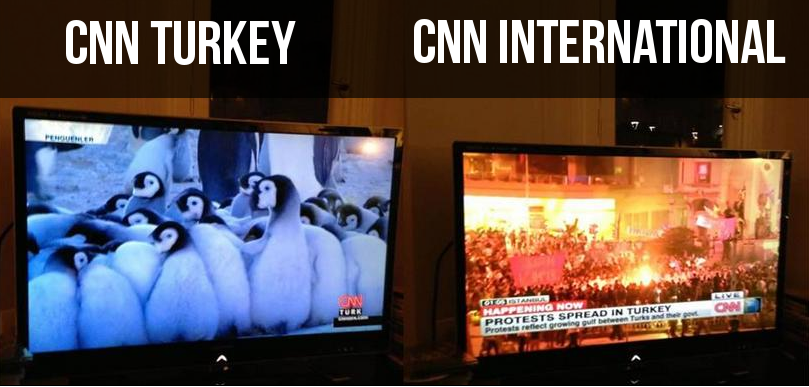
CNN International shows live coverage of the demonstrations in Taksim Square, while CNN Türk airs a penguin documentary.
Turkey-watchers are familiar with the country’s chronic press freedom problems. One of the root causes is related to the ownership structures of Turkish media companies, which opens them up to political pressure, an issue that Yavuz Baydar repeatedly – and convincingly – returns to. One small example of this which I didn’t see anyone else pick up on came with a report, released in April, by respected think-tank the Turkish Economic and Social Studies Foundation (TESEV), titled “Policy Suggestions for Free and Independent Media in Turkey.” The report was thorough and fair, particularly focusing on the crippling conflict of interest that comes when major media outlets are owned by large holding companies involved in other sectors. Although the report was covered by the Gülen-affiliated Zaman newspapers, no newspapers from the Doğan Media Group (owned by billionaire Aydın Doğan – perhaps Exhibit A of the above problem) – Hürriyet, its English language arm Hürriyet Daily News, or Radikal – mentioned it.
With the large media companies so obviously unfit to perform their Fourth Estate function, the focus is shifting to new online independent media. Along with the agenda-setting Twitter, the website T24 has also developed quite a reputation in providing brave, reliable, independent reporting. Veteran journalist Hasan Cemal, for example, after being controversially fired by daily Milliyet, was taken on by T24 and has since written a series of articles based on time spent with the retreating Kurdistan Workers’ Party (PKK) rebels in southeast Turkey, including an interview with military head of the PKK, Murat Karayılan. The Demirören Holding-owned Milliyet would not touch such a daring project. Freely-available online and with little advertising, I’m not sure how T24 is actually funded (if anybody does, please do let me know), or whether it’s a viable long-term model for more serious journalism in Turkey, bypassing the established news organisations. Still, with mainstream media having so thoroughly discredited itself throughout the Gezi Park protests, the void will have to be filled by something if Turkey is to become more democratic.
Whither Turkey’s fourth estate?
May 1, 2013
Once again, Prime Minister Recep Tayyip Erdoğan managed to single-handedly dictate Turkey’s agenda, this time with comments made last weekend suggesting that ayran, rather than the alcoholic rakı, should be considered Turkey’s “national drink.” It was only the latest in the long list of examples demonstrating the same unfortunate point, which has become increasingly obvious throughout the current peace negotiations. Another little-mentioned illustration of the government’s authority over the media came early last month, when Erdoğan was asked at a press conference to comment on the sentencing of Fazıl Say, a day after the famous pianist was handed a 10-month jail term for tweeting anti-Islamic Omar Khayyam couplets. He simply brushed off the question, responding: “Do not occupy our time with such matters.” With hardly a voice of protest from those reporting the event, the prime minister was thus able to completely avoid answering a question on an awkward issue, despite the fact that it had grabbed headlines in both the domestic and international media. The episode chillingly highlighted not only the complacent mentality of the ruling authorities in Turkey, but also the necessary obsequiousness of the reporters attending the press conference. As fellow Turkey-watcher Aaron Stein has tweeted, Erdoğan “is the sun around which the Turkish media rotates.”
In a column written last December, the late Mehmet Ali Birand admonished his colleagues for asking genuflectory questions to elected officials. The examples he gave were as follows:
“Esteemed Prime Minister, you have an extremely correct Middle East policy. Are you going to take new steps in the next term?
“Esteemed Prime Minister, I also believe that the presidential system will solve Turkey’s problems. I know you also want this. Do you know why the opposition opposes it?
“You want to change the structure of the U.N. It’s true that the U.N. has a very anti-democratic structure. The vetoes of the five countries should be overcome. Do European leaders support you in this democratic demand of yours?”
As Birand went on to write, “Questions of this tone do not suit journalism. You are journalists. You do not need to butter up the PM. Your duty is to ask questions impartially and without losing your manners. Please don’t forget this.” Unfortunately, with a high-profile newspaper firing seeming to come every other week in Turkey, it’s hardly surprising that Birand’s words seem to have gone on deaf ears.

PM Erdoğan cuts a ‘Journalists’ Day’ cake with Turkish reporters aboard his official jet in January. (Photo credit: Anadolu Ajansı)
The situation in Turkey is worth comparing to the one prevailing these days in the U.K. Erdoğan’s casual batting away of the Fazıl Say question immediately contrasted in my mind with a now-infamous interview with London Mayor Boris Johnson that aired on BBC television last month. The interview coincided with the broadcast of an admiring Sunday evening documentary focusing on Johnson, but interviewer Eddie Mair pulled no punches, relentlessly posing uncomfortable questions about the London mayor’s integrity and previous professional misdemeanors. The exchange ended with Mair calling Johnson a “nasty piece of work,” while the latter simply squirmed in his seat opposite and offered barely a word of protest. He seemed to implicitly agree that this is what interviewers are there to do.
Viewed from Turkey, where reporters at news conferences feel obliged to “go soft” on whichever government figure is presented to them, the U.K.’s no-nonsense approach naturally seems healthier. But I’m not sure that either is flattered by the comparison. I really don’t want to be witness for the defense for politicians, but I’m suspicious of the pseudo-robust questioning demonstrated by some in the British media whenever an elected official is placed in front of them. There’s a hysterical, arm-waving phoniness about it, something forced and artificial; as if holding power to account is about little more than treating elected officials with barely concealed contempt, asking reductive yes/no questions, and then not waiting for an answer. I’d suggest that this is simply one unhappy symptom of the dangerous cynicism felt by an increasing number of Brits about the entire political process.
Needless to say, a robust and properly-functioning fourth estate is crucial for the health of any democracy. While the situation in the U.K. on this issue is certainly preferable to that in Turkey, it’s fair to say that neither gets the balance exactly right.
Having lead a government that has spent much of the last 10 years in a bitter tug-of-war for power with the military establishment, it has recently become clear that Prime Minister Recep Tayyip Erdoğan is now attempting to secure rapprochement with the Turkish armed forces. The latest indication came with his visit on Feb. 9 to the hospital bedside of retired general Ergin Saygun, whose 18-year prison sentence in the Balyoz (Sledgehammer) coup plot trial was suspended on Feb. 7 following a medical report. Saygun is now undergoing critical heart treatment in Istanbul.
The hospital visit was just the latest in a series of moves that indicate Erdoğan’s changed approach. In recent months, he has repeatedly expressed frustration at the long detention times of military officers and even at the alleged excesses in the ongoing Ergenekon coup plot investigation. Two weeks ago he complained in a live television interview: “There are currently 400 retired commissioned or non-commissioned officers. Most of them are detained … If the evidence is indisputable, give a verdict. If you consider hundreds of officers and the [former] chief of staff to be members of an illegal organization this would destroy the morale of the armed forces. How will these people be able to fight terrorism?” Indeed, with so many detained or facing trial, there have also been rumours of growing organisational chaos inside the armed forces due to the lack of staff; as many as a fifth of Turkey’s top military chiefs are currently languishing behind bars. (In an unfortunate gaff, one opposition deputy recently bemoaned the lack of serving generals currently available to conduct a military coup.)
The Fethullah Gülen religious movement (cemaat) is the strongest and most powerful advocate of the ongoing coup plot trials. As Dani Rodrik, a fierce critic of the Ergenekon/Balyoz cases, has written: “[Erdoğan’s] Gülenist allies … have been the key driving force behind the sham trials. It is Gülen’s disciples in the police, judiciary and media who have launched and stage-managed these trials and bear the lion’s share of responsibility.” Below the surface, it is therefore becoming clear that Erdoğan’s recent moves to normalise relations with the military constitute the latest steps in the power struggle between himself and the cemaat. As a leader with impeccable political antennae, Erdoğan also probably recognises the political importance of “moving on” with the military. Despite all the reputational damage it has suffered over the last 10 years, the national armed forces still retain considerable loyalty among the Turkish public.
As the newspaper most closely affiliated with the Gülen movement, it is thus interesting to observe how daily Zaman is reporting Erdoğan’s search for a settlement. On the day after Erdoğan’s hospital visit to Saygun, the paper’s front page carried a picture of him standing at the former general’s bedside, with an innocuous story inside titled “Surprising visit to Ergin Saygun.” However, it is also worth noting that Zaman’s front page headline on the same day focused on the recent three-day summit of the (Gülen-affiliated) “Abant Platform,” which came out in strong support for Turkey’s continued EU membership negotiations. The piece mentioned the “hardening attitude” within the EU and unfair visa restrictions, but also included criticism of the recent public declarations of some Turkish officials, which it said “lead the way to opposition to EU membership among the public.” Erdoğan has been leading the charge in negative statements about the EU process in recent weeks, so Zaman’s emphasis was perhaps not without significance, hinting cryptically at the growing Gülen-Erdoğan split.

Zaman headline Feb. 10: ‘Support to EU process from the Abant Platform’
When Erdoğan speaks, the media follows
January 31, 2013
Prime Minister Recep Tayyip Erdoğan’s recent comments that Turkey could give up its EU membership bid and instead pursue membership of the Shanghai Cooperation Organisation (SCO) are still reverberating in much of the Turkish media. Speaking Jan. 25 on TV station 24TV, Erdoğan said: “The EU does not want to include a Muslim country … Of course, if things go so poorly then, as a prime minister of 75 million people, you seek other paths … The Shanghai Five is better, much stronger.” Last year, Erdoğan had said something similar after a diplomatic visit to Moscow: “I said to [Russian President Vladimir] Putin, ‘You tease us, saying “What is Turkey doing in the EU?” Now I’m teasing you: include us in the Shanghai Five, and we’ll forget about the EU.’”
The “Shanghai Five” was created by Russia, China, Kazakhstan, Kyrgyzstan and Tajikistan in 1996 in an attempt to counter U.S. influence in Asia, and was later joined by Uzbekistan and renamed the SCO in 2001. It has been described as “a vehicle for human rights violations” by the International Federation for Human Rights. Erdoğan’s latest pronouncements on the group were immediately picked up by much of the Turkish commentariat as significant indications of Turkey’s shifting priorities. In Radikal, columnist Cengiz Candar wrote that the prime minister had dropped a “geopolitical bomb.” Hürriyet’s Sedat Ergin has so far spent three days worrying over the remarks, writing that Erdoğan’s words amounted to “one of the most significant foreign policy moves since he took office 10 years ago, maybe the most important.”
For me, the way these latest statements were reported merely highlighted once again the unhealthy intensity with which the Turkish media hangs on every single word uttered by the prime minister. The smallest pronouncement can be seized upon to set the agenda and send the media into a tailspin. It’s a little discussed symptom of a wider (and more discussed) problem – the increasing concentration of power in one pair of hands.
This is the pattern of how an address or press conference given by Erdoğan is typically reflected in the Turkish media: it is broadcast uninterrupted by every major television news station; the words are transcribed and posted immediately on internet news portals, with the only journalistic interjection in each paragraph being “the prime minister said”; the next day’s newspapers feature prominent news stories on the speech, perhaps as the front page headline; finally, the chorus of daily columnists set to work dissecting whatever the prime minister has decided should be the subject of the moment. As Fehmi Koru wrote in Star on Jan. 29: “Erdoğan is a master at forcing an issue, bluffing and occupying others with his own agenda … We have not yet seen one of the opposition parties able to force the country to debate a single topic. They jump into the agendas set by the head or members of the ruling party.” The prime minister is a master at manipulating how news is covered, and the producers of that news coverage are often more than happy to be manipulated.
This week’s episode of the BBC’s Start the Week, where the discussion centred around George Orwell’s 1946 essay “Politics and the English Language,” brought the issue into even sharper relief for me. In the programme, Phil Collins, one time speechwriter for former British Prime Minister Tony Blair, spoke about how he was always acutely aware when writing speeches of the low level of coverage that any public address by a prime minister could today expect to receive in the U.K. press. “Once upon a time your whole speech would be printed verbatim in The Times the next day, but that’s not the case anymore … You’re talking into an atmosphere in which you’re only going to get six seconds on the evening news, whether you like it or not,” he said. This seems to be the inverse of the Turkish problem: symptomatic of a corrosively cynical British public, disengaged from the political process and instinctively suspicious about the public utterances of any elected official.
Of course, there are many such cynics in Turkey, but they are little represented in the conventional large media corporations.
Coverage of Ankara-PKK ‘peace process’ in the Turkish media
January 19, 2013
Peace talks are still ongoing between the Turkish state, representatives of the Kurdistan Workers’ Party (PKK), and PKK leader Abdullah Öcalan. It is likely that for any kind of peace to be secured they will have to go on for quite a while longer. Looking at the attitudes adopted by the Turkish media over the course of the “İmralı process” has been illuminating, particularly the reporting of the Jan. 17 funeral ceremonies in Diyarbakır of the three female Kurdish activists who were recently shot dead in Paris.
The government’s previous “Kurdish Opening” in 2009 came to an abrupt end after the controversy that followed the release of a group of PKK militants at the Habur border crossing and their welcoming back by huge crowds in Diyarbakır. Any comparable scenes carried the danger of enflaming Turkish nationalist sentiments and posed a risk to the latest dialogue process. Thus, in the lead up to the funerals most in the mainstream media were in agreement that they represented a significant test. On the morning of the ceremonies, dailies Vatan, Yeni Şafak, and Yeni Asya all featured front page headlines quoting the words of Prime Minister Recep Tayyip Erdoğan saying that the day would be a “Samimiyet sınavı,” or “Sincerity test.”
The ongoing process is extremely delicate. It’s easy to forget that although public support for the current PKK talks is significantly higher than it was in 2009, suspicion of the talks is still widespread. It was therefore interesting to observe how none of the major TV stations covered the ceremonies live in any detail on the day, despite the fact that they were attended by tens of thousands of people. As with much coverage of the Kurdish issue, (the Uludere/Roboski massacre in December 2011, for example), it is likely that this low key coverage had been “suggested” to the major media organizations by the government, acutely aware of the need to avoid scenes similar to those in Habur in 2009. Tellingly, Deputy Prime Minister Bülent Arınç had the following to say at a media event on Thursday: “The media’s support is so pleasing for us. I know and I see this support. … Eighty percent of media groups are lending their support. They are conducting positive broadcasts and contributing to the process. I hope this continues.” Still, in a column the next day titled “Peace is difficult with this media,” daily Vatan’s Rüşen Çakır had some critical things to say about this mentality:
“Television stations who didn’t show the ceremony yesterday failed the ‘sincerity test.’ In fact, they didn’t even sit the test … In the name of not making mistakes, or avoiding possible crises, or not annoying the government, they chose not to do anything at all … During the latest İmralı process, our media sees only one side as having to take steps – and all of these steps set according to what the government wishes – which itself sabotages the road to peace.”
In the event, Jan. 18’s newspapers exhaled an audible sigh of relief that the day passed without “provocation or sabotage” from either the mourners or the Turkish security forces. In contrast to the relative silence of the TV stations, the majority of the next day’s papers featured the funerals as front page headline stories, showing pictures of the crowds gathered in Diyarbakır and striking a noticeably optimistic tone. Many focused on a makeshift sign that one man was carrying at the ceremonies: “There is no winner from war; there is no loser from peace.”
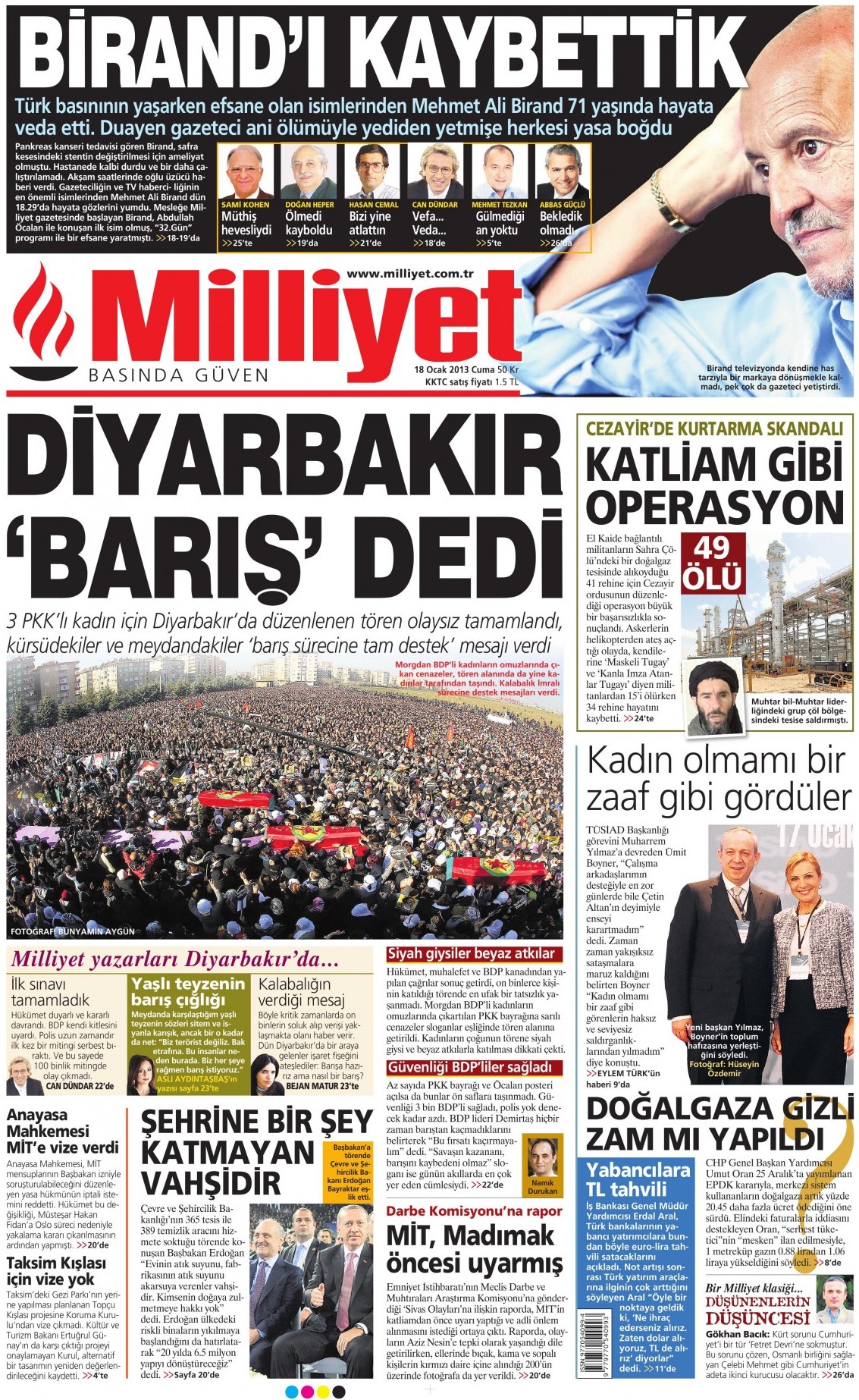
The front page of Milliyet on Jan. 18: ‘Diyarbakır said peace’
That the funerals passed peacefully was a relief not only for the government but also for the Peace and Democracy Party (BDP), which shares grassroots with the PKK. At the moment, both the Justice and Development Party (AKP) government and the BDP have a common interest in continuing the talks. For the process to come to a successful conclusion – still a long way off – this shared interest will need to persist for a while yet.
The New York-based Committee to Protect Journalists (CPJ) has just released its annual report on the number of journalists imprisoned globally – a gloomy read. This year, the global tally reached its highest point since the CPJ began surveys in 1990, with a total of 232 individuals counted as being behind bars, an increase of 53 since 2011. Unsurprising to most in the country, Turkey tops the list this year – followed by Iran and China – with the CPJ counting 49 currently in Turkish prisons for their journalistic activity, (still lower than its last count of 61). A complete list featuring detailed accounts of all imprisoned journalists worldwide is available to view via the CPJ here, while a “path forward” for Turkey, drawn by CPJ Executive Director Joel Simon, can be read here. The CPJ recently focused on the situation in Turkey in a detailed report released in October, which I wrote about on this blog at the time.
In Turkey, most of the newspapers hostile to the government included pieces on the report, with the reliably bellicose Sözcü referring ironically to Prime Minister Recep Tayyip Erdoğan in its Nov. 12 front page headline: “THE MASTER BREAKS THE RECORD: Turkey is the world champion in imprisoned journalists.” Also tongue-in-cheek, daily Taraf dolefully headlined its article on the report: “Again we’re the world’s first!” However, news of the CPJ report was conspicuous by its absence in the Pollyannaish pro-government press – nowhere to be found in Zaman, Sabah, Bugün, Türkiye, Yeni Asya, Yeni Şafak, or Star. Bearing in mind the Doğan Group’s history with the Justice and Development Party (AKP) government, it is also perhaps worth mentioning that neither of its remaining Turkish-language titles, Hürriyet and Radikal, mentioned the report in their print versions either (although both did feature online articles).
Of course, the October CPJ report on Turkey was far more detailed than this latest one, which focused only on the global numbers of journalists in jail. Indeed, the real question of press freedom in the country is rather more complicated than simply a headline figure alone, as I have written before, both here and here. Still, however hypocritical many of the protests on the issue coming from the direction of newspapers like Sözcü are, the situation is certainly deplorable. Complicated as the issue may be, comparing the coverage (or non-coverage) of the CPJ report in the Turkish press at least gives some impression of quite how polarized the media in Turkey really is. Looking at some of the newspapers here, it’s often hard to believe they can be describing the same country.
Yeni Akit shaping the debate?(!)
December 6, 2012
It’s been a while since I last wrote about my favourite hard-line Islamic newspaper, Yeni Akit. It would be wrong to overemphasize Akit’s significance in the overall scheme of things, but a couple of its recent news items are certainly worth mentioning, and indicate that it might have rather more influence than many give it credit for(!)
On Nov. 22, Akit published a story headlined, “Immorality at High School,” containing photographs that it said showed teachers drinking alcohol with their students at a picnic. This photos were taken in the southern province of Antalya, (“known as a castle of the secularists,” according to the article), and were apparently uploaded to Facebook by one of the teachers. “It has been claimed that the teachers are members of the ‘Eğitim Sen’ union, which opposes the headscarf as well as classes on the Quran and the life of the Prophet,” Akit helpfully stated. The Antalya branch of the National Education Directorate opened an investigation into the 11 teachers upon the publishing of the story, but this was quickly dropped after it was established that the photos were in fact taken by a teacher at a family picnic three years ago, and that no students were present. Unbowed, on Dec. 2 Akit went on to publish a photo of a female teacher at the same Antalya school, part of a group at a bar celebrating a friends’ birthday (with glasses of beer on the table). “Do these photographs suit a teacher?” said the headline. However, rather than the Education Directorate setting up an inquiry, the teacher in question is now opening a legal case against Akit.
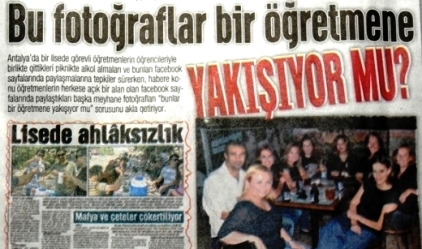
It’s worth mentioning these “photo scandals” because very recently Prime Minister Recep Tayyip Erdoğan used similarly tendentious photographs published in Akit to attack his political opponents. The pictures used by Erdoğan showed deputies of the pro-Kurdish Peace and Democracy Party (BDP) sitting around a table eating kebab, despite the fact that over 600 Kurdish prisoners were entering their 49th day on hunger fasts: “Lamb kebab for us, death fasts for you,” read Akit’s headline. On the same day (Oct. 30) Erdoğan told a meeting of his parliamentary party: “On one hand [they] are eating lamb kebab, on the other [they] are telling those in prison, ‘Die on hunger strike.’” In fact, it soon emerged that the photos had been taken two months before at the wedding of a BDP member in the southeastern province of Mardin.
Erdoğan’s harsh words got a lot of coverage at the time, (here’s the Reuters story on it), but the fact that his source was Yeni Akit obviously received rather less attention. Commentary suggesting that the prime minister is turning Turkey into an “Islamic state” is simplistic and misguided, (a piece in the Wall Street Journal last month claimed that he was “ramming Shariah law into practice.”), but it can’t be a good sign that he’s turning to Yeni Akit for rhetorical fodder to use against his opponents.
Turkish newspapers weigh up the Middle East’s ‘new balances’
November 24, 2012
In the wake of the Nov. 21 ceasefire between Israel and Gaza, there has been much talk of the changing power balances in the Middle East. The leading role played by Egypt and its new president, Mohamed Morsi, in brokering the ceasefire is being interpreted by many as Egypt’s reintroduction as a major regional player. Meanwhile, the crisis was another litmus test for the “rising Turkey” thesis, and Turkey’s apparent marginalization during the process seems to have once again exposed the gap between Foreign Minister Ahmet Davutoğlu’s ambitious rhetoric and the reality. While diplomacy to secure a ceasefire was still ongoing, Tim Arango wrote in The New York Times:
“Turkey’s stature in the Middle East has soared in recent years as it became a vocal defender of Palestinian rights and an outspoken critic of Israel and pursued a foreign policy whose intent was to become a decisive power in regional affairs. But as Gaza and Israel were once again shooting at each other, Turkey found that it had to take a back seat to Egypt on the stage of high diplomacy … Ersin Kalaycioglu, a professor of international politics at Istanbul’s Sabanci University, [says]: ‘Turkey is pretty much left with a position to support what Egypt foresees, but nothing more.’”
In a similar piece, Foreign Policy described “all the hype about Turkey’s aspirations to be a regional power broker” as “overblown”:
“They embraced the principles, themes, and language of anti-Israeli sentiment so common in the Arab world, but without any nuance that would allow them to continue to play in the Arab-Israeli game. The Egyptian, Jordanian, Qatari, and even Saudi governments, for example, have a long history of engaging in very public criticism of Israel, but have always managed to keep lines of communication open to manage regional crises and look out for their interests. Not so the Turks who seemed to relish burning bridges with the Israelis.”
In the Turkish press, Nov. 23’s Taraf weighed up the new regional balances, considering those who gained and those who lost from the conflict. It placed Turkey in the “Loser’s Club,” under a headline saying: “Egypt in, Turkey out”: “The closing of all dialogue channels with Israel has been paid for diplomatically. According to many foreign observers, by only keeping ties with Egypt, Turkey has lost much of its persuasiveness in such issues.”
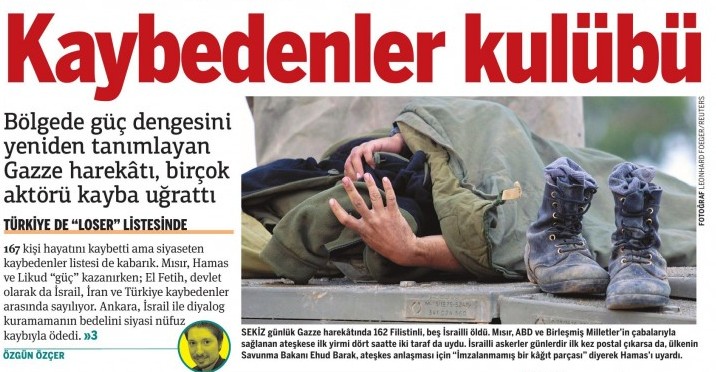
Perhaps unsurprisingly, other pro-government newspapers remained fairly quiet on the issue. Only Kerim Balcı put a brave face on it in Zaman, arguing that Egypt’s mediator role was more natural in an issue like Israel-Palestine:
“Yes, Turkey should wish to take part in efforts to solve any clashes that occur in the region, and indeed the world. However, in this zeal, other international actors should never be left out of the circuit. On the issue of Hamas, Egypt’s entry to the circuit is not a virtue, it’s a duty.”
These words might be more convincing if Turkey hadn’t already made such a big play of being a potential mediator, particularly in conflicts such as that between the Israelis and the Palestinians.
Conservative Islamist daily Yeni Şafak seems to be offering its readers a comforting fictional parallel universe. Alongside the requisite headline story about Israel’s “eight-day long massacre,” its Nov. 23 front page featured a box titled “Thank you, Turkey,” focusing on some marginal quotes from Hamas leader Khaled Mashal thanking the efforts of Turkish officials. It went further the next day, boldly stating in a similar front page box: “Without Turkey it wouldn’t have happened,” referring to the ceasefire process.
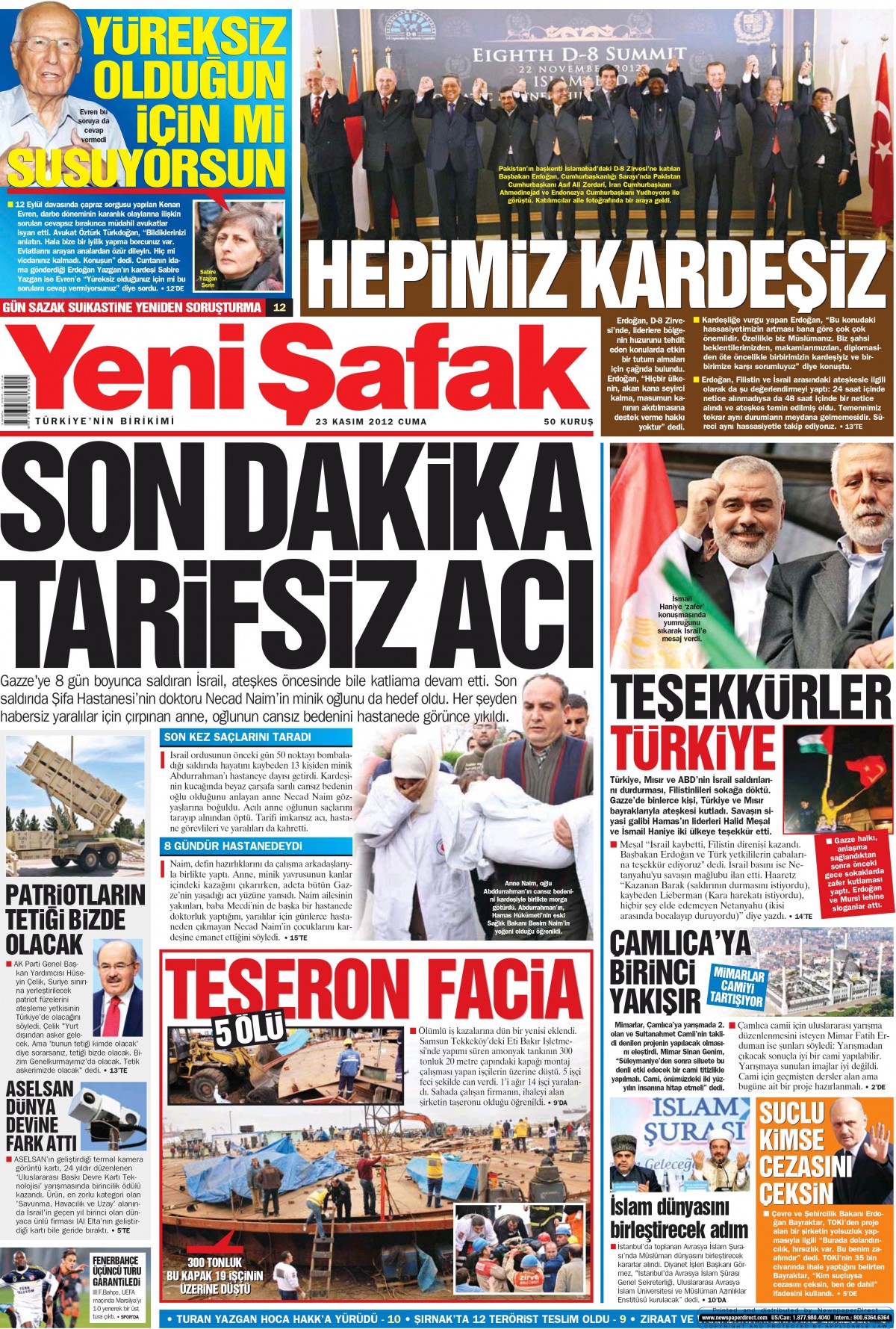
Meanwhile, just a day after being widely praised for his role in the ceasefire, Egyptian President Morsi was being criticized from all sides for his domestic move to assume sweeping new powers, leading to violent clashes in central Cairo. The rapid shift from praise to condemnation was striking. Indeed, while Egypt may – in Foreign Policy’s phrase – have taken over from Turkey as the Middle East’s latest “it” country, it has quickly discovered that this is not an easy role to play.
‘Bring back capital punishment, end this business’
November 14, 2012
Recently, Turkish Prime Minister Recep Tayyip Erdoğan has repeatedly expressed his opinion that Turkey should consider reinstating capital punishment “in certain situations.” He first brought the issue up at a meeting of his Justice and Development Party’s (AKP) deputies on Nov. 3, in reference to Abdullah Öcalan, the convicted leader of the outlawed Kurdistan Workers’ Party (PKK), and has returned to it on a number of occasions since. “Right now a lot of people in public surveys say that capital punishment should be reintroduced … It is legitimate in certain situations,” Erdoğan said. “Yes, the death penalty was removed from Europe, but has it left America, Japan and China? Then there is a justified cause for the death penalty to remain.”
Capital punishment was abolished by Turkey in 2002, just prior to the AKP’s accession to power in the general elections of that year. Although no execution had been carried out by the Turkish state since 1984, an official end to the practice on the Turkish law books was seen as one of the key steps in Turkey’s EU accession process, which was then entering its most energetic period. The decision was fairly controversial at the time, as PKK leader Öcalan was captured and sentenced to death by the Turkish authorities in 1999. With the abolition of capital punishment, this sentence was commuted to life imprisonment, and Öcalan has since been held in a remote prison on İmralı Island in the Marmara Sea. With the recent spike in clashes between the Turkish security forces and the PKK, Erdoğan’s words on capital punishment should be interpreted in terms of the government’s failure to solve the Kurdish question – populist sentiments aiming to deflect nationalist criticism that he has made too many concessions to Kurdish rights with little to show in return.
The most striking newspaper coverage of the issue I saw came from popular pro-government daily Sabah, the newspaper with the fourth highest circulation nationally. Its Nov. 13 front page carried the bold headline “Bring back capital punishment, end this business.” These were the words of Fatma Çınar, the mother of one of the 17 soldiers killed in the recent helicopter crash in the southeastern province of Siirt, speaking at her son’s funeral. The crash was not a result of direct clashes with the PKK, but it was enough for PM Erdoğan to frame it as taking place within “much intensified, multi-dimensional” military operations in the region.

The return of the issue to the national debate has predictably raised eyebrows among those parts of the media who retain forlorn hopes that Turkey’s EU accession process can still be revived from its current moribund state. Opposition Republican People’s Party (CHP) deputy Rıza Türmen, who worked for 10 years at the European Court of Human Rights, wrote in Milliyet on Nov. 13: “Capital punishment is banned according to the third section of the European Union’s founding principles, and the lifting of capital punishment is a precondition for membership of the EU and the European Council … Is leaving the EU process what the prime minister actually wants?” Meanwhile, Taraf editor Ahmet Altan’s disillusionment continued on the same day: “We’ve gone from a country that celebrated with enthusiasm the opening of ‘full EU membership negotiations,’ to one with a prime minister – like a funeral undertaker – shouting ‘hang them, hang them’ at every opportunity.” A response even came from the murky corridors of the EU itself, with Peter Stano, the spokesman for Enlargement Commissioner Stefan Füle, stating: “Our position on this is quite clear. Countries wishing to be a member of the EU cannot practice capital punishment. If capital punishment comes, the EU goes.”
Meanwhile, the hunger strikes of 700 Kurdish prisoners today entered their 64th day. Despite the increasing urgency of the situation, Erdoğan has so far ignored calls to directly engage in finding a solution. He even spent Nov. 12 in his hometown of Rize, receiving an honorary doctorate from the newly-established “Recep Tayyip Erdoğan University” (it’s sometimes difficult to tell in Turkey that you’re not reading The Onion). His words on capital punishment have certainly been an effective tactic distracting some attention away from the critical situation of the strikers. However, like the Peace and Democracy Party’s (BDP) recent remarks about erecting a statue of Öcalan, they have hardly done much to help create an atmosphere congenial to a solution.


 Turkey Book Talk