Growing anti-Iranianism in the pro-AKP media
July 8, 2013
Not so many years ago, a strategic partnership between Turkey and Iran seemed to be developing into one of the region’s more unexpected modern developments. Turkey was vaunted as a mediator in negotiations between the West and Iran over the latter’s nuclear program, and the relationship was reinforced by crucial oil and gas sales from Iran to Turkey. Those days feel rather long ago. The two countries now find themselves at loggerheads backing opposite sides of the bloody civil war in neighboring Syria, with fears of a regional sectarian conflagration steadily turning into an apocalyptic reality. A marker of the Syrian crisis’ deleterious effect on the Turkey-Iran relationship came with the diplomatic spat that followed the deployment of NATO Patriot missiles on Turkey’s southern border earlier this year, which lead the Iranian army’s chief of staff to declare that the move could be a prelude to “world war.” Less spectacular, but also very important, is Iran’s clear unease with Turkey’s delicate ongoing peace process with the Kurdistan Workers’ Party (PKK), which involves the rebel group withdrawing its militants from Turkish soil to their bases in northern Iraq. Tehran is concerned that the withdrawal could result in the militants joining forces with the Party of Free Life of Kurdistan (PJAK), which is the PKK’s offshoot in Iran.
The schism between Turkey and Iran widened to such an extent that Patrick Cockburn recently described relations between the two as “poisonous,” and this is increasingly being reflected in the rising levels of anti-Iran sentiment in Turkey’s Islamist press. In addition to countless pieces targeting Iran for supporting the al-Assad regime in Syria , it has also been striking to see the AKP media include Iranians among the dark “outside forces” stoking the recent Gezi Park protests, supposedly out of discomfort with Turkey’s economic success. In the early days of the demonstrations, it was eagerly reported in all government-supporting media outlets that an “Iranian agent” had been arrested on suspicion of being a “provocateur” behind protests in Ankara. It later emerged in more sceptical news organisations that the individual concerned, Shayan Shamloo, was in fact a rapper who was living in Turkey as a refugee.
Soon afterwards – in one of those truly befuddling Today’s Zaman stories – Abdullah Bozkurt wrote a column titled “Iran plays a subversive role in Turkey,” in which he argued with a straight face (pardon the pun) that Iran was using the protests to infiltrate Turkey with spies disguised as LGBT people in an attempt to bring down the government:
“Recent protests exposed, among other things, the depth of Iranian infiltration into Turkey … [During the protests] about a dozen Iranian agents who were trying to turn rallies into violent anti-government demonstrations were caught by the police… Since it is difficult to distinguish legitimate non-Muslim minority or LGBT (lesbian, gay, bisexual and transgender) people from spies, Iranian intelligence often uses them as a cover to infiltrate Turkey and third countries.”
However weird, Bozkurt’s column wasn’t an outlier in pointing the finger at Iran for Turkey’s problems. Indeed, Zaman and Today’s Zaman have recently been publishing a steady stream of articles and columns critical of negative Iranian influence in the region, and it’s probably also worth noting here that the Today’s Zaman editor, Bülent Keneş, wrote a book on Iran’s links to international terrorism last year.
Much of the Iran-bashing in the Turkish press goes hand in hand with pieces on Turkey’s Alevi minority. The Alevis are an offshoot of Shiism, (distinct from the Alawites in Syria), and have historically been associated by some in Turkey as dangerous fifth columnists with divided loyalties to Iran. Indeed, that association goes back as far as Bosphorus bridge-commemorated Sultan Selim the Grim, whose decision to kill tens of thousands of Alevis was taken during a military campaign against the Persian Safavid Empire in the 16th century.
Some of the most enthusiastic and unpleasant examples negatively associating Alevis with Iran come from the extreme Islamist daily Yeni Akit. For two consecutive days in June, for example, Yeni Akit carried front page headline stories claiming that Iranian authorities had invited Alevi religious leaders across the border to visit Ayatollah Khamenei in an attempt to foment sectarian war in Turkey. The headline of the first day’s story, “Iran is playing with fire” (İran, ateşle oynuyor), was a stomach-turning play on the Turkish term for “flame” (ateş), in reference the fire often used in Alevi rituals. Of course, it should be stressed that Yeni Akit is far from representative of majority sentiment in Turkey, but it probably isn’t quite as marginal as most people like to think. In fact, a few months ago Erdoğan even put two of its writers – including editor-in-chief Hasan Karakaya – on his “Wise Men Commission,” charged with the august task of repeating whatever he said about the ongoing Kurdish peace process.
It all adds up to a worrying picture. With the Syrian crisis having exploded into a wider geopolitical struggle splitting the region on sectarian lines, it’s increasingly clear that the growing schism between majority-Sunni Turkey and majority-Shia Iran is more than just a temporary trend.
‘Gezi Park protests fuelled by foreign media’
June 13, 2013
One of the saddest aspects of the Turkish government’s response to the Gezi Park protests has been its line that the demonstrations are all a part of a “foreign plot” to bring down Turkey. As with everything else, Prime Minister Recep Tayyip Erdoğan fired the starting pistol, singling out the phantom international “interest rate lobby” as being behind the unrest. Since then, leading government figures have been falling over themselves to slander the protests as part of a “foreign conspiracy” by forces “jealous of Turkey’s economic success.” Economy Minister Zafer Çağlayan said “foreign circles” were trying to “undermine the country’s progress” through the protests: “This is totally an attempt to create a foreign hegemony on Turkey, but we are no fools.” EU Minister Egemen Bağış stated: “It is interesting to have such incidents in Turkey when … economic and development figures are at their best levels. The interest rate lobby and several financial institutions are disturbed by the growth and development of Turkey.” Foreign Minister Ahmet Davutoğlu said a deliberate propaganda operation was being conducted by the international media to tarnish Turkey’s image. Delusional? Yes. Seductive for a sizable portion of the Turkish electorate? Undoubtedly.
Overturning every stone only to find a nefarious foreign plot hidden underneath is one of Turkey’s less attractive national pastimes. Considering the past 200 years of the country’s history, it’s understandable, if not excusable. The current government was supposed to have broken with this paradigm. It had opened the country out to its region – both Europe and the Middle East – and was open-minded about doing business abroad and attracting investment for domestic infrastructure projects. The old embattled Turkish borders seemed to be opening to the world. However, the government’s reaction to the Gezi protests has laid bare all its latent insecurity and resentment, which has been most clear in the verbal attacks on the international coverage of the events. While mainstream domestic media has been brought (almost) completely under the thumb of the authorities, one gets the impression that the AKP’s open anger at the international media is now a kind of reflex action, indicating its frustrated inability to control what is being reported. The BBC must have been exaggerating the scale of the protests, as it wasn’t showing a penguin documentary.
Pro-government news outlets have been keen to assist in framing this paranoid narrative. While it was certainly no secret before, the Gezi protests have exposed the full extent of AKP control over the state news agency, Anadolu Ajansı, which has carried some utterly ridiculous The Onion-like headlines about foreign plots and jealous foreign powers. Pro-government newspapers have also loyally joined in, here’s daily Sabah applauding the aforementioned Anatolia for “sending a missile” to Reuters and CNN, by tweeting that 3G services had been cut in London, preventing them from broadcasting coverage of the police operation on the anti-G8 protests. Which to believe: Reuters or Anadolu Ajansı?
I also feel that this embattled sense is probably compounded by the shock of having international media ask genuinely tough questions of Turkish government representatives. Not only does this surprise AKP figures conditioned to having it easy with domestic journalists, but it also reinforces the sense among many government supporters that the international media is now “out to get” it (and, by extension, bring Turkey down). CNN International’s Christiane Amanpour was criticised by many pro-government Turks, (and praised by many protesters), simply for asking (not unusually) tough questions of Erdoğan’s advisor İbrahim Kalın. In fact, she did nothing out of the ordinary, but it must have been striking for anyone accustomed to toothless “interviews” such as the one conducted by Fatih Altaylı with Erdoğan on June 2.
Still, although they may make no logical sense, countering conspiracy theories with rational facts is a fool’s errand. David Aaronovitch wrote in a recent book on the subject that conspiracists tend to be on the “losing side” and conspiracy theories are mostly an expression of their insecurity; it’s therefore both strange and sad that rumours of “foreign plots” behind Turkey’s protests are being spread by a government that won 50% in the last election.
By now, the basics are well known. The mainstream Turkish media was found to be woefully inadequate when it came to reporting the enormous anti-government protests that recently erupted across the country. As Turks took to the streets to confront ruthless security forces armed with gallons of tear gas, pressurized water, tanks and batons, those still at home turned to TV news stations only to find nature documentaries and panel shows discussing liposuction.
It’s fair to say that the protests still ongoing across Turkey have not been the Turkish media’s finest hour. In fact, these events – perhaps more than any previously – have exposed for domestic and international observers just how compromised the Turkish media has become. (As many have observed, this comes with a bitter taste for Kurds, who ask why many now protesting did little when the Kurds were complaining about scant media coverage of their own troubles.) Ironically enough, the lack of TV coverage appears only to have inspired more protests. According to a Bilgi University survey among 3,000 young Gezi Park protesters, 84% cited muted media coverage as one of the main reasons for taking to the streets. This also explains the graffiti around Istanbul lambasting the “sold-out” media, the satirical memes circulating like wildfire on the internet, and the NTV broadcast van trashed and overturned in the middle of Taksim Square.
As is now well documented, where mainstream media failed, social media stepped in. It is estimated that more than 3,000 tweets per minute were sent about the protests after midnight on May 31; Twitter hashtags telling the Turkish media to do its job were trending worldwide, while CNN Türk was airing a documentary about penguins. This also resulted in large demonstrations being organised outside the Habertürk and NTV offices in the following days, which, in a grim irony, NTV ended up reporting on.
Indeed, Twitter became the only place to go to for information (and disinformation) as events unfolded; exposing the enormous chasm that now exists between independent new media and the toothless media corporations in Turkey. While this was no real revelation, (the same happened after the Uludere/Roboski massacre in December 2011, when live tweeters at the scene bypassed and shamed the established media groups), the scale of the awareness that the latest events stirred is unprecedented. Reflecting the government’s frustration at being unable to do much about what gets posted online, Erdoğan described social media as a “trouble” full of “unmitigated lies” (if he was referring to the deluded Twitter ramblings of Ankara Mayor Melih Gökçek he may have had a point). One day later, Deputy Prime Minister Bulent Arınç declared that the government “could have shut down Internet access, but didn’t.” Still, there were other ways for the government to make its point, as 33 protesters were detained in the western city of İzmir for tweets they had posted.
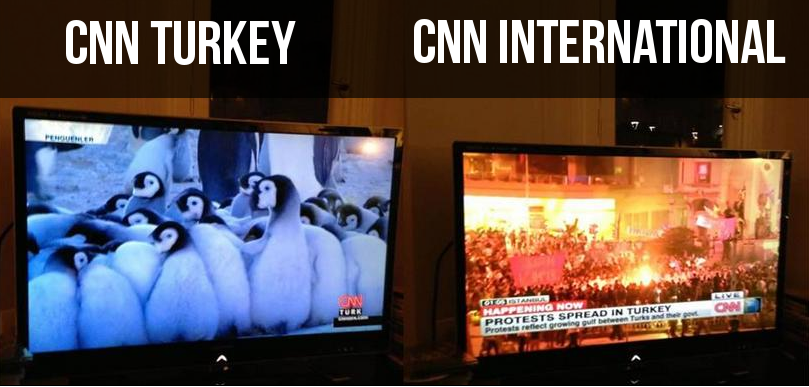
CNN International shows live coverage of the demonstrations in Taksim Square, while CNN Türk airs a penguin documentary.
Turkey-watchers are familiar with the country’s chronic press freedom problems. One of the root causes is related to the ownership structures of Turkish media companies, which opens them up to political pressure, an issue that Yavuz Baydar repeatedly – and convincingly – returns to. One small example of this which I didn’t see anyone else pick up on came with a report, released in April, by respected think-tank the Turkish Economic and Social Studies Foundation (TESEV), titled “Policy Suggestions for Free and Independent Media in Turkey.” The report was thorough and fair, particularly focusing on the crippling conflict of interest that comes when major media outlets are owned by large holding companies involved in other sectors. Although the report was covered by the Gülen-affiliated Zaman newspapers, no newspapers from the Doğan Media Group (owned by billionaire Aydın Doğan – perhaps Exhibit A of the above problem) – Hürriyet, its English language arm Hürriyet Daily News, or Radikal – mentioned it.
With the large media companies so obviously unfit to perform their Fourth Estate function, the focus is shifting to new online independent media. Along with the agenda-setting Twitter, the website T24 has also developed quite a reputation in providing brave, reliable, independent reporting. Veteran journalist Hasan Cemal, for example, after being controversially fired by daily Milliyet, was taken on by T24 and has since written a series of articles based on time spent with the retreating Kurdistan Workers’ Party (PKK) rebels in southeast Turkey, including an interview with military head of the PKK, Murat Karayılan. The Demirören Holding-owned Milliyet would not touch such a daring project. Freely-available online and with little advertising, I’m not sure how T24 is actually funded (if anybody does, please do let me know), or whether it’s a viable long-term model for more serious journalism in Turkey, bypassing the established news organisations. Still, with mainstream media having so thoroughly discredited itself throughout the Gezi Park protests, the void will have to be filled by something if Turkey is to become more democratic.
Whither Turkey’s fourth estate?
May 1, 2013
Once again, Prime Minister Recep Tayyip Erdoğan managed to single-handedly dictate Turkey’s agenda, this time with comments made last weekend suggesting that ayran, rather than the alcoholic rakı, should be considered Turkey’s “national drink.” It was only the latest in the long list of examples demonstrating the same unfortunate point, which has become increasingly obvious throughout the current peace negotiations. Another little-mentioned illustration of the government’s authority over the media came early last month, when Erdoğan was asked at a press conference to comment on the sentencing of Fazıl Say, a day after the famous pianist was handed a 10-month jail term for tweeting anti-Islamic Omar Khayyam couplets. He simply brushed off the question, responding: “Do not occupy our time with such matters.” With hardly a voice of protest from those reporting the event, the prime minister was thus able to completely avoid answering a question on an awkward issue, despite the fact that it had grabbed headlines in both the domestic and international media. The episode chillingly highlighted not only the complacent mentality of the ruling authorities in Turkey, but also the necessary obsequiousness of the reporters attending the press conference. As fellow Turkey-watcher Aaron Stein has tweeted, Erdoğan “is the sun around which the Turkish media rotates.”
In a column written last December, the late Mehmet Ali Birand admonished his colleagues for asking genuflectory questions to elected officials. The examples he gave were as follows:
“Esteemed Prime Minister, you have an extremely correct Middle East policy. Are you going to take new steps in the next term?
“Esteemed Prime Minister, I also believe that the presidential system will solve Turkey’s problems. I know you also want this. Do you know why the opposition opposes it?
“You want to change the structure of the U.N. It’s true that the U.N. has a very anti-democratic structure. The vetoes of the five countries should be overcome. Do European leaders support you in this democratic demand of yours?”
As Birand went on to write, “Questions of this tone do not suit journalism. You are journalists. You do not need to butter up the PM. Your duty is to ask questions impartially and without losing your manners. Please don’t forget this.” Unfortunately, with a high-profile newspaper firing seeming to come every other week in Turkey, it’s hardly surprising that Birand’s words seem to have gone on deaf ears.

PM Erdoğan cuts a ‘Journalists’ Day’ cake with Turkish reporters aboard his official jet in January. (Photo credit: Anadolu Ajansı)
The situation in Turkey is worth comparing to the one prevailing these days in the U.K. Erdoğan’s casual batting away of the Fazıl Say question immediately contrasted in my mind with a now-infamous interview with London Mayor Boris Johnson that aired on BBC television last month. The interview coincided with the broadcast of an admiring Sunday evening documentary focusing on Johnson, but interviewer Eddie Mair pulled no punches, relentlessly posing uncomfortable questions about the London mayor’s integrity and previous professional misdemeanors. The exchange ended with Mair calling Johnson a “nasty piece of work,” while the latter simply squirmed in his seat opposite and offered barely a word of protest. He seemed to implicitly agree that this is what interviewers are there to do.
Viewed from Turkey, where reporters at news conferences feel obliged to “go soft” on whichever government figure is presented to them, the U.K.’s no-nonsense approach naturally seems healthier. But I’m not sure that either is flattered by the comparison. I really don’t want to be witness for the defense for politicians, but I’m suspicious of the pseudo-robust questioning demonstrated by some in the British media whenever an elected official is placed in front of them. There’s a hysterical, arm-waving phoniness about it, something forced and artificial; as if holding power to account is about little more than treating elected officials with barely concealed contempt, asking reductive yes/no questions, and then not waiting for an answer. I’d suggest that this is simply one unhappy symptom of the dangerous cynicism felt by an increasing number of Brits about the entire political process.
Needless to say, a robust and properly-functioning fourth estate is crucial for the health of any democracy. While the situation in the U.K. on this issue is certainly preferable to that in Turkey, it’s fair to say that neither gets the balance exactly right.
Having lead a government that has spent much of the last 10 years in a bitter tug-of-war for power with the military establishment, it has recently become clear that Prime Minister Recep Tayyip Erdoğan is now attempting to secure rapprochement with the Turkish armed forces. The latest indication came with his visit on Feb. 9 to the hospital bedside of retired general Ergin Saygun, whose 18-year prison sentence in the Balyoz (Sledgehammer) coup plot trial was suspended on Feb. 7 following a medical report. Saygun is now undergoing critical heart treatment in Istanbul.
The hospital visit was just the latest in a series of moves that indicate Erdoğan’s changed approach. In recent months, he has repeatedly expressed frustration at the long detention times of military officers and even at the alleged excesses in the ongoing Ergenekon coup plot investigation. Two weeks ago he complained in a live television interview: “There are currently 400 retired commissioned or non-commissioned officers. Most of them are detained … If the evidence is indisputable, give a verdict. If you consider hundreds of officers and the [former] chief of staff to be members of an illegal organization this would destroy the morale of the armed forces. How will these people be able to fight terrorism?” Indeed, with so many detained or facing trial, there have also been rumours of growing organisational chaos inside the armed forces due to the lack of staff; as many as a fifth of Turkey’s top military chiefs are currently languishing behind bars. (In an unfortunate gaff, one opposition deputy recently bemoaned the lack of serving generals currently available to conduct a military coup.)
The Fethullah Gülen religious movement (cemaat) is the strongest and most powerful advocate of the ongoing coup plot trials. As Dani Rodrik, a fierce critic of the Ergenekon/Balyoz cases, has written: “[Erdoğan’s] Gülenist allies … have been the key driving force behind the sham trials. It is Gülen’s disciples in the police, judiciary and media who have launched and stage-managed these trials and bear the lion’s share of responsibility.” Below the surface, it is therefore becoming clear that Erdoğan’s recent moves to normalise relations with the military constitute the latest steps in the power struggle between himself and the cemaat. As a leader with impeccable political antennae, Erdoğan also probably recognises the political importance of “moving on” with the military. Despite all the reputational damage it has suffered over the last 10 years, the national armed forces still retain considerable loyalty among the Turkish public.
As the newspaper most closely affiliated with the Gülen movement, it is thus interesting to observe how daily Zaman is reporting Erdoğan’s search for a settlement. On the day after Erdoğan’s hospital visit to Saygun, the paper’s front page carried a picture of him standing at the former general’s bedside, with an innocuous story inside titled “Surprising visit to Ergin Saygun.” However, it is also worth noting that Zaman’s front page headline on the same day focused on the recent three-day summit of the (Gülen-affiliated) “Abant Platform,” which came out in strong support for Turkey’s continued EU membership negotiations. The piece mentioned the “hardening attitude” within the EU and unfair visa restrictions, but also included criticism of the recent public declarations of some Turkish officials, which it said “lead the way to opposition to EU membership among the public.” Erdoğan has been leading the charge in negative statements about the EU process in recent weeks, so Zaman’s emphasis was perhaps not without significance, hinting cryptically at the growing Gülen-Erdoğan split.

Zaman headline Feb. 10: ‘Support to EU process from the Abant Platform’
When Erdoğan speaks, the media follows
January 31, 2013
Prime Minister Recep Tayyip Erdoğan’s recent comments that Turkey could give up its EU membership bid and instead pursue membership of the Shanghai Cooperation Organisation (SCO) are still reverberating in much of the Turkish media. Speaking Jan. 25 on TV station 24TV, Erdoğan said: “The EU does not want to include a Muslim country … Of course, if things go so poorly then, as a prime minister of 75 million people, you seek other paths … The Shanghai Five is better, much stronger.” Last year, Erdoğan had said something similar after a diplomatic visit to Moscow: “I said to [Russian President Vladimir] Putin, ‘You tease us, saying “What is Turkey doing in the EU?” Now I’m teasing you: include us in the Shanghai Five, and we’ll forget about the EU.’”
The “Shanghai Five” was created by Russia, China, Kazakhstan, Kyrgyzstan and Tajikistan in 1996 in an attempt to counter U.S. influence in Asia, and was later joined by Uzbekistan and renamed the SCO in 2001. It has been described as “a vehicle for human rights violations” by the International Federation for Human Rights. Erdoğan’s latest pronouncements on the group were immediately picked up by much of the Turkish commentariat as significant indications of Turkey’s shifting priorities. In Radikal, columnist Cengiz Candar wrote that the prime minister had dropped a “geopolitical bomb.” Hürriyet’s Sedat Ergin has so far spent three days worrying over the remarks, writing that Erdoğan’s words amounted to “one of the most significant foreign policy moves since he took office 10 years ago, maybe the most important.”
For me, the way these latest statements were reported merely highlighted once again the unhealthy intensity with which the Turkish media hangs on every single word uttered by the prime minister. The smallest pronouncement can be seized upon to set the agenda and send the media into a tailspin. It’s a little discussed symptom of a wider (and more discussed) problem – the increasing concentration of power in one pair of hands.
This is the pattern of how an address or press conference given by Erdoğan is typically reflected in the Turkish media: it is broadcast uninterrupted by every major television news station; the words are transcribed and posted immediately on internet news portals, with the only journalistic interjection in each paragraph being “the prime minister said”; the next day’s newspapers feature prominent news stories on the speech, perhaps as the front page headline; finally, the chorus of daily columnists set to work dissecting whatever the prime minister has decided should be the subject of the moment. As Fehmi Koru wrote in Star on Jan. 29: “Erdoğan is a master at forcing an issue, bluffing and occupying others with his own agenda … We have not yet seen one of the opposition parties able to force the country to debate a single topic. They jump into the agendas set by the head or members of the ruling party.” The prime minister is a master at manipulating how news is covered, and the producers of that news coverage are often more than happy to be manipulated.
This week’s episode of the BBC’s Start the Week, where the discussion centred around George Orwell’s 1946 essay “Politics and the English Language,” brought the issue into even sharper relief for me. In the programme, Phil Collins, one time speechwriter for former British Prime Minister Tony Blair, spoke about how he was always acutely aware when writing speeches of the low level of coverage that any public address by a prime minister could today expect to receive in the U.K. press. “Once upon a time your whole speech would be printed verbatim in The Times the next day, but that’s not the case anymore … You’re talking into an atmosphere in which you’re only going to get six seconds on the evening news, whether you like it or not,” he said. This seems to be the inverse of the Turkish problem: symptomatic of a corrosively cynical British public, disengaged from the political process and instinctively suspicious about the public utterances of any elected official.
Of course, there are many such cynics in Turkey, but they are little represented in the conventional large media corporations.
Coverage of Ankara-PKK ‘peace process’ in the Turkish media
January 19, 2013
Peace talks are still ongoing between the Turkish state, representatives of the Kurdistan Workers’ Party (PKK), and PKK leader Abdullah Öcalan. It is likely that for any kind of peace to be secured they will have to go on for quite a while longer. Looking at the attitudes adopted by the Turkish media over the course of the “İmralı process” has been illuminating, particularly the reporting of the Jan. 17 funeral ceremonies in Diyarbakır of the three female Kurdish activists who were recently shot dead in Paris.
The government’s previous “Kurdish Opening” in 2009 came to an abrupt end after the controversy that followed the release of a group of PKK militants at the Habur border crossing and their welcoming back by huge crowds in Diyarbakır. Any comparable scenes carried the danger of enflaming Turkish nationalist sentiments and posed a risk to the latest dialogue process. Thus, in the lead up to the funerals most in the mainstream media were in agreement that they represented a significant test. On the morning of the ceremonies, dailies Vatan, Yeni Şafak, and Yeni Asya all featured front page headlines quoting the words of Prime Minister Recep Tayyip Erdoğan saying that the day would be a “Samimiyet sınavı,” or “Sincerity test.”
The ongoing process is extremely delicate. It’s easy to forget that although public support for the current PKK talks is significantly higher than it was in 2009, suspicion of the talks is still widespread. It was therefore interesting to observe how none of the major TV stations covered the ceremonies live in any detail on the day, despite the fact that they were attended by tens of thousands of people. As with much coverage of the Kurdish issue, (the Uludere/Roboski massacre in December 2011, for example), it is likely that this low key coverage had been “suggested” to the major media organizations by the government, acutely aware of the need to avoid scenes similar to those in Habur in 2009. Tellingly, Deputy Prime Minister Bülent Arınç had the following to say at a media event on Thursday: “The media’s support is so pleasing for us. I know and I see this support. … Eighty percent of media groups are lending their support. They are conducting positive broadcasts and contributing to the process. I hope this continues.” Still, in a column the next day titled “Peace is difficult with this media,” daily Vatan’s Rüşen Çakır had some critical things to say about this mentality:
“Television stations who didn’t show the ceremony yesterday failed the ‘sincerity test.’ In fact, they didn’t even sit the test … In the name of not making mistakes, or avoiding possible crises, or not annoying the government, they chose not to do anything at all … During the latest İmralı process, our media sees only one side as having to take steps – and all of these steps set according to what the government wishes – which itself sabotages the road to peace.”
In the event, Jan. 18’s newspapers exhaled an audible sigh of relief that the day passed without “provocation or sabotage” from either the mourners or the Turkish security forces. In contrast to the relative silence of the TV stations, the majority of the next day’s papers featured the funerals as front page headline stories, showing pictures of the crowds gathered in Diyarbakır and striking a noticeably optimistic tone. Many focused on a makeshift sign that one man was carrying at the ceremonies: “There is no winner from war; there is no loser from peace.”
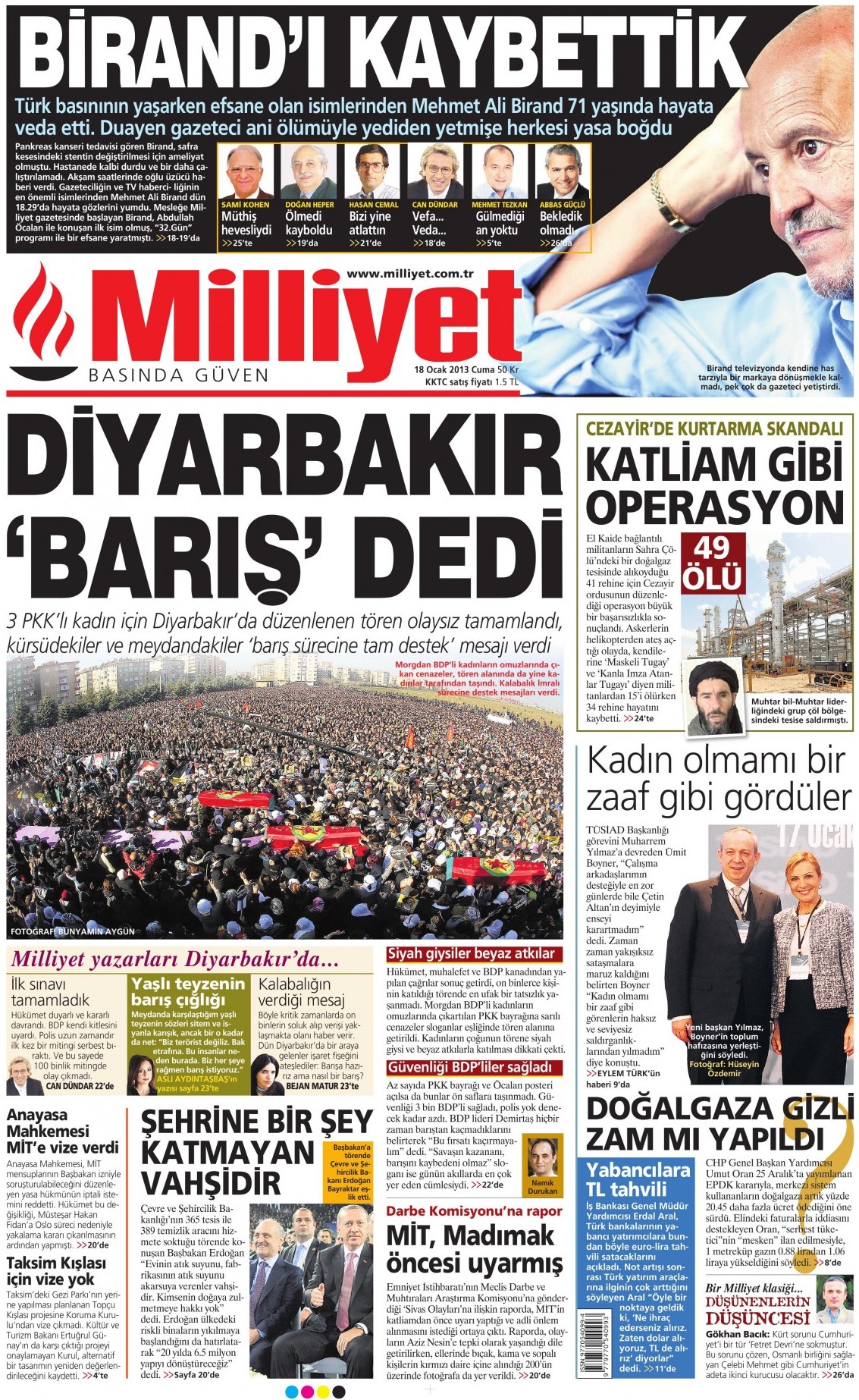
The front page of Milliyet on Jan. 18: ‘Diyarbakır said peace’
That the funerals passed peacefully was a relief not only for the government but also for the Peace and Democracy Party (BDP), which shares grassroots with the PKK. At the moment, both the Justice and Development Party (AKP) government and the BDP have a common interest in continuing the talks. For the process to come to a successful conclusion – still a long way off – this shared interest will need to persist for a while yet.
The New York-based Committee to Protect Journalists (CPJ) has just released its annual report on the number of journalists imprisoned globally – a gloomy read. This year, the global tally reached its highest point since the CPJ began surveys in 1990, with a total of 232 individuals counted as being behind bars, an increase of 53 since 2011. Unsurprising to most in the country, Turkey tops the list this year – followed by Iran and China – with the CPJ counting 49 currently in Turkish prisons for their journalistic activity, (still lower than its last count of 61). A complete list featuring detailed accounts of all imprisoned journalists worldwide is available to view via the CPJ here, while a “path forward” for Turkey, drawn by CPJ Executive Director Joel Simon, can be read here. The CPJ recently focused on the situation in Turkey in a detailed report released in October, which I wrote about on this blog at the time.
In Turkey, most of the newspapers hostile to the government included pieces on the report, with the reliably bellicose Sözcü referring ironically to Prime Minister Recep Tayyip Erdoğan in its Nov. 12 front page headline: “THE MASTER BREAKS THE RECORD: Turkey is the world champion in imprisoned journalists.” Also tongue-in-cheek, daily Taraf dolefully headlined its article on the report: “Again we’re the world’s first!” However, news of the CPJ report was conspicuous by its absence in the Pollyannaish pro-government press – nowhere to be found in Zaman, Sabah, Bugün, Türkiye, Yeni Asya, Yeni Şafak, or Star. Bearing in mind the Doğan Group’s history with the Justice and Development Party (AKP) government, it is also perhaps worth mentioning that neither of its remaining Turkish-language titles, Hürriyet and Radikal, mentioned the report in their print versions either (although both did feature online articles).
Of course, the October CPJ report on Turkey was far more detailed than this latest one, which focused only on the global numbers of journalists in jail. Indeed, the real question of press freedom in the country is rather more complicated than simply a headline figure alone, as I have written before, both here and here. Still, however hypocritical many of the protests on the issue coming from the direction of newspapers like Sözcü are, the situation is certainly deplorable. Complicated as the issue may be, comparing the coverage (or non-coverage) of the CPJ report in the Turkish press at least gives some impression of quite how polarized the media in Turkey really is. Looking at some of the newspapers here, it’s often hard to believe they can be describing the same country.
Yeni Akit shaping the debate?(!)
December 6, 2012
It’s been a while since I last wrote about my favourite hard-line Islamic newspaper, Yeni Akit. It would be wrong to overemphasize Akit’s significance in the overall scheme of things, but a couple of its recent news items are certainly worth mentioning, and indicate that it might have rather more influence than many give it credit for(!)
On Nov. 22, Akit published a story headlined, “Immorality at High School,” containing photographs that it said showed teachers drinking alcohol with their students at a picnic. This photos were taken in the southern province of Antalya, (“known as a castle of the secularists,” according to the article), and were apparently uploaded to Facebook by one of the teachers. “It has been claimed that the teachers are members of the ‘Eğitim Sen’ union, which opposes the headscarf as well as classes on the Quran and the life of the Prophet,” Akit helpfully stated. The Antalya branch of the National Education Directorate opened an investigation into the 11 teachers upon the publishing of the story, but this was quickly dropped after it was established that the photos were in fact taken by a teacher at a family picnic three years ago, and that no students were present. Unbowed, on Dec. 2 Akit went on to publish a photo of a female teacher at the same Antalya school, part of a group at a bar celebrating a friends’ birthday (with glasses of beer on the table). “Do these photographs suit a teacher?” said the headline. However, rather than the Education Directorate setting up an inquiry, the teacher in question is now opening a legal case against Akit.
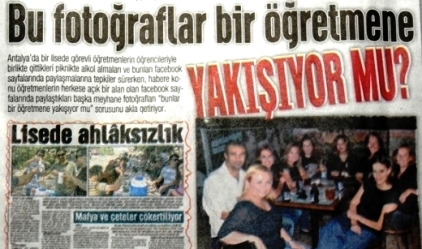
It’s worth mentioning these “photo scandals” because very recently Prime Minister Recep Tayyip Erdoğan used similarly tendentious photographs published in Akit to attack his political opponents. The pictures used by Erdoğan showed deputies of the pro-Kurdish Peace and Democracy Party (BDP) sitting around a table eating kebab, despite the fact that over 600 Kurdish prisoners were entering their 49th day on hunger fasts: “Lamb kebab for us, death fasts for you,” read Akit’s headline. On the same day (Oct. 30) Erdoğan told a meeting of his parliamentary party: “On one hand [they] are eating lamb kebab, on the other [they] are telling those in prison, ‘Die on hunger strike.’” In fact, it soon emerged that the photos had been taken two months before at the wedding of a BDP member in the southeastern province of Mardin.
Erdoğan’s harsh words got a lot of coverage at the time, (here’s the Reuters story on it), but the fact that his source was Yeni Akit obviously received rather less attention. Commentary suggesting that the prime minister is turning Turkey into an “Islamic state” is simplistic and misguided, (a piece in the Wall Street Journal last month claimed that he was “ramming Shariah law into practice.”), but it can’t be a good sign that he’s turning to Yeni Akit for rhetorical fodder to use against his opponents.
On Monday (Oct. 22), the Committee to Protect Journalists (CPJ) released a detailed report on the state of press freedom in Turkey, under the gloomy title: “Turkey’s Press Freedom Crisis – The Dark Days of Jailing Journalists and Criminalizing Dissent.” Although it seems like reports on the subject are released every month, this one received a huge amount of attention, both domestically and internationally. It describes the numerous instances of restrictions on media freedom, citing the familiar examples of the Ergenekon case, the endless prosecutions of journalists writing on Kurdish matters, the increasingly widespread practices of intimidation and self-censorship, as well as the ruling Justice and Development Party (AKP) government’s rising intolerance of dissent.
Bloomberg published a sensible commentary on the same day that the CPJ report was released:
“The committee had come under fire for reporting lower estimates of the number of jailed journalists than other human rights organizations. Turkey’s government has long maintained that only a handful of the journalists were charged with offenses related to their jobs, and because the CPJ hadn’t read all the indictments, it had erred on the side of caution.
“Now it has read the indictments and determined that 61 of the reporters and editors in detention are there because of things they wrote or said in the course of their work. In letters accompanying the report, the Turkish government disputes that characterization and asserts that it is striving to balance the need to prevent ‘the praising of violence and terrorist propaganda, and the need to expand freedom of speech.’
“What’s becoming all too clear during the Justice and Development Party’s third term in office is that despite its claims that the government is now liberalizing press laws and continuing the country’s march toward a European-style democracy, the opposite is happening. …
“Instead of fixing the legal system, the government has used it to repress opponents and intimidate the media. The “insult” laws, as well as the special anti-terrorism courts and laws, should be repealed. They are not worthy of a modern democracy, and they shouldn’t be a model for anyone.”
The report was widely covered in the Turkish media. The Oct. 23 edition of daily Taraf featured the report as its front page headline. It included an interview with Ragıp Zarakolu, a legendary figure in Turkish publishing, who has long written and published bravely on subjects that many others wouldn’t touch. He has spent a significant amount of time in prison over the years for things written or published, and he had some predictably doleful things to say:
“The fact that Turkey is found on these kinds of lists saddens me greatly. Turkey has to go beyond this, but in order to do this a change in mentality is necessary … In the existing system the state’s interests are always seen as more important than the citizen’s interests. For this reason, I don’t believe any changes can come in the end without a process of change in mentality. …
“I’ve been writing in the Kurdish press for 20 years. I witnessed the killing of a 72-year-old editor. Such things aren’t experienced any more. But should we be thankful simply for the fact that we’re not killed, or like Uğur Mumcu we’re not assassinated? Turkey is currently at the end of a 10 year process. But despite constant reforms and improvements being spoken of for 10 years, journalists are still in jail for political reasons, and there are still people who have been in prison for 30 years for political reasons. We have to examine this.”
While it’s imperative to identify the areas in which the current government has attacked press freedom, it’s also important to identify the deeper structural problems undermining freedom of expression in Turkey, too. (I touched on the issue a couple of months ago on this blog.) Also included in the CPJ report is an interview with journalist Yavuz Baydar, in which he discusses some of these problems:
“While the rules of the game in the media landscape remain unchanged, unreformed, what changes are the actors, new proprietors. Turkey’s media owners are – like drug addicts – dependent on the powers in Ankara because they are in all sorts of businesses, need approvals for growth and investments, etc., and therefore keep their media outlets either as weapons for extortion or, at best, at the service of governments. …
“The media owners of these outlets acting as ‘the coalition of the willing’ that openly act submissively to the government and security bureaucracy. I can only refer to a key meeting between the PM and all the media proprietors last autumn, during which media owners went as far as proposing themselves to the PM that they can build a “censor commission” among themselves, to be chaired by a cabinet minister. The PM declined the offer, but the message was taken well. In the case of Uludere, where 34 Kurdish smugglers were bombed to death due to a tragic mistake, there was a full blackout in that media for 17 hours while the news flow was instant and heavy in social media. This pattern of blocking is now the norm.”
A related piece by Baydar, called “Another Gloomy Report,” was published in Today’s Zaman on Oct. 21:
“The greatest source of censorship and increasing self-censorship today [is] the ‘unholy alliance’ between the proprietors of big media groups and the powers in Ankara – a deal that connects mutual greed in terms of money and propaganda. This [will] continue to pollute the climate of good journalism, and even if the government resolved the issue of ‘jailed journalists’ it would leave journalism under huge pressure …
“Turkey’s media, vibrant, diverse, still bold, keen on struggling for its independence, will remain easy prey for those with money and political power.”
Nevertheless, the most immediate threat to freedom of expression still comes directly from the government. Ali Özkaya, a lawyer for Prime Minister Recep Tayyip Erdoğan, was quoted in daily Akşam on Oct. 23, and his words should be alarming to any sentient observer:
“We have to underline that cases we’ve opened against press have been quite a deterrent; the wording of columnists has noticeably changed especially since 2003. Reporters and columnists do not exceed the dose when making criticisms anymore; insulting comments or columns have been reduced to minimum.”
Taraf newspaper and liberal disillusionment (II)
October 22, 2012
I’ve written about “liberal disillusionment” in Turkey through the example of Taraf newspaper before. At that time, (as now), there was much talk about the ruling Justice and Development Party (AKP) government moving away from its reformist impulses and regressing into an increasingly authoritarian conservative nationalism. Taraf had previously been known as a supporter of the government’s anti-military crusade during its first two terms in office, but this support has evidently been waning in recent times, with increasingly strident criticism sent in the direction of the government by editor Ahmet Altan.
Apparently, not everybody at the newspaper is pleased with this new tone, and a heated discussion has recently broken out on its pages. The debate is essentially between those who believe that the AKP government can be redirected back to its previous reformist zeal, and those who think it is beyond saving. Taraf is often seen – by both its critics and its supporters – as being somehow “different” to other Turkish newspapers. However, as Altan writes ironically, there is another difference that has distinguished it of late: “In other newspapers, editors tell their writers: ‘Don’t criticise the government too harshly.’ In our newspaper, the writers tell the editor ‘Don’t criticise the government too harshly.’ I must confess that I don’t enjoy this difference.”
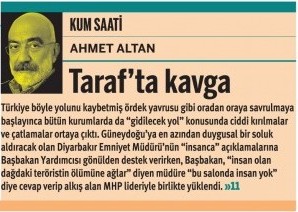
The three main players in the dispute are editor Altan, sub-editor Yıldıray Oğur, and columnist Alper Görmüş. In his criticism of Altan, Görmüş drew a distinction between “critical” and “opposition” journalism, suggesting that what makes Taraf ethically distinct from other newspapers critical of the government was its measured and reasoned criticism, which never veered into automatic “opposition for the sake of opposition.”
Meanwhile, in his own column, Oğur shared Görmüş’s criticisms of Altan, but emphasized a longer view. Mostly focusing on the Kurdish question, Oğur made quite an interesting argument, essentially saying that a bit of tough authoritarianism was necessary in the current situation, and that in the long term a more democratic and palatable system would hopefully emerge. A few eggs have got to be cracked to make an omelette, etc:
“The problem can only be solved by a party like the AK Party, which enjoys the support of 50 percent of society, and by a leader like Erdoğan, who has the broad support of the masses …
“It’s difficult to accept, but the Kurdish question cannot be solved by the Norwegian social democrat prime minister of our dreams. This problem can be solved by a leader who enjoys the support of 50 percent of the population, who Turks still trust even when a new funeral comes every day, and even when he mentions opening new talks with İmralı [referring to Abdullah Öcalan, the leader of the Kurdistan Workers’ Party, or PKK].”
There is a certain amount of onanism to all of this; but, of course, there is a fair amount of onanism to the whole institution of “köşe yazarlık” (column writing) that fills up every Turkish newspaper. Unfortunately, as Justin Vela pointed out recently on Eurasia.org, for many in Turkey: “Having an opinion that you express regularly in a media outlet is enough to make you a journalist.” As I have previously written in a piece on press freedom, although newspaper columnists do perform a certain important function, many in Turkey mistakenly believe that they alone make for an effective forth estate.
(Some) Turkish newspapers report on the AKP Congress
October 2, 2012
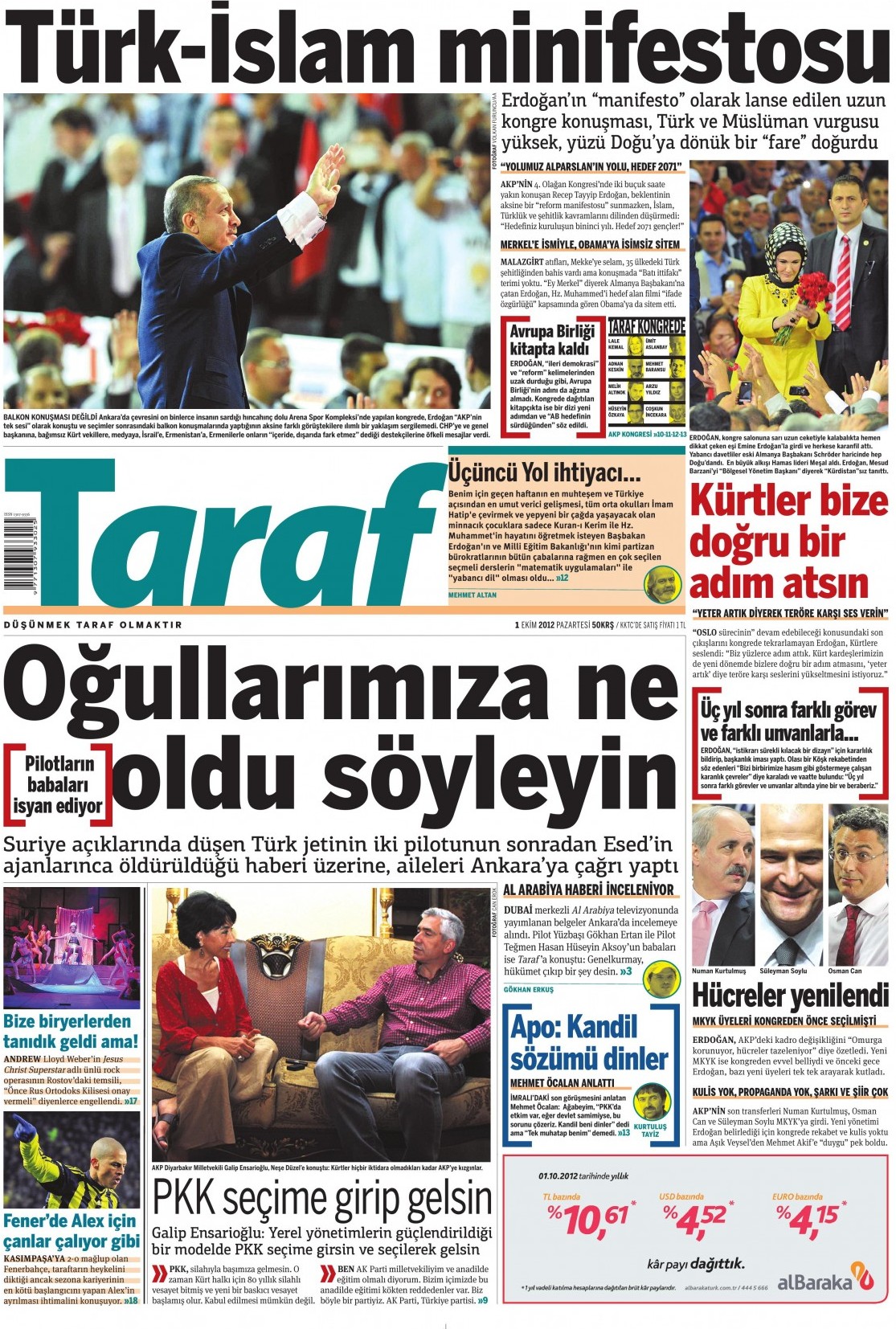
The ruling Justice and Development Party (AKP) held its key congress on Sunday (Sept. 30), the slogan of which was “Büyük Millet, Büyük Güç, Hedef 2023” (Great Nation, Great Strength, Target 2023). Throughout his emotional two-and-a-half hour speech, Prime Minister Recep Tayyip Erdoğan was in full neo-Ottoman mode. He told the 10,000 delegates packed into the Ankara arena that the government was following the same path as Sultan Mehmet II (the conqueror of Constantinople) and Selim I (“The Grim,” who expanded Ottoman territories to the east during the 16th century). He even went so far as to declare – tongue only half in cheek – that the AKP’s new target was 2071, linking the party back to the first Turkish Anatolian state-builders of the 11th century, 2071 being the 1,000th anniversary of Seljuk Turkish leader Alp Arslan’s entry into Anatolia.
It was a speech high in stirring rhetoric. The day after, government supporting newspapers fawned over the “renewal” and “refreshing” emphasis of a new “ustalık” (mastership) era. Daily Sabah focused on what it called the embracing, inclusive nature of Erdoğan’s speech and his words on the Kurdish issue: “Let’s draw a new roadmap together.” Zaman’s front page headline enthusiastically quoted a line from Erdoğan’s speech: “Come, let’s open a new page, let’s say ‘no to terror.’”

The contentious presence of Iraqi Kurdistan Regional leader Massoud Barzani at the congress was rather less trumpeted by Sabah and Zaman. He even gave a speech to the delegates, but the announcer in the arena refrained from using the word “Kurdistan” when introducing him. Indeed, rather than Barzani, it was Erdoğan’s words on the Kurds that received most attention in the pro-government press. This reminded me of one of Nuray Mert’s recent columns in the Hürriyet Daily News:
“The idea of the Ottoman Empire has induced a nostalgic longing for the days when Turkish sultans ruled diverse people in vast lands. For Ottomanists, the idea of the Ottoman Empire as a multi-ethnic haven for diverse cultures and populations is rather misleading, since the basic idea has always been to recall the times when diverse populations lived under ‘Turkish rule.’”
The conspicuously Islamic nature of the congress was also much discussed in the Turkish press – both by those approving and those dissenting. Beside its headline declaring “Great Strength Manifesto,” Islamist daily Yeni Şafak featured an admiring front page box quoting Hamas leader Khaled Meshaal, controversially (or perhaps not) invited to speak at the event: “‘You are not just the leader of Turkey, but also the leader of the Islamic world,’ Meshaal said, receiving extended applause from the crowd.” Indeed, when announced to the audience Mashaal received some of the loudest cheers of the day, (the EU dignitary who was introduced after him didn’t stand a chance!)
Liberal daily Taraf agreed that the congress constituted a Turkish-Islamic “minifesto,” but struck a rather more sceptical tone: “There was a strong Turkish and Muslim emphasis, a mouse with its face turned to the East was born,” (in Turkish, “a mouse was born” means that something underwhelming took place). The paper also noted plaintively that Erdoğan had failed to mention the European Union even once during his speech.
Meanwhile, seven national newspapers were refused accreditation to attend: Cumhuriyet, Sözcü, Evrensel, Birgün, Aydınlık, Yeniçağ, and Özgür Gündem. These publications have diverse sympathies: from left to right wing, from Turkish to Kurdish nationalism. The only thing shared by all is antipathy towards the government.
In response, Monday’s Cumhuriyet included a front page editorial titled “From Cumhuriyet to Public Opinion,” which said some unsurprisingly harsh things:
“Established six months after the founding of the Turkish Republic, our newspaper has been published for 88 years. During periods in the past when democracy has been suspended by the ruling powers our newspaper has been closed down, but outside of this we have always published under the principles of freedom of the press, in the name of people’s right to know. In 21st century Turkey, our newspaper is now exposed to censorship by the ruling powers.
“We will not stay quiet in the face of the anti-democratic implementations applied against us that violate both the constitution and the law.”
The piece went on to detail two constitutional and legal articles that it alleges the congress ban violated: Article no. 69 of the Turkish constitution, which states that internal political party activities, arrangements, and workings must not run counter to the principles of democracy; and Article no. 93 of the Law on Political Parties, which states that decisions taken and actions performed by party central administrations and affiliated groups must not run counter to the principles of democracy.
The International Press Institute’s Turkish National Committee issued a statement about the issue on the day of the AKP Congress, on behalf of the Freedom for Journalists Platform, an umbrella group representing local and national media organisations in Turkey:
“The news that reporters and journalists from some press organs are not allowed to enter the AK Party’s Congress is very worrying.
“Monitoring this historical event of the ruling government party on the spot and transferring it to its readers and viewers are primary duties of news media.
“We have previously protested the accreditation limitations at other institutions. But now, it is very disappointing that the same accreditation is being applied by a political party whose existence depends on democracy.”


 Turkey Book Talk