Social engineering in Turkey from Atatürk to Erdoğan
May 30, 2015
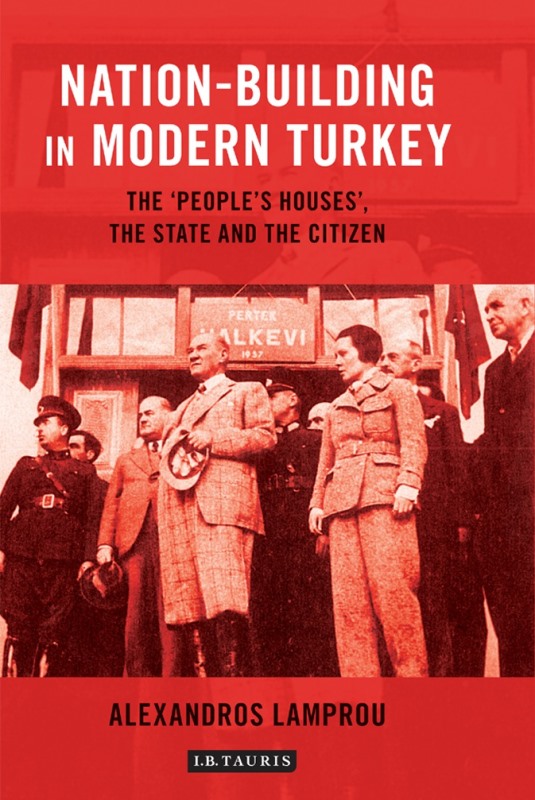
This week I spoke to Alexandros Lamprou, discussing his new book “Nation-Building in Modern Turkey: The People’s Houses, the State and the Citizen.”
The People’s Houses (Halkevleri) were established in 1932 by Turkey’s single-party regime to plant roots for modernising and secularising reforms in towns across the country. Almost 500 Houses were opened until their closure in 1951, and the traditional view has tended to see them as homogeneous institutions propagating reforms strictly according to Kemalist state ideals. Lamprou’s research showed a far more ambiguous picture, with diverse local conditions across Turkey profoundly altering the work of the People’s Houses.
Here’s the interview with Lamprou in the Hürriyet Daily News.
And here’s my review of the book, in which I explore the limits of such social engineering campaigns – from the early Turkish Republic to today.
For those interested in these things, here’s a link to my interview from last year with Mahmut Makal in Bülent Journal. Makal worked as a teacher in a central Anatolian Village Institute, which like the People’s Houses were opened to accelerate the modernization of traditional society. Makal’s books on life as a village teacher describe the uphill struggle to spread reforms in the harsh conditions of rural Turkey in the 1950s, and he was actually jailed by the authorities at the time for painting too bleak a picture.

As a final note, the publisher I.B. Tauris have provided a discount code for online purchases of Lamprou’s book. Details are at the bottom of the review and the interview.
This week I spoke to Eugene Rogan, the author of an authoritative new history “The Fall of the Ottomans: The Great War in the Middle East, 1914-1920.”
Rogan is director of the Middle East Centre at the University of Oxford and also penned a major recent book on the history of the modern Arab world, so I was really happy to speak with him. The conversation was wide-ranging and stimulating, touching on some of the biggest issues around the war – resolved and unresolved – and the continued resonance of the Ottoman Empire’s collapse almost 100 years ago.

Click here to read the interview with Professor Rogan.
Read my review of the book here.
And here’s some footage of Istanbul in 1915 from the British Pathé archives, showing the historic peninsula and various warships heading up the Bosphorus:
PS. I hope my Turkey-based followers can see this post, as WordPress keeps being blocked and unblocked here.
The Sivas Massacre is a ‘19 year lie’: Yeni Akit
July 27, 2012
The massacre that took place in the Central Anatolian town of Sivas in 1993 is one of the darkest episodes in modern Turkish history. On the morning of July 2, a large group of radical Sunni Islamists descended on the Madımak Hotel in Sivas town center, protesting its hosting of an Alevi cultural festival. The mob attacked and set fire to the hotel, which resulted in the deaths of 37 people. Autopsies at the time concluded that the deceased had either died of burns or smoke inhalation.
Radical Islamist daily Yeni Akit’s July 23, 2012 front page carried a large headline declaring “The 19 Year Lie,” accompanied by two photos tastefully showing the morgue full of corpses from the massacre. Aside from the pleasure the paper obviously derived from showing off the photos on its front page once again, the ostensible reason the story was to expose what it called the “lie” that those in the hotel had been killed by the flames. In one of the pictures, a young girl lying on a morgue table, Belkıs Çakır, bears what the paper says is “clearly” a gunshot wound in the chest. This apparently proves that most of the deceased actually killed each other inside the hotel.Unfortunately for Akit, closer inspection reveals that the “blood” from Çakır’s “bullet wound” is simply a braid of hair hanging down from her head.

Akit’s charming July 23 front page
Akit’s piece aroused immediate opprobrium from a number of other Turkish dailies. The next day’s Taraf responded with the headline: “Akit sets fire to Madımak again,” Cumhuriyet said: “One more black publication from Akit,” while leftist-nationalist Yurt bluntly stated on its front page: “A Bigoted Lie.” All included the dismayed reactions from the families of those who died in the tragic incident, as well as their representatives.
Akit said the morgue photos had been hidden for 19 years before passing into their hands, but lawyer Şenal Sarıhan explained to Taraf that the photos were in fact included in a book on the event written by herself, “Madımak Yangını Sivas Davası.” “This book was published in 2002, and it had its third print run in 2011. Akit’s reporter Murat Alan clearly has it. The photos are included on page 97, 100, and 102. To claim that this is the first time they have been seen is completely untrue,” Sarıhan said. Çakır’s original autopsy, she added, was conducted at Sivas’s Numune Hospital, under strict observation. It unambiguously concluded that she had died of burns and from carbon monoxide poisoning. “The definite cause of death was burns and smoke inhalation. There is no dispute on this subject … Neither bullet wounds nor knife wounds can be seen in the photos,” Sarıhan said, adding that the only two people who died of bullet wounds on the day were shot outside the hotel by the demonstrators.
Zeynep Altıok, daughter of the poet Metin Altıok who was killed in the Madımak attack, was quoted as saying that the news did not come as a surprise from Akit. “They have written similar things before. They used to say it was the work of the [outlawed Kurdistan Workers’ Party] PKK. Their aim is to distort the truth. Before, they said it was the PKK, now they’ve gone in completely the opposite direction. I can’t take it seriously.”
Unfortunately, it’s not easy to reason with fanatical Islamists, and Akit’s July 24 front page headline followed on from the previous day, declaring: “Let the autopsies be conducted again”! On July 25, following the condemnations that the earlier pieces had aroused, the paper retreated into comforting victimhood,complaining that the other newspapers constituted a “dirty alliance against Akit … a panicking cartel.”
Yeni Akit is notorious in Turkey as the most vitriolic of the country’s Islamist newspapers. It was established in 2010 after its forerunner, “Anadolu’da Vakit,” was closed down following its failure to pay a fine incurred in 2003 for a piece deemed “insulting to the Turkish Armed Forces” (still officially a crime). Sane-minded observers view Akit with a mixture of incredulity and contempt, and think of it as not much more than a marginal voice on the lunatic fringe. Nevertheless, the fact that it enjoys significantly higher circulation figures than a number of far more respected newspapers must be chastening indeed!
[Hürriyet Daily News (15th June 2012): http://www.hurriyetdailynews.com/ataturk-an-intellectual-biography.aspx?pageID=500&eid=101]
M. Şükrü Hanioğlu – Atatürk: An Intellectual Biography, Princeton University Press, 2011, 280pp
One of the first things guaranteed to strike any newcomer to Turkey is the inescapability of Mustafa Kemal Atatürk – the statues, the portraits in every shop, the street names, the fact that every bookshop has an “Atatürk section,” the fact that every classroom has an “Atatürk Corner.” Whatever truth there is in the concern amongst secular Turks that the founder of the Turkish Republic’s memory is being eroded by a new religious order, it certainly – at least superficially – doesn’t feel that way to the Turkey neophyte.

Of course though, if that neophyte is going to stay for a longer stretch of time, he or she will sooner or later have to get a firmer handle on the Atatürk fundamentals, and Professor M. Şükrü Hanioğlu of Princeton University is the latest to take on the daunting task of producing a biography on the man. As Hanioğlu himself says in the preface to the book, it’s daunting because in Turkey: “For many years, the scholar who aspired to portray Atatürk as he really was resembled the pre-modern historian rash enough to attempt a depiction of the historical Jesus.” Though restricted in scope to the influences that shaped the “intellectual” character of its subject, (rather than filling in details of the personal life story), “Atatürk: An Intellectual Biography” is a sane, fair-minded primer to the ideological forces that shaped the “Father of the Turks.” Unlike so many titles in that “Atatürk section” of the local bookshops, it is resolutely a biography – not a hagiography.
The first step to challenging any holy text is to read it as a product of its historical context. The major objective of this book is to do the same with Atatürk, presenting him as an intellectual and social product of the late nineteenth and early twentieth century Ottoman Empire. The influences affecting the elites of the late Ottoman period are thus given ample space, demonstrating the essential continuity that Mustafa Kemal represented. Even though politically he was to become the symbolic figurehead of the sudden rupture between the old imperial order and the new republic, in crucial respects Atatürk was simply the inheritor of the late Ottoman reformist legacy. This historical continuity is one of the central themes that emerges from almost all serious contemporary historical writing on the period. Hanioğlu summarises:
“it is imperative to realize that Mustafa Kemal emerged from within a specific social milieu … many of the radical ideas destined to become central planks in his reform program were widely held in intellectual circles at the turn of the century … Despite the radical changes that it brought about, the Turkish transformation led by Atatürk was not a rupture with the Late Ottoman past but, in important respects, its continuation.”
While official Turkish historiography considers the founder of the TurkishRepublica kind of omniscient leader for all times, untrammelled by the age in which he emerged, this book paints a convincing alternative picture.
In this respect, the discussion of nineteenth century German military theorist Colmar van der Goltz’s idea of “the Nation in Arms” is particularly illuminating. Goltz held that a state’s military elite should be afforded an exalted role as the ultimate guide of society, a “superior position” being “the natural due of officers as a class.” Such ideas found fertile ground in the lateOttoman Empire, and Goltz was chosen to lead a restructuring of the Ottoman Royal Military in 1883-84. His theories had an obvious effect on the Committee of Union and Progress, (the group of military officers later known as the Young Turks), which swept to power in 1908, and were clearly significant in justifying the military’s later elite position in the Turkish Republic. Equally important to Ottoman thinking of the time – and consequently to Atatürk – was another German import, the concept of Vulgarmaterialismus:
“a vulgarized version of the doctrine of materialism, fusing popular notions of materialism, scientism, and Darwinism into a simplistic creed that upheld the role of science in society. The late Ottoman version of this materialism was a further simplification of the German original and a medley of highly disparate ideas.”
Hanioğlu remarks on the inherent irony of the self-contradictory, one-dimensional worship of scientific materialism by the era’s elites, a secular creed held on to with as much unquestioning zeal as the most pious of religious believers. The early republican fetish for the all-encompassing power of science was clearly a direct inheritance from this late Ottoman tendency.
Such oversimplification also gave rise to some of the more eccentric, often troubling republican intellectual predilections. The scientistic cult logically led to scientific racism and theories of exclusivist Turkish racial superiority, (the body of 16th century imperial Ottoman architect Mimar Sinan was exhumed in 1925 to confirm the brachycephalic shape of his skull, in order to prove beyond all doubt that he was, indeed, an ethnic Turk). It also fed into the aberration of the various Turkist language theories – which resulted in the brutal purging of all “foreign elements” in order to form a new “purified” Turkish language, with artificial replacements dredged up from ancient Turkic languages. In the words of Geoffrey Lewis, the reforms were a “catastrophic success,” and meant that Atatürk’s famous 36-hour speech of 1926 had already become unintelligible and had to be rendered into modern usage by 1963. There was also the new Turkish history thesis that found its way into official Turkish textbooks, which involved a comprehensive effort to prove that all ancient civilisations, including Greece and Rome, came from a central Asian Turkish wellspring. Despite obviously being nonsense, this revisionist interpretation of human history was seductive because it served a number of practical purposes. Firstly, it helped bypass the awkwardly religious Ottoman past; secondly, it helped pre-empt claims by rival nationalisms that Turks were latecomers to Anatolia; and thirdly, in the Turks’ mission civilisatrice, it also sought to solidify Turkey’s position as an integral part of the West, (although even this may have been a step down for some, with one contemporary text claiming that “Turks lived clothed during the stone age in 12000 BC, while Europeans reached that stage 5,000 years later.”) Atatürk never feels further from the figure of the high Enlightenment – and closer to his own, authoritarian age – than when we read of these quixotic social engineering projects. (I was struck recently when my neighbourhood plumber, Ali, while repairing some piping in my bathroom, began expounding something that sounded suspiciously close to the “Sun Language Theory.” I used to think of such things as being not much more than an eccentric footnote, representing the lunatic fringe of the early republican age, but perhaps I was being too generous.)
Nevertheless, despite the fact that it was personally one of his central intellectual pillars, Atatürk tended not to emphasise the more esoteric expressions of his Turkism until the future of the republic had been properly secured. Until this time, Hanioğlu stresses, Atatürk displayed an often underappreciated pragmatism as a politician. This is especially the case with regard to religion, which is far from the black and white picture that is often assumed. Atatürk was never averse to invoking Islam, particularly early on, when seeking to mobilise the masses in the struggle against the Allies and the non-Muslim populations, which were seen as a mortal threat to the very independence of the nation. Despite his contempt for communism, he also made use of a “purely rhetorical Socialism,” largely aiming to maintain the young republic’s alliance of convenience with theSoviet Union. “This pattern of dissimulation,” Hanioğlu writes:
“was undoubtedly part of a deliberate strategy to align the nationalists with the most powerful and broad-based ideologies of resistance, while obfuscating the exclusionary objectives of the movement. This ideological mishmash was crucial to Mustafa Kemal as he performed his difficult role as political leader, diplomat, and supreme military commander.”
Although he was the leading figure behind the abolition of the Ottoman Sultanate and, soon after, the Islamic Caliphate, this too was achieved in an extremely careful, gradualist way. As is often the case, what seems now like a sudden jolt and break with the past can, in many senses, be seen as merely the logical culmination of tendencies that had been developing for decades.
Westerners tend to view the Turkish adoration of Atatürk in rather narrow, technocratic terms, without understanding that the emotional resonance his image has across Turkish society couldn’t possibly be accounted for by his intellectual convictions alone. Like all icons, his image is still powerful in today’s Turkey because it has been effectively divested of all meaning, and the viewer can invest it with whatever symbolism he or she wishes to. As in any personality cult, Atatürk’s image must necessarily mean different things to different people. Depending on the context, Hanioğlu says, Atatürk “may be invoked in support of ideas that are étatist or liberal, nationalist or socialist, religious or scientistic, elitist or populist.” A westernised Turk on the Aegean coast might revere him for his secularizing, modernising vision, whilst a religious conservative in Central Anatolia can selectively ignore this, and instead place the emphasis elsewhere – perhaps instead respecting the strongman who successfully defended his homeland and gave the West a bloody nose. He probably sees no contradiction at all in praying five times a day while also passionately admiring Atatürk.
Shared by both caricatures is a veneration for the redeemer of the nation, and it is this aspect more than anything else that lends Atatürk the emotional impact needed to endure. This is the reason why detached and technical books like this, while welcome, can really only ever have a minor impact. The majority are guided by impulses rather less rational and rather more emotional. Atatürk himself understood that, even though it is this paradox that perhaps ultimately illustrates the limits of his ultra-rational, positivist intellectual convictions.
[Published on openDemocracy (20th June 2012): http://www.opendemocracy.net/william-armstrong/turkey-as-test-case-in-multipolar-post-cold-war-order]
Much is made of Turkey’s ‘difference’ in the Middle East. Why is it being identified an inspiration to the region? Why is there talk of Turkey as a model for Egypt, and not the other way around? In a recent interview with Turkish Policy Quarterly, historian Bernard Lewis makes much of Turkey’s republican history of independence and self-criticism since the Ottoman era, which he says accounts for the country’s regional pre-eminence today. Whilst these differences are indeed significant, a reasonable case can be made that they were not nearly so pronounced as Lewis claims. In fact, after the Second World War, Turkey was no more immune to the hard choices that had to be made in a bipolar world order than other Eastern European and Middle Eastern states. As such, like many others, it was only ever nominally independent.The difference between Turkey and the other countries in the region, however, is that it was able to emerge much more quickly in the post-Cold War era, when states previously under Soviet influence became independent, and the ‘protection’ of those under U.S. sway was rendered unnecessary. This emergence can be ascribed to Turkey’s higher economic, educational, industrial and institutional development, as well as its important narrative of national sovereignty and proud republican history. Its regional pre-eminence today is therefore closely linked to its status as a pioneer of the new, multi-polar post-Cold War era. The sense that the country is now defining itself, as opposed to being defined by outsiders, is a crucial psychological hurdle.
For the duration of the Cold War, the Middle East was an object region acted upon by outside forces, rather than a subject acting for itself. In practice, this meant states being pulled into the influence of either the U.S. or the Soviet Union. Turkey was no different in this sense, and was considered by Washingtonan essential bulwark against communism on the south-eastern fringe of Europe. In order to anchor Turkey to the west, the U.S. bankrolled the Turkish military through the Truman Doctrine in the post-war era, and it was made a full member of NATO in 1952 (at the same time as Greece, the other subject state of the Truman Doctrine). U.S. support – tacit or otherwise – was crucial in the three military coups of 1960, 1971, and 1980, all of which helped to maintain the status quo order. Like so many others, during the Cold War period Turkey was barely democratic, with its western allies preferring a stable, reliable partner to one that genuinely reflected its people’s unpredictable wishes. The 1980 coup is particularly instructive, being seen by the U.S. at the time as necessary to prevent any danger of the country sliding towards communism, as the Turkish left was extremely mobilised throughout the 1970s. CIA Ankara station chief at the time, Paul Henze, is on record as saying that he cabled Washington – shortly after the coup had been carried out by the Turkish military – to say ‘our boys did it’. Gossip perhaps, but illuminating gossip.
The 1980 coup therefore illustrates the old Turkish model, and its similarities with the systems that have also characterised the Arab world in the recent past: U.S./western support for an essentially non-democratic state, in return for the guarantee of stability. Turgut Özal, who became Prime Minister in 1982, could therefore be seen as a kind of non-military Turkish version of General Pinochet. Coming to power shortly after an American-backed coup, Özal was pro-U.S., anti-communist, and neo-liberal – significantly opening up the Turkish economy to international market forces with U.S. support. It’s an interesting irony that in many ways it was these very reforms that helped prepare Turkey to develop economically in the post-Cold War era.
After the Soviet Union collapsed, it also – perhaps paradoxically – became increasingly clear that the old U.S.-dominant model had also become redundant, with much of the previous justification for U.S. support to stable but undemocratic regimes having been lost. Slowly, it became possible for new, popular movements to emerge in the region, and this goes some way to explaining both the revolts sweeping across the Arab world today as well as Turkey’s (less violent) development of a strongly independent government representing popular will. There are, however, significant differences that may legislate against post-Cold War Arab countries following the same trajectory as Turkey. Not least of these is the multi-ethnic, multi-linguistic, multi-confessional nature of most of these countries – none can really be considered ‘nation states’ in anything like the organically-evolving western European sense of the world. Turkey’s own early 20th century nation-building project relied on an enormous amount of violently imposed state-directed social reorganisation, essentially imitating the western model, (in terms of the uniform cultural, ethnic, linguistic, religious cohesiveness that was stressed). On its own terms, the Turkish model of modernisation was successful – taking a multi-linguistic, multi-ethnic population and forging out of it a unitary, monolingual, officially mono-cultural state. In the modern nation states of the Arab world, with their fragmented and multifarious social, ethnic, religious, linguistic, sectarian structures, it is difficult to see how the same results can be achieved in the early 21st century – or even how such results would be desirable. The new Middle East is perhaps more likely to be one where – instead of two great outside powers seeking to impose their influence and maintain an unthreatening stability – a regional struggle will play out between multiple competing local forces. This struggle will be based on old fissures that the old Cold War order had previously kept an uneasy lid on.
[Hürriyet Daily News (21st May 2012): http://www.hurriyetdailynews.com/the-bridge-a-journey-between-orient-and-occident-.aspx?pageID=500&eid=53]
Geert Mak – The Bridge: A Journey Between Orient and Occident, Random House UK, 2010, 160pp
The Galata Bridge is one of the more obvious metaphors for all those oppositions that Istanbul is famously caught between: Occident and Orient; east and west; tradition and modernity. The half-kilometre stretch across the Golden Horn connects the “historic” old Stamboul – with the imperial mosques, palaces and bazaars – to the “modern” Galata and Pera – originally settled by Genoese merchants and later the quarter of European ambassadors, diplomats, traders and artists. Geert Mak roamed the entire European continent for his impressionistic 2004 travelogue “In Europe,” but this book offers a complete contrast in terms of scale.
As Mak himself wryly states, “The Bridge” is “a travelogue covering 490 metres,” his focus having infinitely narrowed to one bridge, in one corner of the old continent. The book is subtitled “A Journey Between Orient and Occident,” but I suspect that’s a marketing decision from the publisher, rather than from the author. Mak is wise to the cliché, and he makes sure not to labour it. Instead, his book mainly focuses on the vicissitudes of today’s bridge-dwellers, and in this it is a triumph of understated sensitivity.

Over the years a total of five bridges have been built on the site: two wooden, two iron, and one (today’s) concrete (“not a pretty sight”, Mak laconically observes). Istanbul, he says, “is a classic city […] poverty has pitched its tent in the heart of the old city, the middle classes, ring after ring, live further and further away from [it].” As the city’s breakneck modernisation continues apace, this old arrangement is coming under increasing pressure, but it still largely holds true. In a sense, the Galata Bridge is the centre of this pitched tent, so much of the book concerns itself with giving the reader a vivid sense of the consequences that an urban hand-to-mouth existence, (“an economy of spare change”), has on those who spend their lives on the bridge. “The lives of the tea seller, the cigarette boys and the insole vendor are set against the backdrop of a remarkable corner of the globe, but precious little good that does them,” Mak suggests.
To anyone who has crossed the Galata Bridge recently, or got trapped in one of those underground shopping tunnels that take you across the roads on either side, the sights described in the book will be familiar. Those knock-off children’s action figurines crawling mechanically in the lids of cardboard boxes; the fake perfumes; the fake mobile phones; the cheap sets of pens; the cheap tea; cheap shoes; jeans; umbrellas; insoles; shoelaces; smuggled cigarettes; condoms. However, I doubt anyone has stopped to take such an interest in the people behind these items as Mak, and this is where “The Bridge” is a revelation. We are introduced to the drifters selling those petty goods, as well as the indefatigable fishermen dangling rods (with steadily diminishing returns) over the bridge’s rails, the lottery ticket sellers, glue-sniffers, and pickpockets. Most are displaced migrants, having come to Istanbul from somewhere in eastern Anatolia, perhaps from a village now deserted, or one that simply can’t support them anymore. This mass of rootless internal migrants makes up an ever increasing proportion of Istanbul’s uncontrollably booming population, and Mak gets most of his material by simply mining them for stories, painting an authentic picture of the bridge’s unique fauna. He lets the people he meets on the bridge talk about their backgrounds, their daily routine, the starkness of their prospects, the financial knife-edge that a living scraped by selling cheap plastic umbrellas from a cardboard box entails, the psychological contortions required to maintain some sense of personal dignity or honor. As one man (and this is a resolutely male landscape) says: “Everyone here, almost all of us come from the back of beyond […] But there’s nothing there for us. Unless you want to go into the mountains, to join the terrorists. If you don’t want to do that, you have no choice but to make the best of things here, to sell tea, or flog pirated CDs, or shift stolen mobile phones, or sell fake perfume…” Almost all harbor dreams of migrating to Europe. One of the umbrella sellers once tried to smuggle himself into London, but was detected by the immigration authorities at Heathrow and sent back to Turkey, and now dreams of suing Britain.
The narrative is divided between these personal ruminations and more widescreen historical vignettes, which elegantly sketch the background that has shaped the way the bridge – and the city itself – have come to be the way they are today. Mak vividly describes the historical, Ottoman Istanbul, a city of all creeds of Christians, Jews and Muslims. It was, he says, “perhaps the most multicultural city of all time,” but at the same time it was run according to strictly defined lines of demarcation: Istanbul “consisted of communities that worked and did business together, but were otherwise imprisoned in their own compartments of neighbourhood, house, family, gender, rank and standing […] all these peoples and cultures inhabited worlds of their own. The city’s tolerance depended on looking the other way; contact with those other worlds was devoid of all curiosity.” Interestingly – and perhaps a little fancifully – Mak finds some kind of continuity between those historical hidden lines of division and modern ones constructed by the displaced internal migrant drifters. The bridge has its own intricate sociology of “economic compartmentalisation.” “Countless tightly knit immigrant communities exist in this way, all of them operating in isolation from the others and within the strict borders allotted them […] The fishmongers all hail from the eastern city of Erzincan. Most of the professional anglers come from Trabzon, on the Black Sea. The rods and tackle, on the other hand, are sold generally by immigrants from Kastamonu […] And if you’re Kurdish there is no sense in trying to rent a space and fry fish, for that monopoly is in the hands of another group.”
Mak is never boring, but he is on less sure ground when trying to chart a course through the choppy waters of the city’s modern political situation. One pages-long section in particular – attempting to unknot the delicate “headscarf question” with little more than platitudinous observations – feels too deliberate, like a hunk of meat thrown only because he knows the audience back in western Europe is interested in these things.
Describing the brutal realities of a life spent in perpetual, unbreakable poverty, it would be easy to slip into mawkishness, but “The Bridge” never does. This is an admirably warm-spirited, well-judged book. It’s occasionally lyrical, but never patronises or succumbs to sentimentality. Mak spent his time on the bridge wisely, observing and talking to the people he found, always with an eye on the history that has formed the city. It is this dual vision that makes the book a success. He pulls off a smart trick: by focussing on a small geographical area and a limited cast of characters, he is able to give us a convincing, holistic portrait of a wider society and its conflicted place in history.
[I’ve started writing book reviews for the Hürriyet Daily News blog. I’ll be able to post them here a couple of weeks after they first appear on there (contractual yawn). This one went up on May 5, and can be found in original form here: http://www.hurriyetdailynews.com/literary-reflections-on-the-armenian-issue.aspx?pageID=500&eid=16]
Ece Temelkuran – Deep Mountain: Across the Turkish-Armenian Divide, Verso, 2010, 288pp
Fethiye Çetin – My Grandmother, Verso, 2008, 144pp
There’s a book, quite easily found in any reasonably-sized Istanbul bookshop, its name written in block capitals along the spine: ‘Ermeni Dosyası’ (The Armenian Dossier). Written by former Turkish diplomat Kamuran Gurun, and ominously subtitled ‘The Myth of Innocence Exposed’, it has been popular amongst Turkish readers ever since first being published in1983. Packed with imposing-looking graphs and statistics, its main thesis can be summarised thus: The numbers claimed by the Armenians as killed in the ‘events’ of 1915 is far too high and, in fact, Ottoman soldiers were themselves also killed in large numbers at the same time. In any case, the Armenian population was far from innocent, with large numbers rebelling against the empire and often colluding with the advancing Russian forces on the eastern Anatolian frontier. Essentially, the book implies, the Armenians got what they had coming to them. If you’re interested, a new English-language print run of the book came out only two months ago. I haven’t read it, nor do I ever intend to make that sacrifice, but – however questionable its scholarship – ‘The Armenian Dossier’ is unquestionably significant, if only because it represents what has been the official Turkish narrative for almost 100 years.
Encouragingly however, this isn’t the only story on the shelves any more. While they still may not attract the sales figures of more flattering histories, voices dissenting from the official line are being increasingly heard in today’s Turkey. Ece Temelkuran was once a columnist with daily newspaper Habertürk (ironically enough one of the mouthpieces of the nationalist establishment) and her ‘Deep Mountain’, published in English in 2010, is part of this new, questioning tendency.

Temelkuran set herself the ostensibly simple task of meeting Armenians, talking to them, listening to them, and reporting back for the Turkish audience. Eschewing the directly political, she preferred ‘to write about Armenians, not necessarily what happened in 1915’, and while this may seem like a modest undertaking to an outsider, in Turkey it was a brave and taboo-shaking exercise. Quite how perilous the path was can be judgedfrom the example ofthe Turkish-Armenian journalist Hrant Dink, to whom Temelkuran dedicates the book. Dink decried the politics of megaphone slogans and foreign parliamentary writs on the issue, and instead spent years trying to get the two sides talking to each other honestly about their shared history and common trauma. He was assassinated for his troubles in 2007 by an ultra-nationalist Turkish gang, outside the Istanbul office of his newspaper. Dink’s killing could have acted as either a spur to writing, or a warning against it, so – first and foremost – ‘Deep Mountain’ should be applauded as an act of bravery.
The book is divided into three parts, the first detailing Temelkuran’s encounters with the Armenians of Armenia itself, and the other two her meetings with the Armenian Diaspora communities in Franceand the United States. The picture painted of Armenian capital Yerevan is of a cultured but impoverished city of feeble opportunities and feeble ambitions, still yet to recover from the end of the Soviet Union and now crippled by the closed (since 1993) border with Turkey. Whilst bitter enmity for Turks exists, the Armenian Armenians are perhaps most concerned with the practical matter of getting the border open again, and with it securing an economic lifeline. The French and American Armenians, however, have come to adopt the genocide as the essential, irreducible feature of what it means to be ‘Armenian’. Meeting numerous community leaders, academics, artists, and businesspeople, Temelkuran describes the trajectory that emerges again and again in the Diaspora: How the first generation of Armenian migrants to Europe and America were most concerned with ‘getting on’ and fitting into the adopted culture, and how it is only with the second and third generation – threatened by the identity-engulfing vortex of a new homeland – that the genocide has been revisited and latched on to as an unshakable, almost pathological core.
As one of the Los Angeles Armenians revealingly says: ‘you need to create an identity, something to hold on to both culturally and individually. Turkey’s refusal to recognise the genocide is what binds those of us in the Diaspora. Were the genocide to be recognized, it would probably be the end of us’. Pain has become ‘the pillar propping up the home’, and to release that pillar means oblivion. Similarly, many Turks – afraid of losing their country and seeing recognition as threatening their own oblivion – cling just as fast to their own selective amnesia. In a striking phrase, the author at one point describes it as a ‘huge industry. Not just politics and money; a psychological industry too, for both sides. An industry of anguish’. The most sympathetic portraits in the book are thus reserved for those who are able to understand this identity paralysis and rise above such acrimony, recognising the absurdity of an official political ‘debate’ that doesn’t go much deeper than one side screaming ‘It was genocide!’ while the other responds ‘No it wasn’t!’
Perhaps inevitably, the book occasionally lapses into worthiness,though not nearly as often as you fear when you read the following meaningless fluff early on: ‘If an Armenian were to lose their way one day anywhere in the world, they’d be able to locate the capital of Armenia by consulting the map of their heart. They would navigate toward it by reference to the coordinates of pride and fear, of mourning and loss’. Worse, when she moves on to Los Angeles, Temelkuran can’t help butoffer a steady stream of unhelpful anti-American swipes. These come off as stale, predictable, and not a little immature (constant sneering about cigars and McDonalds, really?!) But these are minor criticisms, and should not detract from the more important qualities of a book that is sensitive, honest and ‘engaged’ in the best sense of the word.
Another modern voice with little time for the official Turkish narrative is Fethiye Çetin, a human rights lawyer currently representing the deceased’s family in the grimly ongoing Hrant Dink case. Çetin spent her whole youth believing she was of ‘pure’ Turkish stock, until one day her aging grandmother, Seher, took her aside. Seher revealed that she had been born an Armenian Christian, originally named Heranuş, and was plucked from a death march in 1915 by a Turkish gendarme commander, who went on to raise her with his wife as a Muslim Turk. Translated into English in 2008, ‘My Grandmother’ is Çetin’s elegiac description of this story.

The first section of the book contents itself with gentle, sepia-tinged descriptions of a rural upbringing with her family in the eastern Turkish province of Elazığ: her beautiful sisters; her grandfather, whose mood always depended on how full his stomach was; her grandmother, the charismatic matriarch of the family, powerful but taciturn, somehow never able to bring herself to sing, as if always harbouring the secret that would one day be revealed to Fethiye. The central revelation doesn’t come until midway through the book, but when it does Çetin writes that what she heard ‘did not fit with anything I knew. It turned the known world on its head, smashing my values into a thousand pieces’. Seher, or Heranuş, was one of the kılıç artığı, the ‘leftovers of the sword’ of that traumatic period; only one of her sisters was also spared, while the rest of the family – including uncles, aunts, cousins, and her mother – was killed. The second part of the novel consists of Çetin trying to digest this heritage, and also trying to forge a reunion of the two sides of a family which now – like so many Armenian families – is ‘scattered like pomegranate seeds’ across the world.
It’s a quietly powerful book, modest but courageous. There are no unnecessary fireworks or forced emotions. In a way, it could be seen as a manifestation of the very thing Temelkuran advocates in ‘Deep Mountain’, a kind of picking up of the baton. There’s little in the way of direct politics and no recriminations: I don’t think the word ‘genocide’ is mentioned once in the entire book (and that’s not because of Turkish laws against these things). It’s simply a human story, told in an unshowy, humane way.
Both Temelkuran and Çetin manage to address the vexed Armenian issue with admirable clarity, concerning themselves with the personal and the human as a kind of riposte to the debilitating rancour of the official, political dispute. Both try to chart a precipitous course between two entrenched sides that long ago stopped listening to each another; neither condemn anything other than this wilful deafness. In the years to come, one can only hope there are more books published like these two, and less like ‘The Armenian Dossier’.
The neo-Ottoman view of history
April 10, 2012
As the modern vogue for neo-Ottomanism lurches on in Turkey, the contrasts between the contemporary Turkish and British approaches to national history are for me becoming ever clearer. Neither is particularly encouraging, but both are the understandable result of respective historical inheritances.
Ever since the French Revolution, the British have defined themselves against that chaotic pole across the channel: reform rather than revolution has been the rule. Moments of crisis or turmoil have been home grown, not imposed from outside, and the country has always felt able to define itself on its own terms. For all its trauma, even the Second World War only served to confirm Britain in its sense of historical and moral righteousness; no awkward compromises had to be made, and the good ship sailed confidently on. Over time, however, this serene progression has engendered its own problems. Never having been forced to reflect upon it, the general population of modern Britain has slipped into complacent somnambulism about the past. Despite its importance, a dangerous ignorance surrounds the effect and significance – for better or for worse – of the British Empire, which is barely spoken of in today’s Britain and poorly understood by the general public. I recently took one of the example practice ‘citizenship tests’ on the British foreign office website, and while there are plenty of questions about the role of county council representatives or the frequency of local rubbish collections, there is almost nothing on the most fundamental episodes of national history. Compare this with other, similar western states – many of whose own citizenship tests I also had a look at (an exhilarating couple of hours) – and the contrast is far from flattering. Perhaps the crowning symptom of this malaise was the previous Labour government’s decision to remove history as a compulsory subject for students up to 16: an unforgivable sin.
Turkey’s relationship with its past is a lot more fraught with traumatic ruptures, conscious jolts forward, and moments of forced amnesia. Since the founding of the Turkish Republic in 1923, state policy has dictated that to look back on Turkey’s Ottoman past is backward and reactionary – somehow a betrayal of the modern Turkish nation state. The recent ‘neo-Ottoman’ challenge to this stultifying official diktat should therefore be welcome, but it’s so hollow and uneven as to be almost as problematic as what went before. Turkey’s newfound obsession with the past – evident in seductively-costumed films and T.V. series’; architecture; foreign policy; even fashion and interior design – shows no serious attempt to consider anything other than the most flattering, least challenging aspects of national history. A recent post on the Tarlabaşı Istanbul blog quotes Prof. Dr. Uğur Tanyeli on the subject, discussing the architectural example of the tawdry wedding cake confection of the “historically recreated” Demirören shopping mall on Istanbul’s İstiklal Caddesi:
“The fewer traces of the past [an object] carries, the more successful a preservation [is believed] to be … there is not only the Demiören shopping centre, but there are hundreds of buildings along the Bosporus like that. There are ‘renovated’ buildings dating back to the 13th century that look like they have been built yesterday and where not a single screw is historically justified … In Turkey, the historical has to be brand-new and squeaky clean. So what is actually wanted is the illusion of history – It has to be historical, but it is not allowed to carry any baggage of the past, or any of history’s patina, there can’t be anything about it that creates unease.”
The ongoing renovation project in Istanbul’s central Tarlabaşı district is also instructive. Having finally been vacated, most of the historical houses have been mercilessly gutted and left pray to looters and rubbish dumpers. As their sinking bay windows morosely cave in on themselves, it’s hard to see how many of these shells even remain standing. It looks depressingly likely that they are simply going to be demolished, to be replaced by historically empty ‘imitation’ replacements. The so-called ‘regeneration’ of Tarlabaşı’s old buildings thus symbolises the modern, neo-Ottoman view of history: a facile attempt to reclaim the past, without the inconvenience of the antiquated plumbing systems of a truly authentic picture. As Prof. Tanyeli says, it’s “an interesting dilemma … they want the historical, but they do not want anything old”.
Oscillating from queasy shame about the past to shallow glorification of it does not indicate a country at particular ease with its history. Freedom from such jolts, however, can result in the complacent amnesia about the past exemplified in modern Britain. It’s difficult to know which is less healthy.
Europe, Turkey and historical amnesia
April 2, 2012
[Published on openDemocracy (27th March 2012): http://www.opendemocracy.net/william-armstrong/europe-turkey-and-historical-amnesia]
“In the first years after the war … Europeans took shelter behind a collective amnesia.” – Hans-Magnus Enzensberger.
In his robust case for a liberal Euro-scepticism, ‘A Grand Illusion?’ (1996), Tony Judt robustly debunked an oft-repeated myth about the post-war rebuilding project in western Europe. From the very start, rather than being part of a carefully planned attempt to reshape the continent by deliberately sabotaging nation-states from above, (with the eventual goal being to unite the entire continent under one umbrella European super-state), initial moves after the Second World War towards greater European cohesion were, in fact, the logical result of quite distinct national concerns. These concerns only converged in shared European projects by force of convenience. As Judt points out, post-war European cooperation was “a fortuitous outcome of separate and distinctive electoral concerns, economic interests, and national political cultures, it was made necessary by circumstance and rendered possible by prosperity.” In particular, the war of 1939-45 had the lasting consequence of giving the continent something else in common: “a shared recent memory of war, civil war, occupation, and defeat […] The shared experience of defeat points to another common European wartime experience: the memory of things best forgotten […] Hitler’s lasting gift to Europe was thus the degree to which he and his collaborators made it impossible henceforth to dwell with comfort on the past.”
Almost every European participant emerged from the Second World War having lost. The shared perception of a necessity for deliberate historical amnesia in post-war Europe, for forgetting the traumatic recent past, was thus one of the most significant points of convergence between nation states that helped legitimate the new European project. Cooperation was imperative, and part of this cooperation was the tacit agreement between nations as to the importance of ignoring their own roles in the madness of the war that had just ended. At the very most, if not forcibly ignoring, countries tended (or still tend) to absolve themselves of as much responsibility as possible, to trumpet exaggerated national myths of resistance to fascism. The phenomenon is observable in France, (formerly West) Germany, Belgium, Poland, Italy: such methods were considered something like an existential necessity, necessary in order for states to get over the Second World War as cohesive units. It is only since 1989 and the end of the Cold War that a more complex, honestly realistic picture of the European inheritance has emerged, and even now it’s clear that many countries are still far from willing to look their own troubled histories directly in the eye. The official French line, for example, shared by a majority of the French people, continues to exaggerate the significance and size of the French Resistance, and underestimate the completeness of Vichy France’s submission to fascism, and its horrendous consequences. There’s a salutary lesson to be taken from a charmed visit to Paris: its state of flawless architectural continuity was paid for at the price of submission to the Nazis.
In its capacity as a candidate country of the European Union, Turkey’s apparent refusal to come to terms with the Armenian “events” of 1915 is often cited as a clear example of why the country is unsuitable for membership. However, the opposite could well be true. Far from having to recognise these events as “genocide” in order to adhere to established European norms of historical account-settling, Turkey’s continued denial of the Armenian “events” should rather be seen as an advantage, recommending it as an entirely suitable European candidate. Following classic post-war European form, perhaps Turkey’s historical amnesia should be seen as one of the key criteria that it fulfils in its wish to be defined as an authentic European state!
Turkish Islam & Turkish Nationalism: A New Balance (Turkish Policy Quarterly, Winter 2012)
March 2, 2012
[This is an extended and elaborated version of a piece I posted on here some time ago. It is published in the latest, Winter 2012 edition of Turkish Policy Quarterly, which is available for purchase now. You can read the piece below or, along with a slightly anaemic abstract, in its original habitat here: http://www.turkishpolicy.com/article/674/turkish-nationalism-and-turkish-islam-a-new-balance/ ]
Since the establishment of the Republic of Turkey in 1923, received wisdom has tended to consider nationalism and Islam as mutually incompatible forces in the Turkish context. Turkish nationalism – so this narrative goes – is defined by the secularizing, modernizing example of Mustafa Kemal Atatürk, a positivist, military man with an almost religious faith in the ability of science to reshape society. Islam, with its appeals to multinational, multiracial unity, inevitably stood in the way of the “pure”, homogenous nation-state. Such an understanding was propagated by those early secularizing elites within Turkey itself, and largely accepted by observers outside the country for the better part of the past hundred years. However, the fact is that religion has always been a crucial motivating force behind popular expressions of nationalism in Turkey. What makes the current Justice and Development Party (AKP) government’s position unique is its wedding of a popular religious nationalism to real political power. Recent developments – in particular the ongoing recent spat between Turkey and Israel – demonstrate to outsiders what has been observable within Turkey for a long time: that Islam and Turkish nationalism are far from irreconcilable on the political, as well as social, level.
Popular Religion
A singular irony of the founding of the Turkish republic is the fact that for all the talk of institutional secularism, the new nation was, in fact, fundamentally defined on religious grounds. Significant numbers of those resettled on Turkish land during the Greek-Turkish population exchanges, for example, were Greek-speaking Muslims, who, in many cases, could not even speak the Turkish language. The Kurds (and other non-Turkish Muslim minorities) were also included on religious – rather than linguistic – grounds. Whether you spoke a dialect of Laz, Kurdish, Zazaki, or Turkish, religion was the most important category to fulfill in order to be included in the new Turkish state. Even Atatürk himself recognized the increased importance of religious sentiment, and was not averse – particularly in the early years of his leadership – to appealing to the emotional religious feelings of the people when seeking to unite the nation behind his resistance forces. He led the War of Independence as a Gazi, (meaning “Warrior of the Faith” in it’s original Arabic form), repeatedly invoked the name of God and the spiritual dimension of the liberation struggle in public pronouncements, and established Sunni Islam as the state religion in 1924.
Such an approach was seen as necessary following the religious retrenchment experienced by the Ottoman Empire during the late -19th and early -20th century. The loss of almost all Ottoman territory in the Balkans prior to the First World War resulted in the flight of around 400,000 Muslim migrants from hostile regions, to re-settle in Istanbul and Anatolia. Similarly, around the same number of Circassian Muslims from the north coast of the Black Sea also migrated to Ottoman territories in the 1860s, escaping from the increasingly aggressive practices of the Russian Empire. These migrants, or muhajir, had learnt to wear their religion as the singular mark of identity, and saw in the Ottoman Empire (and subsequently the Turkish Republic) a protective confessional motherland. Anatolia went through enormous demographic changes during the later years of the Ottoman Empire. Erik J. Zürcher estimates that immediately prior to the First World War, Anatolia was 80 percent Muslim, whilst ten years later, this figure had risen to 98 percent.[1] This more narrowly Muslim composition inevitably had a large impact on the policies and attitudes of the late-Ottoman and early republican eras. The decision to empty Anatolia of Christian Greeks, Armenians, and Syriacs – both before and after the establishment of the Republic – clearly illustrates how the new nation’s identity had become inseparable from its Muslim identity.
Elite Secularist Nationalism
This religious definition was emphasized even as Turkey’s new elites were preparing to systematically cleanse Islam from state institutions. The newly independent Turkish republic was not just neutral to religion; it actively subordinated it to the state, establishing a rigid and doctrinaire form of laicite in a country that until recently had been the seat of the Islamic Caliphate. All expression of Islam was to be tightly regulated by the new Diyanet İşleri Başkanlığı (Department of Religious Affairs) to ensure compliance with the new secular order. The Caliphate was abolished; independent religious establishments were closed down; imams were appointed and their Friday sermons were written by the state; women were discouraged from wearing the veil. Myriad other cultural and political reforms were initiated, aiming at faster and more effective Westernization. All of this was imposed from above, and all was done in the name of modernization, secularization and – crucially – nationalism: to oppose the changes or the way they were implemented was to risk vilification as an irtıcacı (reactionary), against the modern, independent Turkish nation. The military became the symbol of the secular order, and the four (if we include the “post-modern” coup of 1997) coup d’états that the country experienced during the 20th century were all – at least in part – military responses to perceived religious incursions into political and social life.
Thus, it is clear that there was a tension – even predating the declaration of the Republic – between the technocratic, secular nationalism of the reforming elites and the religious character that was essentially the defining feature of the new nation. In his fine assessment of modern Turkish history, Perry Anderson has described Kemalism as an “ideological code in two registers. One was secular and applied to the elite. The other was crypto-religious and accessible to the masses. Common to both was the integrity of the nation, as supreme political value.”[2] Atatürk’s secularizing reforms have too often been accepted as the defining features of Turkish nationalism but it is clear that such dry, technocratic reforms could not possibly constitute the sole emotional appeal influencing such an aggressive and deeply-felt nationalism. It is significant, for example, that the extreme nationalists of the far-right Nationalist Movement Party (MHP) – which won 13 percent of the votes in the parliamentary election of June 2011 – responded to the reopening of the historic Armenian Surp Haç Church in Ani with reactiveFriday prayers, which they organized two weeks later in the same location.[3] Likewise, it is striking that Turkish soldiers, felled in counter-insurgency conflict with the PKK, are uniformly referred to as şehitler, or “martyrs”, by the Turkish media.
The AKP and Post-nationalism?
The spectacular electoral successes of the AKP, an Islamically-oriented party, starting in 2002, seemed to challenge the assumptions of the secular-nationalist paradigm even further. Here at last, it was thought, was a way out of the monocultural impasse, a tonic to divisive and destructive Turkish nationalism. Many optimistically hoped that the AKP would take the country to a post-nationalist state of peace, respect for human rights, and economic prosperity, and a series of symbolic ‘openings’ helped warm up relations with minority communities within the Turkish borders. In particular, the government was expected to attempt a solution to the “Kurdish Question” by re-emphasizing common religious bonds between Turks and Kurds. More progress was made in the European Union accession process by the AKP than any previous government. It also defanged the Turkish military – that bastion of unreconstructed secular nationalism – which it accuses of plotting a coup to overthrow the elected government in the Balyoz, or “Sledgehammer”, case.
The AKP’s Marriage of Nationalism and Religion
It is becoming clear, however, that the government’s struggle against the generals was in fact only a strike against one, narrowly defined, type of nationalism. Another has become evident, and this form can be said to constitute the new ideological bedrock of the AKP government. Campaigning during the parliamentary election of June 2011, Prime Minister Tayyip Erdoğan adopted a much harder note on the Kurdish question than ever before, and – the AKP having won almost 50 percent of the popular vote – he has continued this tendency since. In response to the Kurdistan Workers Party (PKK) attacks on Turkish forces stationed near the Iraqi border in October, the government retreated back into the full scale military solution that has failed to solve the problem thus far. The feeble “apology on behalf of the state” that Erdoğan offered in November for the Dersim Massacres of 1937-39 can be summarily disregarded, representing nothing more than the government’s latest attempt to score cheap political points against the opposition Republican People’s Party (CHP). The EU process is effectively dead, and the government has wasted no time laying the blame squarely at the door of the EU itself. The United States – and “the West” more generally – comes in for increasingly strident criticism, sanctioned by rising anti-American sentiments in Turkish society (a recent poll found that 64.8 percent of Turks have a “negative” opinion of Americans).[4] Despite evident deficiencies in the “Turkish model”, Erdoğan obviously relishes being idolized across the Arab world and, emboldened by a booming economy, he flexes his muscles on the world stage as no Turkish leader has before. Appealing to the collective libido dominandi, such behavior wins him ever more support back home. Boorish populism is prosecuted in the name of greater and deeper democracy.
The equation of Turkish with Muslim identity was always tacitly understood; now it is explicit. Whilst previous Turkish administrations have, at times, won support by appealing to both nationalist and religious sentiments as well, none have done so as successfully as the AKP. Erdoğan differs from Turgut Özal in degree, organization and success, having become the first leader in Turkish history to win three consecutive elections, with a consistently rising share of the vote. The AKP’s real innovation lies in its ability to achieve what no other government has before: wedding populist religious nationalism to the levers of government and remaining in power whilst doing so.
The New Paradigm and the Turkey-Israel Dispute
As with all nationalist movements, the AKP’s needs outside foes against which to define itself, and perhaps the most significant of these today is Israel. The raid by the Israeli Defense Force (IDF) on the Turkish “Mavi Marmara” aid ship bound for Gaza in 2010 caused widespread public and political outrage, and the Turkish-Israeli diplomatic relationship has since deteriorated to such a degree that Turkey has almost entirely suspended political, military and economic ties with Israel. Owing to the widespread popular support for the government on this issue, the AKP has no motivation to desist; indeed one could argue that it may even have an interest in prolonging, even escalating the dispute. The spat brings into sharp focus the elision that has occurred between nationalism and religion: a hitherto unheard-of instance of secular nationalism and emotional religious indignation uniting in a common cause.
Nationalism and religion have been the two primary energizing forces in Turkish society for almost a hundred years, even if one has always dictated to the other. The current Turkish government’s rhetoric manages to appeal to both impulses, and that is why it is such a powerful brew.
[1] Erik J. Zürcher, Turkey: A Modern History, (London: I.B. Tauris, 2004), p.164.
[2] Perry Anderson, “Kemalism: After the Ottomans,” London Review of Books, 11 September 2008, http://www.lrb.co.uk/v30/n17/perry-anderson/kemalism
[3] “Turkish nationalist party holds Friday prayers at Ani ruins,” Hürriyet Daily News, 1 October 2010, http://web.hurriyetdailynews.com/n.php?n=mhp-prayed-at-ani-ruins-2010-10-01
[4] Talip Küçükcan, “Arab Image in Turkey,” Foundation for Political, Economic and Social Research (SETA) Research Report, June 2010, p.25, http://www.setav.org/ups/dosya/35086.pdf


 Turkey Book Talk