The rise of political Islam in Turkey
March 7, 2015
My review/interview double-header this week was based on “The Rise of Political Islam in Turkey: Urban Poverty, Grassroots Activism and Islamic Fundamentalism” by Kayhan Delibaş, who works at Kent University and Turkey’s Adnan Menderes University.
The book is well worth reading for anyone looking for a deeper look into the political context of the emergence of Islamist parties in Turkey in the 1980s and 1990s. While it’s true that political Islam is an intrinsically transnational phenomenon, it’s always worth remembering the specific conditions that have facilitated it’s emergence, which of course differ everywhere.
Here’s my review of the book in the Hurriyet Daily News.
And here’s my conversation with its author Kayhan Delibaş.

Talking Turkey
January 31, 2015
Just a quick post to say I’m going to be doing author interviews to accompany my book reviews in the Hürriyet Daily News. The interviews won’t be appearing every week, but if that week’s book is new, interesting, and the author is available, the conversation should be appearing shortly after the review. As the latter are published on Thursdays, that means either Friday or Saturday. I’ll be using the opportunity to discuss the main arguments in the book with the author, as well as some of the issues that I haven’t managed to address in the review.
Things got off to a good start a couple of weeks ago, when I spoke to Aaron Stein about his new book, “Turkey’s New Foreign Policy: Davutoğlu, the AKP and the Pursuit of Regional Order” (Routledge). Read the review here, and my chat with Aaron here.

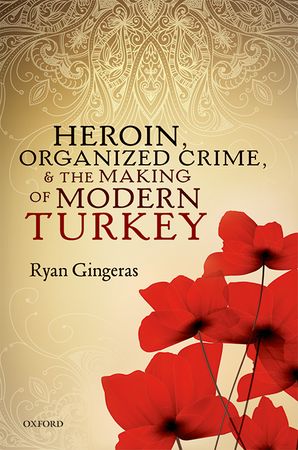
This week, I spoke to Ryan Gingeras about his book “Heroin, Organized Crime, and the Making of Modern Turkey” (OUP). Here’s the review, and here’s the interview.
Henceforth I’ll try to post links to both the reviews and the interviews here on the weekend after they come out.
The Turkish gov’t takes on the foreign media
December 10, 2014
I’ve written a piece for Foreign Policy on the deterioration of the Turkish government’s image in the international media, and Turkey’s aggressive response:
The foreign media image of President Recep Tayyip Erdoğan and the Turkish government has shattered over the past 18 months, and in response Turkey has ramped up an international information blitzkrieg.
The tone is becoming increasingly bitter, motivated by a conviction that the foreign media is a propaganda weapon deployed by the West to attack the ruling Justice and Development Party (AKP). Patriotic Turks are called on to rally behind their government in the name of national sovereignty.
This sense of embattled defiance is important to understand, and reveals much about the resentful mindset gripping the state. Suspicion about the foreign press is hardly new in Turkey, but it’s unfortunate to see the worst of such sentiments returning – openly sponsored by Erdoğan and the AKP’s top brass. The president himself is even managing to turn international criticism to his own advantage, as evidence that the West is implacably hostile to Turkey and its fearless, truth-telling leader — a useful populist line ahead of next June’s crucial parliamentary elections.
Read the full article here.
‘Important statements from the prime minister’
November 11, 2013
The title will be familiar to any follower of news in Turkish. Every day, “news” stories consisting of unedited transcripts of words spoken by Prime Minister Recep Tayyip Erdoğan are published online under that headline by the major newspapers. The recent storm over Erdoğan’s opposition to mixed-sex student accommodation was only the latest example showing that Turkey’s entire news agenda is increasingly becoming subject to the whims of his unpredictable tongue. He opens his mouth and whichever subject he has chosen then dictates the national conversation. When the media is so completely dependent on politicians, how can be expected to hold those same politicians to account?
This problem cuts across the internet, the television, and the printed press. It almost feels like an act of rebellion when a TV station chooses not to cut to a live broadcast of any public utterances from “The Master.” I only came to Turkey in 2009, so I can’t say whether this has always been the case, but I suspect that the situation has only deteriorated of late. The fact is that you can’t get much safer than a “news” story simply providing a transcript of words spoken by the prime minister. What’s more, depressingly, I’ve been told that these articles usually get the most “hits” for websites. This fixation on Erdoğan’s every word is not only extremely distorting, but also exacerbates the bizarre cult of personality that has developed around him amongst his supporters.
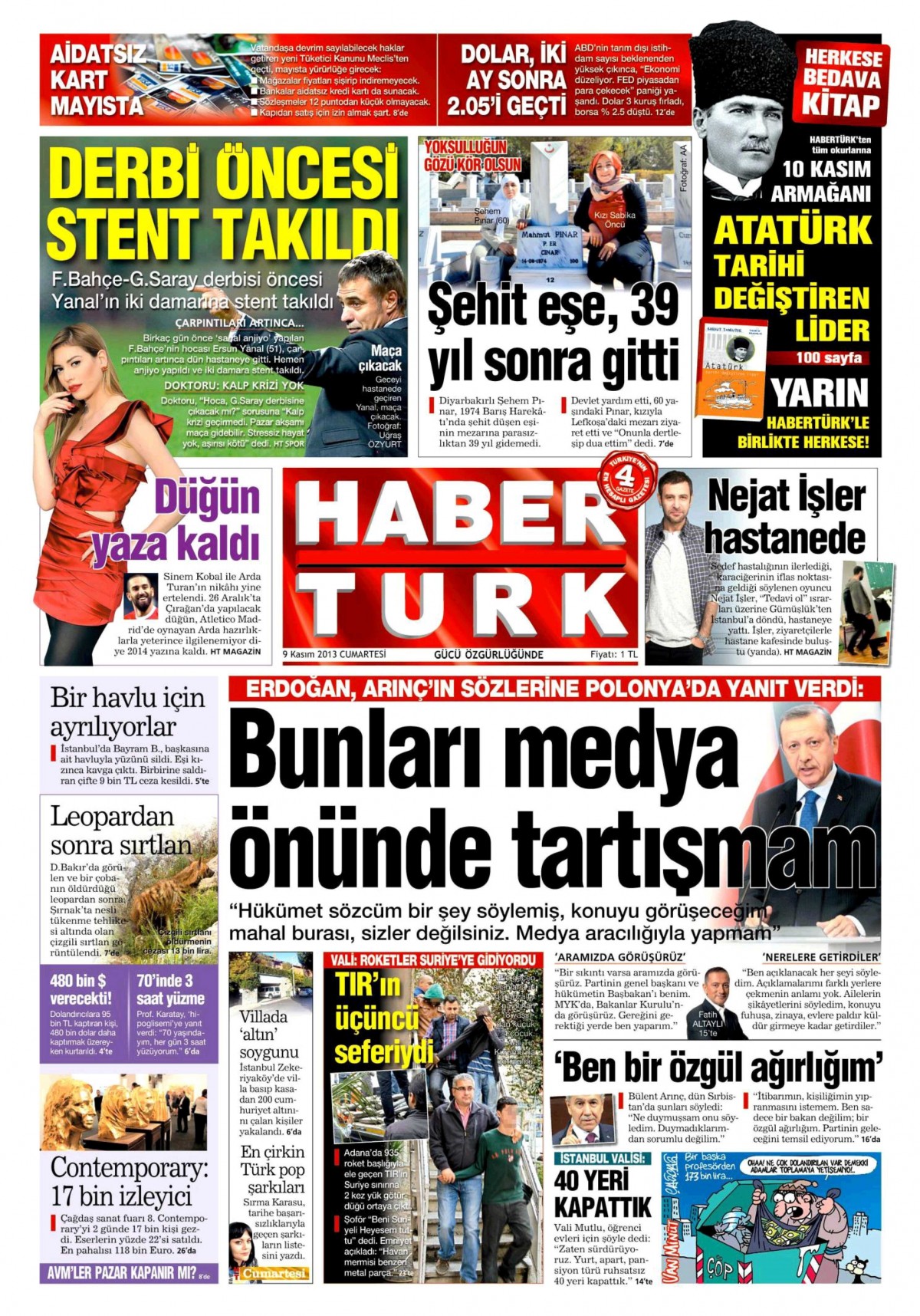
Habertürk parroting the prime minister on Nov. 9. With unintended irony, the headline quotes Erdoğan’s response to Deputy PM Bülent Arınç’s criticism of the mixed-sex student housing debate: ‘I don’t discuss these things in front of the media.’
But while this obsequiousness is lamentable, those official pronouncements in fact are very important. The centralization of decision making is so chronic that Erdoğan’s words, whatever they are, really do have the power to shape the agenda of the country, decide the laws that then get passed, and at what speed. As Adana Governor Hüseyin Avni Coş said shortly after Erdoğan’s utterances on co-ed housing: “We see the prime minister’s words as orders.” Policy is increasingly being shaped on an ad-hoc basis around Erdoğan’s statements; the centralization of power around him now is such that there is a genuine justification for reporters broadcasting and publishing every single thing he says. The vicious cycle is thus reinforced.
That’s why the controversy that is periodically caused by the firing of prominent critical columnists from newspapers often misses the point. Many people’s understanding of news seems to be little deeper than a “who said what?” bish-bash-bosh, responded to by a flood of commentary. As I wrote in my last post, few seem to value deeper investigative reporting, and none ever mention the inherent problem with “stories” consisting of nothing more than an indiscriminate transcript of a minister’s speech. Editors who are encouraging “Important statements from the prime minister” articles are contributing to this dangerous imbalance. Far from the media being a check on power, PM Erdoğan’s tongue is the driving force behind the media.
Having lead a government that has spent much of the last 10 years in a bitter tug-of-war for power with the military establishment, it has recently become clear that Prime Minister Recep Tayyip Erdoğan is now attempting to secure rapprochement with the Turkish armed forces. The latest indication came with his visit on Feb. 9 to the hospital bedside of retired general Ergin Saygun, whose 18-year prison sentence in the Balyoz (Sledgehammer) coup plot trial was suspended on Feb. 7 following a medical report. Saygun is now undergoing critical heart treatment in Istanbul.
The hospital visit was just the latest in a series of moves that indicate Erdoğan’s changed approach. In recent months, he has repeatedly expressed frustration at the long detention times of military officers and even at the alleged excesses in the ongoing Ergenekon coup plot investigation. Two weeks ago he complained in a live television interview: “There are currently 400 retired commissioned or non-commissioned officers. Most of them are detained … If the evidence is indisputable, give a verdict. If you consider hundreds of officers and the [former] chief of staff to be members of an illegal organization this would destroy the morale of the armed forces. How will these people be able to fight terrorism?” Indeed, with so many detained or facing trial, there have also been rumours of growing organisational chaos inside the armed forces due to the lack of staff; as many as a fifth of Turkey’s top military chiefs are currently languishing behind bars. (In an unfortunate gaff, one opposition deputy recently bemoaned the lack of serving generals currently available to conduct a military coup.)
The Fethullah Gülen religious movement (cemaat) is the strongest and most powerful advocate of the ongoing coup plot trials. As Dani Rodrik, a fierce critic of the Ergenekon/Balyoz cases, has written: “[Erdoğan’s] Gülenist allies … have been the key driving force behind the sham trials. It is Gülen’s disciples in the police, judiciary and media who have launched and stage-managed these trials and bear the lion’s share of responsibility.” Below the surface, it is therefore becoming clear that Erdoğan’s recent moves to normalise relations with the military constitute the latest steps in the power struggle between himself and the cemaat. As a leader with impeccable political antennae, Erdoğan also probably recognises the political importance of “moving on” with the military. Despite all the reputational damage it has suffered over the last 10 years, the national armed forces still retain considerable loyalty among the Turkish public.
As the newspaper most closely affiliated with the Gülen movement, it is thus interesting to observe how daily Zaman is reporting Erdoğan’s search for a settlement. On the day after Erdoğan’s hospital visit to Saygun, the paper’s front page carried a picture of him standing at the former general’s bedside, with an innocuous story inside titled “Surprising visit to Ergin Saygun.” However, it is also worth noting that Zaman’s front page headline on the same day focused on the recent three-day summit of the (Gülen-affiliated) “Abant Platform,” which came out in strong support for Turkey’s continued EU membership negotiations. The piece mentioned the “hardening attitude” within the EU and unfair visa restrictions, but also included criticism of the recent public declarations of some Turkish officials, which it said “lead the way to opposition to EU membership among the public.” Erdoğan has been leading the charge in negative statements about the EU process in recent weeks, so Zaman’s emphasis was perhaps not without significance, hinting cryptically at the growing Gülen-Erdoğan split.

Zaman headline Feb. 10: ‘Support to EU process from the Abant Platform’
When Erdoğan speaks, the media follows
January 31, 2013
Prime Minister Recep Tayyip Erdoğan’s recent comments that Turkey could give up its EU membership bid and instead pursue membership of the Shanghai Cooperation Organisation (SCO) are still reverberating in much of the Turkish media. Speaking Jan. 25 on TV station 24TV, Erdoğan said: “The EU does not want to include a Muslim country … Of course, if things go so poorly then, as a prime minister of 75 million people, you seek other paths … The Shanghai Five is better, much stronger.” Last year, Erdoğan had said something similar after a diplomatic visit to Moscow: “I said to [Russian President Vladimir] Putin, ‘You tease us, saying “What is Turkey doing in the EU?” Now I’m teasing you: include us in the Shanghai Five, and we’ll forget about the EU.’”
The “Shanghai Five” was created by Russia, China, Kazakhstan, Kyrgyzstan and Tajikistan in 1996 in an attempt to counter U.S. influence in Asia, and was later joined by Uzbekistan and renamed the SCO in 2001. It has been described as “a vehicle for human rights violations” by the International Federation for Human Rights. Erdoğan’s latest pronouncements on the group were immediately picked up by much of the Turkish commentariat as significant indications of Turkey’s shifting priorities. In Radikal, columnist Cengiz Candar wrote that the prime minister had dropped a “geopolitical bomb.” Hürriyet’s Sedat Ergin has so far spent three days worrying over the remarks, writing that Erdoğan’s words amounted to “one of the most significant foreign policy moves since he took office 10 years ago, maybe the most important.”
For me, the way these latest statements were reported merely highlighted once again the unhealthy intensity with which the Turkish media hangs on every single word uttered by the prime minister. The smallest pronouncement can be seized upon to set the agenda and send the media into a tailspin. It’s a little discussed symptom of a wider (and more discussed) problem – the increasing concentration of power in one pair of hands.
This is the pattern of how an address or press conference given by Erdoğan is typically reflected in the Turkish media: it is broadcast uninterrupted by every major television news station; the words are transcribed and posted immediately on internet news portals, with the only journalistic interjection in each paragraph being “the prime minister said”; the next day’s newspapers feature prominent news stories on the speech, perhaps as the front page headline; finally, the chorus of daily columnists set to work dissecting whatever the prime minister has decided should be the subject of the moment. As Fehmi Koru wrote in Star on Jan. 29: “Erdoğan is a master at forcing an issue, bluffing and occupying others with his own agenda … We have not yet seen one of the opposition parties able to force the country to debate a single topic. They jump into the agendas set by the head or members of the ruling party.” The prime minister is a master at manipulating how news is covered, and the producers of that news coverage are often more than happy to be manipulated.
This week’s episode of the BBC’s Start the Week, where the discussion centred around George Orwell’s 1946 essay “Politics and the English Language,” brought the issue into even sharper relief for me. In the programme, Phil Collins, one time speechwriter for former British Prime Minister Tony Blair, spoke about how he was always acutely aware when writing speeches of the low level of coverage that any public address by a prime minister could today expect to receive in the U.K. press. “Once upon a time your whole speech would be printed verbatim in The Times the next day, but that’s not the case anymore … You’re talking into an atmosphere in which you’re only going to get six seconds on the evening news, whether you like it or not,” he said. This seems to be the inverse of the Turkish problem: symptomatic of a corrosively cynical British public, disengaged from the political process and instinctively suspicious about the public utterances of any elected official.
Of course, there are many such cynics in Turkey, but they are little represented in the conventional large media corporations.
Coverage of Ankara-PKK ‘peace process’ in the Turkish media
January 19, 2013
Peace talks are still ongoing between the Turkish state, representatives of the Kurdistan Workers’ Party (PKK), and PKK leader Abdullah Öcalan. It is likely that for any kind of peace to be secured they will have to go on for quite a while longer. Looking at the attitudes adopted by the Turkish media over the course of the “İmralı process” has been illuminating, particularly the reporting of the Jan. 17 funeral ceremonies in Diyarbakır of the three female Kurdish activists who were recently shot dead in Paris.
The government’s previous “Kurdish Opening” in 2009 came to an abrupt end after the controversy that followed the release of a group of PKK militants at the Habur border crossing and their welcoming back by huge crowds in Diyarbakır. Any comparable scenes carried the danger of enflaming Turkish nationalist sentiments and posed a risk to the latest dialogue process. Thus, in the lead up to the funerals most in the mainstream media were in agreement that they represented a significant test. On the morning of the ceremonies, dailies Vatan, Yeni Şafak, and Yeni Asya all featured front page headlines quoting the words of Prime Minister Recep Tayyip Erdoğan saying that the day would be a “Samimiyet sınavı,” or “Sincerity test.”
The ongoing process is extremely delicate. It’s easy to forget that although public support for the current PKK talks is significantly higher than it was in 2009, suspicion of the talks is still widespread. It was therefore interesting to observe how none of the major TV stations covered the ceremonies live in any detail on the day, despite the fact that they were attended by tens of thousands of people. As with much coverage of the Kurdish issue, (the Uludere/Roboski massacre in December 2011, for example), it is likely that this low key coverage had been “suggested” to the major media organizations by the government, acutely aware of the need to avoid scenes similar to those in Habur in 2009. Tellingly, Deputy Prime Minister Bülent Arınç had the following to say at a media event on Thursday: “The media’s support is so pleasing for us. I know and I see this support. … Eighty percent of media groups are lending their support. They are conducting positive broadcasts and contributing to the process. I hope this continues.” Still, in a column the next day titled “Peace is difficult with this media,” daily Vatan’s Rüşen Çakır had some critical things to say about this mentality:
“Television stations who didn’t show the ceremony yesterday failed the ‘sincerity test.’ In fact, they didn’t even sit the test … In the name of not making mistakes, or avoiding possible crises, or not annoying the government, they chose not to do anything at all … During the latest İmralı process, our media sees only one side as having to take steps – and all of these steps set according to what the government wishes – which itself sabotages the road to peace.”
In the event, Jan. 18’s newspapers exhaled an audible sigh of relief that the day passed without “provocation or sabotage” from either the mourners or the Turkish security forces. In contrast to the relative silence of the TV stations, the majority of the next day’s papers featured the funerals as front page headline stories, showing pictures of the crowds gathered in Diyarbakır and striking a noticeably optimistic tone. Many focused on a makeshift sign that one man was carrying at the ceremonies: “There is no winner from war; there is no loser from peace.”
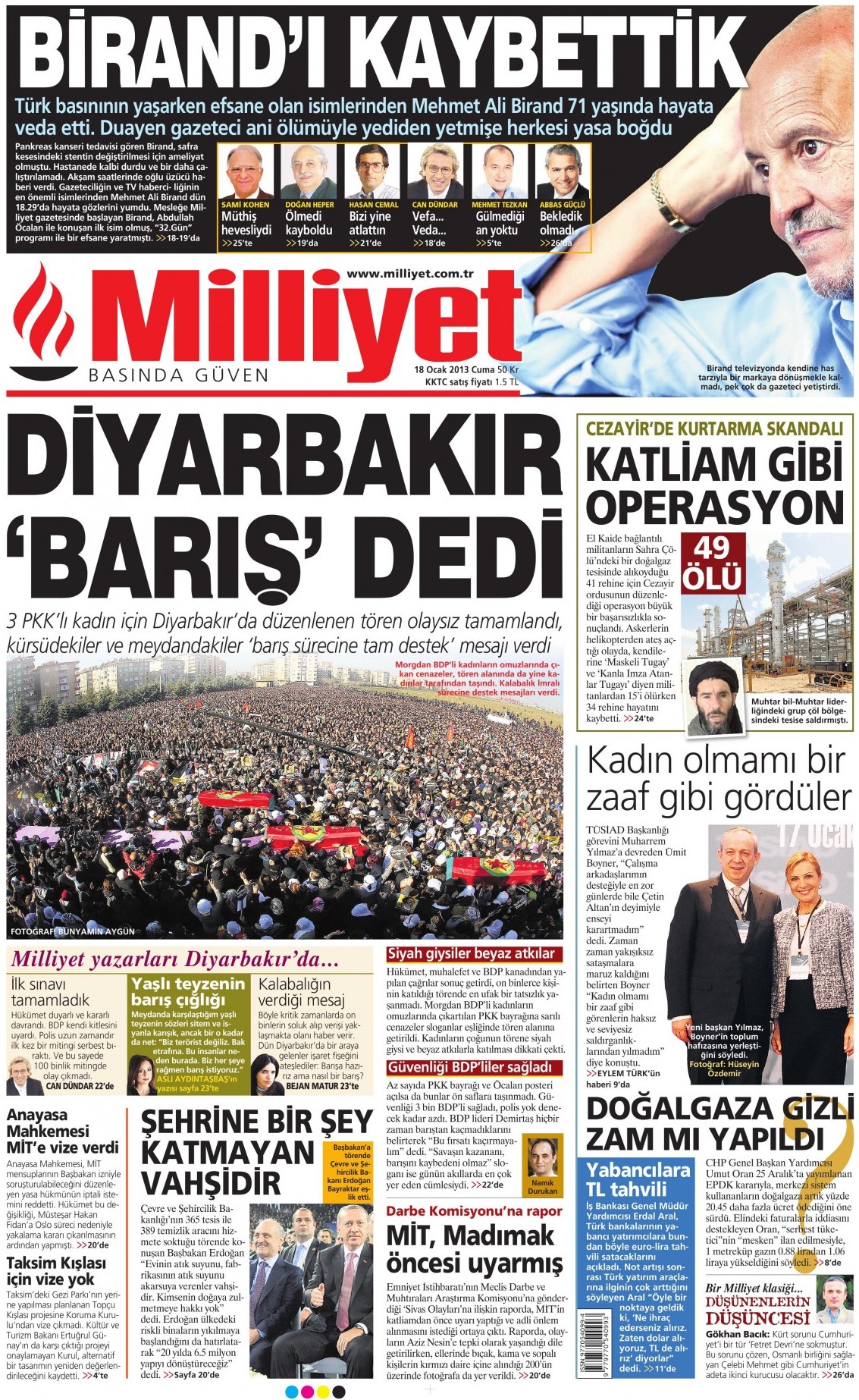
The front page of Milliyet on Jan. 18: ‘Diyarbakır said peace’
That the funerals passed peacefully was a relief not only for the government but also for the Peace and Democracy Party (BDP), which shares grassroots with the PKK. At the moment, both the Justice and Development Party (AKP) government and the BDP have a common interest in continuing the talks. For the process to come to a successful conclusion – still a long way off – this shared interest will need to persist for a while yet.
The New York-based Committee to Protect Journalists (CPJ) has just released its annual report on the number of journalists imprisoned globally – a gloomy read. This year, the global tally reached its highest point since the CPJ began surveys in 1990, with a total of 232 individuals counted as being behind bars, an increase of 53 since 2011. Unsurprising to most in the country, Turkey tops the list this year – followed by Iran and China – with the CPJ counting 49 currently in Turkish prisons for their journalistic activity, (still lower than its last count of 61). A complete list featuring detailed accounts of all imprisoned journalists worldwide is available to view via the CPJ here, while a “path forward” for Turkey, drawn by CPJ Executive Director Joel Simon, can be read here. The CPJ recently focused on the situation in Turkey in a detailed report released in October, which I wrote about on this blog at the time.
In Turkey, most of the newspapers hostile to the government included pieces on the report, with the reliably bellicose Sözcü referring ironically to Prime Minister Recep Tayyip Erdoğan in its Nov. 12 front page headline: “THE MASTER BREAKS THE RECORD: Turkey is the world champion in imprisoned journalists.” Also tongue-in-cheek, daily Taraf dolefully headlined its article on the report: “Again we’re the world’s first!” However, news of the CPJ report was conspicuous by its absence in the Pollyannaish pro-government press – nowhere to be found in Zaman, Sabah, Bugün, Türkiye, Yeni Asya, Yeni Şafak, or Star. Bearing in mind the Doğan Group’s history with the Justice and Development Party (AKP) government, it is also perhaps worth mentioning that neither of its remaining Turkish-language titles, Hürriyet and Radikal, mentioned the report in their print versions either (although both did feature online articles).
Of course, the October CPJ report on Turkey was far more detailed than this latest one, which focused only on the global numbers of journalists in jail. Indeed, the real question of press freedom in the country is rather more complicated than simply a headline figure alone, as I have written before, both here and here. Still, however hypocritical many of the protests on the issue coming from the direction of newspapers like Sözcü are, the situation is certainly deplorable. Complicated as the issue may be, comparing the coverage (or non-coverage) of the CPJ report in the Turkish press at least gives some impression of quite how polarized the media in Turkey really is. Looking at some of the newspapers here, it’s often hard to believe they can be describing the same country.
Yeni Akit shaping the debate?(!)
December 6, 2012
It’s been a while since I last wrote about my favourite hard-line Islamic newspaper, Yeni Akit. It would be wrong to overemphasize Akit’s significance in the overall scheme of things, but a couple of its recent news items are certainly worth mentioning, and indicate that it might have rather more influence than many give it credit for(!)
On Nov. 22, Akit published a story headlined, “Immorality at High School,” containing photographs that it said showed teachers drinking alcohol with their students at a picnic. This photos were taken in the southern province of Antalya, (“known as a castle of the secularists,” according to the article), and were apparently uploaded to Facebook by one of the teachers. “It has been claimed that the teachers are members of the ‘Eğitim Sen’ union, which opposes the headscarf as well as classes on the Quran and the life of the Prophet,” Akit helpfully stated. The Antalya branch of the National Education Directorate opened an investigation into the 11 teachers upon the publishing of the story, but this was quickly dropped after it was established that the photos were in fact taken by a teacher at a family picnic three years ago, and that no students were present. Unbowed, on Dec. 2 Akit went on to publish a photo of a female teacher at the same Antalya school, part of a group at a bar celebrating a friends’ birthday (with glasses of beer on the table). “Do these photographs suit a teacher?” said the headline. However, rather than the Education Directorate setting up an inquiry, the teacher in question is now opening a legal case against Akit.
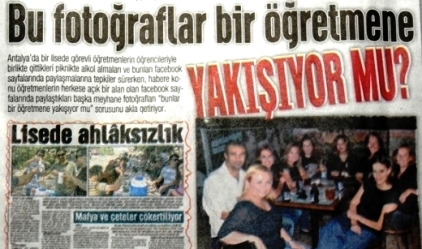
It’s worth mentioning these “photo scandals” because very recently Prime Minister Recep Tayyip Erdoğan used similarly tendentious photographs published in Akit to attack his political opponents. The pictures used by Erdoğan showed deputies of the pro-Kurdish Peace and Democracy Party (BDP) sitting around a table eating kebab, despite the fact that over 600 Kurdish prisoners were entering their 49th day on hunger fasts: “Lamb kebab for us, death fasts for you,” read Akit’s headline. On the same day (Oct. 30) Erdoğan told a meeting of his parliamentary party: “On one hand [they] are eating lamb kebab, on the other [they] are telling those in prison, ‘Die on hunger strike.’” In fact, it soon emerged that the photos had been taken two months before at the wedding of a BDP member in the southeastern province of Mardin.
Erdoğan’s harsh words got a lot of coverage at the time, (here’s the Reuters story on it), but the fact that his source was Yeni Akit obviously received rather less attention. Commentary suggesting that the prime minister is turning Turkey into an “Islamic state” is simplistic and misguided, (a piece in the Wall Street Journal last month claimed that he was “ramming Shariah law into practice.”), but it can’t be a good sign that he’s turning to Yeni Akit for rhetorical fodder to use against his opponents.
Turkish newspapers weigh up the Middle East’s ‘new balances’
November 24, 2012
In the wake of the Nov. 21 ceasefire between Israel and Gaza, there has been much talk of the changing power balances in the Middle East. The leading role played by Egypt and its new president, Mohamed Morsi, in brokering the ceasefire is being interpreted by many as Egypt’s reintroduction as a major regional player. Meanwhile, the crisis was another litmus test for the “rising Turkey” thesis, and Turkey’s apparent marginalization during the process seems to have once again exposed the gap between Foreign Minister Ahmet Davutoğlu’s ambitious rhetoric and the reality. While diplomacy to secure a ceasefire was still ongoing, Tim Arango wrote in The New York Times:
“Turkey’s stature in the Middle East has soared in recent years as it became a vocal defender of Palestinian rights and an outspoken critic of Israel and pursued a foreign policy whose intent was to become a decisive power in regional affairs. But as Gaza and Israel were once again shooting at each other, Turkey found that it had to take a back seat to Egypt on the stage of high diplomacy … Ersin Kalaycioglu, a professor of international politics at Istanbul’s Sabanci University, [says]: ‘Turkey is pretty much left with a position to support what Egypt foresees, but nothing more.’”
In a similar piece, Foreign Policy described “all the hype about Turkey’s aspirations to be a regional power broker” as “overblown”:
“They embraced the principles, themes, and language of anti-Israeli sentiment so common in the Arab world, but without any nuance that would allow them to continue to play in the Arab-Israeli game. The Egyptian, Jordanian, Qatari, and even Saudi governments, for example, have a long history of engaging in very public criticism of Israel, but have always managed to keep lines of communication open to manage regional crises and look out for their interests. Not so the Turks who seemed to relish burning bridges with the Israelis.”
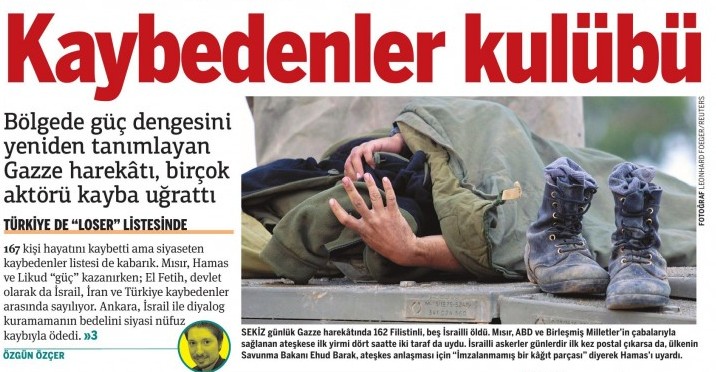
In the Turkish press, Nov. 23’s Taraf weighed up the new regional balances, considering those who gained and those who lost from the conflict. It placed Turkey in the “Loser’s Club,” under a headline saying: “Egypt in, Turkey out”: “The closing of all dialogue channels with Israel has been paid for diplomatically. According to many foreign observers, by only keeping ties with Egypt, Turkey has lost much of its persuasiveness in such issues.”
Perhaps unsurprisingly, other pro-government newspapers remained fairly quiet on the issue. Only Kerim Balcı put a brave face on it in Zaman, arguing that Egypt’s mediator role was more natural in an issue like Israel-Palestine:
“Yes, Turkey should wish to take part in efforts to solve any clashes that occur in the region, and indeed the world. However, in this zeal, other international actors should never be left out of the circuit. On the issue of Hamas, Egypt’s entry to the circuit is not a virtue, it’s a duty.”
These words might be more convincing if Turkey hadn’t already made such a big play of being a potential mediator, particularly in conflicts such as that between the Israelis and the Palestinians.
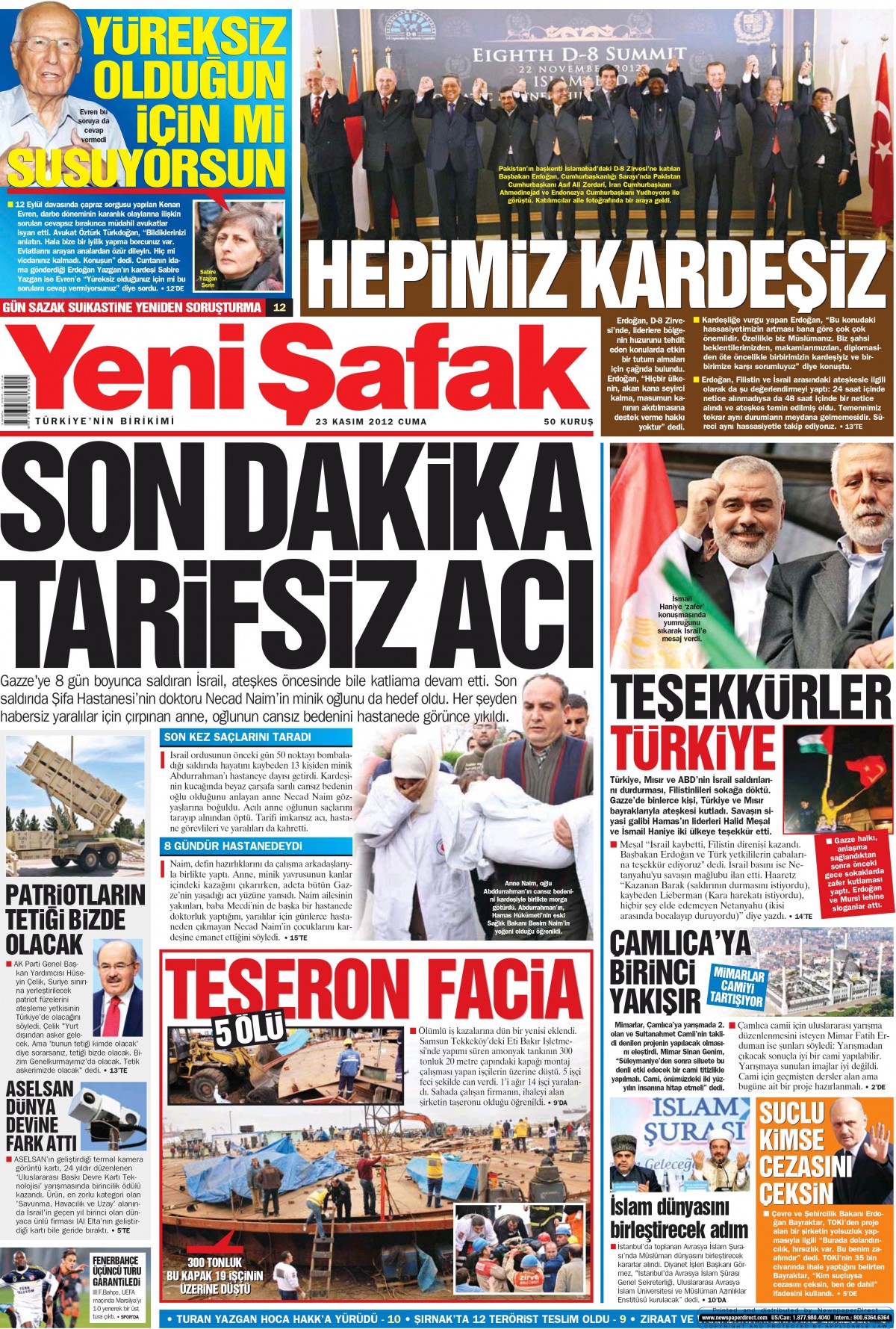
Conservative Islamist daily Yeni Şafak seems to be offering its readers a comforting fictional parallel universe. Alongside the requisite headline story about Israel’s “eight-day long massacre,” its Nov. 23 front page featured a box titled “Thank you, Turkey,” focusing on some marginal quotes from Hamas leader Khaled Mashal thanking the efforts of Turkish officials. It went further the next day, boldly stating in a similar front page box: “Without Turkey it wouldn’t have happened,” referring to the ceasefire process.
Meanwhile, just a day after being widely praised for his role in the ceasefire, Egyptian President Morsi was being criticized from all sides for his domestic move to assume sweeping new powers, leading to violent clashes in central Cairo. The rapid shift from praise to condemnation was striking. Indeed, while Egypt may – in Foreign Policy’s phrase – have taken over from Turkey as the Middle East’s latest “it” country, it has quickly discovered that this is not an easy role to play.
‘Bring back capital punishment, end this business’
November 14, 2012
Recently, Turkish Prime Minister Recep Tayyip Erdoğan has repeatedly expressed his opinion that Turkey should consider reinstating capital punishment “in certain situations.” He first brought the issue up at a meeting of his Justice and Development Party’s (AKP) deputies on Nov. 3, in reference to Abdullah Öcalan, the convicted leader of the outlawed Kurdistan Workers’ Party (PKK), and has returned to it on a number of occasions since. “Right now a lot of people in public surveys say that capital punishment should be reintroduced … It is legitimate in certain situations,” Erdoğan said. “Yes, the death penalty was removed from Europe, but has it left America, Japan and China? Then there is a justified cause for the death penalty to remain.”
Capital punishment was abolished by Turkey in 2002, just prior to the AKP’s accession to power in the general elections of that year. Although no execution had been carried out by the Turkish state since 1984, an official end to the practice on the Turkish law books was seen as one of the key steps in Turkey’s EU accession process, which was then entering its most energetic period. The decision was fairly controversial at the time, as PKK leader Öcalan was captured and sentenced to death by the Turkish authorities in 1999. With the abolition of capital punishment, this sentence was commuted to life imprisonment, and Öcalan has since been held in a remote prison on İmralı Island in the Marmara Sea. With the recent spike in clashes between the Turkish security forces and the PKK, Erdoğan’s words on capital punishment should be interpreted in terms of the government’s failure to solve the Kurdish question – populist sentiments aiming to deflect nationalist criticism that he has made too many concessions to Kurdish rights with little to show in return.
The most striking newspaper coverage of the issue I saw came from popular pro-government daily Sabah, the newspaper with the fourth highest circulation nationally. Its Nov. 13 front page carried the bold headline “Bring back capital punishment, end this business.” These were the words of Fatma Çınar, the mother of one of the 17 soldiers killed in the recent helicopter crash in the southeastern province of Siirt, speaking at her son’s funeral. The crash was not a result of direct clashes with the PKK, but it was enough for PM Erdoğan to frame it as taking place within “much intensified, multi-dimensional” military operations in the region.

The return of the issue to the national debate has predictably raised eyebrows among those parts of the media who retain forlorn hopes that Turkey’s EU accession process can still be revived from its current moribund state. Opposition Republican People’s Party (CHP) deputy Rıza Türmen, who worked for 10 years at the European Court of Human Rights, wrote in Milliyet on Nov. 13: “Capital punishment is banned according to the third section of the European Union’s founding principles, and the lifting of capital punishment is a precondition for membership of the EU and the European Council … Is leaving the EU process what the prime minister actually wants?” Meanwhile, Taraf editor Ahmet Altan’s disillusionment continued on the same day: “We’ve gone from a country that celebrated with enthusiasm the opening of ‘full EU membership negotiations,’ to one with a prime minister – like a funeral undertaker – shouting ‘hang them, hang them’ at every opportunity.” A response even came from the murky corridors of the EU itself, with Peter Stano, the spokesman for Enlargement Commissioner Stefan Füle, stating: “Our position on this is quite clear. Countries wishing to be a member of the EU cannot practice capital punishment. If capital punishment comes, the EU goes.”
Meanwhile, the hunger strikes of 700 Kurdish prisoners today entered their 64th day. Despite the increasing urgency of the situation, Erdoğan has so far ignored calls to directly engage in finding a solution. He even spent Nov. 12 in his hometown of Rize, receiving an honorary doctorate from the newly-established “Recep Tayyip Erdoğan University” (it’s sometimes difficult to tell in Turkey that you’re not reading The Onion). His words on capital punishment have certainly been an effective tactic distracting some attention away from the critical situation of the strikers. However, like the Peace and Democracy Party’s (BDP) recent remarks about erecting a statue of Öcalan, they have hardly done much to help create an atmosphere congenial to a solution.
Taraf newspaper and liberal disillusionment (II)
October 22, 2012
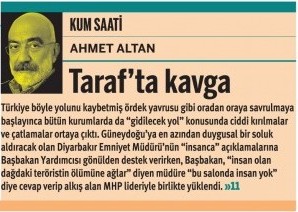
I’ve written about “liberal disillusionment” in Turkey through the example of Taraf newspaper before. At that time, (as now), there was much talk about the ruling Justice and Development Party (AKP) government moving away from its reformist impulses and regressing into an increasingly authoritarian conservative nationalism. Taraf had previously been known as a supporter of the government’s anti-military crusade during its first two terms in office, but this support has evidently been waning in recent times, with increasingly strident criticism sent in the direction of the government by editor Ahmet Altan.
Apparently, not everybody at the newspaper is pleased with this new tone, and a heated discussion has recently broken out on its pages. The debate is essentially between those who believe that the AKP government can be redirected back to its previous reformist zeal, and those who think it is beyond saving. Taraf is often seen – by both its critics and its supporters – as being somehow “different” to other Turkish newspapers. However, as Altan writes ironically, there is another difference that has distinguished it of late: “In other newspapers, editors tell their writers: ‘Don’t criticise the government too harshly.’ In our newspaper, the writers tell the editor ‘Don’t criticise the government too harshly.’ I must confess that I don’t enjoy this difference.”
The three main players in the dispute are editor Altan, sub-editor Yıldıray Oğur, and columnist Alper Görmüş. In his criticism of Altan, Görmüş drew a distinction between “critical” and “opposition” journalism, suggesting that what makes Taraf ethically distinct from other newspapers critical of the government was its measured and reasoned criticism, which never veered into automatic “opposition for the sake of opposition.”
Meanwhile, in his own column, Oğur shared Görmüş’s criticisms of Altan, but emphasized a longer view. Mostly focusing on the Kurdish question, Oğur made quite an interesting argument, essentially saying that a bit of tough authoritarianism was necessary in the current situation, and that in the long term a more democratic and palatable system would hopefully emerge. A few eggs have got to be cracked to make an omelette, etc:
“The problem can only be solved by a party like the AK Party, which enjoys the support of 50 percent of society, and by a leader like Erdoğan, who has the broad support of the masses …
“It’s difficult to accept, but the Kurdish question cannot be solved by the Norwegian social democrat prime minister of our dreams. This problem can be solved by a leader who enjoys the support of 50 percent of the population, who Turks still trust even when a new funeral comes every day, and even when he mentions opening new talks with İmralı [referring to Abdullah Öcalan, the leader of the Kurdistan Workers’ Party, or PKK].”
There is a certain amount of onanism to all of this; but, of course, there is a fair amount of onanism to the whole institution of “köşe yazarlık” (column writing) that fills up every Turkish newspaper. Unfortunately, as Justin Vela pointed out recently on Eurasia.org, for many in Turkey: “Having an opinion that you express regularly in a media outlet is enough to make you a journalist.” As I have previously written in a piece on press freedom, although newspaper columnists do perform a certain important function, many in Turkey mistakenly believe that they alone make for an effective forth estate.


 Turkey Book Talk