Cihan news agency accused over Şemdinli report
November 7, 2012
The hunger strikes of 682 Turkish prisoners are entering their 57th day. The way that they – and the broader issues related to them – are being reported by media outlets known to be close to the ruling Justice and Development Party (AKP) clearly reflects the direction that the government’s Kurdish policy has recently taken.
With the government’s “Kurdish initiative” apparently having run out of steam, the conflict between the Turkish security forces and the outlawed Kurdistan Workers’ Party (PKK) has become increasingly bloody over the last 12 months, and chances for a political solution seem to be ever more remote. The latest bloody incident in south-eastern Turkey took place in the Şemdinli district of Hakkari province on Nov. 4, when a car bomb targeting a military vehicle killed 11-year-old boy Faris Demircan and wounded 26 others. Although there was no immediate claim of responsibility, the PKK is widely thought to be behind the blast.
On Nov. 5, the Gülen-affiliated Cihan news agency reported that pro-Kurdish Peace and Democracy Party (BDP) Hakkari deputy, Esat Canan, tried to visit the family of the deceased to offer his condolences, but was refused entry to the family home. However, no sources were referenced and no quotations on the incident from the family were included in the report. What’s more, no other news agencies mentioned this and local media in the area reported quite the opposite, saying that Canan had in fact been welcomed in to “share the pain.”
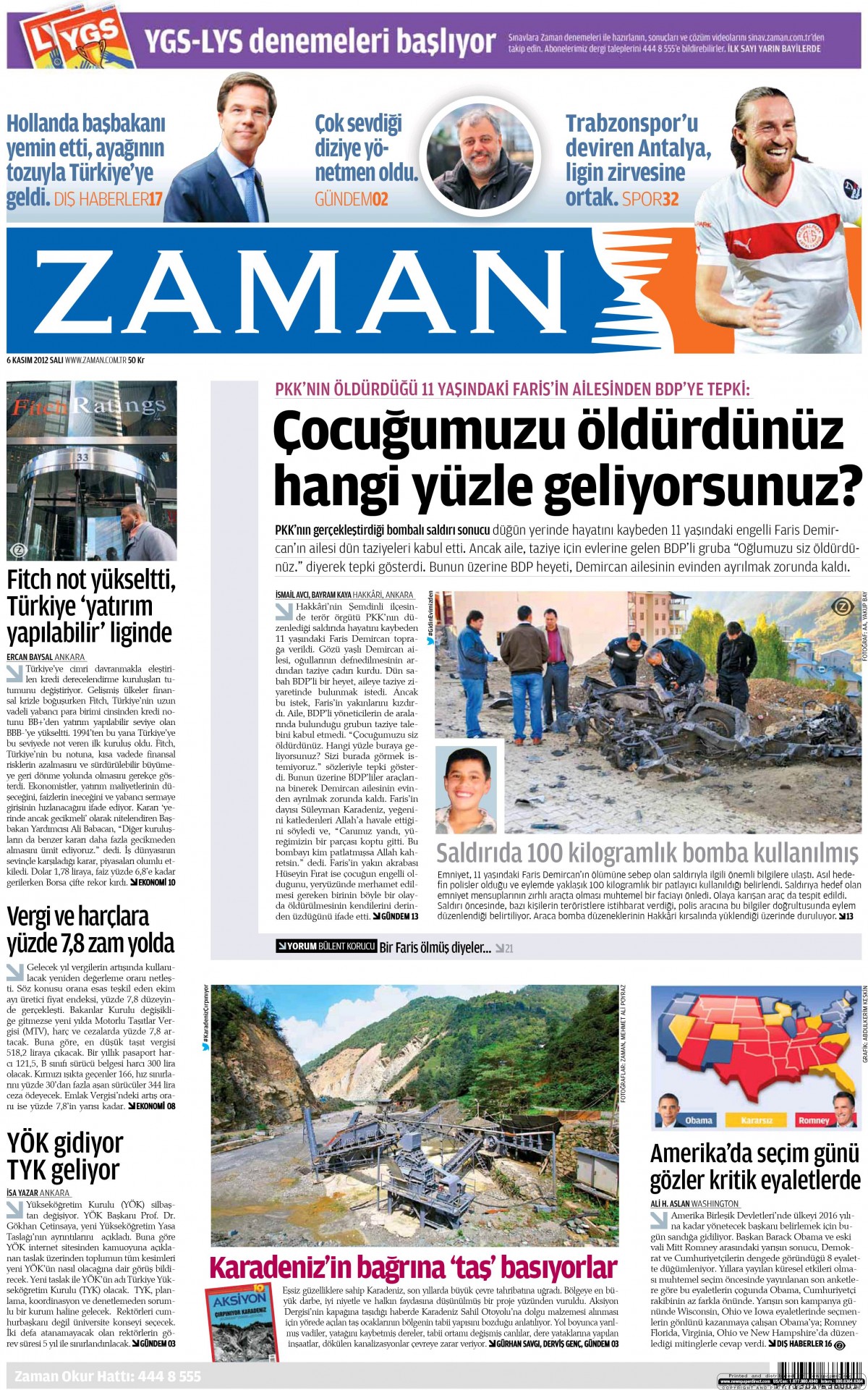
Those known to be close to the government, or the Gülen movement, were the only national newspapers to feature Cihan’s story. Zaman included it as their main front page story, under the headline: “Family of 11-year-old Faris respond to the BDP: ‘You killed our child, how dare you come here’”.
Star included the same story on its front page, alongside news claiming that local traders in Şemdinli were closed in protest against the incident. The headline read: “Şemdinli’s shutters closed against the PKK.”

Strongly Islamist daily Yeni Şafak carried a front page headline declaring: “BDP driven from the door”, included under which was a subtle subtitle: “God damn them.” Popular pro-government daily Sabah also featured the same story at the bottom of its front page under the headline: “You murdered my son.”
BDP deputy Canan has written a formal letter of complaint – which I have read (anybody interested can contact me) – to Cihan news agency about its “baseless” report. In the letter, he says that his visit was in fact accepted by the family of the deceased, and he claims that Cihan’s news was written without any examination of the area and without any correspondent on the ground. He demands a retraction and an apology, warning that he will exercise his full legal rights to pursue the case if he does not receive one.
On Monday (Oct. 22), the Committee to Protect Journalists (CPJ) released a detailed report on the state of press freedom in Turkey, under the gloomy title: “Turkey’s Press Freedom Crisis – The Dark Days of Jailing Journalists and Criminalizing Dissent.” Although it seems like reports on the subject are released every month, this one received a huge amount of attention, both domestically and internationally. It describes the numerous instances of restrictions on media freedom, citing the familiar examples of the Ergenekon case, the endless prosecutions of journalists writing on Kurdish matters, the increasingly widespread practices of intimidation and self-censorship, as well as the ruling Justice and Development Party (AKP) government’s rising intolerance of dissent.
Bloomberg published a sensible commentary on the same day that the CPJ report was released:
“The committee had come under fire for reporting lower estimates of the number of jailed journalists than other human rights organizations. Turkey’s government has long maintained that only a handful of the journalists were charged with offenses related to their jobs, and because the CPJ hadn’t read all the indictments, it had erred on the side of caution.
“Now it has read the indictments and determined that 61 of the reporters and editors in detention are there because of things they wrote or said in the course of their work. In letters accompanying the report, the Turkish government disputes that characterization and asserts that it is striving to balance the need to prevent ‘the praising of violence and terrorist propaganda, and the need to expand freedom of speech.’
“What’s becoming all too clear during the Justice and Development Party’s third term in office is that despite its claims that the government is now liberalizing press laws and continuing the country’s march toward a European-style democracy, the opposite is happening. …
“Instead of fixing the legal system, the government has used it to repress opponents and intimidate the media. The “insult” laws, as well as the special anti-terrorism courts and laws, should be repealed. They are not worthy of a modern democracy, and they shouldn’t be a model for anyone.”
The report was widely covered in the Turkish media. The Oct. 23 edition of daily Taraf featured the report as its front page headline. It included an interview with Ragıp Zarakolu, a legendary figure in Turkish publishing, who has long written and published bravely on subjects that many others wouldn’t touch. He has spent a significant amount of time in prison over the years for things written or published, and he had some predictably doleful things to say:
“The fact that Turkey is found on these kinds of lists saddens me greatly. Turkey has to go beyond this, but in order to do this a change in mentality is necessary … In the existing system the state’s interests are always seen as more important than the citizen’s interests. For this reason, I don’t believe any changes can come in the end without a process of change in mentality. …
“I’ve been writing in the Kurdish press for 20 years. I witnessed the killing of a 72-year-old editor. Such things aren’t experienced any more. But should we be thankful simply for the fact that we’re not killed, or like Uğur Mumcu we’re not assassinated? Turkey is currently at the end of a 10 year process. But despite constant reforms and improvements being spoken of for 10 years, journalists are still in jail for political reasons, and there are still people who have been in prison for 30 years for political reasons. We have to examine this.”
While it’s imperative to identify the areas in which the current government has attacked press freedom, it’s also important to identify the deeper structural problems undermining freedom of expression in Turkey, too. (I touched on the issue a couple of months ago on this blog.) Also included in the CPJ report is an interview with journalist Yavuz Baydar, in which he discusses some of these problems:
“While the rules of the game in the media landscape remain unchanged, unreformed, what changes are the actors, new proprietors. Turkey’s media owners are – like drug addicts – dependent on the powers in Ankara because they are in all sorts of businesses, need approvals for growth and investments, etc., and therefore keep their media outlets either as weapons for extortion or, at best, at the service of governments. …
“The media owners of these outlets acting as ‘the coalition of the willing’ that openly act submissively to the government and security bureaucracy. I can only refer to a key meeting between the PM and all the media proprietors last autumn, during which media owners went as far as proposing themselves to the PM that they can build a “censor commission” among themselves, to be chaired by a cabinet minister. The PM declined the offer, but the message was taken well. In the case of Uludere, where 34 Kurdish smugglers were bombed to death due to a tragic mistake, there was a full blackout in that media for 17 hours while the news flow was instant and heavy in social media. This pattern of blocking is now the norm.”
A related piece by Baydar, called “Another Gloomy Report,” was published in Today’s Zaman on Oct. 21:
“The greatest source of censorship and increasing self-censorship today [is] the ‘unholy alliance’ between the proprietors of big media groups and the powers in Ankara – a deal that connects mutual greed in terms of money and propaganda. This [will] continue to pollute the climate of good journalism, and even if the government resolved the issue of ‘jailed journalists’ it would leave journalism under huge pressure …
“Turkey’s media, vibrant, diverse, still bold, keen on struggling for its independence, will remain easy prey for those with money and political power.”
Nevertheless, the most immediate threat to freedom of expression still comes directly from the government. Ali Özkaya, a lawyer for Prime Minister Recep Tayyip Erdoğan, was quoted in daily Akşam on Oct. 23, and his words should be alarming to any sentient observer:
“We have to underline that cases we’ve opened against press have been quite a deterrent; the wording of columnists has noticeably changed especially since 2003. Reporters and columnists do not exceed the dose when making criticisms anymore; insulting comments or columns have been reduced to minimum.”
Taraf newspaper and liberal disillusionment (II)
October 22, 2012
I’ve written about “liberal disillusionment” in Turkey through the example of Taraf newspaper before. At that time, (as now), there was much talk about the ruling Justice and Development Party (AKP) government moving away from its reformist impulses and regressing into an increasingly authoritarian conservative nationalism. Taraf had previously been known as a supporter of the government’s anti-military crusade during its first two terms in office, but this support has evidently been waning in recent times, with increasingly strident criticism sent in the direction of the government by editor Ahmet Altan.
Apparently, not everybody at the newspaper is pleased with this new tone, and a heated discussion has recently broken out on its pages. The debate is essentially between those who believe that the AKP government can be redirected back to its previous reformist zeal, and those who think it is beyond saving. Taraf is often seen – by both its critics and its supporters – as being somehow “different” to other Turkish newspapers. However, as Altan writes ironically, there is another difference that has distinguished it of late: “In other newspapers, editors tell their writers: ‘Don’t criticise the government too harshly.’ In our newspaper, the writers tell the editor ‘Don’t criticise the government too harshly.’ I must confess that I don’t enjoy this difference.”
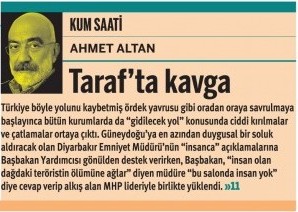
The three main players in the dispute are editor Altan, sub-editor Yıldıray Oğur, and columnist Alper Görmüş. In his criticism of Altan, Görmüş drew a distinction between “critical” and “opposition” journalism, suggesting that what makes Taraf ethically distinct from other newspapers critical of the government was its measured and reasoned criticism, which never veered into automatic “opposition for the sake of opposition.”
Meanwhile, in his own column, Oğur shared Görmüş’s criticisms of Altan, but emphasized a longer view. Mostly focusing on the Kurdish question, Oğur made quite an interesting argument, essentially saying that a bit of tough authoritarianism was necessary in the current situation, and that in the long term a more democratic and palatable system would hopefully emerge. A few eggs have got to be cracked to make an omelette, etc:
“The problem can only be solved by a party like the AK Party, which enjoys the support of 50 percent of society, and by a leader like Erdoğan, who has the broad support of the masses …
“It’s difficult to accept, but the Kurdish question cannot be solved by the Norwegian social democrat prime minister of our dreams. This problem can be solved by a leader who enjoys the support of 50 percent of the population, who Turks still trust even when a new funeral comes every day, and even when he mentions opening new talks with İmralı [referring to Abdullah Öcalan, the leader of the Kurdistan Workers’ Party, or PKK].”
There is a certain amount of onanism to all of this; but, of course, there is a fair amount of onanism to the whole institution of “köşe yazarlık” (column writing) that fills up every Turkish newspaper. Unfortunately, as Justin Vela pointed out recently on Eurasia.org, for many in Turkey: “Having an opinion that you express regularly in a media outlet is enough to make you a journalist.” As I have previously written in a piece on press freedom, although newspaper columnists do perform a certain important function, many in Turkey mistakenly believe that they alone make for an effective forth estate.
(Some) Turkish newspapers report on the AKP Congress
October 2, 2012
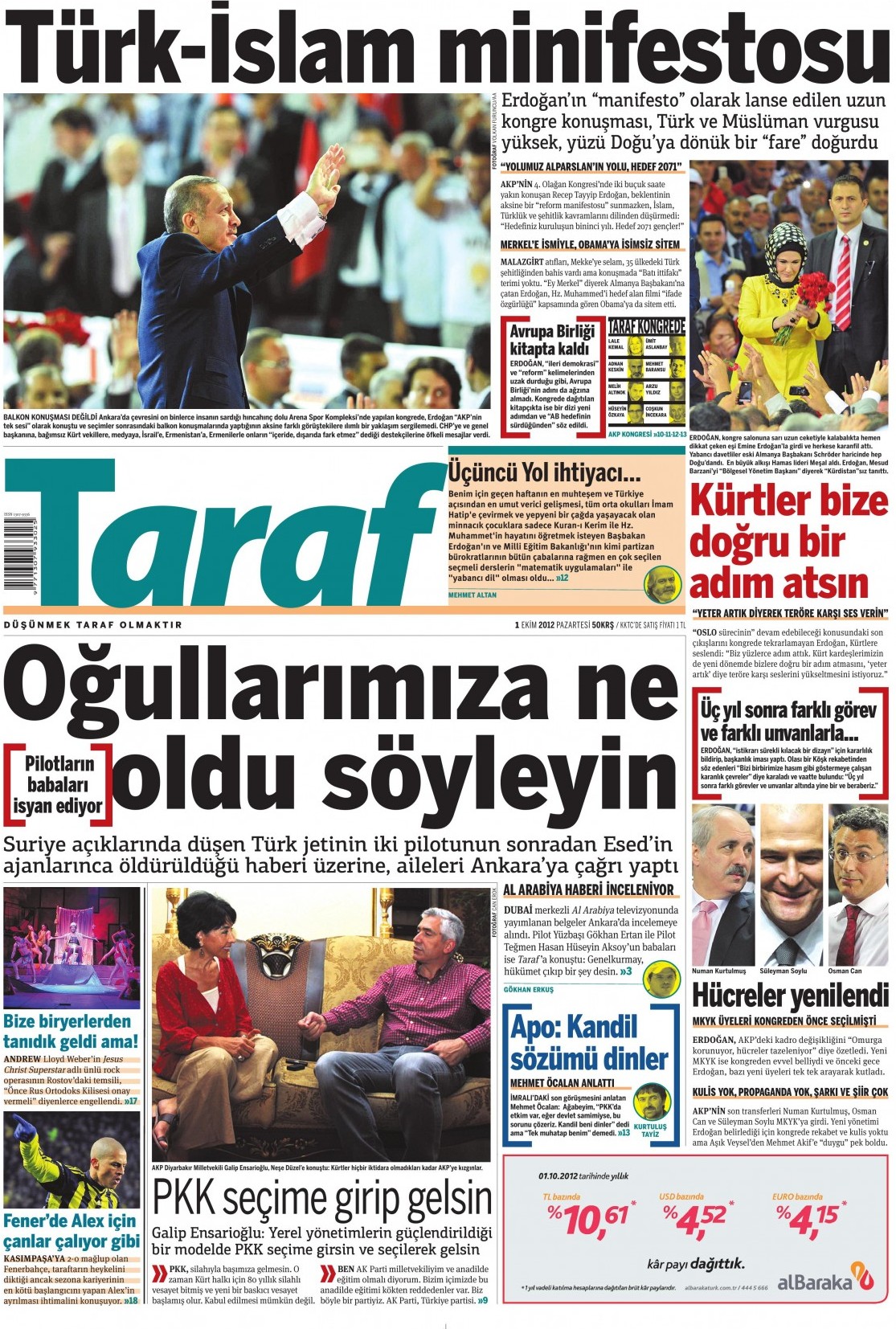
The ruling Justice and Development Party (AKP) held its key congress on Sunday (Sept. 30), the slogan of which was “Büyük Millet, Büyük Güç, Hedef 2023” (Great Nation, Great Strength, Target 2023). Throughout his emotional two-and-a-half hour speech, Prime Minister Recep Tayyip Erdoğan was in full neo-Ottoman mode. He told the 10,000 delegates packed into the Ankara arena that the government was following the same path as Sultan Mehmet II (the conqueror of Constantinople) and Selim I (“The Grim,” who expanded Ottoman territories to the east during the 16th century). He even went so far as to declare – tongue only half in cheek – that the AKP’s new target was 2071, linking the party back to the first Turkish Anatolian state-builders of the 11th century, 2071 being the 1,000th anniversary of Seljuk Turkish leader Alp Arslan’s entry into Anatolia.
It was a speech high in stirring rhetoric. The day after, government supporting newspapers fawned over the “renewal” and “refreshing” emphasis of a new “ustalık” (mastership) era. Daily Sabah focused on what it called the embracing, inclusive nature of Erdoğan’s speech and his words on the Kurdish issue: “Let’s draw a new roadmap together.” Zaman’s front page headline enthusiastically quoted a line from Erdoğan’s speech: “Come, let’s open a new page, let’s say ‘no to terror.’”

The contentious presence of Iraqi Kurdistan Regional leader Massoud Barzani at the congress was rather less trumpeted by Sabah and Zaman. He even gave a speech to the delegates, but the announcer in the arena refrained from using the word “Kurdistan” when introducing him. Indeed, rather than Barzani, it was Erdoğan’s words on the Kurds that received most attention in the pro-government press. This reminded me of one of Nuray Mert’s recent columns in the Hürriyet Daily News:
“The idea of the Ottoman Empire has induced a nostalgic longing for the days when Turkish sultans ruled diverse people in vast lands. For Ottomanists, the idea of the Ottoman Empire as a multi-ethnic haven for diverse cultures and populations is rather misleading, since the basic idea has always been to recall the times when diverse populations lived under ‘Turkish rule.’”
The conspicuously Islamic nature of the congress was also much discussed in the Turkish press – both by those approving and those dissenting. Beside its headline declaring “Great Strength Manifesto,” Islamist daily Yeni Şafak featured an admiring front page box quoting Hamas leader Khaled Meshaal, controversially (or perhaps not) invited to speak at the event: “‘You are not just the leader of Turkey, but also the leader of the Islamic world,’ Meshaal said, receiving extended applause from the crowd.” Indeed, when announced to the audience Mashaal received some of the loudest cheers of the day, (the EU dignitary who was introduced after him didn’t stand a chance!)
Liberal daily Taraf agreed that the congress constituted a Turkish-Islamic “minifesto,” but struck a rather more sceptical tone: “There was a strong Turkish and Muslim emphasis, a mouse with its face turned to the East was born,” (in Turkish, “a mouse was born” means that something underwhelming took place). The paper also noted plaintively that Erdoğan had failed to mention the European Union even once during his speech.
Meanwhile, seven national newspapers were refused accreditation to attend: Cumhuriyet, Sözcü, Evrensel, Birgün, Aydınlık, Yeniçağ, and Özgür Gündem. These publications have diverse sympathies: from left to right wing, from Turkish to Kurdish nationalism. The only thing shared by all is antipathy towards the government.
In response, Monday’s Cumhuriyet included a front page editorial titled “From Cumhuriyet to Public Opinion,” which said some unsurprisingly harsh things:
“Established six months after the founding of the Turkish Republic, our newspaper has been published for 88 years. During periods in the past when democracy has been suspended by the ruling powers our newspaper has been closed down, but outside of this we have always published under the principles of freedom of the press, in the name of people’s right to know. In 21st century Turkey, our newspaper is now exposed to censorship by the ruling powers.
“We will not stay quiet in the face of the anti-democratic implementations applied against us that violate both the constitution and the law.”
The piece went on to detail two constitutional and legal articles that it alleges the congress ban violated: Article no. 69 of the Turkish constitution, which states that internal political party activities, arrangements, and workings must not run counter to the principles of democracy; and Article no. 93 of the Law on Political Parties, which states that decisions taken and actions performed by party central administrations and affiliated groups must not run counter to the principles of democracy.
The International Press Institute’s Turkish National Committee issued a statement about the issue on the day of the AKP Congress, on behalf of the Freedom for Journalists Platform, an umbrella group representing local and national media organisations in Turkey:
“The news that reporters and journalists from some press organs are not allowed to enter the AK Party’s Congress is very worrying.
“Monitoring this historical event of the ruling government party on the spot and transferring it to its readers and viewers are primary duties of news media.
“We have previously protested the accreditation limitations at other institutions. But now, it is very disappointing that the same accreditation is being applied by a political party whose existence depends on democracy.”
Press freedom in Turkey and Sözcü newspaper
September 7, 2012
I’ve been meaning to write something about press freedom in Turkey with reference to daily newspaper Sözcü for quite a while. Then, a couple of days ago, I caught sight of the back page of the paper’s Sept. 4 edition and, like a gift, my primary material was there waiting for me.
The page carried the headline “Turkey’s daily sunshade,” and sarcastically described itself in the top corner as “the kind of journalism that Tayyip wants.” This was in reference to Prime Minister Recep Tayyip Erdoğan’s recent request for the Turkish media “not to exaggerate terror incidents.” The mock stories written underneath therefore contained nothing but praise for the Justice and Development Party (AKP) government and all its wonderful achievements. One was about how the monster of inflation had been miraculously defeated, another was about how Istanbul’s chronic traffic problem had been eradicated (by the way, I can tell you from bitter experience that it hasn’t), another featured a mother who had happily heeded Erdoğan’s advice that all women should give birth to “at least three children,” another described how Syrian refugees had started naming their new born babies “Tayyip” in honour of the heroic Turkish PM.

In fact, the page was relatively mild compared to the populist tub-thumping Sözcü (“spokesman” or “mouthpiece” in English) usually serves up. Its front page typically features some kind of outraged headline about the latest treachery committed by betrayers of the Turkish nation. A short, choleric editorial in the bottom left corner is included every day under the subtle title “Tokmak” (“hammer” or “mallet” in English – apt enough), invariably fuming about some latest disgrace and usually pointing the finger directly at the AKP government. The tone does not get much higher throughout the remaining 19 pages. Recently, the paper has been having almost daily seizures about the government’s Syria policy and its backing for the anti-Assad opposition. These are mostly prompted by fears about how such a policy may facilitate some kind of autonomous Kurdish region stretching from northern Syria to northern Iraq, and conceivably into southeastern Turkey – anathema to the kind of nationalist gallery that Sözcü plays to.
As far as circulation figures go, Sözcü has certainly been one of the undeniable success stories in the Turkish newspaper roster over the last couple of years. When it started printing just over five years ago, it sold around 60,000 copies. This figure has risen steadily ever since, and the paper recently announced it had hit national sales figures of 300,000, making it the fifth-highest selling daily newspaper in the country.
With regard to the state of freedom of expression in today’s Turkey, Sözcü is certainly an interesting phenomenon to consider. Surely, in contrast to the many recent suggestions that freedom of expression is under attack in the country, doesn’t the existence of such a paper indicate that the range of perspectives available on Turkish newsstands is healthily broad? Well, not exactly – the condition of the Turkish media has more fundamental problems that must be taken into account.
In its annual Press Freedom Index for 2011, released in January this year, the Paris-based Reporters Sans Frontières (Reporters Without Borders, or RSF) ranked Turkey 148th out of 179 countries worldwide, down from 138th in 2010. This was the fifth year in succession that Turkey had slipped down the RSF rankings. Over 100 Turkish journalists are currently in jail, a figure higher than China. The number of journalists sacked or sued for what they have written, reported, or even drawn, climbs by the month, and many journalists and editors freely admit to practicing self-censorship to avoid trouble.
One of the most significant and much-discussed episodes took place in September 2009, when Doğan Publishing, then the largest media group in Turkey, was hit with over $3.2 billion in fines for tax irregularities by the Turkish treasury (equivalent to more than four fifths of the combined market value of Doğan Holding and Doğan Publishing).The hugely excessive size of the fines seemed to suggest government disapproval of the group’s newspapers’ reporting of an embezzlement scandal at the “Deniz Feneri” Islamic charity in Germany. It was the biggest charity corruption case in German history, and Doğan newspapers alleged that billions of dollars raised by the charity had somehow found their way into AKP coffers back in Turkey. After the fines were levied, Doğan’s media outlets significantly toned down their reporting of the scandal, as well as their broader criticism of the government. A number of their anti-AKP columnists were sacked, and many of their newspapers were sold off in order to pay the exorbitant fine, which was subsequently lessened after appeal.
There are numerous other examples of similarly shady processes being undertaken by the government. Their effectiveness can perhaps be attributed to one of the more fundamental flaws in the country’s media landscape. As Svante E. Cornell wrote in Turkey Analyst back in January 2010, this is the fact that the Turkish media is overly dominated by large holding companies:
“As a result, major newspapers and television channels are owned by firms with broad and substantial economic interests. For many, winning government tenders is a chief objective. This means that owners of media outlets seldom see these as their main preoccupation, but often as assets they can use for leverage – either by using their assets to pressure incumbents to win favors – or by appeasing the powers that be.”
Those organs wishing to maintain good business relations with the government must toe the line. However, there are still many who simply don’t care about such things, and Sözcü is perhaps the most prominent print example of that today. The case of Emin Çolaşan is a neat symbolic example to consider here. Çolaşan used to write for daily Hürriyet – part of the Doğan media empire – before he was fired in 2007 after 22 years’ service. His sacking was believed to be because of his fierce criticism of the AKP government. Within weeks of leaving Hürriyet, Çolaşan was picked up by Sözcü, where he now writes a reliably bellicose daily column. Evidently, Sözcü doesn’t have quite the same concerns about offending the AKP government that Hürriyet now has.
Still, there is far more to a free and healthy press than simply having a few columnists in certain newspapers feeling free to throw as many tantrums about the government as they want. A well-functioning Fourth Estate should, through rigorous investigative reporting, effectively hold whatever government is in power to account. Unfortunately, there is precious little evidence of this in Turkey’s press landscape. In an excellent piece on “The Deteriorating State of Media Freedom in Turkey,” again in Turkey Analyst, Gareth Jenkins has described this parlous situation thus:
“Unlike in many other countries, Turkish newspapers are dominated not by reporters but by columnists. With a few notable exceptions, journalistic standards in Turkey have always been very low. Little attempt is made to substantiate news reports, with the result that rumor and gossip are often given equal status to undeniable facts … The situation is arguably even worse amongst the columnists, most of whom merely react to something they have heard or read elsewhere in the media without trying to investigate or assess its veracity. The result is that most columnists generate more sound than sense, using invective rather than reasoning to make their voices heard.
… Nor does Turkey have a tradition of investigative journalism. What passes for investigative journalism – and which today mostly appears in book form rather than in newspapers or on television – tends to consist of a compendium of reports and rumors selected to support the author’s preconceptions; and is riddled with the same lack of substantiation that characterizes newspaper and television news reports.”
Sözcü, perhaps unsurprisingly, exemplifies suchshallow prioritizing of reactive opinion over genuinely thoughtful, reflective, investigative writing. Over 50 percent of its “news” pages are filled with belligerent opinion columns from the paper’s popular commentators.
Some might take the overwhelming predominance of highly critical “rent-a-mouths” in almost all Turkish newspapers as proof of the Turkish media’s bustling vitality. However, while Sözcü may get away with its fierce daily anti-AKP invective, that’s a million miles away from contributing to a genuinely effective Fourth Estate. Ultimately, the latter’s development is of critical importance to the future direction of Turkish democracy.
A competition for the ‘giant’ Çamlıca Mosque
August 1, 2012
In May, Prime Minister Recep Tayyip Erdoğan announced to the Turkish media his desire to see a “giant” mosque built on Istanbul’s Çamlıca Hill. In his latest “crazy plan” for the city, Erdoğan said he wanted it to be a mosque that could “be seen from everywhere,” and declared that construction would begin within two months. Çamlıca is situated on the Asian side of the city, and despite currently being the site of a number of enormous television and radio reception towers, the hill is one of Istanbul’s few remaining green, unpopulated spaces. On June 8 the Environment and City Planning Ministry announced that a 250,000 square metre area on Çamlıca Hill had been identified for the project.
The Turkish press is predictably divided along secular/religious lines on the issue. There are, however, a few voices amongst government-supporting newspapers questioning the necessity of a mosque when there are no residents nearby for it to serve. Such objections miss the point that a new mosque on Çamlıca would undoubtedly afford TOKİ developers a golden opportunity to roll up their sleeves in the area(!)

An appropriately crude impression of how a mosque on Çamlıca Hill might look.
Late in June, liberal daily Radikal featured an interview with Ahmet Turan Köksal, professor of architecture at Gaziantep’s Zirve University, to discuss modern tendencies in mosque-building and his thoughts on the Çamlıca plans. He is skeptical: “A mosque should be for the community, not for show. For me, being a mosque architect means only doing work that has a function for the community …. If they want to make a mosque like an Olympic stadium on Çamlıca Hill and want to show off to their friends and rivals, then I’m against this,” he said.
Nevertheless, at the beginning of July, Milliyet included an interview with architect “Hacı” Mehmet Güler, who said he had been charged by the prime minister to make preparations for the new mosque. Güler said it would be designed in a “classical style,” and – in a fine example of “Muslim modesty” – that plans were being drawn up to have it feature the world’s tallest minarets, even surpassing those of the Mosque of the Prophet in Medina.
Following this interview, the issue seemed to fall off the agenda. It was thus quite a surprise to find a number of Turkey’s religion-friendly newspapers recently carrying advertisements announcing: “Çamlıca is searching for its architect!” The advertisements appeal to architects to submit their design ideas, in a competition to find an architect for the new mosque.

The competition opened on July 23, and will be accepting submissions until Sept. 3. According to the website of the organization in charge of the project – the rather clumsily named “Association to Build and Maintain Istanbul Mosques and Educational-Cultural Services” – the winning design will be “suitable for Istanbul’s silhouette and texture, reflect the Ottoman-Turkish style, extend traditions to the future, add value to Istanbul, and become one of Istanbul’s symbols.” The winner, the association has announced, will be awarded the honour of designing the ‘Recep Tayyip Erdoğan’ as yet unnamed mosque, as well as 300,000 Turkish Liras in prize money.
As declared in advertisements for the ruling AKP at the last parliamentary elections, alongside a picture of a vatic looking Erdoğan: “It was a dream, it came true!”
Taraf newspaper and liberal disillusionment
July 15, 2012
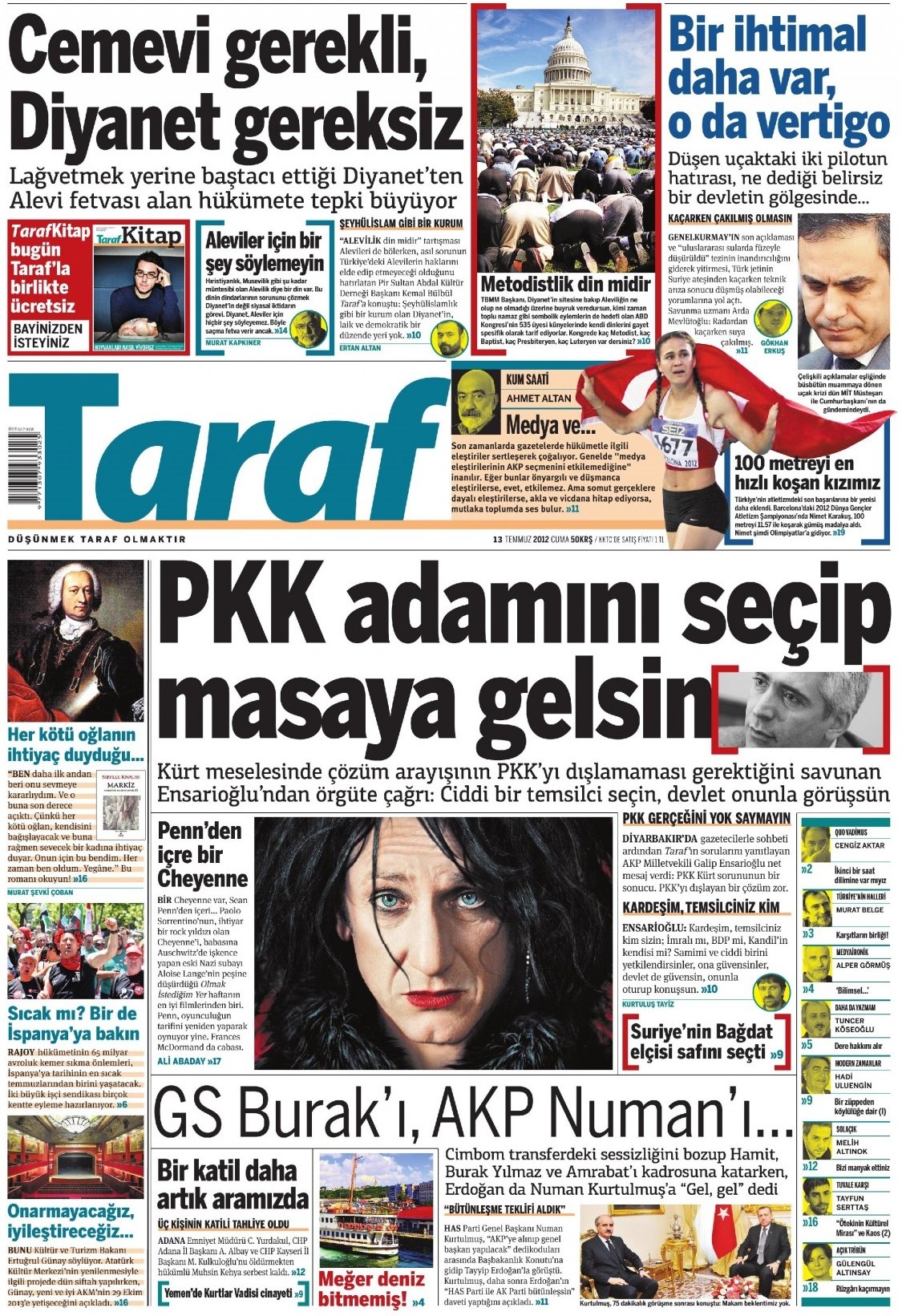
On July 14, leftist daily BirGün included a piece discussing liberal daily Taraf’s recent turn away from the ruling Justice and Development Party (AKP) government. Prompted by Ahmet Altan’s July 13 editorial bemoaning the AKP’s departure from its earlier EU-minded liberal-reformist impulses – the latest in a series of articles critical of the government – BirGün described the shift with some incredulity. Taraf, the piece said, used to label government critics anti-democratic nationalists in thrall to regressive military tutelage, strongly supported a “yes” vote in the September 2010 constitutional referendum, hailed Prime Minister Recep Tayyip Erdoğan as a saviour of the Kurds, and openly recognised the “Armenian Genocide” on its front page. Recently, however, the paper’s criticism of the AKP’s authoritarian turn has increased significantly. Taraf’s move against the government could be seen as representative of disillusioned liberal Turkish opinion these days, but the apparent non-effect this has on opinion polls indicates just how tiny that liberal constituency actually is.
Taraf started printing in 2007 and primarily made a name for itself for its tough anti-military stance. For Turkish liberals at the time, this seemed like the most important battle to be won, and foreign observers routinely used adjectives like “courageous,” “plucky,” and “brave” to describe the paper’s anti-militarist crusade. Domestic critics denigrated it as the AKP’s convenient attack dog, something akin to the “useful idiot” liberal apologists who denied the existence of Lenin’s Soviet police-state terror in the 1910s and 20s. Taraf has been particularly instrumental in the Ergenekon and Balyoz coup plot investigations, claiming numerous scoops against the military in that case, (no matter that most of its anti-military material is widely understood to have been fed to it directly by the AKP government). As Jim Meyer described in a 2009 piece:
“Particularly with regard to the Ergenekon trial, Taraf has managed to frequently scoop the competition with reports (often leaked by the largely AK Party controlled national police force) which have embarrassed military officials […] ‘I don’t see journalistic achievement,’ said one experienced Turkish journalist. ‘They just gobbled up what the police intelligence was leaking them regarding Ergenekon.’”
Meyer’s analysis was written three and a half years ago, and since then the contradictions and evident absurdities in the coup plot cases – as well as the growing anti-democratic practices of the AKP government – have become more and more apparent. While Taraf still maintains its strong anti-military position, it has begun to abandon its previously timid approach to the ruling party and is now voicing tough criticism of various government tendencies. This became particularly clear in January, when lawyers for Prime Minister Erdoğan sued the paper’s editor Ahmet Altan for allegedly “[making] extremely deep insults with the intention of assaulting Erdoğan’s personal rights,” and pressed for 50,000 Turkish Liras in compensation. Evidently, the AKP government wants to keep Taraf on a short leash, but the paper’s continued criticism since then would suggest it has not yet been successful.
Meanwhile, on the same day as BirGün was observing Taraf’s apparent shift against the government, all media outlets were reporting on an upcoming AKP proposal to the Turkish parliament’s Constitution Conciliation Commission (which is currently attempting to put together a new national constitution). The Hürriyet Daily News reports that the proposed changes would “allow the government to limit press freedom in a variety of scenarios that include cases of ‘national security’ and ‘public morals.’”
Referring to the moves, Taraf’s July 14 front page headline story harshly criticised the AKP government for its “prohibitionist mentality.” It cited a 1976 European Court of Human Rights ruling, which stated that: “Freedom of expression […] is applicable not only to “information” or “ideas” that are favourably received or regarded as inoffensive or as a matter of indifference, but also to those that offend, shock or disturb the State or any sector of the population.” Underneath the main headline, the article pointedly said: “we hope this ruling inspires the AKP.”
[Published on openDemocracy (11th May 2012): http://www.opendemocracy.net/william-armstrong/temporary-alliance-akp-fethullah-g%C3%BClen-and-religion-in-turkish-politics]
With the ‘Turkish model’ commonly cited as one of the inspirations for the revolts sweeping the Arab region, and with much speculation about the role of Islam in the newly emerging political systems in those countries, a closer look at religion’s potential future role in Turkish politics seems appropriate. Of course, it’s perilous to look into the crystal ball and make predictions about the medium to long term political future of any country, and this is particularly so in a place with such a volatile political landscape as Turkey. However, at the risk of inviting egg on my face at some point in the future, I would fairly confidently suggest that Turkey will not simply ‘evolve away’ from politicised Islam any time soon – as many hailing the apparent civilianisation of Turkish politics and liberalisation of the country’s economy often tacitly assume. With roots deeply planted – most notably through the Gülen movement of reclusive religious preacher Fethullah Gülen – it’s clear that religion will continue to play a significant role in Turkish political life, as in social life, for the foreseeable future. Whether its vehicle will remain the current ruling Justice and Development Party (AKP), however, is not quite so certain.
Much has been made of the role and importance of the Fethullah Gülen movement, or cemaat (‘community’), both inside and outside Turkey. It emerged as a significant force in the 1980s, initially coalescing around the personality of religious preacher Fethullah Gülen in the western Turkish city of Izmir. The movement now aims to promote conservative social values, with a soft, public face emphasising ecumenism, tolerance and inter-faith dialogue. Gülen now resides on a ranch in Pennsylvania, his cemaat having evolved into a multi-million dollar global network, sustained by donations from members and numerous commercial enterprises. It has been at least passively supported by the U.S. since the 1990s as an apparently moderate, relatively liberal expression of Islam. The Gülen movement is now active in 140 countries, with interests including boarding schools, universities, banks, media companies, newspapers, charities, and think tanks. There is also much evidence that its sympathisers have infiltrated into the higher positions of power within the Turkish police force. As the recently “wikileaked” Stratfor intelligence agency cable put it in 2009, the Gülen brotherhood is “perhaps the best-organized grass roots movement in Turkey … [with] a vast social and economic organization, intelligence assets, a global network”. The cable goes on to give an idea of how it sustains and expands itself:
“FGC [Fethullah Gülen Community] businesses advertise heavily on FGC media, while FGC-owned media runs human interest stories and profiles of FGC sympathisers, businesses and schools. FGC members and sympathisers take holidays in FGC-owned hotels and shop at FGC-owned stores and invest in FGC financial institutions. Graduates of FGC cramming schools funded by FGC businesses often serve as teachers in FGC schools overseas. Finally, FGC media, funded by FGC businesses, reacts sharply to any criticism directed at Fethullah Gulen.”
In a country in which conspiracy theories find such fertile ground, the growth of this far-from-transparent and apparently unaccountable religious movement is alarming for many secular Turks. It would be wrong, however, to automatically equate the Gülen movement with the current Islamist government of the Justice and Development Party (AKP), as many observers tend to do. In fact, the two have significantly different origins. The AKP, which was established in 2001 and has been in government since 2002, evolved out of the Sunni orthodox Milli Görüş/Nakshibendi school, which found primary expression in the various political parties established over the years by the late Islamist leader Necmettin Erbakan. The Gülenists, on the other hand, stem from the ‘Nurcu’ movement, whose origins go back to the late-Ottoman/early-Republican-era Islamic theologian Bediuzzaman Said Nursî. In contrast with the Nakshibendis, the Nurcus have always emphasised refraining from direct involvement in politics, and stayed largely non-partisan, their main aim being the rather more vague imana hizmet or ‘service to the faith’. Thus, the Gülen movement has only ever lent passive support to political parties over time, and it’s significant that this support was never extended to Erbakan’s Refah (Welfare) Party in the 1980s and 90s, out of the ashes of which the AKP emerged.
Both the Gülen movement and the AKP share socially conservative values based in Sunni Islam, and have therefore experienced a kind of alliance of convenience or symbiotic coexistence during the AKP’s term in power. The 2007 “e-memorandum” affair (in which the Turkish military attempted a “post-modern” coup similar to that of 1997), as well as the 2008 closure case at the Constitutional Court against the AKP for alleged anti-secular activities, brought the two even closer together. However, there are increasing signs of a growing divergence of interest. The din surrounding the recent reforms to compulsory education generally portrayed the developments as simply another round in the familiar secular-religious tug-of-war in Turkey. However, a more subtle interpretation was outlined in a recent piece by M. Kemal Kaya and Halil M. Karaveli, suggesting that the reforms were in fact – at least partly – the latest episode in the ongoing covert power struggle between the AKP and the Gülenists. Marked differences of opinion have also been apparent on such contentious topics as the recent Turkish football match-fixing investigation, the Kurdish question, and the continuing friction with Israel.
It would thus be wrong to consider the Sunni religious community in Turkey a homogenous whole. Inevitably, there are fissures and power struggles contained within it, and it seems reasonable to suggest that the outcome of these shifting allegiances will be the dynamic that determines the future direction of Turkish politics, rather than the divided and ineffectual secular opposition. The Gülen brotherhood now has roots deeply planted in many of the institutions of public life inTurkey, and its sensitivities must be taken into account by any political group hoping for electoral success. In a largely pious and conservative country, it seems clear that religion will continue to play a significant role in the political sphere in Turkeyfor a while yet. However, with recent indications of high-level schisms, far less clear is whether the AKP, or some other party that understands and is comfortable with this reality, will be the leading political force to harvest its energies.
Turkish Islam & Turkish Nationalism: A New Balance (Turkish Policy Quarterly, Winter 2012)
March 2, 2012
[This is an extended and elaborated version of a piece I posted on here some time ago. It is published in the latest, Winter 2012 edition of Turkish Policy Quarterly, which is available for purchase now. You can read the piece below or, along with a slightly anaemic abstract, in its original habitat here: http://www.turkishpolicy.com/article/674/turkish-nationalism-and-turkish-islam-a-new-balance/ ]
Since the establishment of the Republic of Turkey in 1923, received wisdom has tended to consider nationalism and Islam as mutually incompatible forces in the Turkish context. Turkish nationalism – so this narrative goes – is defined by the secularizing, modernizing example of Mustafa Kemal Atatürk, a positivist, military man with an almost religious faith in the ability of science to reshape society. Islam, with its appeals to multinational, multiracial unity, inevitably stood in the way of the “pure”, homogenous nation-state. Such an understanding was propagated by those early secularizing elites within Turkey itself, and largely accepted by observers outside the country for the better part of the past hundred years. However, the fact is that religion has always been a crucial motivating force behind popular expressions of nationalism in Turkey. What makes the current Justice and Development Party (AKP) government’s position unique is its wedding of a popular religious nationalism to real political power. Recent developments – in particular the ongoing recent spat between Turkey and Israel – demonstrate to outsiders what has been observable within Turkey for a long time: that Islam and Turkish nationalism are far from irreconcilable on the political, as well as social, level.
Popular Religion
A singular irony of the founding of the Turkish republic is the fact that for all the talk of institutional secularism, the new nation was, in fact, fundamentally defined on religious grounds. Significant numbers of those resettled on Turkish land during the Greek-Turkish population exchanges, for example, were Greek-speaking Muslims, who, in many cases, could not even speak the Turkish language. The Kurds (and other non-Turkish Muslim minorities) were also included on religious – rather than linguistic – grounds. Whether you spoke a dialect of Laz, Kurdish, Zazaki, or Turkish, religion was the most important category to fulfill in order to be included in the new Turkish state. Even Atatürk himself recognized the increased importance of religious sentiment, and was not averse – particularly in the early years of his leadership – to appealing to the emotional religious feelings of the people when seeking to unite the nation behind his resistance forces. He led the War of Independence as a Gazi, (meaning “Warrior of the Faith” in it’s original Arabic form), repeatedly invoked the name of God and the spiritual dimension of the liberation struggle in public pronouncements, and established Sunni Islam as the state religion in 1924.
Such an approach was seen as necessary following the religious retrenchment experienced by the Ottoman Empire during the late -19th and early -20th century. The loss of almost all Ottoman territory in the Balkans prior to the First World War resulted in the flight of around 400,000 Muslim migrants from hostile regions, to re-settle in Istanbul and Anatolia. Similarly, around the same number of Circassian Muslims from the north coast of the Black Sea also migrated to Ottoman territories in the 1860s, escaping from the increasingly aggressive practices of the Russian Empire. These migrants, or muhajir, had learnt to wear their religion as the singular mark of identity, and saw in the Ottoman Empire (and subsequently the Turkish Republic) a protective confessional motherland. Anatolia went through enormous demographic changes during the later years of the Ottoman Empire. Erik J. Zürcher estimates that immediately prior to the First World War, Anatolia was 80 percent Muslim, whilst ten years later, this figure had risen to 98 percent.[1] This more narrowly Muslim composition inevitably had a large impact on the policies and attitudes of the late-Ottoman and early republican eras. The decision to empty Anatolia of Christian Greeks, Armenians, and Syriacs – both before and after the establishment of the Republic – clearly illustrates how the new nation’s identity had become inseparable from its Muslim identity.
Elite Secularist Nationalism
This religious definition was emphasized even as Turkey’s new elites were preparing to systematically cleanse Islam from state institutions. The newly independent Turkish republic was not just neutral to religion; it actively subordinated it to the state, establishing a rigid and doctrinaire form of laicite in a country that until recently had been the seat of the Islamic Caliphate. All expression of Islam was to be tightly regulated by the new Diyanet İşleri Başkanlığı (Department of Religious Affairs) to ensure compliance with the new secular order. The Caliphate was abolished; independent religious establishments were closed down; imams were appointed and their Friday sermons were written by the state; women were discouraged from wearing the veil. Myriad other cultural and political reforms were initiated, aiming at faster and more effective Westernization. All of this was imposed from above, and all was done in the name of modernization, secularization and – crucially – nationalism: to oppose the changes or the way they were implemented was to risk vilification as an irtıcacı (reactionary), against the modern, independent Turkish nation. The military became the symbol of the secular order, and the four (if we include the “post-modern” coup of 1997) coup d’états that the country experienced during the 20th century were all – at least in part – military responses to perceived religious incursions into political and social life.
Thus, it is clear that there was a tension – even predating the declaration of the Republic – between the technocratic, secular nationalism of the reforming elites and the religious character that was essentially the defining feature of the new nation. In his fine assessment of modern Turkish history, Perry Anderson has described Kemalism as an “ideological code in two registers. One was secular and applied to the elite. The other was crypto-religious and accessible to the masses. Common to both was the integrity of the nation, as supreme political value.”[2] Atatürk’s secularizing reforms have too often been accepted as the defining features of Turkish nationalism but it is clear that such dry, technocratic reforms could not possibly constitute the sole emotional appeal influencing such an aggressive and deeply-felt nationalism. It is significant, for example, that the extreme nationalists of the far-right Nationalist Movement Party (MHP) – which won 13 percent of the votes in the parliamentary election of June 2011 – responded to the reopening of the historic Armenian Surp Haç Church in Ani with reactiveFriday prayers, which they organized two weeks later in the same location.[3] Likewise, it is striking that Turkish soldiers, felled in counter-insurgency conflict with the PKK, are uniformly referred to as şehitler, or “martyrs”, by the Turkish media.
The AKP and Post-nationalism?
The spectacular electoral successes of the AKP, an Islamically-oriented party, starting in 2002, seemed to challenge the assumptions of the secular-nationalist paradigm even further. Here at last, it was thought, was a way out of the monocultural impasse, a tonic to divisive and destructive Turkish nationalism. Many optimistically hoped that the AKP would take the country to a post-nationalist state of peace, respect for human rights, and economic prosperity, and a series of symbolic ‘openings’ helped warm up relations with minority communities within the Turkish borders. In particular, the government was expected to attempt a solution to the “Kurdish Question” by re-emphasizing common religious bonds between Turks and Kurds. More progress was made in the European Union accession process by the AKP than any previous government. It also defanged the Turkish military – that bastion of unreconstructed secular nationalism – which it accuses of plotting a coup to overthrow the elected government in the Balyoz, or “Sledgehammer”, case.
The AKP’s Marriage of Nationalism and Religion
It is becoming clear, however, that the government’s struggle against the generals was in fact only a strike against one, narrowly defined, type of nationalism. Another has become evident, and this form can be said to constitute the new ideological bedrock of the AKP government. Campaigning during the parliamentary election of June 2011, Prime Minister Tayyip Erdoğan adopted a much harder note on the Kurdish question than ever before, and – the AKP having won almost 50 percent of the popular vote – he has continued this tendency since. In response to the Kurdistan Workers Party (PKK) attacks on Turkish forces stationed near the Iraqi border in October, the government retreated back into the full scale military solution that has failed to solve the problem thus far. The feeble “apology on behalf of the state” that Erdoğan offered in November for the Dersim Massacres of 1937-39 can be summarily disregarded, representing nothing more than the government’s latest attempt to score cheap political points against the opposition Republican People’s Party (CHP). The EU process is effectively dead, and the government has wasted no time laying the blame squarely at the door of the EU itself. The United States – and “the West” more generally – comes in for increasingly strident criticism, sanctioned by rising anti-American sentiments in Turkish society (a recent poll found that 64.8 percent of Turks have a “negative” opinion of Americans).[4] Despite evident deficiencies in the “Turkish model”, Erdoğan obviously relishes being idolized across the Arab world and, emboldened by a booming economy, he flexes his muscles on the world stage as no Turkish leader has before. Appealing to the collective libido dominandi, such behavior wins him ever more support back home. Boorish populism is prosecuted in the name of greater and deeper democracy.
The equation of Turkish with Muslim identity was always tacitly understood; now it is explicit. Whilst previous Turkish administrations have, at times, won support by appealing to both nationalist and religious sentiments as well, none have done so as successfully as the AKP. Erdoğan differs from Turgut Özal in degree, organization and success, having become the first leader in Turkish history to win three consecutive elections, with a consistently rising share of the vote. The AKP’s real innovation lies in its ability to achieve what no other government has before: wedding populist religious nationalism to the levers of government and remaining in power whilst doing so.
The New Paradigm and the Turkey-Israel Dispute
As with all nationalist movements, the AKP’s needs outside foes against which to define itself, and perhaps the most significant of these today is Israel. The raid by the Israeli Defense Force (IDF) on the Turkish “Mavi Marmara” aid ship bound for Gaza in 2010 caused widespread public and political outrage, and the Turkish-Israeli diplomatic relationship has since deteriorated to such a degree that Turkey has almost entirely suspended political, military and economic ties with Israel. Owing to the widespread popular support for the government on this issue, the AKP has no motivation to desist; indeed one could argue that it may even have an interest in prolonging, even escalating the dispute. The spat brings into sharp focus the elision that has occurred between nationalism and religion: a hitherto unheard-of instance of secular nationalism and emotional religious indignation uniting in a common cause.
Nationalism and religion have been the two primary energizing forces in Turkish society for almost a hundred years, even if one has always dictated to the other. The current Turkish government’s rhetoric manages to appeal to both impulses, and that is why it is such a powerful brew.
[1] Erik J. Zürcher, Turkey: A Modern History, (London: I.B. Tauris, 2004), p.164.
[2] Perry Anderson, “Kemalism: After the Ottomans,” London Review of Books, 11 September 2008, http://www.lrb.co.uk/v30/n17/perry-anderson/kemalism
[3] “Turkish nationalist party holds Friday prayers at Ani ruins,” Hürriyet Daily News, 1 October 2010, http://web.hurriyetdailynews.com/n.php?n=mhp-prayed-at-ani-ruins-2010-10-01
[4] Talip Küçükcan, “Arab Image in Turkey,” Foundation for Political, Economic and Social Research (SETA) Research Report, June 2010, p.25, http://www.setav.org/ups/dosya/35086.pdf
Germane examples from Ottoman and British history
February 17, 2012
You may or may not find the following two historical nuggets useful when considering the modern-day Turkish situation.
The reign of Sultan Abdülhamit II (1880-1909)
I came upon the first in Norman Stone’s recently published history of Turkey. It follows thus: Ottoman Sultan Abdülhamit II’s reign was characterised in Europe at the time as tyrannical, authoritarian, and paranoid. Prompted by wider events gripping the Ottoman Empire, Abdülhamit attempted to reassert the Islamic character of the empire and reemphasise the Ottoman Caliphate, suspending the liberal constitution almost as soon as it was passed in 1876. He himself retired from the open, European-style Dolmabahçe Palace on the banks of the Bosphorus to the secluded Yıldız Palace in the forest just up the hill, where he weaved an elaborate network of spy cells and state informants. However, at the same time Abdülhamit made important reforms to the civil service and significantly modernised the army. He also did much for education, introducing the first girls’ schools and setting up numerous technical institutions, schools of engineering, medicine, and even business foundations. His great achievement was perhaps the Hejaz railway, a fine metaphor for the paradoxical combination of religion and modernity symbolised by his reign: a fine logistical feat and the first Muslim-built railway, designed to take pilgrims securely from Damascus to the holy places of Mecca and Medina.
Abdülhamit’s authoritarian nature, his reemphasis of the Islamic character of Ottoman lands, and his simultaneous modernising reforms have their obvious parallels in contemporary Turkish politics. He was ultimately deposed in the Young Turk Revolution of 1909, which reintroduced liberal constitutional rule to the empire in a last attempt at preserving the withering Ottoman state. Norman Stone argues that the impetus for this revolution came, ironically enough, from the same technical, military intelligentsia that Abdülhamit had in fact helped create. He goes on to suggest that “modern Turkey is undergoing a smudgy version of what happened in the later nineteenth century”, and though he refrains from making any concrete predictions, there is a rather Whiggish suggestion that something like the model that ultimately led to the Young Turk revolution may well be repeated.
The “Glorious” Revolution (1688)
The second example is more fanciful, perhaps even “maverick”. It was suggested on my long commute to work as I listened to Melvyn Bragg (described by Will Self as a “handsome walnut”) discussing the “Glorious” Revolution of 1688 with his guests on BBC Radio 4’s In Our Time. Consider the following landmark in the development of English parliamentary democracy in the murky light of modern-day Turkish politics:
The Revolution of 1688 saw the Catholic King James II of England overthrown, to be replaced by his Protestant Dutch nephew and son-in-law, William of Orange (William III). The revolution was effectively organised by a union of Whig and Tory parliamentarians: an elite who had run the country and who between them had agreed that there was only one group of people who should be frozen out of politics and office (Catholics). James came to the throne in 1685 intent on removing the barriers that prevented Catholics from accessing office, and tried to get restrictive rules repealed. When he couldn’t do so, he effectively tried to subvert the law by dispensing members of the old order from office and replacing them with his own sympathisers in the army, the court, and in local government. He manipulated parliament, packing with MPs that would be favourable to his policies; he built up an alternative standing army that was feared could be used to impose his personal will; he revoked charters signed by previous monarchs. What started out as a seemingly innocent attempt to extend religious liberties to Catholics soon began to be seen as threatening authoritarianism. James seemed to be giving an extra twist to the policy of toleration that the English monarchy had been pursuing since the restoration of 1660.
The Orangist conspirators who eventually facilitated the revolution of 1688 comprised of the Protestant aristocracy and gentry, a far from representative group of individuals. They increasingly felt that their liberty and their parliament was under threat, and that if that Catholics were allowed equal freedom with Protestants, they would only use it as a first step to eventually subvert the toleration achieved and become the dominant power. Wherever Popery first arrives, so they thought, arbitrary or authoritarian government inevitably comes in its wake. Historians have discussed in some detail what James’ reign actually represented. Some say he was in fact never intent on absolutism, but was simply trying to achieve toleration for Catholics, in an age when the formal practice of Catholicism was still officially banned. Others believe that the authoritarian Catholic Louis XIV was his model, citing the growing links between the English monarchy and the French court. Absolutism was his ultimate goal, which he initially sought to achieve through liberal steps.
Esoteric though they may be, the parallels with modern Turkey should be fairly clear to anyone with even a sketchy knowledge of the contemporary Turkish political situation. For ‘Catholics’ read pious Sunni Muslims, for ‘Whigs and Tories’ read Turkey’s traditional secular order. To stretch the comparison ad absurdum: 1688 in England has its parallel in the failed attempted military coup of 2007 in Turkey. Imagine if the revolution of 1688 hadn’t happened, and that James II had stayed on the throne – that’s where Turkey stands today with the AKP government, with Recep Tayyip Erdoğan as the Jacobite potential despot. However, while James II faced organised, energised and rising resistance in the Whigs and Tories, today’s ruling AKP has effectively pursued the remnants of the old order out of their traditional centres of power, and is blessed to be faced with an inchoate, haggered, and backward-looking opposition.
It’s up to you whether you find the above examples absurd, or enlightening, or both. What’s undoubtedly true is that if anyone says that they know what’s eventually going to happen to the political system in Turkey, they’re wrong.
The ‘anti-Armenian Genocide denial’ bill & Franco-Turkish cynicism
February 2, 2012
On Jan. 24 the French Senate passed a bill to criminalise denial that the killings of Armenians by the Ottoman Turks in 1915-16 amounted to genocide. The law has caused Franco-Turkish relations to plunge to an unprecedented nadir. The car crash was obvious long in advance, which only made it – and the predictable reaction that followed – all the more painful to watch. France had already officially “recognised” the genocide in 2001, but the new law goes one step further, making it illegal for a French citizen to publicly question the events. The signatures of enough French lawmakers have since been collected to challenge the bill in the French constitutional court, which is where it sits now. But if it ends up passing that test and going into the statute books, those found guilty will be landed with a maximum 45,000 euro fine and one year in jail. In the days leading up to the vote, thousands of French-Turks demonstrated in the streets of Paris to protest the law, and on the day of the vote rival groups of Turks and Armenians – separated by police – gathered outside the French Senate, waving flags and blowing whistles.
Some expressed quiet surprise at the apparent “moderation” of the Turkish response, although if that was “moderate” one wonders what the “extreme” reaction would look like. Prime Minister Recep Tayyip Erdoğan railed furiously against the bill and threatened strong concrete measures – including economic sanctions and recalling the Turkish ambassador from Paris – if it wasn’t revoked: “This is politics based on racism, discrimination and xenophobia. This is using Turkophobia and Islamophobia to gain votes, and it raises concerns regarding these issues not only in Francebut all Europe.” According to Erdoğan, the vote disturbingly echoes the “footsteps of fascism.” “The votes in the French Parliament and the proposal that has been adopted are an open demonstration of discrimination and racism and amount to a massacre of free thought,” he said. “This bill has removed the atmosphere of free discussion [inFrance]. The principles of liberty, fraternity and equality, which form the basis of the French Revolution, have been trampled on.” Other Turkish politicians and diplomats have also revelled in casting themselves as defenders of the liberal European ideal. Vice chairman of the ruling Justice and Development Party (AKP), Ömer Çelik, took to twitter to claim: “Sarkozy is turningFranceinto Bastille Prison step by step.” Chief Turkish EU negotiator, Egeman Bagis, similarly tweeted: “I celebrate 40,000 Turks marching against the bill to defend the French Revolution’s values.”
The prospect of Turkish politicians posing as modern day Voltaires, protesting in defence of the principles of the French Revolution must be irresistible for the satirist. Such a stance might appear more sincere if Article 301 of Turkey’s own constitution didn’t make it punishable by law to “insult Turkishness.” It might also if there weren’t currently more journalists locked up in Turkish jails than there are in China (95 at the last count); or if Turkey didn’t rank 148th out of 178 countries in the Reporters Without Borders (RSF) World Press Freedom Index; or if Turkey wasn’t by far the worst violator of human rights among the 47 signatory states of the European Convention on Human Rights; or if that same court hadn’t received nearly 9,500 complaints against Turkey for breaches of press freedom and freedom of expression in 2011 (compared with 6,500 in 2009). A distinct tendency towards authoritarianism has been unmistakably creeping into the AKP’s rule of late, perhaps giving some perspective to this most recent outburst in defence of European liberalism.
And the French defence? There isn’t much to be said. Before the vote, President Sarkozy claimed: “The genocide of Armenians is a historic reality that was recognised by France. Collective denial is even worse than individual denial […] We are always stronger when we look our history in the face, and denial is not acceptable.” Nevertheless, the law is widely understood to be a cynical piece of electioneering, the ruling Union for a Popular Movement (UMP) having bowed to the active and well-organised Armenian lobby in Paris, and seeking to secure the 500,000 French-Armenian votes ahead of this spring’s French Presidential election. The move will also doubtless serve to further paralyse Turkey’s already-moribund EU accession bid, which Sarkozy repeatedly makes clear he opposes. There may also be some truth in the accusation that the UMP is seeking to curry favour with France’s populist right-wing, with a move targeted at a Muslim minority.
The question of whether national governments should legislate on how historical events are remembered is probably an unanswerable one. But that won’t stop both sides attempting an answer to fit their own national political agendas. Do you think those 40,000 angry Turks were protesting on the streets of Paris out of earnest concern for Enlightenment values and in sincere defence of free speech? Such lofty protestations are mere fig leaves. Whether it’s Sarkozy opportunistically chasing votes in return for laws, or the Turks spuriously invoking the French Revolution and defending some destructive, nebulous idea of “national honour,” both sides are cynically invoking the high-minded language of moral righteousness to pursue squalid political ends.


 Turkey Book Talk