‘Dear Prime Minister Erdoğan’: CPJ delivers fresh media freedom letter to government
September 18, 2013
On Sept. 17, the Committee to Protect Journalists (CPJ) hand delivered its latest letter to Turkey’s Ministry of Justice, expressing the group’s deep concern over the “continued press freedom crisis in Turkey.”
The CPJ had previously published a long and detailed special report on media freedom in Turkey in October 2012, and this latest letter, addressed to Prime Minister Recep Tayyip Erdoğan, explains how the difficulties described in that report remain unresolved. It also discusses the increasingly oppressive environment in the aftermath of the summer’s anti-government Gezi Park protests, paying particular attention to the fact that open threats from officials have become worryingly commonplace, which “emboldens zealous prosecutors to go after critics.”
The letter doesn’t much dwell on the issue of ownership and conflict of interest – by no means the be all and end all, but certainly a crucial issue that must be addressed if improvements are to be made. Other than that, it makes for a good primer on the biggest challenges to freedom across all media in today’s Turkey: imprisoned journalists and associated legal irregularities, the inappropriate use of anti-terrorism laws, censorship and self-censorship, gag orders on sensitive issues, and the threats being issued by government figures with increasing brazenness. Below are some of the most salient points made in the CPJ’s letter:
“While the restrictive laws and prosecutions are central to the media crisis in Turkey, so too is the atmosphere fostered at the top levels of government. When top officials use the term ‘terrorists’ to describe critical journalists they send a disturbing message that could cause others to take action …
“With traditional media under pressure, the Internet, including social media, has become an important outlet for free expression in Turkey. But recent official comments, including threats to restrict the online flow of information, cause concern …
“Time and again, history has proven that, at times of unrest, a well-informed society has a better capacity to restore and heal itself. The government of Turkey ought to encourage a vibrant debate, a diversity of opinions, and independent reporting on news events crucial to the public …
“In mid-June, with tensions running high, you publicly accused the international media of biased coverage of the Gezi Park events, singling out CNN International, the BBC, and Reuters. Before a supporters’ rally, you said the foreign media ‘fabricated news,’ The New York Times reported. ‘You portrayed Turkey differently to the world,’ you reportedly said, referring to international media. ‘You are left alone with your lies.’ We find your suggestion that international coverage was part of a plot to subvert your government highly disturbing.
“In late June, Ankara Mayor Melih Gökçek launched a spurious and inflammatory campaign on Twitter against local BBC reporter Selin Girit, labeling her a traitor and a spy in apparent disagreement with the BBC’s coverage of the protests.
“Gökçek created a critical hashtag ‘#ingiltereadınaajanlıkyapmaselingirit,’ which in English means ‘Don’t be a spy in the name of England, Selin Girit’ and urged his followers to popularize it on Twitter. Girit received ‘a large number of threatening messages’ in response to the mayor’s actions, the BBC said in a statement.
“CPJ is also alarmed by reports of numerous firings and forced resignations of critical columnists, editors, and reporters, and in apparent retaliation for their coverage of the Gezi Park protests. According to our colleagues at the Turkish Union of Journalists, an independent media association that documents attacks on the press, at least 22 journalists were fired and another 37 were forced to quit their jobs over their coverage of the anti-government protests. As a result of direct or indirect government pressure, media owners have dismissed many popular journalists and the absence of their voices has been conspicuous.”
The letter can be read in full here.
Growing anti-Iranianism in the pro-AKP media
July 8, 2013
Not so many years ago, a strategic partnership between Turkey and Iran seemed to be developing into one of the region’s more unexpected modern developments. Turkey was vaunted as a mediator in negotiations between the West and Iran over the latter’s nuclear program, and the relationship was reinforced by crucial oil and gas sales from Iran to Turkey. Those days feel rather long ago. The two countries now find themselves at loggerheads backing opposite sides of the bloody civil war in neighboring Syria, with fears of a regional sectarian conflagration steadily turning into an apocalyptic reality. A marker of the Syrian crisis’ deleterious effect on the Turkey-Iran relationship came with the diplomatic spat that followed the deployment of NATO Patriot missiles on Turkey’s southern border earlier this year, which lead the Iranian army’s chief of staff to declare that the move could be a prelude to “world war.” Less spectacular, but also very important, is Iran’s clear unease with Turkey’s delicate ongoing peace process with the Kurdistan Workers’ Party (PKK), which involves the rebel group withdrawing its militants from Turkish soil to their bases in northern Iraq. Tehran is concerned that the withdrawal could result in the militants joining forces with the Party of Free Life of Kurdistan (PJAK), which is the PKK’s offshoot in Iran.
The schism between Turkey and Iran widened to such an extent that Patrick Cockburn recently described relations between the two as “poisonous,” and this is increasingly being reflected in the rising levels of anti-Iran sentiment in Turkey’s Islamist press. In addition to countless pieces targeting Iran for supporting the al-Assad regime in Syria , it has also been striking to see the AKP media include Iranians among the dark “outside forces” stoking the recent Gezi Park protests, supposedly out of discomfort with Turkey’s economic success. In the early days of the demonstrations, it was eagerly reported in all government-supporting media outlets that an “Iranian agent” had been arrested on suspicion of being a “provocateur” behind protests in Ankara. It later emerged in more sceptical news organisations that the individual concerned, Shayan Shamloo, was in fact a rapper who was living in Turkey as a refugee.
Soon afterwards – in one of those truly befuddling Today’s Zaman stories – Abdullah Bozkurt wrote a column titled “Iran plays a subversive role in Turkey,” in which he argued with a straight face (pardon the pun) that Iran was using the protests to infiltrate Turkey with spies disguised as LGBT people in an attempt to bring down the government:
“Recent protests exposed, among other things, the depth of Iranian infiltration into Turkey … [During the protests] about a dozen Iranian agents who were trying to turn rallies into violent anti-government demonstrations were caught by the police… Since it is difficult to distinguish legitimate non-Muslim minority or LGBT (lesbian, gay, bisexual and transgender) people from spies, Iranian intelligence often uses them as a cover to infiltrate Turkey and third countries.”
However weird, Bozkurt’s column wasn’t an outlier in pointing the finger at Iran for Turkey’s problems. Indeed, Zaman and Today’s Zaman have recently been publishing a steady stream of articles and columns critical of negative Iranian influence in the region, and it’s probably also worth noting here that the Today’s Zaman editor, Bülent Keneş, wrote a book on Iran’s links to international terrorism last year.
Much of the Iran-bashing in the Turkish press goes hand in hand with pieces on Turkey’s Alevi minority. The Alevis are an offshoot of Shiism, (distinct from the Alawites in Syria), and have historically been associated by some in Turkey as dangerous fifth columnists with divided loyalties to Iran. Indeed, that association goes back as far as Bosphorus bridge-commemorated Sultan Selim the Grim, whose decision to kill tens of thousands of Alevis was taken during a military campaign against the Persian Safavid Empire in the 16th century.
Some of the most enthusiastic and unpleasant examples negatively associating Alevis with Iran come from the extreme Islamist daily Yeni Akit. For two consecutive days in June, for example, Yeni Akit carried front page headline stories claiming that Iranian authorities had invited Alevi religious leaders across the border to visit Ayatollah Khamenei in an attempt to foment sectarian war in Turkey. The headline of the first day’s story, “Iran is playing with fire” (İran, ateşle oynuyor), was a stomach-turning play on the Turkish term for “flame” (ateş), in reference the fire often used in Alevi rituals. Of course, it should be stressed that Yeni Akit is far from representative of majority sentiment in Turkey, but it probably isn’t quite as marginal as most people like to think. In fact, a few months ago Erdoğan even put two of its writers – including editor-in-chief Hasan Karakaya – on his “Wise Men Commission,” charged with the august task of repeating whatever he said about the ongoing Kurdish peace process.
It all adds up to a worrying picture. With the Syrian crisis having exploded into a wider geopolitical struggle splitting the region on sectarian lines, it’s increasingly clear that the growing schism between majority-Sunni Turkey and majority-Shia Iran is more than just a temporary trend.
‘Gezi Park protests fuelled by foreign media’
June 13, 2013
One of the saddest aspects of the Turkish government’s response to the Gezi Park protests has been its line that the demonstrations are all a part of a “foreign plot” to bring down Turkey. As with everything else, Prime Minister Recep Tayyip Erdoğan fired the starting pistol, singling out the phantom international “interest rate lobby” as being behind the unrest. Since then, leading government figures have been falling over themselves to slander the protests as part of a “foreign conspiracy” by forces “jealous of Turkey’s economic success.” Economy Minister Zafer Çağlayan said “foreign circles” were trying to “undermine the country’s progress” through the protests: “This is totally an attempt to create a foreign hegemony on Turkey, but we are no fools.” EU Minister Egemen Bağış stated: “It is interesting to have such incidents in Turkey when … economic and development figures are at their best levels. The interest rate lobby and several financial institutions are disturbed by the growth and development of Turkey.” Foreign Minister Ahmet Davutoğlu said a deliberate propaganda operation was being conducted by the international media to tarnish Turkey’s image. Delusional? Yes. Seductive for a sizable portion of the Turkish electorate? Undoubtedly.
Overturning every stone only to find a nefarious foreign plot hidden underneath is one of Turkey’s less attractive national pastimes. Considering the past 200 years of the country’s history, it’s understandable, if not excusable. The current government was supposed to have broken with this paradigm. It had opened the country out to its region – both Europe and the Middle East – and was open-minded about doing business abroad and attracting investment for domestic infrastructure projects. The old embattled Turkish borders seemed to be opening to the world. However, the government’s reaction to the Gezi protests has laid bare all its latent insecurity and resentment, which has been most clear in the verbal attacks on the international coverage of the events. While mainstream domestic media has been brought (almost) completely under the thumb of the authorities, one gets the impression that the AKP’s open anger at the international media is now a kind of reflex action, indicating its frustrated inability to control what is being reported. The BBC must have been exaggerating the scale of the protests, as it wasn’t showing a penguin documentary.
Pro-government news outlets have been keen to assist in framing this paranoid narrative. While it was certainly no secret before, the Gezi protests have exposed the full extent of AKP control over the state news agency, Anadolu Ajansı, which has carried some utterly ridiculous The Onion-like headlines about foreign plots and jealous foreign powers. Pro-government newspapers have also loyally joined in, here’s daily Sabah applauding the aforementioned Anatolia for “sending a missile” to Reuters and CNN, by tweeting that 3G services had been cut in London, preventing them from broadcasting coverage of the police operation on the anti-G8 protests. Which to believe: Reuters or Anadolu Ajansı?
I also feel that this embattled sense is probably compounded by the shock of having international media ask genuinely tough questions of Turkish government representatives. Not only does this surprise AKP figures conditioned to having it easy with domestic journalists, but it also reinforces the sense among many government supporters that the international media is now “out to get” it (and, by extension, bring Turkey down). CNN International’s Christiane Amanpour was criticised by many pro-government Turks, (and praised by many protesters), simply for asking (not unusually) tough questions of Erdoğan’s advisor İbrahim Kalın. In fact, she did nothing out of the ordinary, but it must have been striking for anyone accustomed to toothless “interviews” such as the one conducted by Fatih Altaylı with Erdoğan on June 2.
Still, although they may make no logical sense, countering conspiracy theories with rational facts is a fool’s errand. David Aaronovitch wrote in a recent book on the subject that conspiracists tend to be on the “losing side” and conspiracy theories are mostly an expression of their insecurity; it’s therefore both strange and sad that rumours of “foreign plots” behind Turkey’s protests are being spread by a government that won 50% in the last election.
Whither Turkey’s fourth estate?
May 1, 2013
Once again, Prime Minister Recep Tayyip Erdoğan managed to single-handedly dictate Turkey’s agenda, this time with comments made last weekend suggesting that ayran, rather than the alcoholic rakı, should be considered Turkey’s “national drink.” It was only the latest in the long list of examples demonstrating the same unfortunate point, which has become increasingly obvious throughout the current peace negotiations. Another little-mentioned illustration of the government’s authority over the media came early last month, when Erdoğan was asked at a press conference to comment on the sentencing of Fazıl Say, a day after the famous pianist was handed a 10-month jail term for tweeting anti-Islamic Omar Khayyam couplets. He simply brushed off the question, responding: “Do not occupy our time with such matters.” With hardly a voice of protest from those reporting the event, the prime minister was thus able to completely avoid answering a question on an awkward issue, despite the fact that it had grabbed headlines in both the domestic and international media. The episode chillingly highlighted not only the complacent mentality of the ruling authorities in Turkey, but also the necessary obsequiousness of the reporters attending the press conference. As fellow Turkey-watcher Aaron Stein has tweeted, Erdoğan “is the sun around which the Turkish media rotates.”
In a column written last December, the late Mehmet Ali Birand admonished his colleagues for asking genuflectory questions to elected officials. The examples he gave were as follows:
“Esteemed Prime Minister, you have an extremely correct Middle East policy. Are you going to take new steps in the next term?
“Esteemed Prime Minister, I also believe that the presidential system will solve Turkey’s problems. I know you also want this. Do you know why the opposition opposes it?
“You want to change the structure of the U.N. It’s true that the U.N. has a very anti-democratic structure. The vetoes of the five countries should be overcome. Do European leaders support you in this democratic demand of yours?”
As Birand went on to write, “Questions of this tone do not suit journalism. You are journalists. You do not need to butter up the PM. Your duty is to ask questions impartially and without losing your manners. Please don’t forget this.” Unfortunately, with a high-profile newspaper firing seeming to come every other week in Turkey, it’s hardly surprising that Birand’s words seem to have gone on deaf ears.

PM Erdoğan cuts a ‘Journalists’ Day’ cake with Turkish reporters aboard his official jet in January. (Photo credit: Anadolu Ajansı)
The situation in Turkey is worth comparing to the one prevailing these days in the U.K. Erdoğan’s casual batting away of the Fazıl Say question immediately contrasted in my mind with a now-infamous interview with London Mayor Boris Johnson that aired on BBC television last month. The interview coincided with the broadcast of an admiring Sunday evening documentary focusing on Johnson, but interviewer Eddie Mair pulled no punches, relentlessly posing uncomfortable questions about the London mayor’s integrity and previous professional misdemeanors. The exchange ended with Mair calling Johnson a “nasty piece of work,” while the latter simply squirmed in his seat opposite and offered barely a word of protest. He seemed to implicitly agree that this is what interviewers are there to do.
Viewed from Turkey, where reporters at news conferences feel obliged to “go soft” on whichever government figure is presented to them, the U.K.’s no-nonsense approach naturally seems healthier. But I’m not sure that either is flattered by the comparison. I really don’t want to be witness for the defense for politicians, but I’m suspicious of the pseudo-robust questioning demonstrated by some in the British media whenever an elected official is placed in front of them. There’s a hysterical, arm-waving phoniness about it, something forced and artificial; as if holding power to account is about little more than treating elected officials with barely concealed contempt, asking reductive yes/no questions, and then not waiting for an answer. I’d suggest that this is simply one unhappy symptom of the dangerous cynicism felt by an increasing number of Brits about the entire political process.
Needless to say, a robust and properly-functioning fourth estate is crucial for the health of any democracy. While the situation in the U.K. on this issue is certainly preferable to that in Turkey, it’s fair to say that neither gets the balance exactly right.
Yet another international organisation has issued a report on Turkey’s dolorous press freedom record, with Amnesty International this week publishing “Decriminalize dissent: Time to deliver on the right to freedom of expression.”
The particular focus of this latest report is the “fourth package” of judicial reforms that was submitted to the Turkish parliament at the beginning of this month. The package follows a previous set of reforms that went into effect last July, and has been presented by the government as a move to deepen democracy and reduce the number of cases brought against Turkey at the European Court of Human Rights (ECHR). However, Amnesty says the package “fail[s] to make the necessary legislative amendments to bring national law in line with international human rights standards.” That conclusion is based on research including trial observations, the review of hundreds of criminal cases, and “interviews with civil society organizations, lawyers, academics, individuals under prosecution and public officials.”
A familiar charge sheet is presented by Amnesty regarding recent developments, including “the increasingly arbitrary use of anti-terrorism laws to prosecute legitimate activities including political speeches, critical writing, attendance of demonstrations and association with recognised political groups and organizations.”
The report continues:
“Government statements initially indicated that the ‘Fourth judicial package’ would seek to bring prosecutions of expression related offences in line with international human rights standards and the case law of the European Court of Human Rights. However, the draft law, currently before Parliament does not go nearly far enough. It proposes amendments to five offences frequently used in ways that violate the right to freedom of expression. The proposals leave on the statute a number of laws that directly limit the right to freedom of expression that should be repealed entirely. Other offences that threaten the right to freedom of expression through their overly broad wording are not brought into line with international standards on the right to freedom of expression under the current proposals. If passed by Parliament in its present form, the ‘Fourth judicial package’ would represent another missed opportunity to deliver genuine human rights reform.”
Voting on articles in the fourth judicial package is expected to start in parliament next week. The full PDF of the Amnesty report can be accessed here.
The dust has almost settled after the fallout from daily Milliyet’s controversial publication of the “İmralı leaks.” The paper’s reporting of leaked details of the meeting between imprisoned PKK head Abdullah Öcalan and a parliamentary delegation shook the media agenda two weeks ago, and was widely condemned by government officials as an attempt to “sabotage” the ongoing peace process. In fact, the episode has not had this effect, but it has managed to expose the fragile state of media freedom in Turkey once again – it’s regretful that such bold government criticism of the media has become increasingly familiar of late.
Prime Minister Recep Tayyip Erdoğan led the reactions from the front, repeatedly singling out Milliyet in the days following the leaks. “If that’s how you’re doing your journalism, shame on you! The media will say [the same thing] again: The prime minister is attacking us. But whoever tries to spoil the process in the media is against me and my government. There cannot be limitless freedom,” he said, before calling on the media only to report “in the national interest.” Of course, given Erdoğan’s past record on such matters it’s not surprising to hear him once again hitting out at media coverage that he considers inconvenient. However, the apparent emotion behind the outbursts on this occasion is probably related to the fact that his personal political destiny depends to a large extent on the success of the current peace talks.

Milliyet’s front page on Feb. 28, announcing the leaked details of the İmralı island prison meeting between Abdullah Öcalan and a parliamentary delegation from the BDP.
Rumours circulated that sackings and resignations from Milliyet would follow the leaks, but editor-in-chief Derya Sazak wrote a robust defense on the Monday following Erdoğan’s words: “If the story is accurate, which it is, we print it. We do not take the prime minister’s words upon us.” Nevertheless, the criticism evidently had an effect, as veteran writer Hasan Pulur’s column did not appear on the same day, and it was also widely reported that the paper’s owner wanted government critics Can Dündar and Hasan Cemal to be removed on the prime minister’s order. Indeed, Cemal has not appeared in Milliyet for two weeks since the İmralı leaks, although no official announcement has been made. Dündar and Cemal are perhaps surprising names for Erdoğan to target, as – despite often being critical of the ruling AKP – both have expressed their support for its current peace process.
Although many government-supporting voices in the media unsurprisingly joined Erdoğan in condemning Milliyet’s “sabotage” attempts, there were many others defending the principle of media independence. In her daily Habertürk column, The Economist’s Turkey correspondent Amberin Zaman described Milliyet’s responsibility to print the İmralı meeting details as being a journalistic duty in the public interest:
“A journalist’s job is to find the truth and then inform the public; to protect the citizen from the state … By publishing the İmralı minutes, did Milliyet give Turkey’s enemies advantageous operational information? No. Did it put the sources’ lives at risk? No. Was sharing the talks between Öcalan and the BDP something that would injure the national interest? No. In the end, Milliyet was only doing journalism.”
In an interview with daily Akşam, Alper Görmüş – the editor-in-chief of political journal Nokta when it was closed down under military pressure in 2007 – also said Milliyet was right to print the leaked minutes, stating that he too would have published them if he was in the same situation.
Meanwhile, the International Press Institute issued a statement condemning Erdoğan’s comments and warning about the troubled state of media freedom in Turkey:
“The principle criterion of journalism is honest reporting. The fact that no party has refuted Milliyet’s story on the ‘Imrali transcripts’ and that almost all of Turkey’s newspapers quoted the story the following day show that it was true … The public has been informed truthfully about a process that it has an interest in learning about. This is honest and proper journalism …
“The media has no mission to side with the political power. It should stand by the truth. A contribution to the process of a solution can only be realized by writing the truth and the facts, not by hiding them or by exercising self-censorship.
“Indeed, governing a country and practicing journalism are different things. In a country where those who govern try to teach journalists how to do their job and where journalists attempt to govern, it cannot be possible for democracy to stand on its feet.”
A thoughtful response to the events also came from Today’s Zaman’s Yavuz Baydar, who again returned to the effect of media ownership structures on press freedom in Turkey – one of the most crucial (but less discussed) aspects of the issue:
“Jail and detention have been the focus with regards to Turkey, but the real threat to the media remains (under an old, well-known dark shadow of the power) owner-induced censorship and self-censorship, including being banned from writing on specific subjects.
“Whether one denies it or not, ownership issues dominate the freedom and independence of our media today. If we in emerging democracies need to defend both of these issues, we need new ownership models.”
In the same paper, Orhan Kemal Cengiz bemoaned the more immediate issue of direct government pressure on the media with respect to Milliyet’s İmralı leaks:
“Yes, it is true; the publishing of these leaked notes has damaged the peace process … But it is a level of damage which is absolutely nothing when compared to the damage that would occur to our democracy and freedoms if our media suddenly starts censuring itself out of fear from ‘what will the government say?’ every time it encounters a newsworthy and important document it wants to print.”
Actually, the situation is rather more urgent than Cengiz suggests. The fact is that the damage that “would” come from self-censorship has already been occurring for quite some time.
Having lead a government that has spent much of the last 10 years in a bitter tug-of-war for power with the military establishment, it has recently become clear that Prime Minister Recep Tayyip Erdoğan is now attempting to secure rapprochement with the Turkish armed forces. The latest indication came with his visit on Feb. 9 to the hospital bedside of retired general Ergin Saygun, whose 18-year prison sentence in the Balyoz (Sledgehammer) coup plot trial was suspended on Feb. 7 following a medical report. Saygun is now undergoing critical heart treatment in Istanbul.
The hospital visit was just the latest in a series of moves that indicate Erdoğan’s changed approach. In recent months, he has repeatedly expressed frustration at the long detention times of military officers and even at the alleged excesses in the ongoing Ergenekon coup plot investigation. Two weeks ago he complained in a live television interview: “There are currently 400 retired commissioned or non-commissioned officers. Most of them are detained … If the evidence is indisputable, give a verdict. If you consider hundreds of officers and the [former] chief of staff to be members of an illegal organization this would destroy the morale of the armed forces. How will these people be able to fight terrorism?” Indeed, with so many detained or facing trial, there have also been rumours of growing organisational chaos inside the armed forces due to the lack of staff; as many as a fifth of Turkey’s top military chiefs are currently languishing behind bars. (In an unfortunate gaff, one opposition deputy recently bemoaned the lack of serving generals currently available to conduct a military coup.)
The Fethullah Gülen religious movement (cemaat) is the strongest and most powerful advocate of the ongoing coup plot trials. As Dani Rodrik, a fierce critic of the Ergenekon/Balyoz cases, has written: “[Erdoğan’s] Gülenist allies … have been the key driving force behind the sham trials. It is Gülen’s disciples in the police, judiciary and media who have launched and stage-managed these trials and bear the lion’s share of responsibility.” Below the surface, it is therefore becoming clear that Erdoğan’s recent moves to normalise relations with the military constitute the latest steps in the power struggle between himself and the cemaat. As a leader with impeccable political antennae, Erdoğan also probably recognises the political importance of “moving on” with the military. Despite all the reputational damage it has suffered over the last 10 years, the national armed forces still retain considerable loyalty among the Turkish public.
As the newspaper most closely affiliated with the Gülen movement, it is thus interesting to observe how daily Zaman is reporting Erdoğan’s search for a settlement. On the day after Erdoğan’s hospital visit to Saygun, the paper’s front page carried a picture of him standing at the former general’s bedside, with an innocuous story inside titled “Surprising visit to Ergin Saygun.” However, it is also worth noting that Zaman’s front page headline on the same day focused on the recent three-day summit of the (Gülen-affiliated) “Abant Platform,” which came out in strong support for Turkey’s continued EU membership negotiations. The piece mentioned the “hardening attitude” within the EU and unfair visa restrictions, but also included criticism of the recent public declarations of some Turkish officials, which it said “lead the way to opposition to EU membership among the public.” Erdoğan has been leading the charge in negative statements about the EU process in recent weeks, so Zaman’s emphasis was perhaps not without significance, hinting cryptically at the growing Gülen-Erdoğan split.

Zaman headline Feb. 10: ‘Support to EU process from the Abant Platform’
When Erdoğan speaks, the media follows
January 31, 2013
Prime Minister Recep Tayyip Erdoğan’s recent comments that Turkey could give up its EU membership bid and instead pursue membership of the Shanghai Cooperation Organisation (SCO) are still reverberating in much of the Turkish media. Speaking Jan. 25 on TV station 24TV, Erdoğan said: “The EU does not want to include a Muslim country … Of course, if things go so poorly then, as a prime minister of 75 million people, you seek other paths … The Shanghai Five is better, much stronger.” Last year, Erdoğan had said something similar after a diplomatic visit to Moscow: “I said to [Russian President Vladimir] Putin, ‘You tease us, saying “What is Turkey doing in the EU?” Now I’m teasing you: include us in the Shanghai Five, and we’ll forget about the EU.’”
The “Shanghai Five” was created by Russia, China, Kazakhstan, Kyrgyzstan and Tajikistan in 1996 in an attempt to counter U.S. influence in Asia, and was later joined by Uzbekistan and renamed the SCO in 2001. It has been described as “a vehicle for human rights violations” by the International Federation for Human Rights. Erdoğan’s latest pronouncements on the group were immediately picked up by much of the Turkish commentariat as significant indications of Turkey’s shifting priorities. In Radikal, columnist Cengiz Candar wrote that the prime minister had dropped a “geopolitical bomb.” Hürriyet’s Sedat Ergin has so far spent three days worrying over the remarks, writing that Erdoğan’s words amounted to “one of the most significant foreign policy moves since he took office 10 years ago, maybe the most important.”
For me, the way these latest statements were reported merely highlighted once again the unhealthy intensity with which the Turkish media hangs on every single word uttered by the prime minister. The smallest pronouncement can be seized upon to set the agenda and send the media into a tailspin. It’s a little discussed symptom of a wider (and more discussed) problem – the increasing concentration of power in one pair of hands.
This is the pattern of how an address or press conference given by Erdoğan is typically reflected in the Turkish media: it is broadcast uninterrupted by every major television news station; the words are transcribed and posted immediately on internet news portals, with the only journalistic interjection in each paragraph being “the prime minister said”; the next day’s newspapers feature prominent news stories on the speech, perhaps as the front page headline; finally, the chorus of daily columnists set to work dissecting whatever the prime minister has decided should be the subject of the moment. As Fehmi Koru wrote in Star on Jan. 29: “Erdoğan is a master at forcing an issue, bluffing and occupying others with his own agenda … We have not yet seen one of the opposition parties able to force the country to debate a single topic. They jump into the agendas set by the head or members of the ruling party.” The prime minister is a master at manipulating how news is covered, and the producers of that news coverage are often more than happy to be manipulated.
This week’s episode of the BBC’s Start the Week, where the discussion centred around George Orwell’s 1946 essay “Politics and the English Language,” brought the issue into even sharper relief for me. In the programme, Phil Collins, one time speechwriter for former British Prime Minister Tony Blair, spoke about how he was always acutely aware when writing speeches of the low level of coverage that any public address by a prime minister could today expect to receive in the U.K. press. “Once upon a time your whole speech would be printed verbatim in The Times the next day, but that’s not the case anymore … You’re talking into an atmosphere in which you’re only going to get six seconds on the evening news, whether you like it or not,” he said. This seems to be the inverse of the Turkish problem: symptomatic of a corrosively cynical British public, disengaged from the political process and instinctively suspicious about the public utterances of any elected official.
Of course, there are many such cynics in Turkey, but they are little represented in the conventional large media corporations.
Coverage of Ankara-PKK ‘peace process’ in the Turkish media
January 19, 2013
Peace talks are still ongoing between the Turkish state, representatives of the Kurdistan Workers’ Party (PKK), and PKK leader Abdullah Öcalan. It is likely that for any kind of peace to be secured they will have to go on for quite a while longer. Looking at the attitudes adopted by the Turkish media over the course of the “İmralı process” has been illuminating, particularly the reporting of the Jan. 17 funeral ceremonies in Diyarbakır of the three female Kurdish activists who were recently shot dead in Paris.
The government’s previous “Kurdish Opening” in 2009 came to an abrupt end after the controversy that followed the release of a group of PKK militants at the Habur border crossing and their welcoming back by huge crowds in Diyarbakır. Any comparable scenes carried the danger of enflaming Turkish nationalist sentiments and posed a risk to the latest dialogue process. Thus, in the lead up to the funerals most in the mainstream media were in agreement that they represented a significant test. On the morning of the ceremonies, dailies Vatan, Yeni Şafak, and Yeni Asya all featured front page headlines quoting the words of Prime Minister Recep Tayyip Erdoğan saying that the day would be a “Samimiyet sınavı,” or “Sincerity test.”
The ongoing process is extremely delicate. It’s easy to forget that although public support for the current PKK talks is significantly higher than it was in 2009, suspicion of the talks is still widespread. It was therefore interesting to observe how none of the major TV stations covered the ceremonies live in any detail on the day, despite the fact that they were attended by tens of thousands of people. As with much coverage of the Kurdish issue, (the Uludere/Roboski massacre in December 2011, for example), it is likely that this low key coverage had been “suggested” to the major media organizations by the government, acutely aware of the need to avoid scenes similar to those in Habur in 2009. Tellingly, Deputy Prime Minister Bülent Arınç had the following to say at a media event on Thursday: “The media’s support is so pleasing for us. I know and I see this support. … Eighty percent of media groups are lending their support. They are conducting positive broadcasts and contributing to the process. I hope this continues.” Still, in a column the next day titled “Peace is difficult with this media,” daily Vatan’s Rüşen Çakır had some critical things to say about this mentality:
“Television stations who didn’t show the ceremony yesterday failed the ‘sincerity test.’ In fact, they didn’t even sit the test … In the name of not making mistakes, or avoiding possible crises, or not annoying the government, they chose not to do anything at all … During the latest İmralı process, our media sees only one side as having to take steps – and all of these steps set according to what the government wishes – which itself sabotages the road to peace.”
In the event, Jan. 18’s newspapers exhaled an audible sigh of relief that the day passed without “provocation or sabotage” from either the mourners or the Turkish security forces. In contrast to the relative silence of the TV stations, the majority of the next day’s papers featured the funerals as front page headline stories, showing pictures of the crowds gathered in Diyarbakır and striking a noticeably optimistic tone. Many focused on a makeshift sign that one man was carrying at the ceremonies: “There is no winner from war; there is no loser from peace.”
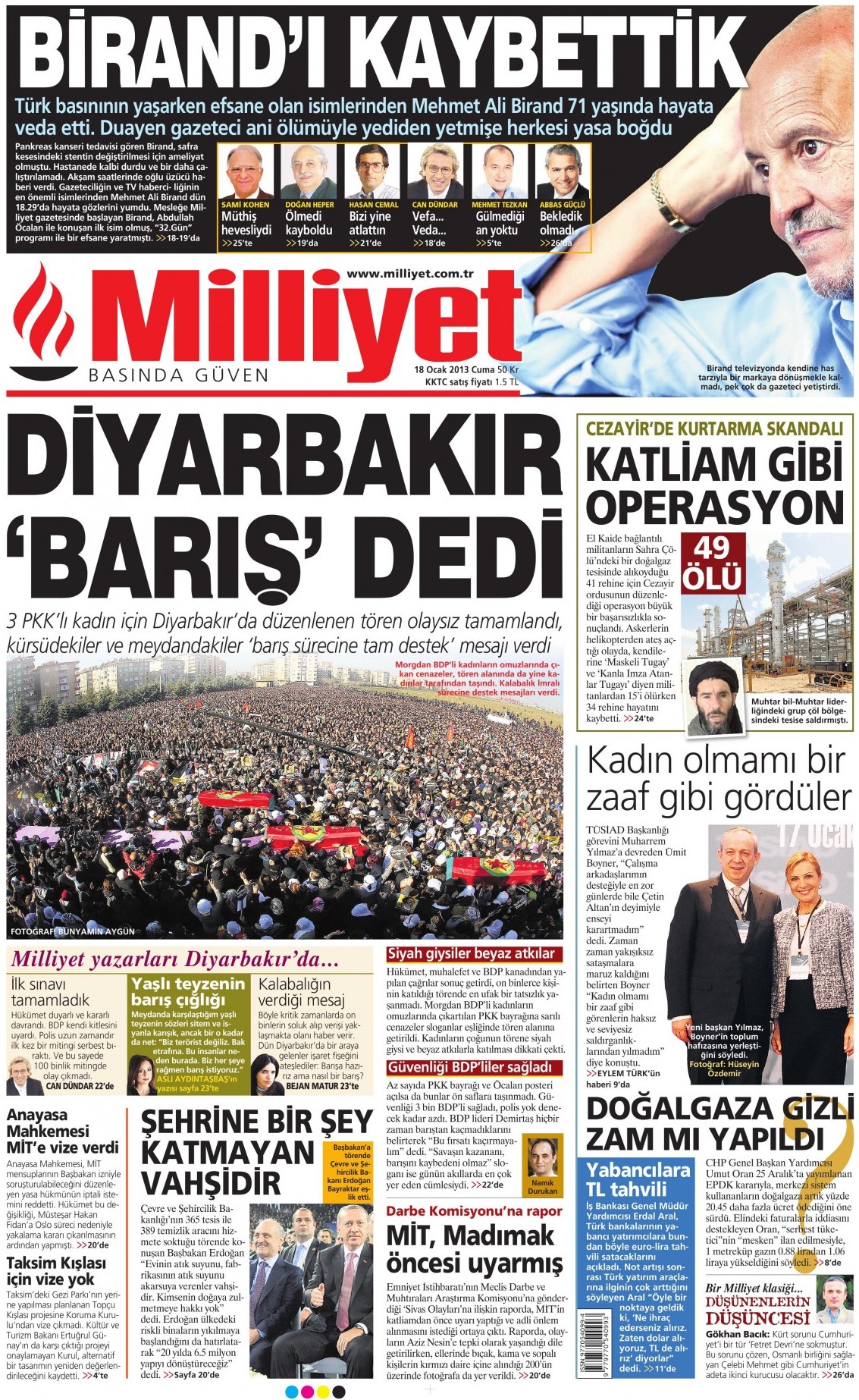
The front page of Milliyet on Jan. 18: ‘Diyarbakır said peace’
That the funerals passed peacefully was a relief not only for the government but also for the Peace and Democracy Party (BDP), which shares grassroots with the PKK. At the moment, both the Justice and Development Party (AKP) government and the BDP have a common interest in continuing the talks. For the process to come to a successful conclusion – still a long way off – this shared interest will need to persist for a while yet.
Zaman’s circulation figures – the Gülen effect?
January 9, 2013
Daily Zaman is often described as Turkey’s most read newspaper, with its circulation having recently tipped over the 1 million mark. It was therefore rather interesting to see a recent chart on medyatava.com indicating that this figure is made up almost entirely of subscribers, with only around 20,000 copies actually bought in shops every day.
This isn’t a complete surprise – for all its faults Zaman has never really been a “populist” newspaper, always self-consciously higher brow than the average fare on the Turkish newsstands. It’s pretty rare to see the local simitçi walking around Istanbul with a copy of Zaman tucked under his arm – at least in comparison with Sabah, Posta, Hürriyet, etc.
The high proportion of subscriptions can almost certainly be ascribed to Zaman’s links to the Fethullah Gülen religious movement (cemaat). Copies of the paper are delivered to most businesses/schools/individuals/hotels associated with the cemaat, which would account for the disproportionately high subscription number. As the “wikileaked” Stratfor intelligence agency cable explained back in 2009:
“FGC [Fethullah Gülen Community] businesses advertise heavily on FGC media, while FGC-owned media runs human interest stories and profiles of FGC sympathisers, businesses and schools. FGC members and sympathisers take holidays in FGC-owned hotels and shop at FGC-owned stores and invest in FGC financial institutions. Graduates of FGC cramming schools funded by FGC businesses often serve as teachers in FGC schools overseas. Finally, FGC media, funded by FGC businesses, reacts sharply to any criticism directed at Fethullah Gulen.”
A similar pattern can be observed at Today’s Zaman, the English-language arm of Zaman, which has 8,500 subscribers to just 1,900 sales.
***
While on the dull subject of newspaper circulation figures, it’s worth taking the opportunity to note that since last month’s shock resignations from Taraf, the paper has seen its circulation increase substantially. While Taraf had previously hovered around 50,000, this figure is now approaching close to 70,000. Whether or not the resignations were good from a journalistic perspective, they certainly seem to have made economic sense.
On Friday Dec. 14, news of resignations from daily Taraf filtered out, with editor-in-chief Ahmet Altan, assistant editor Yasemin Çongar, and columnists Murat Belge and Neşe Tüzel resigning from their posts at the paper.
Founded in 2007, Taraf has become one of the most controversial and agenda-setting newspapers over the last five years. Originally set up by a group of like-minded liberals and leftists, the paper became renowned for its anti-military stance, publishing a series of highly-controversial stories that revealed the extent of the Turkish military’s involvement in daily political affairs. Taking on the once-mighty Turkish military saw Taraf regularly prefixed with adjectives like “plucky” and “brave,” and even lead to its accreditation from military press releases being cancelled. However, as question marks have steadily increased over the inconsistencies and judicial irregularities of anti-military crusades such as the Ergenekon and Balyoz cases, differences of opinion within Taraf have become increasingly evident. Altan’s editorials became increasingly critical of the Justice and Development Party (AKP) government, creating friction within the paper that I previously wrote about here and here. This divergence of opinion appears to be the main reason behind the latest resignations, with the more critical, anti-AKP voices having been purged, (it is strongly rumoured that they have gone – like many in other newspapers – following government pressure).
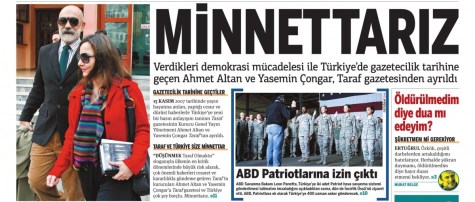
Taraf’s front page banner on Dec. 15, showing Altan and Çongar. The headline reads: “We are grateful”
Most have assumed that the resignations bring about the effective the end of the paper. Nevertheless, Taraf patron Başar Arslan apparently intends to continue publication, announcing to the Istanbul Stock Exchange on Monday that former managing editor Markar Esayan had “temporarily” taken over its editorial chair. Nevertheless, a number of important names from Taraf’s Ankara bureau signed an open letter addressed to Arslan, stating:
“If Ahmet Altan and Yasemin Çongar go, it means that we go too … We are sure that Altan’s removal from the newspaper was a political decision … Our last word is this: We are waiting for Altan and Çongar to be returned to their previous positions as soon as possible.”
Following the resignations, veteran Turkish media observer Yavuz Baydar described the events at Taraf as “a new wound for journalism.” In a similar tone, Taraf columnist Emre Uslu wrote in Today’s Zaman:
“This crisis is a benchmark by which to understand the standards of Turkish democracy because Taraf was the last bastion of refuge for democrats and civilian opposition, who fought alongside the AK Party government against the military but turned against this government as it moves away from democratic standards … Taraf was criticizing the government for not bringing about and not institutionalizing democratic standards, yet ironically the paper became the victim of the system it has been criticizing for a long time.”
Milliyet columnist Kadri Gürsel wrote what was effectively an obituary for Taraf, describing it as a “zombie paper” that had now outlived its original purpose:
“With the ‘spirit of Taraf’ Ahmet Altan having left, the paper will from now on be a zombie … Taraf was established as a newspaper with a mission … Its aim was to purge the military from politics, ‘demilitarisation.’ But it has become clear that democratisation does not necessarily follow demilitarisation and civilianisation.”
Meanwhile, Dani Rodrik, (who moonlights as the leading name writing in English on the contradictions and irregularities of the Ergenekon and Balyoz cases – found on his blog here), conspicuously used the past tense to describe Taraf on Twitter:
“Taraf’s journalistic standards were absolutely the pits. Calling the publication ‘liberal’ is a great insult to liberals … Taraf published countless bogus ‘exposes’ fed to it by the police. Its motto was ‘we will publish any trash as long as its anti-military’ … In the name of democracy, Taraf voluntarily cooperated with a gang and together violated the rules of media ethics.”
Still, correct as Rodrik is, that doesn’t necessarily mean that the recent resignations don’t also represent “prime evidence of how much Turkey is slipping backwards,” as written by Yigil Schleifer – both can be true. If the past tense can really now be used to discuss Taraf, perhaps it can also finally be used to talk about any remnants of liberal Turkish sympathy for the AKP. With the passing of Taraf perhaps a chapter in Turkish politics also passes, and the last (much belated) nail can finally be hammered into the coffin of the 10-year-long flirtation between liberals and the AKP.


 Turkey Book Talk