Here’s my conversation with Şakir Dinçşahin about his book on the life and times of Turkish intellectual Niyazi Berkes.

Download the podcast, or listen below:

You can also now subscribe to the Turkey Book Talk podcast on Stitcher. Alternatively subscribe via iTunes or via PodBean.

Here’s my review of “State and Intellectuals: The Life and Times of Niyazi Berkes” (Rowman) at the Hürriyet Daily News.

State and intellectuals

If the issues discussed are your thing, check out this interview from last year with Andros Lamprou, who wrote an interesting book on the People’s Houses.

Also worth plugging this piece I wrote a couple of years ago on Mahmut Makal and his book “Bizim Köy” (Our Village), on his experiences as a teacher at a Village Institute in the 1940s.

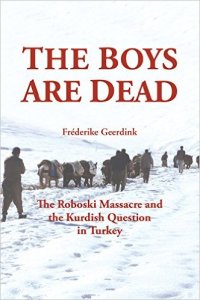
This week’s podcast is with Frederike Geerdink, author of “The Boys are Dead: The Roboski Massacre and the Kurdish Question in Turkey” (Gomidas).

We chat about her time as a journalist in the Kurdish-majority city Diyarbakır, her deportation from Turkey last year, and the troubled history/present of the issue in the wake of the collapse of the peace process last summer.

Download the podcast, or listen below:

Here’s my review of the book at Hürriyet Daily News.

The boys are dead

Subscribe to the Turkey Book Talk podcast via iTunes or via PodBean.

Follow Frederike Geerdink on Twitter.

Added bonus: I’ve dug out this interview from last year with sociologist Cem Emrence, co-author of “Zones of Rebellion: Kurdish Insurgents and the Turkish State” – quite a thought-provoking book.

This week I spoke to author Ryan Gingeras on his new biography of Turkey’s founding father, “Mustafa Kemal Atatürk: Heir to an Empire” (Oxford University Press).

Download the podcast.

Or just listen here:

Here’s an edited transcript of the interview.

And here’s my review of the book (which is highly recommended).
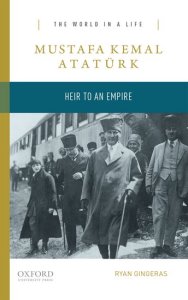
Mustafa Kemal Atatürk


As I mentioned in the podcast, here’s a link to an interview I did with Ryan last year about another of his books, “Heroin, Organized Crime, and the Making of Modern Turkey.”

Subscribe to the Turkish Book Talk Podcast via PodBean, or via iTunes.

This week’s podcast is with Nilgün Önder of the University of Regina, who joined to discuss her new book “The Economic Transformation of Turkey: Neoliberalism and State Intervention” (IB Tauris).

It’s a great and detailed book on some of the paradoxes of the economic reforms passed after Turkey’s military coup of 1980 – rather than rolling back, the authority of the state was substantially deepened by the reforms.

Download the podcast here. Or listen/subscribe via PodBean.

Here’s a transcript of the interview at Hürriyet Daily News.

And here’s my review of the book.

economic transformation

Subscribe to the Turkey Book Talk podcast via iTunes, PodBean, or Soundcloud.

Thanks for listening!

Lastly, apologies for the dodgy sound quality in these first few podcasts. I’ve got a new mic in the post so that should go some way to sorting it out.

I should say that the two things in the title are unrelated.

My interview this week was with Toni Alaranta of the Finnish Institute of International Affairs, discussing his new book “National and State Identity in Turkey: The Transformation of the Republic’s Status in the International System” (Rowman). In the book, Alaranta traces how the entrenchment in power of authoritarian political Islam in Turkey after 2002 was critically aided by the West’s misguided search for a “moderate Muslim democracy” after the end of the Cold War and the 9/11 terror attacks.

Read the interview at the Hürriyet Daily News here.

And read my review of the book here.
Alaranta

This also marks my first step into the world of podcasting. From now on I’ll be publishing these author interviews in audio as well as written form, through my new podcast “Turkey Book Talk.” The podcast will include some extra parts that didn’t make the written edit, as well as some fancy music, etc.

Click here to listen to the first episode (a work in progress as I’m still figuring out the best host, player, etc).

To subscribe to the feed, visit my PodBean page.

Subscribe via iTunes here.

Please spread the word to anyone you think may be interested, and do get in touch with any suggestions on how I can improve the podcast!

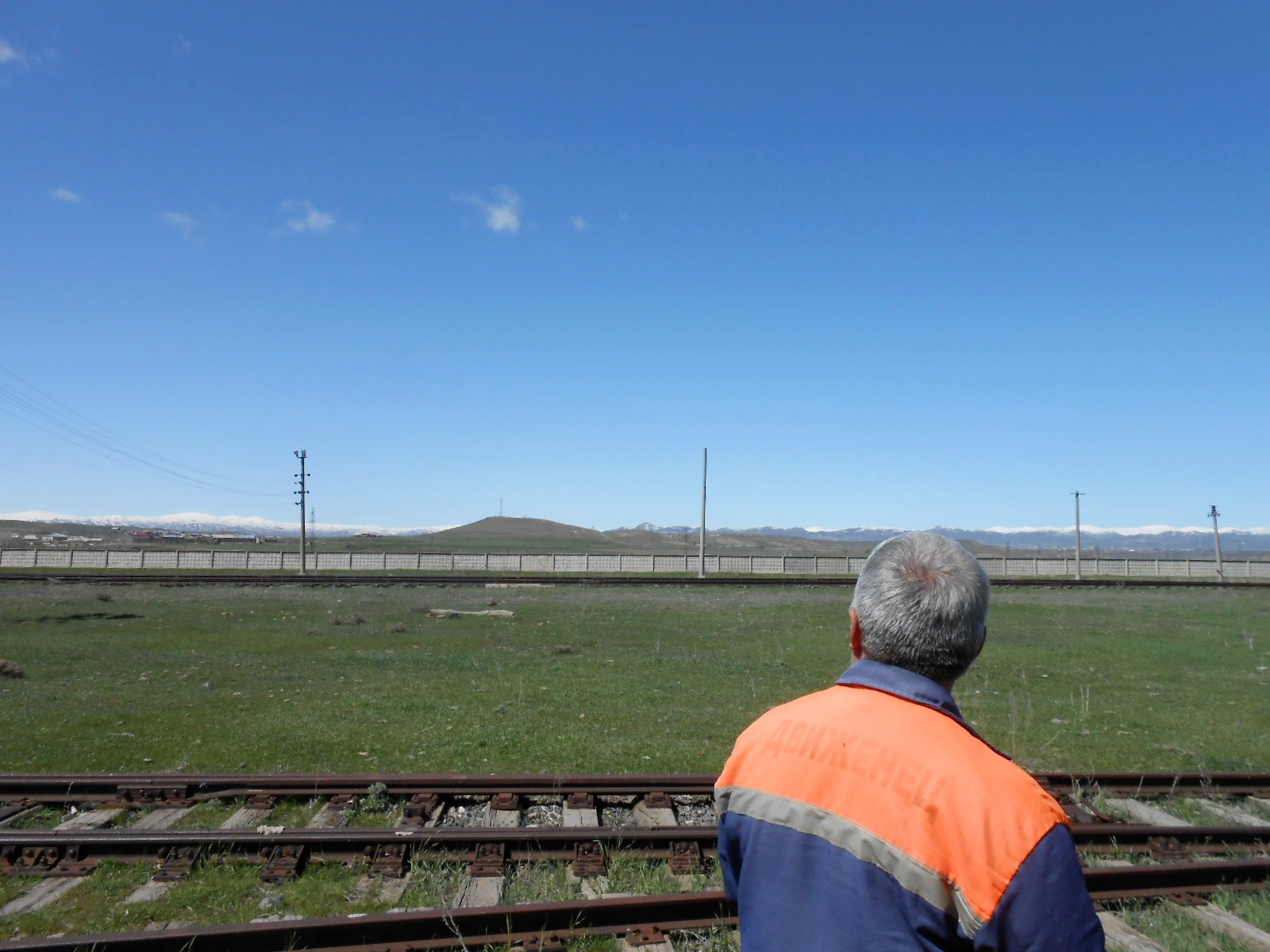
A couple of months ago I visited the Armenian side of the border with Turkey – specifically the Akhuryan train station, 2 km from the border and just outside Armenia’s second biggest city Gyumri.

The station has been closed since 1993, when Turkey sealed the border amid the Nagorno-Karabakh War between Armenia and Azerbaijan. Ever since, former station conductor Hagop Kevorkian has stayed on as a guard, forlornly waiting for services to restart.

When we visited, Hagop was just sitting alone in the dark station office wearing his fading old Soviet-era uniform, midway through his 12-hour shift doing nothing. Another guard waits at the station on rotating days, but they have not seen trains for over two decades. The Akhuryan Station is thus a sad symbol of the human cost of the diplomatic impasse between Ankara and Yerevan.

I wrote an article for Al Monitor about the station and the slim chances for the border reopening.

Below are some of the photos I took of Hagop and the station.

DSCN1065

DSCN1047

DSCN1051

DSCN1052

DSCN1057

DSCN1058

DSCN1061

DSCN1079

DSCN1090

DSCN1106

DSCN1112

I’ve written a piece for Politico about Turkey’s critical general election. Specifically, the article looks at the shift by President Erdoğan and the government in recent months from emphasising economic competence to peddling bombastic conspiracy theories:

“While signs of this paranoiac shift have long been evident, the AKP’s earlier years in power mostly focused on making an economy-based pitch to voters. Economic competence and extending services to the poorer sections of society – along with an appeal to the conservative religious values held by many Turkish citizens – proved a winning combination for a string of crushing election victories. But while the party still pledges to spur development, its rhetoric leading up to Sunday’s election has tilted decisively in favor of a combination of conspiracy theories laced with historic posturing about reconnecting Turkey with the glory of the Ottoman Empire. When you’re on a glorious path, the AKP’s leaders suggest, you will inevitably have enemies.”

Read the whole thing over at Politico.

maxresdefault


This week I interviewed Zeynel Abidin Besleney, the author of a new book on the history of Circassian political activism in Turkey. The book is probably the most detailed available title on what is a pretty obscure subject, and I learnt plenty from it.

Here’s a link to the interview with Besleney at the Hürriyet Daily News.

And here’s my review of the book.

The Circassian Diaspora

My review/interview double-header this week was based on “The Rise of Political Islam in Turkey: Urban Poverty, Grassroots Activism and Islamic Fundamentalism” by Kayhan Delibaş, who works at Kent University and Turkey’s Adnan Menderes University.

The book is well worth reading for anyone looking for a deeper look into the political context of the emergence of Islamist parties in Turkey in the 1980s and 1990s. While it’s true that political Islam is an intrinsically transnational phenomenon, it’s always worth remembering the specific conditions that have facilitated it’s emergence, which of course differ everywhere.

Here’s my review of the book in the Hurriyet Daily News.

And here’s my conversation with its author Kayhan Delibaş.

The Rise of politicl islam

Is Turkey’s new Prime Minister Ahmet Davutoğlu a pan-Islamist ideologue, with imperialist ambitions to reshape the Middle East into a post-national order based on Turkish and Sunni religious supremacy? That is the blockbuster thesis currently turning heads both inside and outside Turkey, thanks to a series of recent articles by Marmara University Assistant Professor Behlül Özkan.

Özkan, a one-time student of Davutoğlu’s from the latter’s time as an international relations professor, bases his provocative conclusion on close study of 300 articles penned by Davutoğlu in the 1980s and 90s. He first made his case in an essay for the August-September edition of the International Institute for Strategic Studies’ journal“Survival,” before introducing it to a wider English audience with pieces on Al-Monitor and in the New York Times.

In his NYT op-ed “Turkey’s Imperial Fantasy” published last week, Özkan remembered Professor Davutoğlu as a hard-working and “genial figure” who “enjoyed spending hours conversing with his students.” In contrast with his academic peers, however, he believed that Turkey would “soon emerge as the leader of the Islamic world by taking advantage of its proud heritage and geographical potential … encompass[ing] the Middle East, the Caucasus and Central Asia, and include Albania and Bosnia”:

Mr. Davutoglu’s classroom pronouncements often sounded more like fairy tales than political analysis. He cited the historical precedents of Britain, which created a global empire in the aftermath of its 17th-century civil war, and Germany, a fragmented nation which became a global power following its 19th-century unification. Mr. Davutoglu was confident that his vision could transform what was then an inflation-battered nation, nearly torn apart by a war with Kurdish separatists, into a global power.

He crystallized these ideas in the book ‘Strategic Depth,’ in 2001, a year before the Justice and Development Party, or A.K.P., came to power. In the book, he defined Turkey as a nation that does not study history, but writes it — a nation that is not at the periphery of the West, but at the center of Islamic civilization … Mr. Davutoglu saw himself as a grand theorist at the helm of his country as it navigated what he called the ‘river of history.’ He and his country were not mere pawns in world politics, but the players who moved the pieces.

Özkan rejects that Davutoğlu’s ideas amount to “neo-Ottomanism,” as often accused. Instead, he gives Turkey’s new prime minister the even heftier label of “pan-Islamist”:

The movement known as Ottomanism emerged in the 1830s as the empire’s elites decided to replace existing Islamic institutions with modern European-style ones, in fields from education to politics. By contrast, Mr. Davutoglu believes that Turkey should look to the past and embrace Islamic values and institutions.

But, ironically, he bases his pan-Islamist vision on the political theories that were used to legitimize Western imperial expansion prior to 1945. While purporting to offer Turkey a new foreign policy for the 21st century, his magnum opus draws on the outdated concepts of geopolitical thinkers like the American Alfred Thayer Mahan, the Briton Halford Mackinder and the German Karl Haushofer, who popularized the term “Lebensraum,” or living space, a phrase most famously employed by Germany during the 1920s and 1930s to emphasize the need to expand its borders.

According to Mr. Davutoglu, the nation states established after the breakup of the Ottoman Empire are artificial creations and Turkey must now carve out its own Lebensraum — a phrase he uses unapologetically. Doing so would bring about the cultural and economic integration of the Islamic world, which Turkey would eventually lead. Turkey must either establish economic hegemony over the Caucasus, the Balkans and the Middle East, or remain a conflict-riven nation-state that risks falling apart.

After becoming Turkey’s foreign minister from 2009, Davutoğlu had the opportunity to put these ideas into practice – with disastrous results:

As foreign minister, Mr. Davutoglu fervently believed that the Arab Spring had finally provided Turkey with a historic opportunity to put these ideas into practice. He predicted that the overthrown dictatorships would be replaced with Islamic regimes, thus creating a regional ‘Muslim Brotherhood belt’ under Turkey’s leadership.

He sought Western support by packaging his project as a ‘democratic transformation’ of the Middle East. Yet today, instead of the democratic regimes promised three years ago, Turkey shares a border with ISIS’s self-proclaimed caliphate. Two months ago, its fighters raided the Turkish consulate in the Iraqi city of Mosul, and is still holding 49 Turkish diplomats hostage. Mr. Davutoglu, who has argued that Turkey should create an Islamic Union by abolishing borders, seems to have no idea how to deal with the jihadis in Syria and Iraq, who have made Turkey’s own borders as porous as Swiss cheese.

To repair this dire situation as prime minister, Özkan says Davutoğlu needs to pragmatically reconnect Turkey’s regional policy with reality:

The new prime minister is mistaken in believing that the clock in the Middle East stopped in 1918 — the year the Ottoman Empire was destroyed — or that Turkey can erase the region’s borders and become the leader of an Islamic Union, ignoring an entire century of Arab nationalism and secularism. What Mr. Davutoglu needs to do, above all, is to accept that his pan-Islamist worldview, based on archaic theories of expansionism, is obsolete.

Turkey's new prime minister, Ahmet Davutoğlu (Photo: Anadolu Agency)

Turkey’s new prime minister, Ahmet Davutoğlu (Photo: Anadolu Agency)

Özkan’s thesis certainly seems to have struck a chord, with plenty of prominent figures declaring their admiration. Still, the reception has not been universally positive. In Radikal, political scientist Fuat Keyman expressed skepticism about the use of any catch-all term such as “pan-Islamist” to accurately describe Davutoğlu’s worldview:

As someone who has read many – if not all – of Davutoğlu’s works, it’s difficult to understand how Dr. Özkan has drawn the conclusion that Davutoğlu is a pan-Islamist (which is problematic as a term anyway).

It shouldn’t be forgotten that such expressions have only recently started to be used for Erdoğan and Davutoğlu. It could be said that irresponsible, anti-Semitic writings and comments made [by others] in Turkey recently have contributed to the increased use of terms like ‘pan-Islamism’ abroad.

Still, I don’t think terms such as ‘neo-Ottoman,’ ‘sectarian,’ or ‘pan-Islamist’ are useful or appropriate when describing Davutoğlu’s worldview, or his approach to foreign and domestic politics … Criticism of Turkish foreign policy should instead focus on the strategic errors that have been made, the exaggeration of Turkey’s power, and recently its distancing from democracy.

In Zaman, meanwhile, Şahin Alpay similarly questioned the validity of any term that sought to place a rigid label on the often multi-dimensional policies of Davutoğlu and the AKP:

The foreign policies pursued by Erdoğan and Davutoğlu do not fit into the mold of ‘neo-Ottoman,’ ‘pan-Islamist,’ or ‘Sunni sectarian.’ It’s difficult to apply a single ideological label for a foreign policy that started negotiations to join the EU, gave NATO permission for its Kürecik bases, received prizes from the Israeli lobby, struck up a personal friendship with Bashar al-Assad, recommended secularism to Egypt, and felt Tehran to be its own home. Rather than being based on certain principles, the policies pursued by the AKP, domestically and abroad, can be said to be either pragmatic, populist, opportunistic, or aimed at securing or protecting power. But if an ideological tag is necessary, Islamic Kemalism or religious nationalism could be used.

A deeper and more academic critique of Özkan’s work that has attracted particular attention was posted on the personal website of Ali Balcı, an associate professor at Sakarya University. Balcı doesn’t take issue with Özkan’s use of such a blanket term as “pan-Islamist,” but voices more substantial reservations about the underlying fundamentals of his work:

Özkan argues that the ‘pan-Islamic’ conclusions and analyses made by Davutoğlu as an academic in the second half of the 1980s and the 1990s can be used to understand Davutoğlu’s later foreign policy. This strongly indicates a ‘once an Islamist always an Islamist’ assumption, suggesting that Davutoğlu’s essential core is unchanging in the face of different times and conditions … The work’s fundamental problem is that despite all of the changes in conditions [since Davutoğlu wrote], it still puts forward that a pan-Islamist is always a pan-Islamist – a reductionist and essentialist reading.

Balcı says it isn’t clear why Özkan searches for proof of Davutoğlu’s “pan-Islamism” in his old academic articles, while he supports the “neo-Ottoman” label for former Turkish President Turgut Özal using evidence from the latter’s period in office:

Examples of Özal’s neo-Ottomanism given by the writer can also be given for the AK Parti’s time in power and in Davutoğlu’s period as foreign minister. As stated by the writer, Özal applied for EU membership in 1987, worked to broaden influence in the Caucasus and the Balkans, tried to solve the Kurdish problem through reforms, and worked to establish control in its relations with Iraq. If all of these practical realities have also emerged during the AK Parti and Davutoğlu eras, how can Özal be considered a neo-Ottoman while Davutoğlu is a pan-Islamist? In answer to this question the writer only presents certain criticisms of Özal made by Davutoğlu. But while proving Özal’s neo-Ottomanism with practical examples, [Özkan] doesn’t answer why he looks for examples of Davutoğlu’s pan-Islamism in articles written while he was an academic.

Some of these criticisms are valid, but some are wide of the mark. It may not be true that “once a pan-Islamist is always a pan-Islamist,” but there is plenty of evidence that today’s Davutoğlu still sympathizes with the views expressed in his old academic work. While he certainly has demonstrated a keen sense of pragmatism and adaptability in the past, there’s can be little doubt that he has steadily moved away from this realism and back to a far more dogmatic and ideological approach in recent years. It may be less articulate than Balcı’s blog post, but the government’s hagiographical short film that accompanied Davutoğlu’s recent nomination as prime minister was equally germane to the issue: “He is the awaited spirit of Abdülhamid,” the lyrics say at one point, referencing the 19th century sultan who deployed Islamism to combat the collapse of the Ottoman Empire. “For the nation, for the ummah, for Allah.”

Now that Davutoğlu is in the prime minister’s chair, the question is whether he will continue to be seduced by his ideological convictions and lose touch with his former pragmatism. If he does, then Özkan’s thesis will look even more prescient.


[Originally posted at Hürriyet Daily News]

The draft bill to “transform” test prep schools (dershanes) into formal private schools was submitted to the Turkish parliament last week. The mooted closure of dershanes – many of which are operated by sympathisers of Islamic scholar Fethullah Gülen – is widely interpreted as an Erdoğan-lead strike against the Gülen movement, and seems to have been the trigger leading to the Gülenist-led corruption probes that have targeted figures close to the government since December. The precise effects that a closure of the dershanes would have aren’t clear, but it’s reasonable to assume that it would significantly affect the reach of the Gülen movement and its influential media arms. Gülen-affiliated outlets probably aren’t commercially viable as independent entities, but they are useful as public relations arms for the movement’s wider interests. In this sense, the business models of the pro-Gülen media – mostly controlled by either Feza Publications or the Samanyolu Publishing Group – aren’t dissimilar to those of mainstream government-friendly titles: Losses can be accepted in consideration of a bigger picture. Those losses will be far more difficult to sustain without the profits flowing in, directly or indirectly, from dershanes.

As U.S.-based press watchdog Freedom House stated in its report on Turkey published Feb. 3: “Media outlets are used to promote their ownership group’s financial interests … Members of the media and the government alike describe newspapers’ Ankara bureau chiefs as ‘lobbyists’ for their companies.” Owning a media outlet isn’t profitable in itself, but it helps to have one in order to facilitate business in other sectors; at least a dozen newspapers and 10 television stations are owned by conglomerates with energy, construction or mining interests, all sectors heavily dependent on government business. Moguls are willing to temporarily handle the losses involved in owning media groups – and are often encouraged to do so by the government – as they know that other business benefits will follow (in the winning of construction tenders, for example). As such, their number one priority is usually to protect their good relations with the government.

The Gülenist media is useful as a lobbyist for the Gülen movement’s interests in the same way that the pro-Erdoğan media lobbies for the government’s (and their own companies’) interests. Media outlets don’t necessarily have to be profitable to make commercial sense. For example, the pro-Gülen Zaman newspaper has the highest circulation figures of any Turkish newspaper, but these figures are mostly made up of subsidised subscriptions. It’s not uncommon in Turkey to see copies of Zaman left in the lobbies of apartment buildings or tucked into the gates at the entrance of a shop or a residential site. Thousands of copies are also sent, solicited or unsolicited, to businesses with ties (either tight or loose) to Gülen. According to figures that I noticed last year, only a tiny fraction of Zaman’s circulation figures come from actual sales. I don’t know about online and print advertising revenue, but it’s clear that a profit can’t possibly be run when sales are so low and subsidised subscription is so high.

But the value of Zaman lies in more than just headline profits – the paper is part of the broader Gülen movement eco-system. Zaman is owned by Feza Publications, which is a partner organisation of the Samanyolu Publishing Group; between them, they operate dozens of newspapers, websites, TV stations, radio stations and magazines, both in Turkey and abroad. These don’t directly come under the umbrella of a wider holding company operating in other sectors, as most of the mainstream pro-AKP media does, but the relationship is similar. All Gülen media groups are supported directly and indirectly by profits from other Gülenist business interests. Without the financial support provided by the operation of the dershanes, the Gülenist media would find it more difficult to sustain itself.

Joshua Hendrick, the author of the most respected book on the Gülen movement so far available in English, has suggested that the move to close the dershanes primarily aims to “[go] after the existential nature of the movement by destroying its human resources.” The financial ramifications of a closure of dershanes would also be significant. The Gulenists run 2,000 schools in 160 countries, and Hendrick estimates that the Gülen-affiliated charter schools in the U.S. alone bring in around $500 million per year. Although they are primarily seen as a means of attracting new sympathisers, the hundreds of Gülen-affiliated dershanes in Turkey also make up a multimillion-dollar industry. On both human and financial fronts, therefore, a dershane closure – which the draft just submitted to parliament ensures would be completed by September 2015 – would likely have big ramifications for the Gülen-affiliated media.

The title will be familiar to any follower of news in Turkish. Every day, “news” stories consisting of unedited transcripts of words spoken by Prime Minister Recep Tayyip Erdoğan are published online under that headline by the major newspapers. The recent storm over Erdoğan’s opposition to mixed-sex student accommodation was only the latest example showing that Turkey’s entire news agenda is increasingly becoming subject to the whims of his unpredictable tongue. He opens his mouth and whichever subject he has chosen then dictates the national conversation. When the media is so completely dependent on politicians, how can be expected to hold those same politicians to account?

This problem cuts across the internet, the television, and the printed press. It almost feels like an act of rebellion when a TV station chooses not to cut to a live broadcast of any public utterances from “The Master.” I only came to Turkey in 2009, so I can’t say whether this has always been the case, but I suspect that the situation has only deteriorated of late. The fact is that you can’t get much safer than a “news” story simply providing a transcript of words spoken by the prime minister. What’s more, depressingly, I’ve been told that these articles usually get the most “hits” for websites. This fixation on Erdoğan’s every word is not only extremely distorting, but also exacerbates the bizarre cult of personality that has developed around him amongst his supporters.


Habertürk parroting the prime minister on Nov. 9. With unintended irony, the headline quotes Erdoğan’s response to Deputy PM Bülent Arınç’s criticism of the mixed-sex student housing debate: ‘I don’t discuss these things in front of the media’.

Habertürk parroting the prime minister on Nov. 9. With unintended irony, the headline quotes Erdoğan’s response to Deputy PM Bülent Arınç’s criticism of the mixed-sex student housing debate: ‘I don’t discuss these things in front of the media.’


But while this obsequiousness is lamentable, those official pronouncements in fact are very important. The centralization of decision making is so chronic that Erdoğan’s words, whatever they are, really do have the power to shape the agenda of the country, decide the laws that then get passed, and at what speed. As Adana Governor Hüseyin Avni Coş said shortly after Erdoğan’s utterances on co-ed housing: “We see the prime minister’s words as orders.” Policy is increasingly being shaped on an ad-hoc basis around Erdoğan’s statements; the centralization of power around him now is such that there is a genuine justification for reporters broadcasting and publishing every single thing he says. The vicious cycle is thus reinforced.

That’s why the controversy that is periodically caused by the firing of prominent critical columnists from newspapers often misses the point. Many people’s understanding of news seems to be little deeper than a “who said what?”  bish-bash-bosh, responded to by a flood of commentary. As I wrote in my last post, few seem to value deeper investigative reporting, and none ever mention the inherent problem with “stories” consisting of nothing more than an indiscriminate transcript of a minister’s speech. Editors who are encouraging “Important statements from the prime minister” articles are contributing to this dangerous imbalance. Far from the media being a check on power, PM Erdoğan’s tongue is the driving force behind the media.