Mustafa Gurbuz on ‘rival Kurdish movements in Turkey’
March 12, 2016
The latest Turkey Book Talk podcast is with Mustafa Gürbüz, the author of “Rival Kurdish Movements in Turkey: Transforming Ethnic Conflict” (Amsterdam University Press).
Apologies for the delay in dropping this latest pod. I’ve had a technical nightmare.
Download the podcast or listen below.
Subscribe: iTunes / PodBean / Stitcher / Facebook / RSS
Here’s my review of the book at Hürriyet Daily News. Here’s the interview in written form.

Here’s another interview I did with him from last year about his research on the outlawed Kurdish Islamist militant group Hizbullah.
Finally, reposting my recent podcast with Frederike Geerdink discussing the Kurdish issue.
Frederike Geerdink on Turkey’s Kurdish question
February 5, 2016
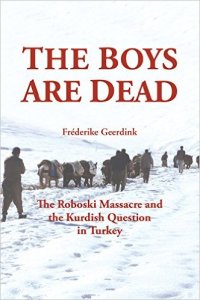
This week’s podcast is with Frederike Geerdink, author of “The Boys are Dead: The Roboski Massacre and the Kurdish Question in Turkey” (Gomidas).
We chat about her time as a journalist in the Kurdish-majority city Diyarbakır, her deportation from Turkey last year, and the troubled history/present of the issue in the wake of the collapse of the peace process last summer.
Download the podcast, or listen below:
Here’s my review of the book at Hürriyet Daily News.
Subscribe to the Turkey Book Talk podcast via iTunes or via PodBean.
Follow Frederike Geerdink on Twitter.
Added bonus: I’ve dug out this interview from last year with sociologist Cem Emrence, co-author of “Zones of Rebellion: Kurdish Insurgents and the Turkish State” – quite a thought-provoking book.
Markus Dressler on the ‘making of Turkish Alevi Islam’
November 28, 2015
This week’s interview/podcast is with Markus Dressler, author of the book “Writing Religion: The Making of Turkish Alevi Islam.” The book examines how the idea of Alevism is an almost entirely modern concept, formed towards the end of the Ottoman Empire as part of efforts to integrate disparate Anatolian religious groups into the Turkish and Muslim nation.
Download a podcast of our conversation.
Here’s a transcript of the interview at the Hürriyet Daily News.
Here’s my review of the book.

Subscribe to the Turkey Book Talk podcast via iTunes, PodBean, or Soundcloud.
NB – I’ve also just created a Facebook page for the podcast, where I’ll be posting new episodes. Check it out here.
Cengiz Şişman on the Dönmes of Turkey
November 14, 2015
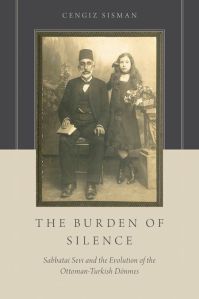
This week I spoke to Cengiz Şişman about his new book on the history of the Dönmes, a crypto-religious sect that first developed around Jewish messiah Sabbatai Sevi in cities around the Ottoman Empire in the 17th century.
Download a podcast of our conversation. Or listen below:
Subscribe to the Turkey Book Talk podcast via iTunes, PodBean, or Soundcloud.
Read an edited transcript of the interview at the Hürriyet Daily News.
And read my review of Şişman’s book, “The Burden of Silence: Sabbatai Sevi and the Evolution of the Ottoman-Turkish Dönmes.”
Turkey and the PKK at another crossroads
July 25, 2015
This week saw some of the worst clashes between Turkish security forces and the Kurdistan Workers’ Party (PKK) since the (now ended?) peace process officially started over two years ago.
As a result my interview and review this week are sadly topical. I spoke to Cem Emrence, who co-authored a new title on the history of the Turkey-PKK conflict, “Zones of Rebellion: Kurdish Insurgents and the Turkish State.” It is a slim but rich book, elaborating a complex theory of path dependence that has limited the options of both the Turkish state and the PKK over three decades and ultimately led to stalemate.
Read the Q&A with Emrence in Hürriyet Daily News here.
And read my review of the book from earlier this week here.

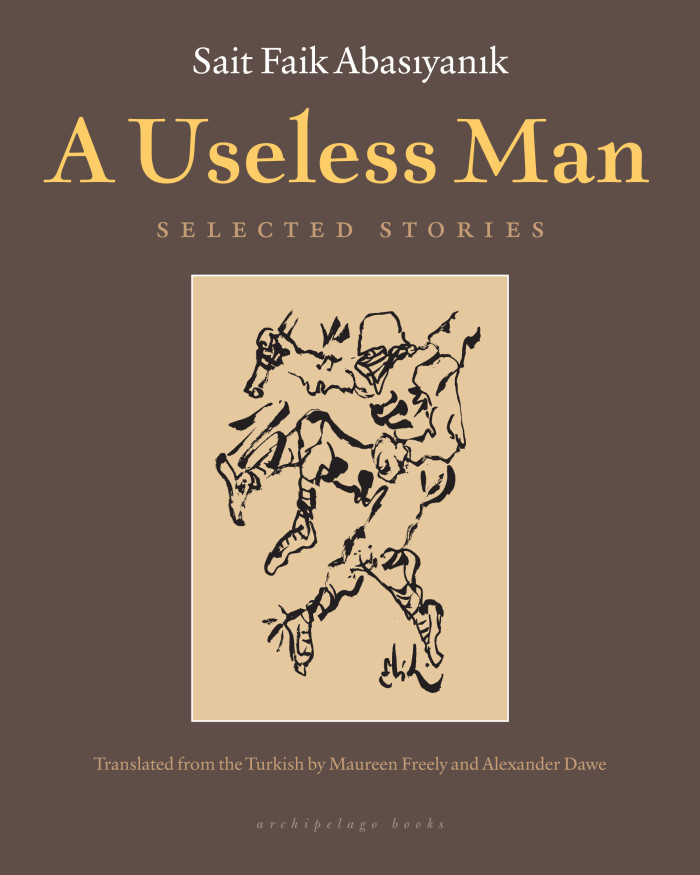
And something completely different: In next week’s Times Literary Supplement I review a new English selection of the great Sait Faik’s stories. It’s only available in print form so you’ll have to seek out an actual real physical copy of the TLS if you’re interested in reading it.
‘Insulting the religious beliefs held by a section of society’: Plenty of evidence in Turkish newspapers
April 19, 2013
Handing its 10-month jail sentence to Turkish pianist Fazıl Say on April 15, the Istanbul court stated that Say was guilty of “denigrating the religious beliefs held by a section of society” and had thus violated Article 216 of the Turkish Penal Code (TCK). Although “blasphemy laws” still officially remain in many states, they are now almost completely dormant in most democracies. The rare prosecutions that are attempted based on them almost always fail, either because of sensible legal interpretation or the fact that a guilty verdict would clash with legally enshrined principles of freedom of expression.
Say’s prosecution was based on his retweeting of couplets attributed to medieval Persian poet Omar Khayyam last year, including lines such as: “You say its rivers will flow with wine. Is the Garden of Eden a drinking house? You say you will give two houris to each Muslim. Is the Garden of Eden a whorehouse?” He also posted a personal tweet, stating: “I don’t know whether you have noticed or not, but wherever there is a stupid person or a thief, they are believers in God. Is this a paradox?” However misguided Article 216 may be, there can be little doubt that Say deliberately intended to “denigrate the religious beliefs held by a section of society.” Of course, deliberate insult should never be criminalized, but as it is considered legitimate grounds for prosecution in Turkey it’s worth asking why cases aren’t regularly opened against material published in certain Turkish newspapers. The fact is that there are a number of Turkish dailies with considerable reputations for directing abuse at religious, ethnic, and sexual minorities.
Yeni Akit has a considerable track record of targeting respected journalists for aggressive and persistent smear campaigns, including Cengiz Çandar, Hasan Cemal, Ahmet Altan, and Amberin Zaman. It has even recently been waging a bizarre campaign against the “deviant spirituality” of yoga. Although it and fellow hard-line Islamist newspaper Milli Gazete (affiliated to the minor Felicity Party) have both been fined on numerous occasions for slander and libel, they have never to my knowledge been prosecuted for “insulting a section of society.” That may seem odd after considering the following examples, dredged up on their websites by a simple search of the words “Christian,” “Jew,” “Alevi,” and “homosexual”:
– Milli Gazete’s April 18 front page headline focused on the “scandal” that the EU was “making the Turkish state pay” the costs for lighting non-Muslim places of worship “such as churches and synagogues.”
– On the same front page, it was also disbelievingly reported that New Zealand had become the latest country to legalise gay marriage. The article was headlined, “Your destruction is near,” and was accompanied on the printed page by a picture of two fossilised victims from Pompeii.
– The same paper also carried a headline story in January warning about the dangers of “Zoroastrian missionaries” spreading “terrorist propaganda” in Turkey’s southeast.
– Again Milli Gazete, this time declaring as its Jan. 8 front page: “Here’s the Jewish mind.” The story was about Jewish religious jewellery being sold by a U.S.-based company, which donated some of its profits to the Israeli army.

Milli Gazete, Jan. 8, 2013: ‘Here’s the Jewish mind’
– On the same day that Milli Gazete was warning about “the Jewish mind,” Yeni Akit reported news of an old church in the Black Sea province of Giresun making “Christian propaganda.” Despite the fact that the church had been converted into a library in 2001, the article bemoaned that crosses and Stars of David were still to be found inside the building, “blurring young minds.”
– Yeni Akit on Feb. 3: “Support for perverts from the CHP and BDP,” regarding attempts in January by opposition deputies to reform the law stating that “dirty” and “deviant” homosexuality is legitimate justification for expulsion from the Turkish military.
– Yeni Akit: “The 19 Year Lie,” in which a host of slanderous claims were made about the massacre of over 30 Alevis in the central Anatolian town of Sivas in 1993.
On any given day you can open either Milli Gazete or Yeni Akit and be sure to find similar stories, written in the most unpleasant, insulting language. Should it really be surprising that Article 216 isn’t extended to these cases?
Even if the necessary sections of the Turkish penal code were reformed, they would still undoubtedly be liable to misuse through selective interpretation. However decent a country’s set of laws may be, and however enshrined they are in decent-sounding constitutions, problems generally come from the interpretation of those laws. If Article 216 was always applied as rigorously as it was against Say, then all the above examples would be investigated. In the end, the most important factor behind scandals such as the Say case is the mentality behind them, which is not something that can be transformed by a simple change in legal language.
Coverage of Ankara-PKK ‘peace process’ in the Turkish media
January 19, 2013
Peace talks are still ongoing between the Turkish state, representatives of the Kurdistan Workers’ Party (PKK), and PKK leader Abdullah Öcalan. It is likely that for any kind of peace to be secured they will have to go on for quite a while longer. Looking at the attitudes adopted by the Turkish media over the course of the “İmralı process” has been illuminating, particularly the reporting of the Jan. 17 funeral ceremonies in Diyarbakır of the three female Kurdish activists who were recently shot dead in Paris.
The government’s previous “Kurdish Opening” in 2009 came to an abrupt end after the controversy that followed the release of a group of PKK militants at the Habur border crossing and their welcoming back by huge crowds in Diyarbakır. Any comparable scenes carried the danger of enflaming Turkish nationalist sentiments and posed a risk to the latest dialogue process. Thus, in the lead up to the funerals most in the mainstream media were in agreement that they represented a significant test. On the morning of the ceremonies, dailies Vatan, Yeni Şafak, and Yeni Asya all featured front page headlines quoting the words of Prime Minister Recep Tayyip Erdoğan saying that the day would be a “Samimiyet sınavı,” or “Sincerity test.”
The ongoing process is extremely delicate. It’s easy to forget that although public support for the current PKK talks is significantly higher than it was in 2009, suspicion of the talks is still widespread. It was therefore interesting to observe how none of the major TV stations covered the ceremonies live in any detail on the day, despite the fact that they were attended by tens of thousands of people. As with much coverage of the Kurdish issue, (the Uludere/Roboski massacre in December 2011, for example), it is likely that this low key coverage had been “suggested” to the major media organizations by the government, acutely aware of the need to avoid scenes similar to those in Habur in 2009. Tellingly, Deputy Prime Minister Bülent Arınç had the following to say at a media event on Thursday: “The media’s support is so pleasing for us. I know and I see this support. … Eighty percent of media groups are lending their support. They are conducting positive broadcasts and contributing to the process. I hope this continues.” Still, in a column the next day titled “Peace is difficult with this media,” daily Vatan’s Rüşen Çakır had some critical things to say about this mentality:
“Television stations who didn’t show the ceremony yesterday failed the ‘sincerity test.’ In fact, they didn’t even sit the test … In the name of not making mistakes, or avoiding possible crises, or not annoying the government, they chose not to do anything at all … During the latest İmralı process, our media sees only one side as having to take steps – and all of these steps set according to what the government wishes – which itself sabotages the road to peace.”
In the event, Jan. 18’s newspapers exhaled an audible sigh of relief that the day passed without “provocation or sabotage” from either the mourners or the Turkish security forces. In contrast to the relative silence of the TV stations, the majority of the next day’s papers featured the funerals as front page headline stories, showing pictures of the crowds gathered in Diyarbakır and striking a noticeably optimistic tone. Many focused on a makeshift sign that one man was carrying at the ceremonies: “There is no winner from war; there is no loser from peace.”
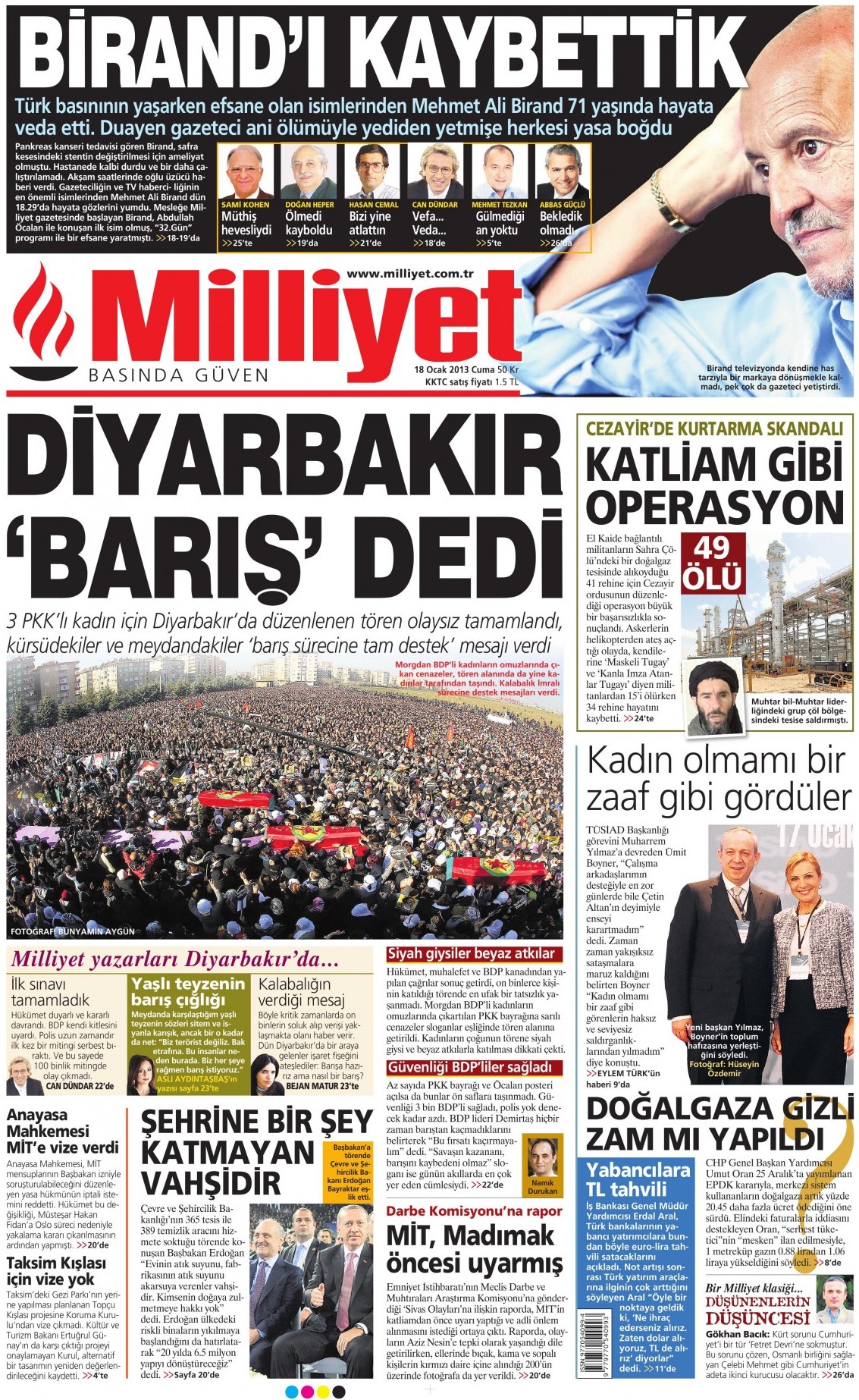
The front page of Milliyet on Jan. 18: ‘Diyarbakır said peace’
That the funerals passed peacefully was a relief not only for the government but also for the Peace and Democracy Party (BDP), which shares grassroots with the PKK. At the moment, both the Justice and Development Party (AKP) government and the BDP have a common interest in continuing the talks. For the process to come to a successful conclusion – still a long way off – this shared interest will need to persist for a while yet.
‘Bring back capital punishment, end this business’
November 14, 2012
Recently, Turkish Prime Minister Recep Tayyip Erdoğan has repeatedly expressed his opinion that Turkey should consider reinstating capital punishment “in certain situations.” He first brought the issue up at a meeting of his Justice and Development Party’s (AKP) deputies on Nov. 3, in reference to Abdullah Öcalan, the convicted leader of the outlawed Kurdistan Workers’ Party (PKK), and has returned to it on a number of occasions since. “Right now a lot of people in public surveys say that capital punishment should be reintroduced … It is legitimate in certain situations,” Erdoğan said. “Yes, the death penalty was removed from Europe, but has it left America, Japan and China? Then there is a justified cause for the death penalty to remain.”
Capital punishment was abolished by Turkey in 2002, just prior to the AKP’s accession to power in the general elections of that year. Although no execution had been carried out by the Turkish state since 1984, an official end to the practice on the Turkish law books was seen as one of the key steps in Turkey’s EU accession process, which was then entering its most energetic period. The decision was fairly controversial at the time, as PKK leader Öcalan was captured and sentenced to death by the Turkish authorities in 1999. With the abolition of capital punishment, this sentence was commuted to life imprisonment, and Öcalan has since been held in a remote prison on İmralı Island in the Marmara Sea. With the recent spike in clashes between the Turkish security forces and the PKK, Erdoğan’s words on capital punishment should be interpreted in terms of the government’s failure to solve the Kurdish question – populist sentiments aiming to deflect nationalist criticism that he has made too many concessions to Kurdish rights with little to show in return.
The most striking newspaper coverage of the issue I saw came from popular pro-government daily Sabah, the newspaper with the fourth highest circulation nationally. Its Nov. 13 front page carried the bold headline “Bring back capital punishment, end this business.” These were the words of Fatma Çınar, the mother of one of the 17 soldiers killed in the recent helicopter crash in the southeastern province of Siirt, speaking at her son’s funeral. The crash was not a result of direct clashes with the PKK, but it was enough for PM Erdoğan to frame it as taking place within “much intensified, multi-dimensional” military operations in the region.

The return of the issue to the national debate has predictably raised eyebrows among those parts of the media who retain forlorn hopes that Turkey’s EU accession process can still be revived from its current moribund state. Opposition Republican People’s Party (CHP) deputy Rıza Türmen, who worked for 10 years at the European Court of Human Rights, wrote in Milliyet on Nov. 13: “Capital punishment is banned according to the third section of the European Union’s founding principles, and the lifting of capital punishment is a precondition for membership of the EU and the European Council … Is leaving the EU process what the prime minister actually wants?” Meanwhile, Taraf editor Ahmet Altan’s disillusionment continued on the same day: “We’ve gone from a country that celebrated with enthusiasm the opening of ‘full EU membership negotiations,’ to one with a prime minister – like a funeral undertaker – shouting ‘hang them, hang them’ at every opportunity.” A response even came from the murky corridors of the EU itself, with Peter Stano, the spokesman for Enlargement Commissioner Stefan Füle, stating: “Our position on this is quite clear. Countries wishing to be a member of the EU cannot practice capital punishment. If capital punishment comes, the EU goes.”
Meanwhile, the hunger strikes of 700 Kurdish prisoners today entered their 64th day. Despite the increasing urgency of the situation, Erdoğan has so far ignored calls to directly engage in finding a solution. He even spent Nov. 12 in his hometown of Rize, receiving an honorary doctorate from the newly-established “Recep Tayyip Erdoğan University” (it’s sometimes difficult to tell in Turkey that you’re not reading The Onion). His words on capital punishment have certainly been an effective tactic distracting some attention away from the critical situation of the strikers. However, like the Peace and Democracy Party’s (BDP) recent remarks about erecting a statue of Öcalan, they have hardly done much to help create an atmosphere congenial to a solution.
Cihan news agency accused over Şemdinli report
November 7, 2012
The hunger strikes of 682 Turkish prisoners are entering their 57th day. The way that they – and the broader issues related to them – are being reported by media outlets known to be close to the ruling Justice and Development Party (AKP) clearly reflects the direction that the government’s Kurdish policy has recently taken.
With the government’s “Kurdish initiative” apparently having run out of steam, the conflict between the Turkish security forces and the outlawed Kurdistan Workers’ Party (PKK) has become increasingly bloody over the last 12 months, and chances for a political solution seem to be ever more remote. The latest bloody incident in south-eastern Turkey took place in the Şemdinli district of Hakkari province on Nov. 4, when a car bomb targeting a military vehicle killed 11-year-old boy Faris Demircan and wounded 26 others. Although there was no immediate claim of responsibility, the PKK is widely thought to be behind the blast.
On Nov. 5, the Gülen-affiliated Cihan news agency reported that pro-Kurdish Peace and Democracy Party (BDP) Hakkari deputy, Esat Canan, tried to visit the family of the deceased to offer his condolences, but was refused entry to the family home. However, no sources were referenced and no quotations on the incident from the family were included in the report. What’s more, no other news agencies mentioned this and local media in the area reported quite the opposite, saying that Canan had in fact been welcomed in to “share the pain.”
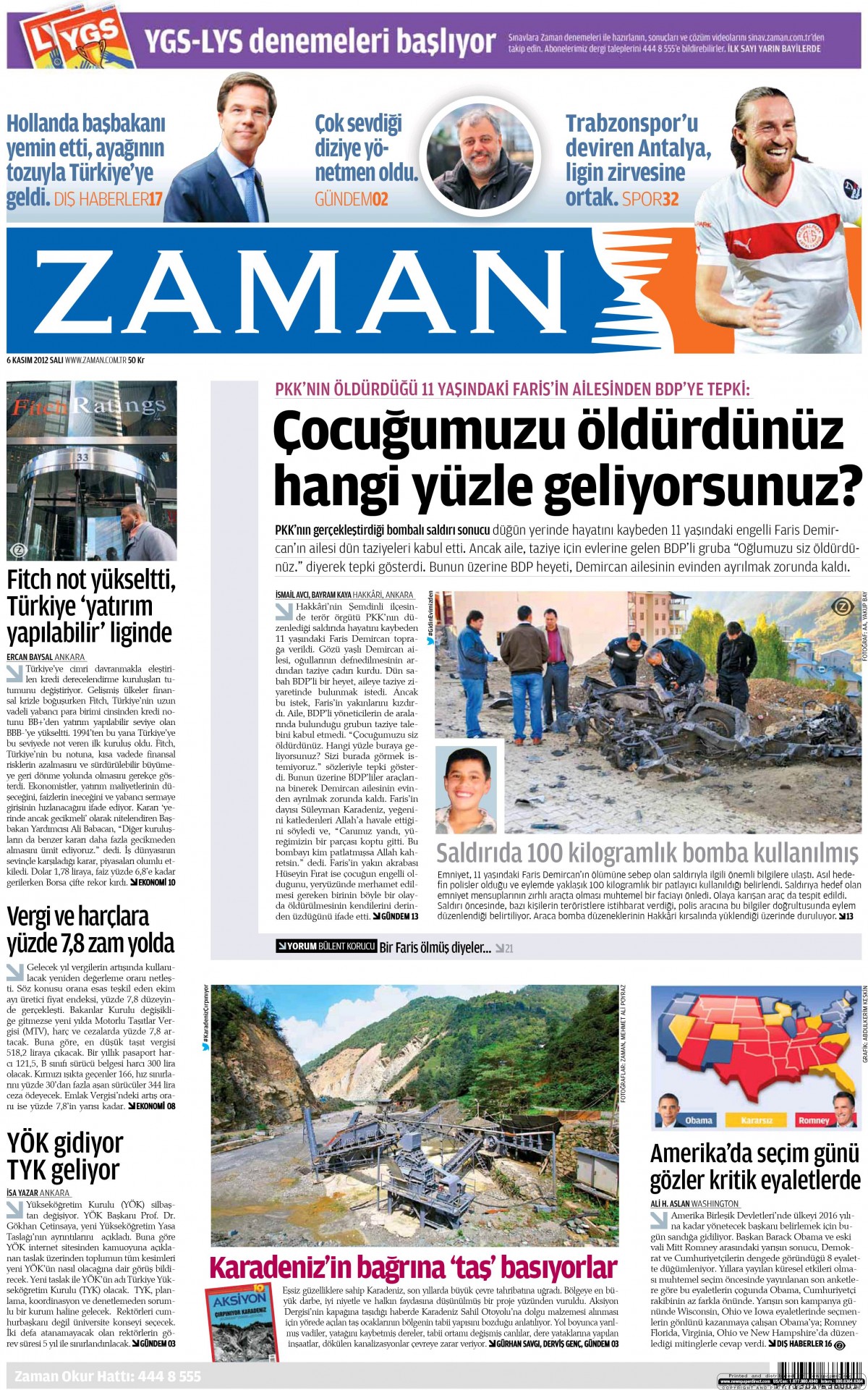
Those known to be close to the government, or the Gülen movement, were the only national newspapers to feature Cihan’s story. Zaman included it as their main front page story, under the headline: “Family of 11-year-old Faris respond to the BDP: ‘You killed our child, how dare you come here’”.
Star included the same story on its front page, alongside news claiming that local traders in Şemdinli were closed in protest against the incident. The headline read: “Şemdinli’s shutters closed against the PKK.”

Strongly Islamist daily Yeni Şafak carried a front page headline declaring: “BDP driven from the door”, included under which was a subtle subtitle: “God damn them.” Popular pro-government daily Sabah also featured the same story at the bottom of its front page under the headline: “You murdered my son.”
BDP deputy Canan has written a formal letter of complaint – which I have read (anybody interested can contact me) – to Cihan news agency about its “baseless” report. In the letter, he says that his visit was in fact accepted by the family of the deceased, and he claims that Cihan’s news was written without any examination of the area and without any correspondent on the ground. He demands a retraction and an apology, warning that he will exercise his full legal rights to pursue the case if he does not receive one.
Turkish dailies on the Gaziantep terror attack funerals
August 25, 2012
I came back to Istanbul this week, after spending three weeks at home in the UK. On my return I was greeted by airport newsstands full of papers with headlines focusing on the funerals of the nine “martyrs” killed in the recent terror attacks in the southern Turkish city of Gaziantep. Of course, I kept vaguely up-to-date with events while I was away, but the contrast between Turkey – currently in one of those periodic bouts of nationalist hysteria that always follow clashes with the Kurdistan Workers’ Party (PKK) – and Britain – which is still basking in the fuzzy, generous, inclusive afterglow of the London Olympics – was nevertheless striking.
Although there are serious doubts as to whether the PKK was actually responsible for this latest attack, the Turkish press did not hesitate in reverting to predictable form. For a flavour of the current mood, here is a selection of newspaper front pages from Thursday (Aug. 23), focusing on the previous day’s funerals.

Like many others, nationalist daily Sözcü showed a photo from one of the funerals, with a coffin wrapped in the Turkish flag in the foreground. The funeral was attended by various state heavyweights, including the leaders of all three main political parties, all of whom were shown in mourning in front of the coffin. Above this, a larger picture showed the face of one-year-old Almina Melisa, whose mother and father were both killed in the Gaziantep bomb. Addressing the political figures in the picture below, the headline challenged: “Almina, will she forgive you?”

Islamist daily Yeni Şafak’s main photo also showed the same funeral. The headline above read: “70 million people on the same side”.
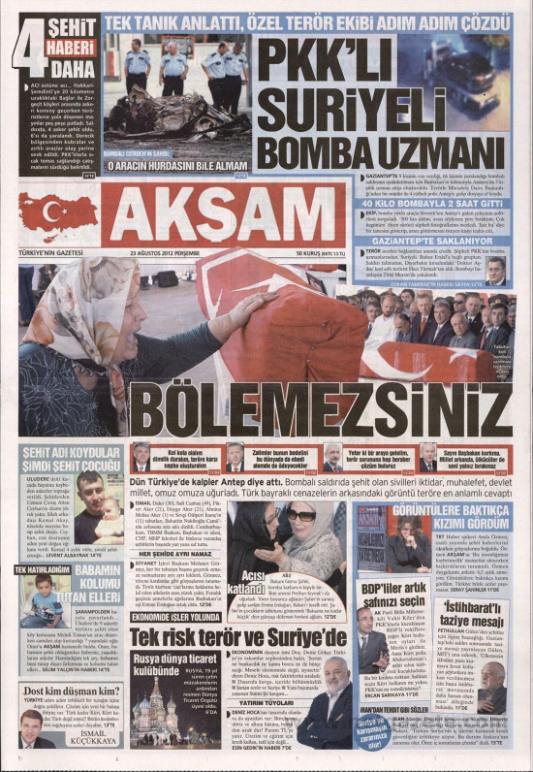
Daily Akşam: “You cannot divide”
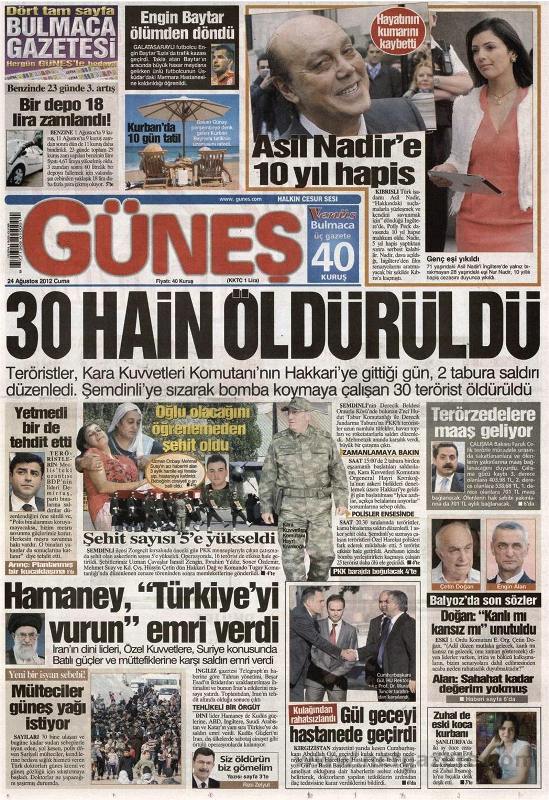
Finally, here is the reassuring front page of tabloid daily Güneş’s Friday edition. The headline referred to counter operations conducted against the PKK by the Turkish military in the southeastern province of Hakkari: “30 Traitors Killed”.
The Sivas Massacre is a ‘19 year lie’: Yeni Akit
July 27, 2012
The massacre that took place in the Central Anatolian town of Sivas in 1993 is one of the darkest episodes in modern Turkish history. On the morning of July 2, a large group of radical Sunni Islamists descended on the Madımak Hotel in Sivas town center, protesting its hosting of an Alevi cultural festival. The mob attacked and set fire to the hotel, which resulted in the deaths of 37 people. Autopsies at the time concluded that the deceased had either died of burns or smoke inhalation.
Radical Islamist daily Yeni Akit’s July 23, 2012 front page carried a large headline declaring “The 19 Year Lie,” accompanied by two photos tastefully showing the morgue full of corpses from the massacre. Aside from the pleasure the paper obviously derived from showing off the photos on its front page once again, the ostensible reason the story was to expose what it called the “lie” that those in the hotel had been killed by the flames. In one of the pictures, a young girl lying on a morgue table, Belkıs Çakır, bears what the paper says is “clearly” a gunshot wound in the chest. This apparently proves that most of the deceased actually killed each other inside the hotel.Unfortunately for Akit, closer inspection reveals that the “blood” from Çakır’s “bullet wound” is simply a braid of hair hanging down from her head.

Akit’s charming July 23 front page
Akit’s piece aroused immediate opprobrium from a number of other Turkish dailies. The next day’s Taraf responded with the headline: “Akit sets fire to Madımak again,” Cumhuriyet said: “One more black publication from Akit,” while leftist-nationalist Yurt bluntly stated on its front page: “A Bigoted Lie.” All included the dismayed reactions from the families of those who died in the tragic incident, as well as their representatives.
Akit said the morgue photos had been hidden for 19 years before passing into their hands, but lawyer Şenal Sarıhan explained to Taraf that the photos were in fact included in a book on the event written by herself, “Madımak Yangını Sivas Davası.” “This book was published in 2002, and it had its third print run in 2011. Akit’s reporter Murat Alan clearly has it. The photos are included on page 97, 100, and 102. To claim that this is the first time they have been seen is completely untrue,” Sarıhan said. Çakır’s original autopsy, she added, was conducted at Sivas’s Numune Hospital, under strict observation. It unambiguously concluded that she had died of burns and from carbon monoxide poisoning. “The definite cause of death was burns and smoke inhalation. There is no dispute on this subject … Neither bullet wounds nor knife wounds can be seen in the photos,” Sarıhan said, adding that the only two people who died of bullet wounds on the day were shot outside the hotel by the demonstrators.
Zeynep Altıok, daughter of the poet Metin Altıok who was killed in the Madımak attack, was quoted as saying that the news did not come as a surprise from Akit. “They have written similar things before. They used to say it was the work of the [outlawed Kurdistan Workers’ Party] PKK. Their aim is to distort the truth. Before, they said it was the PKK, now they’ve gone in completely the opposite direction. I can’t take it seriously.”
Unfortunately, it’s not easy to reason with fanatical Islamists, and Akit’s July 24 front page headline followed on from the previous day, declaring: “Let the autopsies be conducted again”! On July 25, following the condemnations that the earlier pieces had aroused, the paper retreated into comforting victimhood,complaining that the other newspapers constituted a “dirty alliance against Akit … a panicking cartel.”
Yeni Akit is notorious in Turkey as the most vitriolic of the country’s Islamist newspapers. It was established in 2010 after its forerunner, “Anadolu’da Vakit,” was closed down following its failure to pay a fine incurred in 2003 for a piece deemed “insulting to the Turkish Armed Forces” (still officially a crime). Sane-minded observers view Akit with a mixture of incredulity and contempt, and think of it as not much more than a marginal voice on the lunatic fringe. Nevertheless, the fact that it enjoys significantly higher circulation figures than a number of far more respected newspapers must be chastening indeed!


 Turkey Book Talk