Cihan news agency accused over Şemdinli report
November 7, 2012
The hunger strikes of 682 Turkish prisoners are entering their 57th day. The way that they – and the broader issues related to them – are being reported by media outlets known to be close to the ruling Justice and Development Party (AKP) clearly reflects the direction that the government’s Kurdish policy has recently taken.
With the government’s “Kurdish initiative” apparently having run out of steam, the conflict between the Turkish security forces and the outlawed Kurdistan Workers’ Party (PKK) has become increasingly bloody over the last 12 months, and chances for a political solution seem to be ever more remote. The latest bloody incident in south-eastern Turkey took place in the Şemdinli district of Hakkari province on Nov. 4, when a car bomb targeting a military vehicle killed 11-year-old boy Faris Demircan and wounded 26 others. Although there was no immediate claim of responsibility, the PKK is widely thought to be behind the blast.
On Nov. 5, the Gülen-affiliated Cihan news agency reported that pro-Kurdish Peace and Democracy Party (BDP) Hakkari deputy, Esat Canan, tried to visit the family of the deceased to offer his condolences, but was refused entry to the family home. However, no sources were referenced and no quotations on the incident from the family were included in the report. What’s more, no other news agencies mentioned this and local media in the area reported quite the opposite, saying that Canan had in fact been welcomed in to “share the pain.”
Those known to be close to the government, or the Gülen movement, were the only national newspapers to feature Cihan’s story. Zaman included it as their main front page story, under the headline: “Family of 11-year-old Faris respond to the BDP: ‘You killed our child, how dare you come here’”.
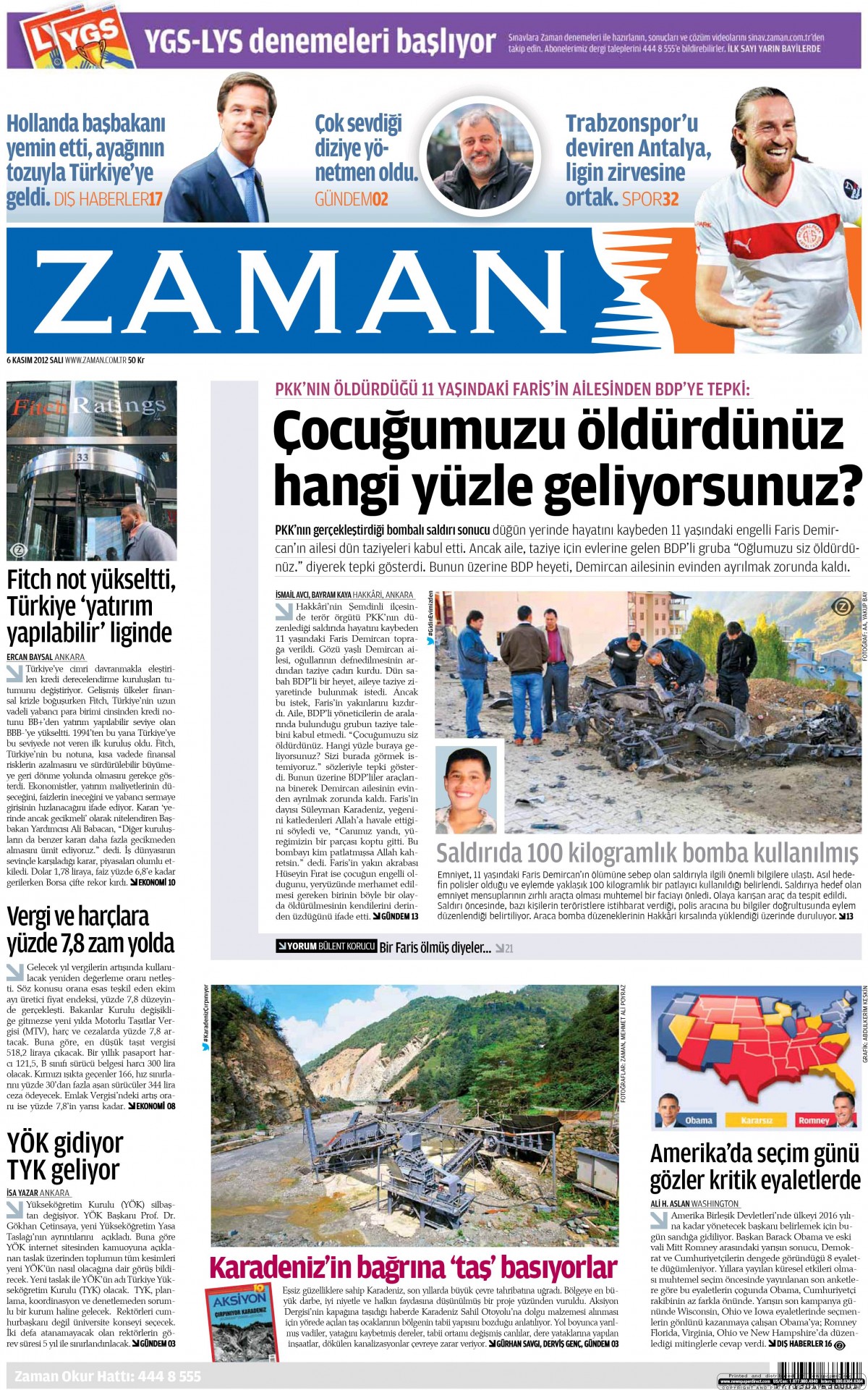
Star included the same story on its front page, alongside news claiming that local traders in Şemdinli were closed in protest against the incident. The headline read: “Şemdinli’s shutters closed against the PKK.”

Strongly Islamist daily Yeni Şafak carried a front page headline declaring: “BDP driven from the door”, included under which was a subtle subtitle: “God damn them.” Popular pro-government daily Sabah also featured the same story at the bottom of its front page under the headline: “You murdered my son.”
BDP deputy Canan has written a formal letter of complaint – which I have read (anybody interested can contact me) – to Cihan news agency about its “baseless” report. In the letter, he says that his visit was in fact accepted by the family of the deceased, and he claims that Cihan’s news was written without any examination of the area and without any correspondent on the ground. He demands a retraction and an apology, warning that he will exercise his full legal rights to pursue the case if he does not receive one.
On Monday (Oct. 22), the Committee to Protect Journalists (CPJ) released a detailed report on the state of press freedom in Turkey, under the gloomy title: “Turkey’s Press Freedom Crisis – The Dark Days of Jailing Journalists and Criminalizing Dissent.” Although it seems like reports on the subject are released every month, this one received a huge amount of attention, both domestically and internationally. It describes the numerous instances of restrictions on media freedom, citing the familiar examples of the Ergenekon case, the endless prosecutions of journalists writing on Kurdish matters, the increasingly widespread practices of intimidation and self-censorship, as well as the ruling Justice and Development Party (AKP) government’s rising intolerance of dissent.
Bloomberg published a sensible commentary on the same day that the CPJ report was released:
“The committee had come under fire for reporting lower estimates of the number of jailed journalists than other human rights organizations. Turkey’s government has long maintained that only a handful of the journalists were charged with offenses related to their jobs, and because the CPJ hadn’t read all the indictments, it had erred on the side of caution.
“Now it has read the indictments and determined that 61 of the reporters and editors in detention are there because of things they wrote or said in the course of their work. In letters accompanying the report, the Turkish government disputes that characterization and asserts that it is striving to balance the need to prevent ‘the praising of violence and terrorist propaganda, and the need to expand freedom of speech.’
“What’s becoming all too clear during the Justice and Development Party’s third term in office is that despite its claims that the government is now liberalizing press laws and continuing the country’s march toward a European-style democracy, the opposite is happening. …
“Instead of fixing the legal system, the government has used it to repress opponents and intimidate the media. The “insult” laws, as well as the special anti-terrorism courts and laws, should be repealed. They are not worthy of a modern democracy, and they shouldn’t be a model for anyone.”
The report was widely covered in the Turkish media. The Oct. 23 edition of daily Taraf featured the report as its front page headline. It included an interview with Ragıp Zarakolu, a legendary figure in Turkish publishing, who has long written and published bravely on subjects that many others wouldn’t touch. He has spent a significant amount of time in prison over the years for things written or published, and he had some predictably doleful things to say:
“The fact that Turkey is found on these kinds of lists saddens me greatly. Turkey has to go beyond this, but in order to do this a change in mentality is necessary … In the existing system the state’s interests are always seen as more important than the citizen’s interests. For this reason, I don’t believe any changes can come in the end without a process of change in mentality. …
“I’ve been writing in the Kurdish press for 20 years. I witnessed the killing of a 72-year-old editor. Such things aren’t experienced any more. But should we be thankful simply for the fact that we’re not killed, or like Uğur Mumcu we’re not assassinated? Turkey is currently at the end of a 10 year process. But despite constant reforms and improvements being spoken of for 10 years, journalists are still in jail for political reasons, and there are still people who have been in prison for 30 years for political reasons. We have to examine this.”
While it’s imperative to identify the areas in which the current government has attacked press freedom, it’s also important to identify the deeper structural problems undermining freedom of expression in Turkey, too. (I touched on the issue a couple of months ago on this blog.) Also included in the CPJ report is an interview with journalist Yavuz Baydar, in which he discusses some of these problems:
“While the rules of the game in the media landscape remain unchanged, unreformed, what changes are the actors, new proprietors. Turkey’s media owners are – like drug addicts – dependent on the powers in Ankara because they are in all sorts of businesses, need approvals for growth and investments, etc., and therefore keep their media outlets either as weapons for extortion or, at best, at the service of governments. …
“The media owners of these outlets acting as ‘the coalition of the willing’ that openly act submissively to the government and security bureaucracy. I can only refer to a key meeting between the PM and all the media proprietors last autumn, during which media owners went as far as proposing themselves to the PM that they can build a “censor commission” among themselves, to be chaired by a cabinet minister. The PM declined the offer, but the message was taken well. In the case of Uludere, where 34 Kurdish smugglers were bombed to death due to a tragic mistake, there was a full blackout in that media for 17 hours while the news flow was instant and heavy in social media. This pattern of blocking is now the norm.”
A related piece by Baydar, called “Another Gloomy Report,” was published in Today’s Zaman on Oct. 21:
“The greatest source of censorship and increasing self-censorship today [is] the ‘unholy alliance’ between the proprietors of big media groups and the powers in Ankara – a deal that connects mutual greed in terms of money and propaganda. This [will] continue to pollute the climate of good journalism, and even if the government resolved the issue of ‘jailed journalists’ it would leave journalism under huge pressure …
“Turkey’s media, vibrant, diverse, still bold, keen on struggling for its independence, will remain easy prey for those with money and political power.”
Nevertheless, the most immediate threat to freedom of expression still comes directly from the government. Ali Özkaya, a lawyer for Prime Minister Recep Tayyip Erdoğan, was quoted in daily Akşam on Oct. 23, and his words should be alarming to any sentient observer:
“We have to underline that cases we’ve opened against press have been quite a deterrent; the wording of columnists has noticeably changed especially since 2003. Reporters and columnists do not exceed the dose when making criticisms anymore; insulting comments or columns have been reduced to minimum.”
Taraf newspaper and liberal disillusionment
July 15, 2012
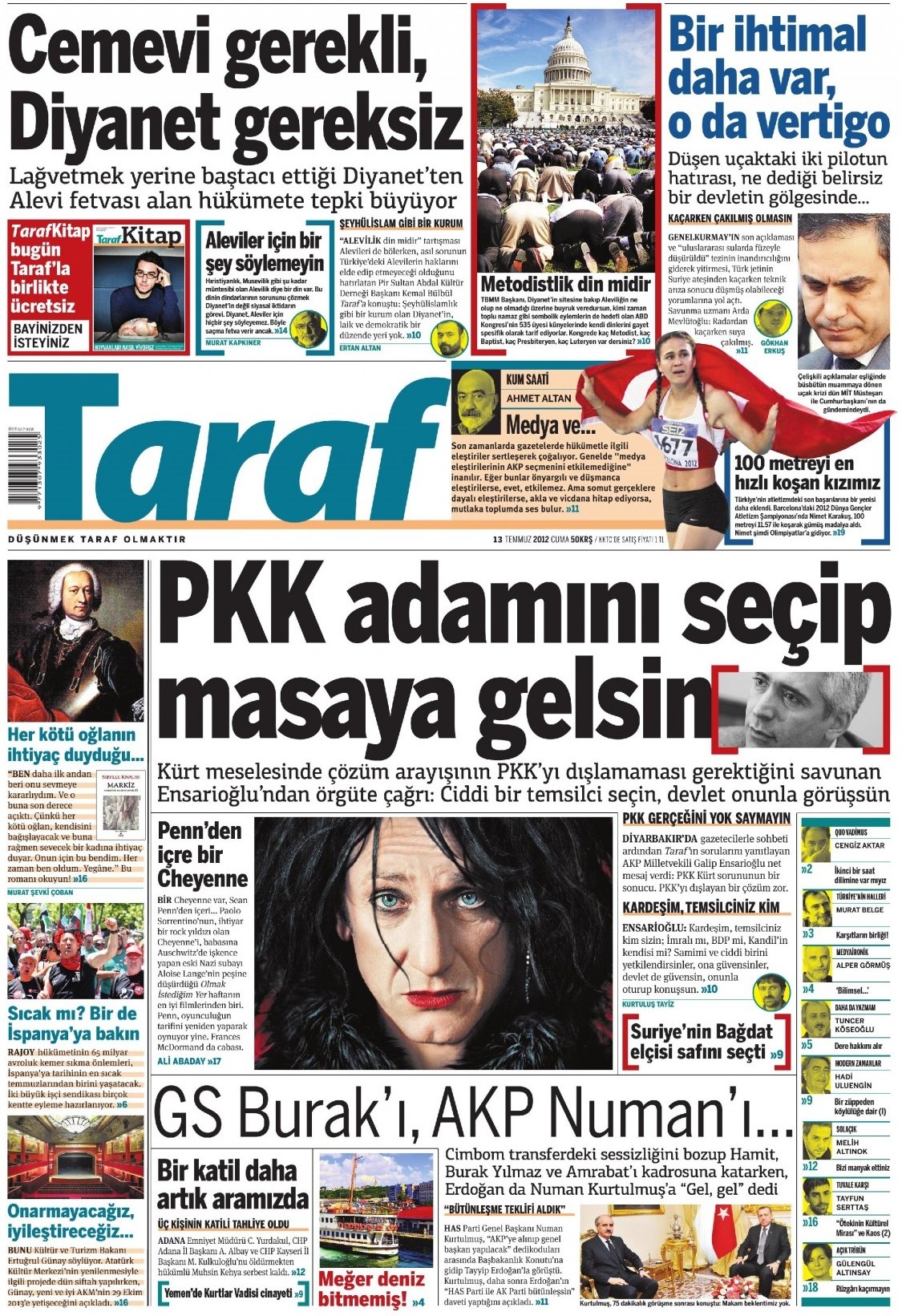
On July 14, leftist daily BirGün included a piece discussing liberal daily Taraf’s recent turn away from the ruling Justice and Development Party (AKP) government. Prompted by Ahmet Altan’s July 13 editorial bemoaning the AKP’s departure from its earlier EU-minded liberal-reformist impulses – the latest in a series of articles critical of the government – BirGün described the shift with some incredulity. Taraf, the piece said, used to label government critics anti-democratic nationalists in thrall to regressive military tutelage, strongly supported a “yes” vote in the September 2010 constitutional referendum, hailed Prime Minister Recep Tayyip Erdoğan as a saviour of the Kurds, and openly recognised the “Armenian Genocide” on its front page. Recently, however, the paper’s criticism of the AKP’s authoritarian turn has increased significantly. Taraf’s move against the government could be seen as representative of disillusioned liberal Turkish opinion these days, but the apparent non-effect this has on opinion polls indicates just how tiny that liberal constituency actually is.
Taraf started printing in 2007 and primarily made a name for itself for its tough anti-military stance. For Turkish liberals at the time, this seemed like the most important battle to be won, and foreign observers routinely used adjectives like “courageous,” “plucky,” and “brave” to describe the paper’s anti-militarist crusade. Domestic critics denigrated it as the AKP’s convenient attack dog, something akin to the “useful idiot” liberal apologists who denied the existence of Lenin’s Soviet police-state terror in the 1910s and 20s. Taraf has been particularly instrumental in the Ergenekon and Balyoz coup plot investigations, claiming numerous scoops against the military in that case, (no matter that most of its anti-military material is widely understood to have been fed to it directly by the AKP government). As Jim Meyer described in a 2009 piece:
“Particularly with regard to the Ergenekon trial, Taraf has managed to frequently scoop the competition with reports (often leaked by the largely AK Party controlled national police force) which have embarrassed military officials […] ‘I don’t see journalistic achievement,’ said one experienced Turkish journalist. ‘They just gobbled up what the police intelligence was leaking them regarding Ergenekon.’”
Meyer’s analysis was written three and a half years ago, and since then the contradictions and evident absurdities in the coup plot cases – as well as the growing anti-democratic practices of the AKP government – have become more and more apparent. While Taraf still maintains its strong anti-military position, it has begun to abandon its previously timid approach to the ruling party and is now voicing tough criticism of various government tendencies. This became particularly clear in January, when lawyers for Prime Minister Erdoğan sued the paper’s editor Ahmet Altan for allegedly “[making] extremely deep insults with the intention of assaulting Erdoğan’s personal rights,” and pressed for 50,000 Turkish Liras in compensation. Evidently, the AKP government wants to keep Taraf on a short leash, but the paper’s continued criticism since then would suggest it has not yet been successful.
Meanwhile, on the same day as BirGün was observing Taraf’s apparent shift against the government, all media outlets were reporting on an upcoming AKP proposal to the Turkish parliament’s Constitution Conciliation Commission (which is currently attempting to put together a new national constitution). The Hürriyet Daily News reports that the proposed changes would “allow the government to limit press freedom in a variety of scenarios that include cases of ‘national security’ and ‘public morals.’”
Referring to the moves, Taraf’s July 14 front page headline story harshly criticised the AKP government for its “prohibitionist mentality.” It cited a 1976 European Court of Human Rights ruling, which stated that: “Freedom of expression […] is applicable not only to “information” or “ideas” that are favourably received or regarded as inoffensive or as a matter of indifference, but also to those that offend, shock or disturb the State or any sector of the population.” Underneath the main headline, the article pointedly said: “we hope this ruling inspires the AKP.”
The ‘anti-Armenian Genocide denial’ bill & Franco-Turkish cynicism
February 2, 2012
On Jan. 24 the French Senate passed a bill to criminalise denial that the killings of Armenians by the Ottoman Turks in 1915-16 amounted to genocide. The law has caused Franco-Turkish relations to plunge to an unprecedented nadir. The car crash was obvious long in advance, which only made it – and the predictable reaction that followed – all the more painful to watch. France had already officially “recognised” the genocide in 2001, but the new law goes one step further, making it illegal for a French citizen to publicly question the events. The signatures of enough French lawmakers have since been collected to challenge the bill in the French constitutional court, which is where it sits now. But if it ends up passing that test and going into the statute books, those found guilty will be landed with a maximum 45,000 euro fine and one year in jail. In the days leading up to the vote, thousands of French-Turks demonstrated in the streets of Paris to protest the law, and on the day of the vote rival groups of Turks and Armenians – separated by police – gathered outside the French Senate, waving flags and blowing whistles.
Some expressed quiet surprise at the apparent “moderation” of the Turkish response, although if that was “moderate” one wonders what the “extreme” reaction would look like. Prime Minister Recep Tayyip Erdoğan railed furiously against the bill and threatened strong concrete measures – including economic sanctions and recalling the Turkish ambassador from Paris – if it wasn’t revoked: “This is politics based on racism, discrimination and xenophobia. This is using Turkophobia and Islamophobia to gain votes, and it raises concerns regarding these issues not only in Francebut all Europe.” According to Erdoğan, the vote disturbingly echoes the “footsteps of fascism.” “The votes in the French Parliament and the proposal that has been adopted are an open demonstration of discrimination and racism and amount to a massacre of free thought,” he said. “This bill has removed the atmosphere of free discussion [inFrance]. The principles of liberty, fraternity and equality, which form the basis of the French Revolution, have been trampled on.” Other Turkish politicians and diplomats have also revelled in casting themselves as defenders of the liberal European ideal. Vice chairman of the ruling Justice and Development Party (AKP), Ömer Çelik, took to twitter to claim: “Sarkozy is turningFranceinto Bastille Prison step by step.” Chief Turkish EU negotiator, Egeman Bagis, similarly tweeted: “I celebrate 40,000 Turks marching against the bill to defend the French Revolution’s values.”
The prospect of Turkish politicians posing as modern day Voltaires, protesting in defence of the principles of the French Revolution must be irresistible for the satirist. Such a stance might appear more sincere if Article 301 of Turkey’s own constitution didn’t make it punishable by law to “insult Turkishness.” It might also if there weren’t currently more journalists locked up in Turkish jails than there are in China (95 at the last count); or if Turkey didn’t rank 148th out of 178 countries in the Reporters Without Borders (RSF) World Press Freedom Index; or if Turkey wasn’t by far the worst violator of human rights among the 47 signatory states of the European Convention on Human Rights; or if that same court hadn’t received nearly 9,500 complaints against Turkey for breaches of press freedom and freedom of expression in 2011 (compared with 6,500 in 2009). A distinct tendency towards authoritarianism has been unmistakably creeping into the AKP’s rule of late, perhaps giving some perspective to this most recent outburst in defence of European liberalism.
And the French defence? There isn’t much to be said. Before the vote, President Sarkozy claimed: “The genocide of Armenians is a historic reality that was recognised by France. Collective denial is even worse than individual denial […] We are always stronger when we look our history in the face, and denial is not acceptable.” Nevertheless, the law is widely understood to be a cynical piece of electioneering, the ruling Union for a Popular Movement (UMP) having bowed to the active and well-organised Armenian lobby in Paris, and seeking to secure the 500,000 French-Armenian votes ahead of this spring’s French Presidential election. The move will also doubtless serve to further paralyse Turkey’s already-moribund EU accession bid, which Sarkozy repeatedly makes clear he opposes. There may also be some truth in the accusation that the UMP is seeking to curry favour with France’s populist right-wing, with a move targeted at a Muslim minority.
The question of whether national governments should legislate on how historical events are remembered is probably an unanswerable one. But that won’t stop both sides attempting an answer to fit their own national political agendas. Do you think those 40,000 angry Turks were protesting on the streets of Paris out of earnest concern for Enlightenment values and in sincere defence of free speech? Such lofty protestations are mere fig leaves. Whether it’s Sarkozy opportunistically chasing votes in return for laws, or the Turks spuriously invoking the French Revolution and defending some destructive, nebulous idea of “national honour,” both sides are cynically invoking the high-minded language of moral righteousness to pursue squalid political ends.


 Turkey Book Talk