Maureen Freely joins to discuss the tragic life of author Sabahattin Ali and her translation of his classic 1943 novel “Madonna in a Fur Coat,” just published in a first ever English edition by Penguin.
Download the episode or listen below:
Subscribe to Turkey Book Talk: iTunes / PodBean / Stitcher / Facebook / RSS
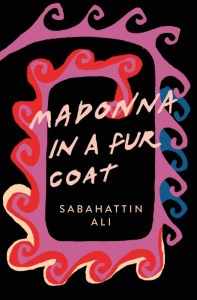
Check my review of the book at Hürriyet Daily News, previously published in the Times Literary Supplement.
Support the Turkey Book Talk podcast with a per episode donation via Patreon – Many thanks to current supporters Özlem Beyarslan, Steve Bryant and Andrew Cruickshank.
A long and revealing interview with Doğan Ertuğrul, the former senior news editor of the staunchly pro-government daily Star, appeared on the news website T24 on May 5. Ertuğrul resigned from the newspaper in March, issuing a statement complaining that it had descended into the realm of “black propaganda”:
In the state of insanity that Turkey is currently experiencing, the media has suffered more than its share. ‘News’ papers and TV stations that don’t observe news values and instead aim for perception management – or, more accurately, black propaganda – have become routine.I have held the same position at Star for years, but I feel there is no longer any possibility there to do responsible and balanced journalism.
One wonders why it took so long to come to this conclusion, but Ertuğrul candidly explained his thoughts to T24‘s Hazal Özvarış.
Star is one of the pillars of the friendly new media establishment that has developed around Turkey’s ruling Justice and Development Party (AKP) since it came to power in 2002. As comes through in the interview with Ertuğrul, it sees itself as more intellectual that the higher-circulation Sabah, though you have to ask just how highbrow a title featuring bi-weekly columns from PM Erdoğan’s economic advisor and telekinesis-detector Yiğit Bulut can be. Along with its sister TV station, Kanal 24, Star was bought by businessman Ethem Sancak in 2007, with Sancak declaring soon afterwards that he had entered the media sector “to serve the prime minister.” Kanal 24 is now equally devoted to the government as Star, and is probably even more influential, reaching a much wider audience while remaining just as partisan. After selling both off in 2009 (having made the necessary editorial adjustments), Sancak bought them back last month.

Star’s front page headline on May 4, slamming Washington-based think tank Freedom House for it’s recent press freedom report describing the Turkish media as “Not free.” The subheading says Freedom House has links to “Israel lobbies” as well as “famous speculator George Soros,” while the text underneath emphasises that its president, David Kramer, is a Jew.
Back in 2007, Sancak declared himself “lovesick for the prime minister,” adding that Erdoğan was his “most important idol.” He is one of the wealthiest and most prominent members of the AKP’s new constructocracy, with economic interests intertwining closely with the political interests of the government. Money can’t be made from owning a newspaper, but Sancak knows that owning an AKP-friendly media company is a necessary overhead to win contracts in other areas, (just last week his firm won the tender for armoured vehicle and bus manufacturer BMC).
He first bought the Star Media Group at a time when Turkey’s “old elite” was applying a huge amount of pressure against Erdoğan and the AKP over Abdullah Gül’s presidential candidacy in 2007, and just one year before the closure case against the party was to be brought to the Constitutional Court. The AKP became convinced that a new, friendly media was needed to defend it against such attacks, so it actively went about fostering this. In light of the harsh atmosphere of the period and as part of the narrative of Turkey’s “normalisation,” there was actually a defendable case to be made for such a move. However, as in many other areas, it has all gone too far. Pressure is now being applied to media across the spectrum, and the core group of pro-government titles has descended into blatant distortion, parrot-like repetition of AKP public statements, and vitriolic character assassinations. As Henri Barkey recently wrote, Turkey’s slavishly devoted pro-government media now resembles “Pravda on steroids.”
T24’s interview with Ertuğrul highlights his revelation about how an interview with President Gül was censored by Star in order to not disturb PM Erdoğan. However, it is perhaps more interesting for the glimpse that Ertuğrul gives into the inner workings of the newspaper; none of it comes as a surprise, but it is quite unusual for an “insider” to go public in such a way. Translated below are some of the most important points, which I think speak for themselves:
My colleagues at Star used to jokingly call me “Brother ethics” because of my concern about journalistic principles. I used to hold many of the same ideals as the AK Parti government, but when the party started to abandon these principles, the media that is close to the government also started to follow the same path. My first realisation of this was during the Gezi protests. I went to Gezi and so did my children. I had the opportunity to see both the groups using violence, and also those with ordinary, democratic demands. For this reason I found the attitude taken against Gezi by the government and the government media very disturbing.
….
There was a complicated process during the “Kabataş assault” story during Gezi. At the editorial meeting I came out and said this story was fantastical and unconvincing. Many other editors expressed similar views. I said it was wrong to publish news without any evidence at all, based only on the claims of the young headscarved mother. But I couldn’t prevent the story from being published … After the camera footage emerged showing what really happened in Kabataş we even debated writing a formal apology at the editorial meeting; but as the prime minister’s attitude became clearer, this became impossible to publish.
….
I had already been objecting to a lot of things, and my objections were always taken into consideration. However, by the end the number of these objections being considered dropped … We had a responsibility to the public before our responsibility to Erdoğan. But that threshold was passed long ago.
…
The prime minister doesn’t see anyone’s position as “enough.” This happened in a lot of incidents with us. After saying to ourselves, “This [language] is very tough, let’s not put it in the headline,” we then saw Sabah’s headline the next day and we said to ourselves jokingly, “Ah, the prime minister will now criticize us by saying, ‘Look, have you seen this?’”
…
In the government’s media there is no need for “Alo Fatih” calls interfering in the editorial process. There, people already know the reflexes of the prime minister and the government. In this sense, Star is a comfortable newspaper … The editors know what they have to do, what will or will not upset the government. There’s a kind of shared mind-set that doesn’t exist in somewhere like Habertürk, for example … I can’t speak for elsewhere, but I can speak clearly about the situation in Star. [PM Erdoğan’s economic advisor] Yiğit Bulut is a writer there, and before he was a TV station’s director; [Erdoğan’s political advisor] Yalçın Akdoğan also writes in Star. Both of them very regularly visit the newspaper. Therefore, caricature-like “Alo Fatih” phone calls are not even necessary at Star.
…
The issue isn’t just about patronage. These newspapers also have directors. If we look at just bosses, we can see that Yeni Şafak’s boss has his own personal agenda. For example, despite the prime minister’s support, Yeni Şafak ran a campaign to prevent Mehmet Görmez from becoming the Religious Affairs minister. For some reason or another, the paper’s boss doesn’t like Görmez. In other newspapers, the most important thing is to consider which minister or which prime minister’s assistant they are close to, and what kind of closeness they have.
…
It’s possible that many journalists are supporting the government both out of the opportunities this offers and also because they share its ideology. The AK Parti has created its own ideology; call it AK Parti-ism or Erdoğanism. The business environment is connected to the government, so is the media, so is the judiciary, so is the bureaucracy. This is a summary of the Turkey of Tayyip Erdoğan’s dreams.
A coterie has developed that uses the political and economic opportunities provided by the government. In the media at the moment there are people supporting the government, but a large number of these will curse Erdoğan when his government declines. There are a lot of people behind him who have no real sympathy for him.
…
During the Gezi protests and especially after Dec. 17 [corruption probe] there were dozens of headlines that unfortunately didn’t conform with proper news criteria and were published for propaganda purposes. It’s no longer difficult to see how the government is the source behind a lot of news and a lot of journalists. Sabah, Yeni Şafak, Star, and Akşam haven’t published a single line about the claims in the Dec. 17 investigations. There hasn’t been a single piece of news about what the claims actually were. At the same time, we read propaganda in the government media about the Gezi protesters’ “global terror links,” about Israel being behind Dec. 17, and even debates about the Gülen movement’s Islamic-ness.
…
There were a lot of former police chiefs, bureaucrats, and politicians found guilty in the Ergenekon and Balyoz cases who started to feature in Star headline stories just because they took the same positions as the prime minister. People like Emin Aslan, Sabri Uzun, Hanefi Avcı. Once upon a time the accusations against them were widely reported in the newspaper. As that was the case, what were we doing back then? And what are we doing now?
…
While I still worked at Star, I struggled to keep doing the things that I believed were correct in the name of journalism. I asked myself whether I should quit, or stay and struggle. In order to change things you must struggle. I objected to what was being done, I did what I could, and when I saw that I wouldn’t be able to do it any more I quit. I wondered about whether the insane atmosphere in Turkey would end after the local elections in March … But I saw how the country and Star became even harsher after the elections.
Commentary vs. Reporting
October 10, 2013
I’ve been meaning to post about the imbalance between undervalued journalists and overvalued commentators in the Turkish media landscape for a while. The aftermath of the Gezi Park protests saw an unprecedented purging of critical columnists from various newspapers, but such bloodspilling tends to receive attention only when it is a recognisable, big name figure who has been fired. Although it’s less discussed, intense pressure is also being exerted on the few embattled investigative reporters working these days, and in the long run this pressure may prove even more damaging to the country’s fourth estate than the silencing of some columnists.
A recent controversy involving daily Radikal reporter İsmail Saymaz illustrated this pressure with particular clarity. Saymaz had written a series of pieces in the aftermath of the killing of Gezi protester Ali İsmail Korkmaz in the Central Anatolian city of Eskişehir, about which he received an extraordinary email from the provincial governor in the early hours of Oct. 2. In the email, Governor Azim Tuna demanded that the “dishonourable” Saymaz stop his “vile and inglorious” reporting, adding that he “shouldn’t forget the underground” (after death), where they would both meet each other in the end.
Usually, pressure from the authorities doesn’t come so openly. Saymaz has done some excellent work in Radikal, but for him – like most others – there are plenty of untouchable subjects. He himself learnt that back in 2010, when he was charged with “interfering in the judicial process” over stories he had written on the notorious arrest of Erzincan’s chief prosecutor, İlhan Cihaner, an arrest that was widely seen as part of the government’s moves to combat the “deep state.” Shortly before being charged, Saymaz had published a book about the Gülen movement’s involvement in the prosecution of the Ergenekon coup plot case, and ended up facing charges that could have lead to 45 years in jail. Such cases seem to have had the desired effect; the major news organisations’ reporting of issues such as Ergenekon, official corruption, and the Gülen movement, has become increasingly tame, if not non-existent. As Saymaz himself has said, “We, as reporters, both censor our minds and bite our tongues while we are reporting.” Without a rigorous media doing its bit to hold the authorities to account, can it be surprising when the government behaves with such impunity?
The lack of corruption exposure in the Turkish media was also recently indicated after Milliyet published an interview with Ateş Ünal Erzen, the opposition Republican People’s Party’s (CHP) mayor for the Istanbul district of Bakırköy. In the interview, Erzen indirectly admitted to systematic corruption in his municipality, which caused a tiny stir before dropping off the agenda completely. The fact that the revelation effectively came as a result of a slip of the tongue, the handwringing that followed it, and the lack of any deeper subsequent investigation, all point to the Turkish media’s ineffectiveness when it comes to investigating corruption. It’s probably also worth mentioning again here the much-cited example of Hürriyet halting its reporting on the Deniz Feneri charity embezzlement scandal, after being landed with a multi-billion dollar tax fine in 2009. Through such measures, the investigative potential of journalists at major Turkish news outlets has been steadily hollowed out.
The emphasis on commentary over proper reporting should be considered in this context. Columns are indeed cheap and easy to churn out, but the prioritising of columnists over reporters is not just an economic calculation; opinions are not only cheaper, they are also less dangerous than deep reporting, less threatening than labour-intensive original journalism. Everyone has an opinion, and almost anyone can write out their views in a few hundred words, (and looking at the standard on offer, almost anyone does). This range of columnists in the Turkish media allows pro-government voices to claim with a straight face that the continued existence of the popular and rabidly anti-AKP commentary-heavy Sözcü, for example, is proof of the healthy variety of journalism on offer. Not only does this argument ignore the countless cases of sackings and news manipulation based on direct pressure from the authorities, but it also fails to address the crippling government-imposed handicaps on serious investigative journalism.
Of course, (here’s the usual disclaimer), it’s important not to look back on an imagined halcyon age of journalism in Turkey. Things have often been much worse: Jenny White recently described a visit to the offices of Milliyet in the 1990s, when she found that the paper was surviving on a grant from the state, which was handing “black lists” to the paper’s owners about who should be fired and promoted from the editorial staff. But while it’s true that things have never been perfect, it’s alarming to see the heavy hand of the amorphous deep state simply replaced by a similarly overbearing civilian authority.
Concerns about the health of the Turkish media are well-justified, but many expressions of this concern fail to appreciate that infringements on press freedom don’t just involve restrictions on what ten-a-penny columnists can write about. Equally damaging, if not more so, are restrictions on what can be reported, and the depth to which journalists can probe sensitive issues. The cacophony of news commentary in Turkey, while indicative of a vibrant and energetic society, does not in itself make for a healthy fourth estate.
‘Dear Prime Minister Erdoğan’: CPJ delivers fresh media freedom letter to government
September 18, 2013
On Sept. 17, the Committee to Protect Journalists (CPJ) hand delivered its latest letter to Turkey’s Ministry of Justice, expressing the group’s deep concern over the “continued press freedom crisis in Turkey.”
The CPJ had previously published a long and detailed special report on media freedom in Turkey in October 2012, and this latest letter, addressed to Prime Minister Recep Tayyip Erdoğan, explains how the difficulties described in that report remain unresolved. It also discusses the increasingly oppressive environment in the aftermath of the summer’s anti-government Gezi Park protests, paying particular attention to the fact that open threats from officials have become worryingly commonplace, which “emboldens zealous prosecutors to go after critics.”
The letter doesn’t much dwell on the issue of ownership and conflict of interest – by no means the be all and end all, but certainly a crucial issue that must be addressed if improvements are to be made. Other than that, it makes for a good primer on the biggest challenges to freedom across all media in today’s Turkey: imprisoned journalists and associated legal irregularities, the inappropriate use of anti-terrorism laws, censorship and self-censorship, gag orders on sensitive issues, and the threats being issued by government figures with increasing brazenness. Below are some of the most salient points made in the CPJ’s letter:
“While the restrictive laws and prosecutions are central to the media crisis in Turkey, so too is the atmosphere fostered at the top levels of government. When top officials use the term ‘terrorists’ to describe critical journalists they send a disturbing message that could cause others to take action …
“With traditional media under pressure, the Internet, including social media, has become an important outlet for free expression in Turkey. But recent official comments, including threats to restrict the online flow of information, cause concern …
“Time and again, history has proven that, at times of unrest, a well-informed society has a better capacity to restore and heal itself. The government of Turkey ought to encourage a vibrant debate, a diversity of opinions, and independent reporting on news events crucial to the public …
“In mid-June, with tensions running high, you publicly accused the international media of biased coverage of the Gezi Park events, singling out CNN International, the BBC, and Reuters. Before a supporters’ rally, you said the foreign media ‘fabricated news,’ The New York Times reported. ‘You portrayed Turkey differently to the world,’ you reportedly said, referring to international media. ‘You are left alone with your lies.’ We find your suggestion that international coverage was part of a plot to subvert your government highly disturbing.
“In late June, Ankara Mayor Melih Gökçek launched a spurious and inflammatory campaign on Twitter against local BBC reporter Selin Girit, labeling her a traitor and a spy in apparent disagreement with the BBC’s coverage of the protests.
“Gökçek created a critical hashtag ‘#ingiltereadınaajanlıkyapmaselingirit,’ which in English means ‘Don’t be a spy in the name of England, Selin Girit’ and urged his followers to popularize it on Twitter. Girit received ‘a large number of threatening messages’ in response to the mayor’s actions, the BBC said in a statement.
“CPJ is also alarmed by reports of numerous firings and forced resignations of critical columnists, editors, and reporters, and in apparent retaliation for their coverage of the Gezi Park protests. According to our colleagues at the Turkish Union of Journalists, an independent media association that documents attacks on the press, at least 22 journalists were fired and another 37 were forced to quit their jobs over their coverage of the anti-government protests. As a result of direct or indirect government pressure, media owners have dismissed many popular journalists and the absence of their voices has been conspicuous.”
The letter can be read in full here.
By now, the basics are well known. The mainstream Turkish media was found to be woefully inadequate when it came to reporting the enormous anti-government protests that recently erupted across the country. As Turks took to the streets to confront ruthless security forces armed with gallons of tear gas, pressurized water, tanks and batons, those still at home turned to TV news stations only to find nature documentaries and panel shows discussing liposuction.
It’s fair to say that the protests still ongoing across Turkey have not been the Turkish media’s finest hour. In fact, these events – perhaps more than any previously – have exposed for domestic and international observers just how compromised the Turkish media has become. (As many have observed, this comes with a bitter taste for Kurds, who ask why many now protesting did little when the Kurds were complaining about scant media coverage of their own troubles.) Ironically enough, the lack of TV coverage appears only to have inspired more protests. According to a Bilgi University survey among 3,000 young Gezi Park protesters, 84% cited muted media coverage as one of the main reasons for taking to the streets. This also explains the graffiti around Istanbul lambasting the “sold-out” media, the satirical memes circulating like wildfire on the internet, and the NTV broadcast van trashed and overturned in the middle of Taksim Square.
As is now well documented, where mainstream media failed, social media stepped in. It is estimated that more than 3,000 tweets per minute were sent about the protests after midnight on May 31; Twitter hashtags telling the Turkish media to do its job were trending worldwide, while CNN Türk was airing a documentary about penguins. This also resulted in large demonstrations being organised outside the Habertürk and NTV offices in the following days, which, in a grim irony, NTV ended up reporting on.
Indeed, Twitter became the only place to go to for information (and disinformation) as events unfolded; exposing the enormous chasm that now exists between independent new media and the toothless media corporations in Turkey. While this was no real revelation, (the same happened after the Uludere/Roboski massacre in December 2011, when live tweeters at the scene bypassed and shamed the established media groups), the scale of the awareness that the latest events stirred is unprecedented. Reflecting the government’s frustration at being unable to do much about what gets posted online, Erdoğan described social media as a “trouble” full of “unmitigated lies” (if he was referring to the deluded Twitter ramblings of Ankara Mayor Melih Gökçek he may have had a point). One day later, Deputy Prime Minister Bulent Arınç declared that the government “could have shut down Internet access, but didn’t.” Still, there were other ways for the government to make its point, as 33 protesters were detained in the western city of İzmir for tweets they had posted.
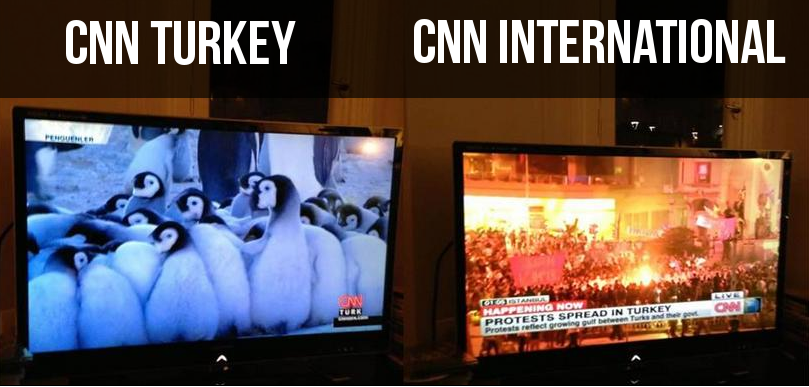
CNN International shows live coverage of the demonstrations in Taksim Square, while CNN Türk airs a penguin documentary.
Turkey-watchers are familiar with the country’s chronic press freedom problems. One of the root causes is related to the ownership structures of Turkish media companies, which opens them up to political pressure, an issue that Yavuz Baydar repeatedly – and convincingly – returns to. One small example of this which I didn’t see anyone else pick up on came with a report, released in April, by respected think-tank the Turkish Economic and Social Studies Foundation (TESEV), titled “Policy Suggestions for Free and Independent Media in Turkey.” The report was thorough and fair, particularly focusing on the crippling conflict of interest that comes when major media outlets are owned by large holding companies involved in other sectors. Although the report was covered by the Gülen-affiliated Zaman newspapers, no newspapers from the Doğan Media Group (owned by billionaire Aydın Doğan – perhaps Exhibit A of the above problem) – Hürriyet, its English language arm Hürriyet Daily News, or Radikal – mentioned it.
With the large media companies so obviously unfit to perform their Fourth Estate function, the focus is shifting to new online independent media. Along with the agenda-setting Twitter, the website T24 has also developed quite a reputation in providing brave, reliable, independent reporting. Veteran journalist Hasan Cemal, for example, after being controversially fired by daily Milliyet, was taken on by T24 and has since written a series of articles based on time spent with the retreating Kurdistan Workers’ Party (PKK) rebels in southeast Turkey, including an interview with military head of the PKK, Murat Karayılan. The Demirören Holding-owned Milliyet would not touch such a daring project. Freely-available online and with little advertising, I’m not sure how T24 is actually funded (if anybody does, please do let me know), or whether it’s a viable long-term model for more serious journalism in Turkey, bypassing the established news organisations. Still, with mainstream media having so thoroughly discredited itself throughout the Gezi Park protests, the void will have to be filled by something if Turkey is to become more democratic.
Yet another international organisation has issued a report on Turkey’s dolorous press freedom record, with Amnesty International this week publishing “Decriminalize dissent: Time to deliver on the right to freedom of expression.”
The particular focus of this latest report is the “fourth package” of judicial reforms that was submitted to the Turkish parliament at the beginning of this month. The package follows a previous set of reforms that went into effect last July, and has been presented by the government as a move to deepen democracy and reduce the number of cases brought against Turkey at the European Court of Human Rights (ECHR). However, Amnesty says the package “fail[s] to make the necessary legislative amendments to bring national law in line with international human rights standards.” That conclusion is based on research including trial observations, the review of hundreds of criminal cases, and “interviews with civil society organizations, lawyers, academics, individuals under prosecution and public officials.”
A familiar charge sheet is presented by Amnesty regarding recent developments, including “the increasingly arbitrary use of anti-terrorism laws to prosecute legitimate activities including political speeches, critical writing, attendance of demonstrations and association with recognised political groups and organizations.”
The report continues:
“Government statements initially indicated that the ‘Fourth judicial package’ would seek to bring prosecutions of expression related offences in line with international human rights standards and the case law of the European Court of Human Rights. However, the draft law, currently before Parliament does not go nearly far enough. It proposes amendments to five offences frequently used in ways that violate the right to freedom of expression. The proposals leave on the statute a number of laws that directly limit the right to freedom of expression that should be repealed entirely. Other offences that threaten the right to freedom of expression through their overly broad wording are not brought into line with international standards on the right to freedom of expression under the current proposals. If passed by Parliament in its present form, the ‘Fourth judicial package’ would represent another missed opportunity to deliver genuine human rights reform.”
Voting on articles in the fourth judicial package is expected to start in parliament next week. The full PDF of the Amnesty report can be accessed here.
On Friday Dec. 14, news of resignations from daily Taraf filtered out, with editor-in-chief Ahmet Altan, assistant editor Yasemin Çongar, and columnists Murat Belge and Neşe Tüzel resigning from their posts at the paper.
Founded in 2007, Taraf has become one of the most controversial and agenda-setting newspapers over the last five years. Originally set up by a group of like-minded liberals and leftists, the paper became renowned for its anti-military stance, publishing a series of highly-controversial stories that revealed the extent of the Turkish military’s involvement in daily political affairs. Taking on the once-mighty Turkish military saw Taraf regularly prefixed with adjectives like “plucky” and “brave,” and even lead to its accreditation from military press releases being cancelled. However, as question marks have steadily increased over the inconsistencies and judicial irregularities of anti-military crusades such as the Ergenekon and Balyoz cases, differences of opinion within Taraf have become increasingly evident. Altan’s editorials became increasingly critical of the Justice and Development Party (AKP) government, creating friction within the paper that I previously wrote about here and here. This divergence of opinion appears to be the main reason behind the latest resignations, with the more critical, anti-AKP voices having been purged, (it is strongly rumoured that they have gone – like many in other newspapers – following government pressure).
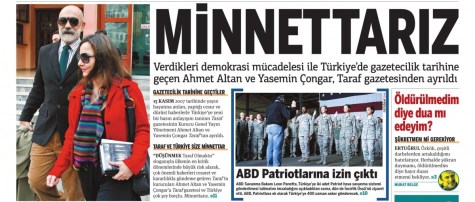
Taraf’s front page banner on Dec. 15, showing Altan and Çongar. The headline reads: “We are grateful”
Most have assumed that the resignations bring about the effective the end of the paper. Nevertheless, Taraf patron Başar Arslan apparently intends to continue publication, announcing to the Istanbul Stock Exchange on Monday that former managing editor Markar Esayan had “temporarily” taken over its editorial chair. Nevertheless, a number of important names from Taraf’s Ankara bureau signed an open letter addressed to Arslan, stating:
“If Ahmet Altan and Yasemin Çongar go, it means that we go too … We are sure that Altan’s removal from the newspaper was a political decision … Our last word is this: We are waiting for Altan and Çongar to be returned to their previous positions as soon as possible.”
Following the resignations, veteran Turkish media observer Yavuz Baydar described the events at Taraf as “a new wound for journalism.” In a similar tone, Taraf columnist Emre Uslu wrote in Today’s Zaman:
“This crisis is a benchmark by which to understand the standards of Turkish democracy because Taraf was the last bastion of refuge for democrats and civilian opposition, who fought alongside the AK Party government against the military but turned against this government as it moves away from democratic standards … Taraf was criticizing the government for not bringing about and not institutionalizing democratic standards, yet ironically the paper became the victim of the system it has been criticizing for a long time.”
Milliyet columnist Kadri Gürsel wrote what was effectively an obituary for Taraf, describing it as a “zombie paper” that had now outlived its original purpose:
“With the ‘spirit of Taraf’ Ahmet Altan having left, the paper will from now on be a zombie … Taraf was established as a newspaper with a mission … Its aim was to purge the military from politics, ‘demilitarisation.’ But it has become clear that democratisation does not necessarily follow demilitarisation and civilianisation.”
Meanwhile, Dani Rodrik, (who moonlights as the leading name writing in English on the contradictions and irregularities of the Ergenekon and Balyoz cases – found on his blog here), conspicuously used the past tense to describe Taraf on Twitter:
“Taraf’s journalistic standards were absolutely the pits. Calling the publication ‘liberal’ is a great insult to liberals … Taraf published countless bogus ‘exposes’ fed to it by the police. Its motto was ‘we will publish any trash as long as its anti-military’ … In the name of democracy, Taraf voluntarily cooperated with a gang and together violated the rules of media ethics.”
Still, correct as Rodrik is, that doesn’t necessarily mean that the recent resignations don’t also represent “prime evidence of how much Turkey is slipping backwards,” as written by Yigil Schleifer – both can be true. If the past tense can really now be used to discuss Taraf, perhaps it can also finally be used to talk about any remnants of liberal Turkish sympathy for the AKP. With the passing of Taraf perhaps a chapter in Turkish politics also passes, and the last (much belated) nail can finally be hammered into the coffin of the 10-year-long flirtation between liberals and the AKP.
The New York-based Committee to Protect Journalists (CPJ) has just released its annual report on the number of journalists imprisoned globally – a gloomy read. This year, the global tally reached its highest point since the CPJ began surveys in 1990, with a total of 232 individuals counted as being behind bars, an increase of 53 since 2011. Unsurprising to most in the country, Turkey tops the list this year – followed by Iran and China – with the CPJ counting 49 currently in Turkish prisons for their journalistic activity, (still lower than its last count of 61). A complete list featuring detailed accounts of all imprisoned journalists worldwide is available to view via the CPJ here, while a “path forward” for Turkey, drawn by CPJ Executive Director Joel Simon, can be read here. The CPJ recently focused on the situation in Turkey in a detailed report released in October, which I wrote about on this blog at the time.
In Turkey, most of the newspapers hostile to the government included pieces on the report, with the reliably bellicose Sözcü referring ironically to Prime Minister Recep Tayyip Erdoğan in its Nov. 12 front page headline: “THE MASTER BREAKS THE RECORD: Turkey is the world champion in imprisoned journalists.” Also tongue-in-cheek, daily Taraf dolefully headlined its article on the report: “Again we’re the world’s first!” However, news of the CPJ report was conspicuous by its absence in the Pollyannaish pro-government press – nowhere to be found in Zaman, Sabah, Bugün, Türkiye, Yeni Asya, Yeni Şafak, or Star. Bearing in mind the Doğan Group’s history with the Justice and Development Party (AKP) government, it is also perhaps worth mentioning that neither of its remaining Turkish-language titles, Hürriyet and Radikal, mentioned the report in their print versions either (although both did feature online articles).
Of course, the October CPJ report on Turkey was far more detailed than this latest one, which focused only on the global numbers of journalists in jail. Indeed, the real question of press freedom in the country is rather more complicated than simply a headline figure alone, as I have written before, both here and here. Still, however hypocritical many of the protests on the issue coming from the direction of newspapers like Sözcü are, the situation is certainly deplorable. Complicated as the issue may be, comparing the coverage (or non-coverage) of the CPJ report in the Turkish press at least gives some impression of quite how polarized the media in Turkey really is. Looking at some of the newspapers here, it’s often hard to believe they can be describing the same country.
On Monday (Oct. 22), the Committee to Protect Journalists (CPJ) released a detailed report on the state of press freedom in Turkey, under the gloomy title: “Turkey’s Press Freedom Crisis – The Dark Days of Jailing Journalists and Criminalizing Dissent.” Although it seems like reports on the subject are released every month, this one received a huge amount of attention, both domestically and internationally. It describes the numerous instances of restrictions on media freedom, citing the familiar examples of the Ergenekon case, the endless prosecutions of journalists writing on Kurdish matters, the increasingly widespread practices of intimidation and self-censorship, as well as the ruling Justice and Development Party (AKP) government’s rising intolerance of dissent.
Bloomberg published a sensible commentary on the same day that the CPJ report was released:
“The committee had come under fire for reporting lower estimates of the number of jailed journalists than other human rights organizations. Turkey’s government has long maintained that only a handful of the journalists were charged with offenses related to their jobs, and because the CPJ hadn’t read all the indictments, it had erred on the side of caution.
“Now it has read the indictments and determined that 61 of the reporters and editors in detention are there because of things they wrote or said in the course of their work. In letters accompanying the report, the Turkish government disputes that characterization and asserts that it is striving to balance the need to prevent ‘the praising of violence and terrorist propaganda, and the need to expand freedom of speech.’
“What’s becoming all too clear during the Justice and Development Party’s third term in office is that despite its claims that the government is now liberalizing press laws and continuing the country’s march toward a European-style democracy, the opposite is happening. …
“Instead of fixing the legal system, the government has used it to repress opponents and intimidate the media. The “insult” laws, as well as the special anti-terrorism courts and laws, should be repealed. They are not worthy of a modern democracy, and they shouldn’t be a model for anyone.”
The report was widely covered in the Turkish media. The Oct. 23 edition of daily Taraf featured the report as its front page headline. It included an interview with Ragıp Zarakolu, a legendary figure in Turkish publishing, who has long written and published bravely on subjects that many others wouldn’t touch. He has spent a significant amount of time in prison over the years for things written or published, and he had some predictably doleful things to say:
“The fact that Turkey is found on these kinds of lists saddens me greatly. Turkey has to go beyond this, but in order to do this a change in mentality is necessary … In the existing system the state’s interests are always seen as more important than the citizen’s interests. For this reason, I don’t believe any changes can come in the end without a process of change in mentality. …
“I’ve been writing in the Kurdish press for 20 years. I witnessed the killing of a 72-year-old editor. Such things aren’t experienced any more. But should we be thankful simply for the fact that we’re not killed, or like Uğur Mumcu we’re not assassinated? Turkey is currently at the end of a 10 year process. But despite constant reforms and improvements being spoken of for 10 years, journalists are still in jail for political reasons, and there are still people who have been in prison for 30 years for political reasons. We have to examine this.”
While it’s imperative to identify the areas in which the current government has attacked press freedom, it’s also important to identify the deeper structural problems undermining freedom of expression in Turkey, too. (I touched on the issue a couple of months ago on this blog.) Also included in the CPJ report is an interview with journalist Yavuz Baydar, in which he discusses some of these problems:
“While the rules of the game in the media landscape remain unchanged, unreformed, what changes are the actors, new proprietors. Turkey’s media owners are – like drug addicts – dependent on the powers in Ankara because they are in all sorts of businesses, need approvals for growth and investments, etc., and therefore keep their media outlets either as weapons for extortion or, at best, at the service of governments. …
“The media owners of these outlets acting as ‘the coalition of the willing’ that openly act submissively to the government and security bureaucracy. I can only refer to a key meeting between the PM and all the media proprietors last autumn, during which media owners went as far as proposing themselves to the PM that they can build a “censor commission” among themselves, to be chaired by a cabinet minister. The PM declined the offer, but the message was taken well. In the case of Uludere, where 34 Kurdish smugglers were bombed to death due to a tragic mistake, there was a full blackout in that media for 17 hours while the news flow was instant and heavy in social media. This pattern of blocking is now the norm.”
A related piece by Baydar, called “Another Gloomy Report,” was published in Today’s Zaman on Oct. 21:
“The greatest source of censorship and increasing self-censorship today [is] the ‘unholy alliance’ between the proprietors of big media groups and the powers in Ankara – a deal that connects mutual greed in terms of money and propaganda. This [will] continue to pollute the climate of good journalism, and even if the government resolved the issue of ‘jailed journalists’ it would leave journalism under huge pressure …
“Turkey’s media, vibrant, diverse, still bold, keen on struggling for its independence, will remain easy prey for those with money and political power.”
Nevertheless, the most immediate threat to freedom of expression still comes directly from the government. Ali Özkaya, a lawyer for Prime Minister Recep Tayyip Erdoğan, was quoted in daily Akşam on Oct. 23, and his words should be alarming to any sentient observer:
“We have to underline that cases we’ve opened against press have been quite a deterrent; the wording of columnists has noticeably changed especially since 2003. Reporters and columnists do not exceed the dose when making criticisms anymore; insulting comments or columns have been reduced to minimum.”
Yeni Şafak and ‘the world’s richest Jew’
September 20, 2012
It is not particularly gratifying to scratch around the dregs of the Turkish press, but here’s the latest sludge I have been able to dredge up from the bottom of the barrel.
Islamist daily Yeni Şafak’s front page headline on Monday Sept. 17 focused on the reported recent meeting between Turkish Prime Minister Recep Tayyip Erdoğan and a “famous Jewish businessman.” The businessman, Ronald Lauder, was apparently sent as an intermediary by Israel to try to help restore its broken relations with Turkey. Following the meeting, Yeni Şafak’s headline stated: “The world’s richest Jew was the mediator.”

Perhaps I’ve become desensitized to this kind of thing after reading so many Turkish newspapers, but such casual playing on lazy Jewish stereotypes seems mild now that I write it down. Far worse examples can be found elsewhere every day (the front page of my favourite daily Akit recently included a graphic of a serpent sliding through a Star of David alongside that day’s requisite story about Israel). However, what was particularly striking to me about Yeni Şafak’s headline was that it came at a time when much of the Muslim Middle East was in violent uproar against the (similarly squalid) film produced in America, “The Innocence of Muslims.”
You only have to do a quick search on Google or YouTube to easily find thousands of articles and videos insulting Christianity (and Christians), Judaism (and Jews), or Islam (and Muslims). None of it is very nice, but thank God the world’s Jews don’t rise up in violent protests every time an offensive headline or story appears in a Turkish or Arabic newspaper.
Press freedom in Turkey and Sözcü newspaper
September 7, 2012
I’ve been meaning to write something about press freedom in Turkey with reference to daily newspaper Sözcü for quite a while. Then, a couple of days ago, I caught sight of the back page of the paper’s Sept. 4 edition and, like a gift, my primary material was there waiting for me.
The page carried the headline “Turkey’s daily sunshade,” and sarcastically described itself in the top corner as “the kind of journalism that Tayyip wants.” This was in reference to Prime Minister Recep Tayyip Erdoğan’s recent request for the Turkish media “not to exaggerate terror incidents.” The mock stories written underneath therefore contained nothing but praise for the Justice and Development Party (AKP) government and all its wonderful achievements. One was about how the monster of inflation had been miraculously defeated, another was about how Istanbul’s chronic traffic problem had been eradicated (by the way, I can tell you from bitter experience that it hasn’t), another featured a mother who had happily heeded Erdoğan’s advice that all women should give birth to “at least three children,” another described how Syrian refugees had started naming their new born babies “Tayyip” in honour of the heroic Turkish PM.

In fact, the page was relatively mild compared to the populist tub-thumping Sözcü (“spokesman” or “mouthpiece” in English) usually serves up. Its front page typically features some kind of outraged headline about the latest treachery committed by betrayers of the Turkish nation. A short, choleric editorial in the bottom left corner is included every day under the subtle title “Tokmak” (“hammer” or “mallet” in English – apt enough), invariably fuming about some latest disgrace and usually pointing the finger directly at the AKP government. The tone does not get much higher throughout the remaining 19 pages. Recently, the paper has been having almost daily seizures about the government’s Syria policy and its backing for the anti-Assad opposition. These are mostly prompted by fears about how such a policy may facilitate some kind of autonomous Kurdish region stretching from northern Syria to northern Iraq, and conceivably into southeastern Turkey – anathema to the kind of nationalist gallery that Sözcü plays to.
As far as circulation figures go, Sözcü has certainly been one of the undeniable success stories in the Turkish newspaper roster over the last couple of years. When it started printing just over five years ago, it sold around 60,000 copies. This figure has risen steadily ever since, and the paper recently announced it had hit national sales figures of 300,000, making it the fifth-highest selling daily newspaper in the country.
With regard to the state of freedom of expression in today’s Turkey, Sözcü is certainly an interesting phenomenon to consider. Surely, in contrast to the many recent suggestions that freedom of expression is under attack in the country, doesn’t the existence of such a paper indicate that the range of perspectives available on Turkish newsstands is healthily broad? Well, not exactly – the condition of the Turkish media has more fundamental problems that must be taken into account.
In its annual Press Freedom Index for 2011, released in January this year, the Paris-based Reporters Sans Frontières (Reporters Without Borders, or RSF) ranked Turkey 148th out of 179 countries worldwide, down from 138th in 2010. This was the fifth year in succession that Turkey had slipped down the RSF rankings. Over 100 Turkish journalists are currently in jail, a figure higher than China. The number of journalists sacked or sued for what they have written, reported, or even drawn, climbs by the month, and many journalists and editors freely admit to practicing self-censorship to avoid trouble.
One of the most significant and much-discussed episodes took place in September 2009, when Doğan Publishing, then the largest media group in Turkey, was hit with over $3.2 billion in fines for tax irregularities by the Turkish treasury (equivalent to more than four fifths of the combined market value of Doğan Holding and Doğan Publishing).The hugely excessive size of the fines seemed to suggest government disapproval of the group’s newspapers’ reporting of an embezzlement scandal at the “Deniz Feneri” Islamic charity in Germany. It was the biggest charity corruption case in German history, and Doğan newspapers alleged that billions of dollars raised by the charity had somehow found their way into AKP coffers back in Turkey. After the fines were levied, Doğan’s media outlets significantly toned down their reporting of the scandal, as well as their broader criticism of the government. A number of their anti-AKP columnists were sacked, and many of their newspapers were sold off in order to pay the exorbitant fine, which was subsequently lessened after appeal.
There are numerous other examples of similarly shady processes being undertaken by the government. Their effectiveness can perhaps be attributed to one of the more fundamental flaws in the country’s media landscape. As Svante E. Cornell wrote in Turkey Analyst back in January 2010, this is the fact that the Turkish media is overly dominated by large holding companies:
“As a result, major newspapers and television channels are owned by firms with broad and substantial economic interests. For many, winning government tenders is a chief objective. This means that owners of media outlets seldom see these as their main preoccupation, but often as assets they can use for leverage – either by using their assets to pressure incumbents to win favors – or by appeasing the powers that be.”
Those organs wishing to maintain good business relations with the government must toe the line. However, there are still many who simply don’t care about such things, and Sözcü is perhaps the most prominent print example of that today. The case of Emin Çolaşan is a neat symbolic example to consider here. Çolaşan used to write for daily Hürriyet – part of the Doğan media empire – before he was fired in 2007 after 22 years’ service. His sacking was believed to be because of his fierce criticism of the AKP government. Within weeks of leaving Hürriyet, Çolaşan was picked up by Sözcü, where he now writes a reliably bellicose daily column. Evidently, Sözcü doesn’t have quite the same concerns about offending the AKP government that Hürriyet now has.
Still, there is far more to a free and healthy press than simply having a few columnists in certain newspapers feeling free to throw as many tantrums about the government as they want. A well-functioning Fourth Estate should, through rigorous investigative reporting, effectively hold whatever government is in power to account. Unfortunately, there is precious little evidence of this in Turkey’s press landscape. In an excellent piece on “The Deteriorating State of Media Freedom in Turkey,” again in Turkey Analyst, Gareth Jenkins has described this parlous situation thus:
“Unlike in many other countries, Turkish newspapers are dominated not by reporters but by columnists. With a few notable exceptions, journalistic standards in Turkey have always been very low. Little attempt is made to substantiate news reports, with the result that rumor and gossip are often given equal status to undeniable facts … The situation is arguably even worse amongst the columnists, most of whom merely react to something they have heard or read elsewhere in the media without trying to investigate or assess its veracity. The result is that most columnists generate more sound than sense, using invective rather than reasoning to make their voices heard.
… Nor does Turkey have a tradition of investigative journalism. What passes for investigative journalism – and which today mostly appears in book form rather than in newspapers or on television – tends to consist of a compendium of reports and rumors selected to support the author’s preconceptions; and is riddled with the same lack of substantiation that characterizes newspaper and television news reports.”
Sözcü, perhaps unsurprisingly, exemplifies suchshallow prioritizing of reactive opinion over genuinely thoughtful, reflective, investigative writing. Over 50 percent of its “news” pages are filled with belligerent opinion columns from the paper’s popular commentators.
Some might take the overwhelming predominance of highly critical “rent-a-mouths” in almost all Turkish newspapers as proof of the Turkish media’s bustling vitality. However, while Sözcü may get away with its fierce daily anti-AKP invective, that’s a million miles away from contributing to a genuinely effective Fourth Estate. Ultimately, the latter’s development is of critical importance to the future direction of Turkish democracy.
Taraf newspaper and liberal disillusionment
July 15, 2012
On July 14, leftist daily BirGün included a piece discussing liberal daily Taraf’s recent turn away from the ruling Justice and Development Party (AKP) government. Prompted by Ahmet Altan’s July 13 editorial bemoaning the AKP’s departure from its earlier EU-minded liberal-reformist impulses – the latest in a series of articles critical of the government – BirGün described the shift with some incredulity. Taraf, the piece said, used to label government critics anti-democratic nationalists in thrall to regressive military tutelage, strongly supported a “yes” vote in the September 2010 constitutional referendum, hailed Prime Minister Recep Tayyip Erdoğan as a saviour of the Kurds, and openly recognised the “Armenian Genocide” on its front page. Recently, however, the paper’s criticism of the AKP’s authoritarian turn has increased significantly. Taraf’s move against the government could be seen as representative of disillusioned liberal Turkish opinion these days, but the apparent non-effect this has on opinion polls indicates just how tiny that liberal constituency actually is.
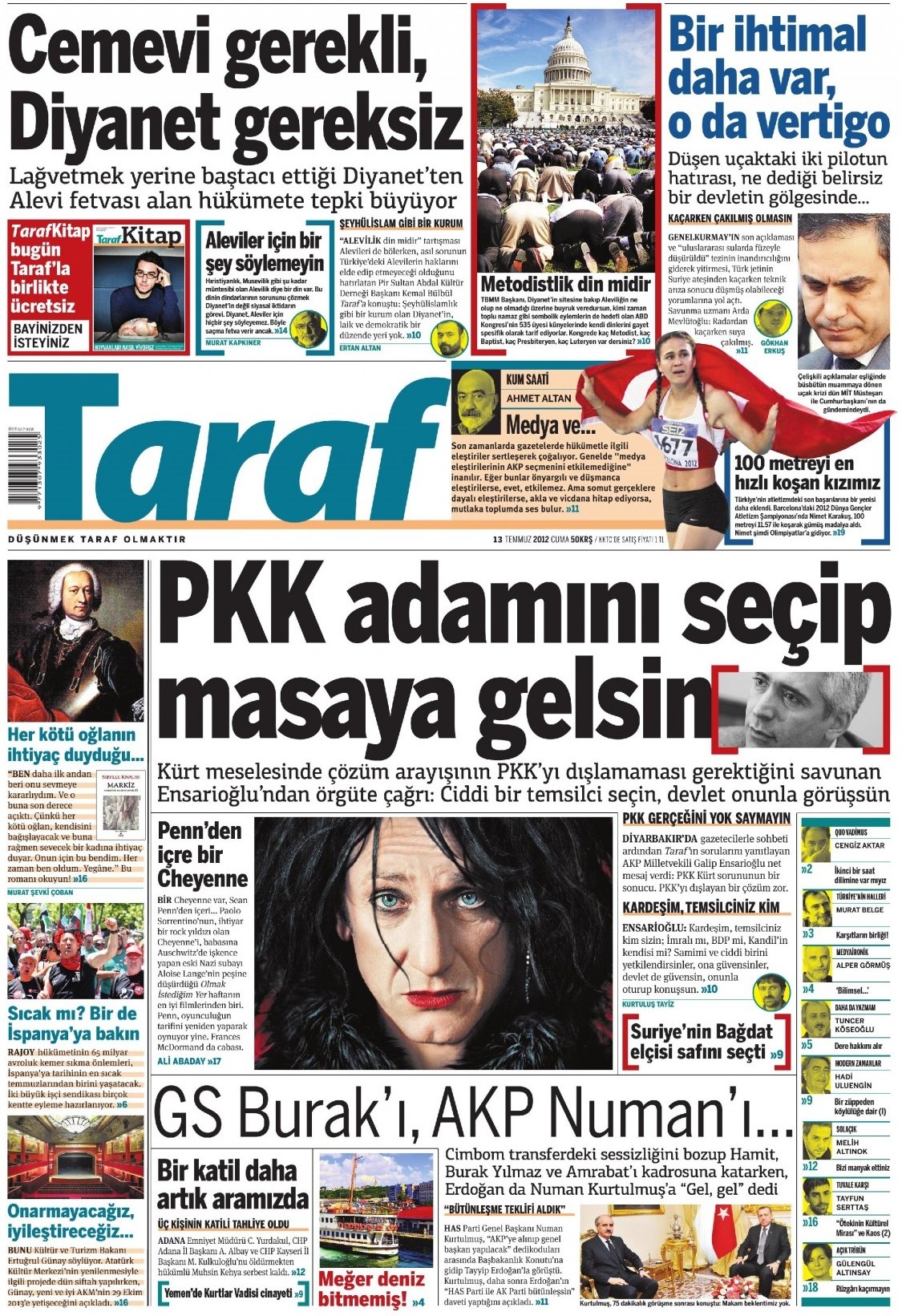
Taraf started printing in 2007 and primarily made a name for itself for its tough anti-military stance. For Turkish liberals at the time, this seemed like the most important battle to be won, and foreign observers routinely used adjectives like “courageous,” “plucky,” and “brave” to describe the paper’s anti-militarist crusade. Domestic critics denigrated it as the AKP’s convenient attack dog, something akin to the “useful idiot” liberal apologists who denied the existence of Lenin’s Soviet police-state terror in the 1910s and 20s. Taraf has been particularly instrumental in the Ergenekon and Balyoz coup plot investigations, claiming numerous scoops against the military in that case, (no matter that most of its anti-military material is widely understood to have been fed to it directly by the AKP government). As Jim Meyer described in a 2009 piece:
“Particularly with regard to the Ergenekon trial, Taraf has managed to frequently scoop the competition with reports (often leaked by the largely AK Party controlled national police force) which have embarrassed military officials […] ‘I don’t see journalistic achievement,’ said one experienced Turkish journalist. ‘They just gobbled up what the police intelligence was leaking them regarding Ergenekon.’”
Meyer’s analysis was written three and a half years ago, and since then the contradictions and evident absurdities in the coup plot cases – as well as the growing anti-democratic practices of the AKP government – have become more and more apparent. While Taraf still maintains its strong anti-military position, it has begun to abandon its previously timid approach to the ruling party and is now voicing tough criticism of various government tendencies. This became particularly clear in January, when lawyers for Prime Minister Erdoğan sued the paper’s editor Ahmet Altan for allegedly “[making] extremely deep insults with the intention of assaulting Erdoğan’s personal rights,” and pressed for 50,000 Turkish Liras in compensation. Evidently, the AKP government wants to keep Taraf on a short leash, but the paper’s continued criticism since then would suggest it has not yet been successful.
Meanwhile, on the same day as BirGün was observing Taraf’s apparent shift against the government, all media outlets were reporting on an upcoming AKP proposal to the Turkish parliament’s Constitution Conciliation Commission (which is currently attempting to put together a new national constitution). The Hürriyet Daily News reports that the proposed changes would “allow the government to limit press freedom in a variety of scenarios that include cases of ‘national security’ and ‘public morals.’”
Referring to the moves, Taraf’s July 14 front page headline story harshly criticised the AKP government for its “prohibitionist mentality.” It cited a 1976 European Court of Human Rights ruling, which stated that: “Freedom of expression […] is applicable not only to “information” or “ideas” that are favourably received or regarded as inoffensive or as a matter of indifference, but also to those that offend, shock or disturb the State or any sector of the population.” Underneath the main headline, the article pointedly said: “we hope this ruling inspires the AKP.”


 Turkey Book Talk