When Erdoğan speaks, the media follows
January 31, 2013
Prime Minister Recep Tayyip Erdoğan’s recent comments that Turkey could give up its EU membership bid and instead pursue membership of the Shanghai Cooperation Organisation (SCO) are still reverberating in much of the Turkish media. Speaking Jan. 25 on TV station 24TV, Erdoğan said: “The EU does not want to include a Muslim country … Of course, if things go so poorly then, as a prime minister of 75 million people, you seek other paths … The Shanghai Five is better, much stronger.” Last year, Erdoğan had said something similar after a diplomatic visit to Moscow: “I said to [Russian President Vladimir] Putin, ‘You tease us, saying “What is Turkey doing in the EU?” Now I’m teasing you: include us in the Shanghai Five, and we’ll forget about the EU.’”
The “Shanghai Five” was created by Russia, China, Kazakhstan, Kyrgyzstan and Tajikistan in 1996 in an attempt to counter U.S. influence in Asia, and was later joined by Uzbekistan and renamed the SCO in 2001. It has been described as “a vehicle for human rights violations” by the International Federation for Human Rights. Erdoğan’s latest pronouncements on the group were immediately picked up by much of the Turkish commentariat as significant indications of Turkey’s shifting priorities. In Radikal, columnist Cengiz Candar wrote that the prime minister had dropped a “geopolitical bomb.” Hürriyet’s Sedat Ergin has so far spent three days worrying over the remarks, writing that Erdoğan’s words amounted to “one of the most significant foreign policy moves since he took office 10 years ago, maybe the most important.”
For me, the way these latest statements were reported merely highlighted once again the unhealthy intensity with which the Turkish media hangs on every single word uttered by the prime minister. The smallest pronouncement can be seized upon to set the agenda and send the media into a tailspin. It’s a little discussed symptom of a wider (and more discussed) problem – the increasing concentration of power in one pair of hands.
This is the pattern of how an address or press conference given by Erdoğan is typically reflected in the Turkish media: it is broadcast uninterrupted by every major television news station; the words are transcribed and posted immediately on internet news portals, with the only journalistic interjection in each paragraph being “the prime minister said”; the next day’s newspapers feature prominent news stories on the speech, perhaps as the front page headline; finally, the chorus of daily columnists set to work dissecting whatever the prime minister has decided should be the subject of the moment. As Fehmi Koru wrote in Star on Jan. 29: “Erdoğan is a master at forcing an issue, bluffing and occupying others with his own agenda … We have not yet seen one of the opposition parties able to force the country to debate a single topic. They jump into the agendas set by the head or members of the ruling party.” The prime minister is a master at manipulating how news is covered, and the producers of that news coverage are often more than happy to be manipulated.
This week’s episode of the BBC’s Start the Week, where the discussion centred around George Orwell’s 1946 essay “Politics and the English Language,” brought the issue into even sharper relief for me. In the programme, Phil Collins, one time speechwriter for former British Prime Minister Tony Blair, spoke about how he was always acutely aware when writing speeches of the low level of coverage that any public address by a prime minister could today expect to receive in the U.K. press. “Once upon a time your whole speech would be printed verbatim in The Times the next day, but that’s not the case anymore … You’re talking into an atmosphere in which you’re only going to get six seconds on the evening news, whether you like it or not,” he said. This seems to be the inverse of the Turkish problem: symptomatic of a corrosively cynical British public, disengaged from the political process and instinctively suspicious about the public utterances of any elected official.
Of course, there are many such cynics in Turkey, but they are little represented in the conventional large media corporations.
Coverage of Ankara-PKK ‘peace process’ in the Turkish media
January 19, 2013
Peace talks are still ongoing between the Turkish state, representatives of the Kurdistan Workers’ Party (PKK), and PKK leader Abdullah Öcalan. It is likely that for any kind of peace to be secured they will have to go on for quite a while longer. Looking at the attitudes adopted by the Turkish media over the course of the “İmralı process” has been illuminating, particularly the reporting of the Jan. 17 funeral ceremonies in Diyarbakır of the three female Kurdish activists who were recently shot dead in Paris.
The government’s previous “Kurdish Opening” in 2009 came to an abrupt end after the controversy that followed the release of a group of PKK militants at the Habur border crossing and their welcoming back by huge crowds in Diyarbakır. Any comparable scenes carried the danger of enflaming Turkish nationalist sentiments and posed a risk to the latest dialogue process. Thus, in the lead up to the funerals most in the mainstream media were in agreement that they represented a significant test. On the morning of the ceremonies, dailies Vatan, Yeni Şafak, and Yeni Asya all featured front page headlines quoting the words of Prime Minister Recep Tayyip Erdoğan saying that the day would be a “Samimiyet sınavı,” or “Sincerity test.”
The ongoing process is extremely delicate. It’s easy to forget that although public support for the current PKK talks is significantly higher than it was in 2009, suspicion of the talks is still widespread. It was therefore interesting to observe how none of the major TV stations covered the ceremonies live in any detail on the day, despite the fact that they were attended by tens of thousands of people. As with much coverage of the Kurdish issue, (the Uludere/Roboski massacre in December 2011, for example), it is likely that this low key coverage had been “suggested” to the major media organizations by the government, acutely aware of the need to avoid scenes similar to those in Habur in 2009. Tellingly, Deputy Prime Minister Bülent Arınç had the following to say at a media event on Thursday: “The media’s support is so pleasing for us. I know and I see this support. … Eighty percent of media groups are lending their support. They are conducting positive broadcasts and contributing to the process. I hope this continues.” Still, in a column the next day titled “Peace is difficult with this media,” daily Vatan’s Rüşen Çakır had some critical things to say about this mentality:
“Television stations who didn’t show the ceremony yesterday failed the ‘sincerity test.’ In fact, they didn’t even sit the test … In the name of not making mistakes, or avoiding possible crises, or not annoying the government, they chose not to do anything at all … During the latest İmralı process, our media sees only one side as having to take steps – and all of these steps set according to what the government wishes – which itself sabotages the road to peace.”
In the event, Jan. 18’s newspapers exhaled an audible sigh of relief that the day passed without “provocation or sabotage” from either the mourners or the Turkish security forces. In contrast to the relative silence of the TV stations, the majority of the next day’s papers featured the funerals as front page headline stories, showing pictures of the crowds gathered in Diyarbakır and striking a noticeably optimistic tone. Many focused on a makeshift sign that one man was carrying at the ceremonies: “There is no winner from war; there is no loser from peace.”
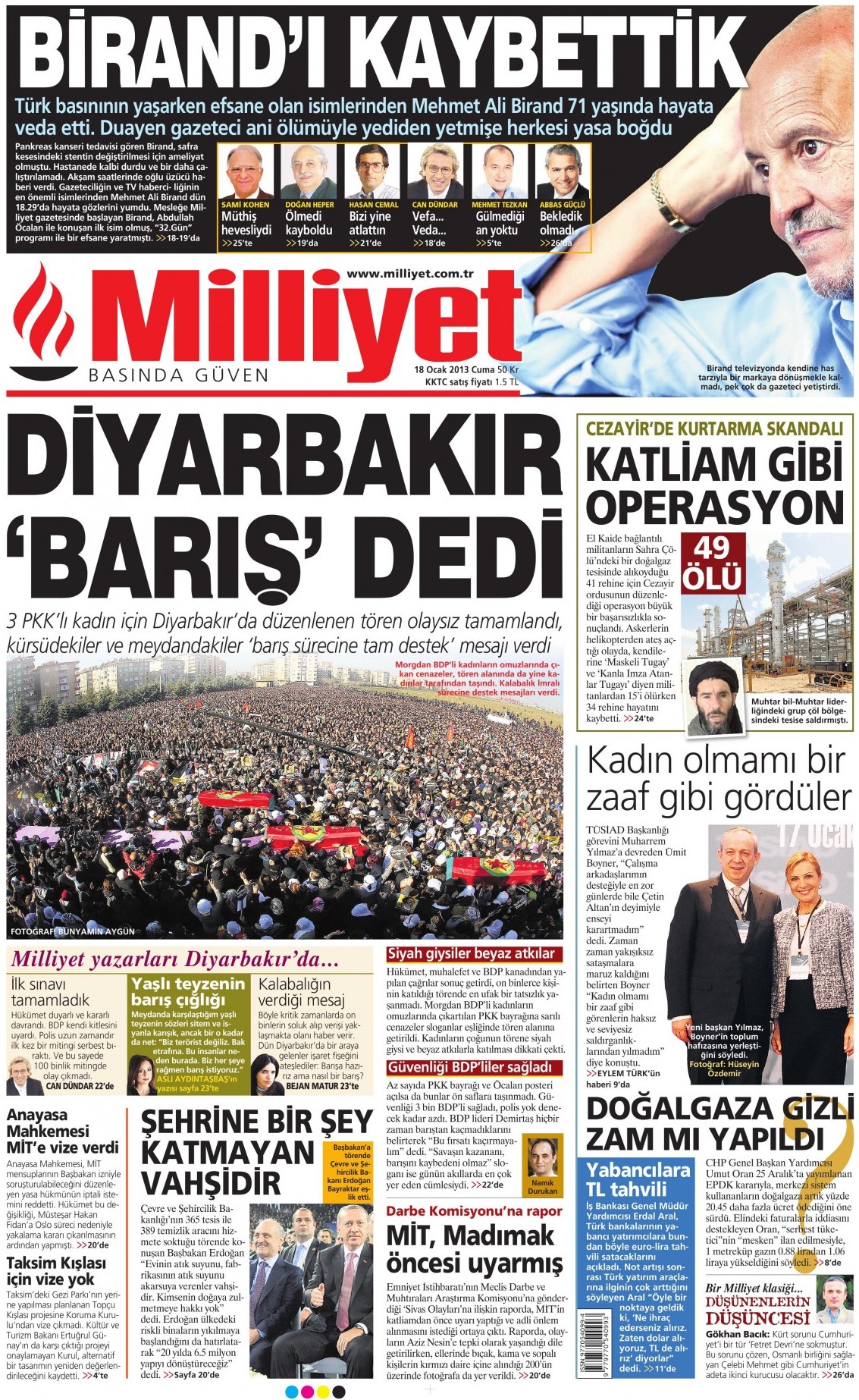
The front page of Milliyet on Jan. 18: ‘Diyarbakır said peace’
That the funerals passed peacefully was a relief not only for the government but also for the Peace and Democracy Party (BDP), which shares grassroots with the PKK. At the moment, both the Justice and Development Party (AKP) government and the BDP have a common interest in continuing the talks. For the process to come to a successful conclusion – still a long way off – this shared interest will need to persist for a while yet.
Zaman’s circulation figures – the Gülen effect?
January 9, 2013
Daily Zaman is often described as Turkey’s most read newspaper, with its circulation having recently tipped over the 1 million mark. It was therefore rather interesting to see a recent chart on medyatava.com indicating that this figure is made up almost entirely of subscribers, with only around 20,000 copies actually bought in shops every day.
This isn’t a complete surprise – for all its faults Zaman has never really been a “populist” newspaper, always self-consciously higher brow than the average fare on the Turkish newsstands. It’s pretty rare to see the local simitçi walking around Istanbul with a copy of Zaman tucked under his arm – at least in comparison with Sabah, Posta, Hürriyet, etc.
The high proportion of subscriptions can almost certainly be ascribed to Zaman’s links to the Fethullah Gülen religious movement (cemaat). Copies of the paper are delivered to most businesses/schools/individuals/hotels associated with the cemaat, which would account for the disproportionately high subscription number. As the “wikileaked” Stratfor intelligence agency cable explained back in 2009:
“FGC [Fethullah Gülen Community] businesses advertise heavily on FGC media, while FGC-owned media runs human interest stories and profiles of FGC sympathisers, businesses and schools. FGC members and sympathisers take holidays in FGC-owned hotels and shop at FGC-owned stores and invest in FGC financial institutions. Graduates of FGC cramming schools funded by FGC businesses often serve as teachers in FGC schools overseas. Finally, FGC media, funded by FGC businesses, reacts sharply to any criticism directed at Fethullah Gulen.”
A similar pattern can be observed at Today’s Zaman, the English-language arm of Zaman, which has 8,500 subscribers to just 1,900 sales.
***
While on the dull subject of newspaper circulation figures, it’s worth taking the opportunity to note that since last month’s shock resignations from Taraf, the paper has seen its circulation increase substantially. While Taraf had previously hovered around 50,000, this figure is now approaching close to 70,000. Whether or not the resignations were good from a journalistic perspective, they certainly seem to have made economic sense.


 Turkey Book Talk