Yeni Şafak and ‘the world’s richest Jew’
September 20, 2012
It is not particularly gratifying to scratch around the dregs of the Turkish press, but here’s the latest sludge I have been able to dredge up from the bottom of the barrel.
Islamist daily Yeni Şafak’s front page headline on Monday Sept. 17 focused on the reported recent meeting between Turkish Prime Minister Recep Tayyip Erdoğan and a “famous Jewish businessman.” The businessman, Ronald Lauder, was apparently sent as an intermediary by Israel to try to help restore its broken relations with Turkey. Following the meeting, Yeni Şafak’s headline stated: “The world’s richest Jew was the mediator.”

Perhaps I’ve become desensitized to this kind of thing after reading so many Turkish newspapers, but such casual playing on lazy Jewish stereotypes seems mild now that I write it down. Far worse examples can be found elsewhere every day (the front page of my favourite daily Akit recently included a graphic of a serpent sliding through a Star of David alongside that day’s requisite story about Israel). However, what was particularly striking to me about Yeni Şafak’s headline was that it came at a time when much of the Muslim Middle East was in violent uproar against the (similarly squalid) film produced in America, “The Innocence of Muslims.”
You only have to do a quick search on Google or YouTube to easily find thousands of articles and videos insulting Christianity (and Christians), Judaism (and Jews), or Islam (and Muslims). None of it is very nice, but thank God the world’s Jews don’t rise up in violent protests every time an offensive headline or story appears in a Turkish or Arabic newspaper.
Press freedom in Turkey and Sözcü newspaper
September 7, 2012
I’ve been meaning to write something about press freedom in Turkey with reference to daily newspaper Sözcü for quite a while. Then, a couple of days ago, I caught sight of the back page of the paper’s Sept. 4 edition and, like a gift, my primary material was there waiting for me.
The page carried the headline “Turkey’s daily sunshade,” and sarcastically described itself in the top corner as “the kind of journalism that Tayyip wants.” This was in reference to Prime Minister Recep Tayyip Erdoğan’s recent request for the Turkish media “not to exaggerate terror incidents.” The mock stories written underneath therefore contained nothing but praise for the Justice and Development Party (AKP) government and all its wonderful achievements. One was about how the monster of inflation had been miraculously defeated, another was about how Istanbul’s chronic traffic problem had been eradicated (by the way, I can tell you from bitter experience that it hasn’t), another featured a mother who had happily heeded Erdoğan’s advice that all women should give birth to “at least three children,” another described how Syrian refugees had started naming their new born babies “Tayyip” in honour of the heroic Turkish PM.

In fact, the page was relatively mild compared to the populist tub-thumping Sözcü (“spokesman” or “mouthpiece” in English) usually serves up. Its front page typically features some kind of outraged headline about the latest treachery committed by betrayers of the Turkish nation. A short, choleric editorial in the bottom left corner is included every day under the subtle title “Tokmak” (“hammer” or “mallet” in English – apt enough), invariably fuming about some latest disgrace and usually pointing the finger directly at the AKP government. The tone does not get much higher throughout the remaining 19 pages. Recently, the paper has been having almost daily seizures about the government’s Syria policy and its backing for the anti-Assad opposition. These are mostly prompted by fears about how such a policy may facilitate some kind of autonomous Kurdish region stretching from northern Syria to northern Iraq, and conceivably into southeastern Turkey – anathema to the kind of nationalist gallery that Sözcü plays to.
As far as circulation figures go, Sözcü has certainly been one of the undeniable success stories in the Turkish newspaper roster over the last couple of years. When it started printing just over five years ago, it sold around 60,000 copies. This figure has risen steadily ever since, and the paper recently announced it had hit national sales figures of 300,000, making it the fifth-highest selling daily newspaper in the country.
With regard to the state of freedom of expression in today’s Turkey, Sözcü is certainly an interesting phenomenon to consider. Surely, in contrast to the many recent suggestions that freedom of expression is under attack in the country, doesn’t the existence of such a paper indicate that the range of perspectives available on Turkish newsstands is healthily broad? Well, not exactly – the condition of the Turkish media has more fundamental problems that must be taken into account.
In its annual Press Freedom Index for 2011, released in January this year, the Paris-based Reporters Sans Frontières (Reporters Without Borders, or RSF) ranked Turkey 148th out of 179 countries worldwide, down from 138th in 2010. This was the fifth year in succession that Turkey had slipped down the RSF rankings. Over 100 Turkish journalists are currently in jail, a figure higher than China. The number of journalists sacked or sued for what they have written, reported, or even drawn, climbs by the month, and many journalists and editors freely admit to practicing self-censorship to avoid trouble.
One of the most significant and much-discussed episodes took place in September 2009, when Doğan Publishing, then the largest media group in Turkey, was hit with over $3.2 billion in fines for tax irregularities by the Turkish treasury (equivalent to more than four fifths of the combined market value of Doğan Holding and Doğan Publishing).The hugely excessive size of the fines seemed to suggest government disapproval of the group’s newspapers’ reporting of an embezzlement scandal at the “Deniz Feneri” Islamic charity in Germany. It was the biggest charity corruption case in German history, and Doğan newspapers alleged that billions of dollars raised by the charity had somehow found their way into AKP coffers back in Turkey. After the fines were levied, Doğan’s media outlets significantly toned down their reporting of the scandal, as well as their broader criticism of the government. A number of their anti-AKP columnists were sacked, and many of their newspapers were sold off in order to pay the exorbitant fine, which was subsequently lessened after appeal.
There are numerous other examples of similarly shady processes being undertaken by the government. Their effectiveness can perhaps be attributed to one of the more fundamental flaws in the country’s media landscape. As Svante E. Cornell wrote in Turkey Analyst back in January 2010, this is the fact that the Turkish media is overly dominated by large holding companies:
“As a result, major newspapers and television channels are owned by firms with broad and substantial economic interests. For many, winning government tenders is a chief objective. This means that owners of media outlets seldom see these as their main preoccupation, but often as assets they can use for leverage – either by using their assets to pressure incumbents to win favors – or by appeasing the powers that be.”
Those organs wishing to maintain good business relations with the government must toe the line. However, there are still many who simply don’t care about such things, and Sözcü is perhaps the most prominent print example of that today. The case of Emin Çolaşan is a neat symbolic example to consider here. Çolaşan used to write for daily Hürriyet – part of the Doğan media empire – before he was fired in 2007 after 22 years’ service. His sacking was believed to be because of his fierce criticism of the AKP government. Within weeks of leaving Hürriyet, Çolaşan was picked up by Sözcü, where he now writes a reliably bellicose daily column. Evidently, Sözcü doesn’t have quite the same concerns about offending the AKP government that Hürriyet now has.
Still, there is far more to a free and healthy press than simply having a few columnists in certain newspapers feeling free to throw as many tantrums about the government as they want. A well-functioning Fourth Estate should, through rigorous investigative reporting, effectively hold whatever government is in power to account. Unfortunately, there is precious little evidence of this in Turkey’s press landscape. In an excellent piece on “The Deteriorating State of Media Freedom in Turkey,” again in Turkey Analyst, Gareth Jenkins has described this parlous situation thus:
“Unlike in many other countries, Turkish newspapers are dominated not by reporters but by columnists. With a few notable exceptions, journalistic standards in Turkey have always been very low. Little attempt is made to substantiate news reports, with the result that rumor and gossip are often given equal status to undeniable facts … The situation is arguably even worse amongst the columnists, most of whom merely react to something they have heard or read elsewhere in the media without trying to investigate or assess its veracity. The result is that most columnists generate more sound than sense, using invective rather than reasoning to make their voices heard.
… Nor does Turkey have a tradition of investigative journalism. What passes for investigative journalism – and which today mostly appears in book form rather than in newspapers or on television – tends to consist of a compendium of reports and rumors selected to support the author’s preconceptions; and is riddled with the same lack of substantiation that characterizes newspaper and television news reports.”
Sözcü, perhaps unsurprisingly, exemplifies suchshallow prioritizing of reactive opinion over genuinely thoughtful, reflective, investigative writing. Over 50 percent of its “news” pages are filled with belligerent opinion columns from the paper’s popular commentators.
Some might take the overwhelming predominance of highly critical “rent-a-mouths” in almost all Turkish newspapers as proof of the Turkish media’s bustling vitality. However, while Sözcü may get away with its fierce daily anti-AKP invective, that’s a million miles away from contributing to a genuinely effective Fourth Estate. Ultimately, the latter’s development is of critical importance to the future direction of Turkish democracy.
The Sivas Massacre is a ‘19 year lie’: Yeni Akit
July 27, 2012
The massacre that took place in the Central Anatolian town of Sivas in 1993 is one of the darkest episodes in modern Turkish history. On the morning of July 2, a large group of radical Sunni Islamists descended on the Madımak Hotel in Sivas town center, protesting its hosting of an Alevi cultural festival. The mob attacked and set fire to the hotel, which resulted in the deaths of 37 people. Autopsies at the time concluded that the deceased had either died of burns or smoke inhalation.
Radical Islamist daily Yeni Akit’s July 23, 2012 front page carried a large headline declaring “The 19 Year Lie,” accompanied by two photos tastefully showing the morgue full of corpses from the massacre. Aside from the pleasure the paper obviously derived from showing off the photos on its front page once again, the ostensible reason the story was to expose what it called the “lie” that those in the hotel had been killed by the flames. In one of the pictures, a young girl lying on a morgue table, Belkıs Çakır, bears what the paper says is “clearly” a gunshot wound in the chest. This apparently proves that most of the deceased actually killed each other inside the hotel.Unfortunately for Akit, closer inspection reveals that the “blood” from Çakır’s “bullet wound” is simply a braid of hair hanging down from her head.

Akit’s charming July 23 front page
Akit’s piece aroused immediate opprobrium from a number of other Turkish dailies. The next day’s Taraf responded with the headline: “Akit sets fire to Madımak again,” Cumhuriyet said: “One more black publication from Akit,” while leftist-nationalist Yurt bluntly stated on its front page: “A Bigoted Lie.” All included the dismayed reactions from the families of those who died in the tragic incident, as well as their representatives.
Akit said the morgue photos had been hidden for 19 years before passing into their hands, but lawyer Şenal Sarıhan explained to Taraf that the photos were in fact included in a book on the event written by herself, “Madımak Yangını Sivas Davası.” “This book was published in 2002, and it had its third print run in 2011. Akit’s reporter Murat Alan clearly has it. The photos are included on page 97, 100, and 102. To claim that this is the first time they have been seen is completely untrue,” Sarıhan said. Çakır’s original autopsy, she added, was conducted at Sivas’s Numune Hospital, under strict observation. It unambiguously concluded that she had died of burns and from carbon monoxide poisoning. “The definite cause of death was burns and smoke inhalation. There is no dispute on this subject … Neither bullet wounds nor knife wounds can be seen in the photos,” Sarıhan said, adding that the only two people who died of bullet wounds on the day were shot outside the hotel by the demonstrators.
Zeynep Altıok, daughter of the poet Metin Altıok who was killed in the Madımak attack, was quoted as saying that the news did not come as a surprise from Akit. “They have written similar things before. They used to say it was the work of the [outlawed Kurdistan Workers’ Party] PKK. Their aim is to distort the truth. Before, they said it was the PKK, now they’ve gone in completely the opposite direction. I can’t take it seriously.”
Unfortunately, it’s not easy to reason with fanatical Islamists, and Akit’s July 24 front page headline followed on from the previous day, declaring: “Let the autopsies be conducted again”! On July 25, following the condemnations that the earlier pieces had aroused, the paper retreated into comforting victimhood,complaining that the other newspapers constituted a “dirty alliance against Akit … a panicking cartel.”
Yeni Akit is notorious in Turkey as the most vitriolic of the country’s Islamist newspapers. It was established in 2010 after its forerunner, “Anadolu’da Vakit,” was closed down following its failure to pay a fine incurred in 2003 for a piece deemed “insulting to the Turkish Armed Forces” (still officially a crime). Sane-minded observers view Akit with a mixture of incredulity and contempt, and think of it as not much more than a marginal voice on the lunatic fringe. Nevertheless, the fact that it enjoys significantly higher circulation figures than a number of far more respected newspapers must be chastening indeed!
Taraf newspaper and liberal disillusionment
July 15, 2012
On July 14, leftist daily BirGün included a piece discussing liberal daily Taraf’s recent turn away from the ruling Justice and Development Party (AKP) government. Prompted by Ahmet Altan’s July 13 editorial bemoaning the AKP’s departure from its earlier EU-minded liberal-reformist impulses – the latest in a series of articles critical of the government – BirGün described the shift with some incredulity. Taraf, the piece said, used to label government critics anti-democratic nationalists in thrall to regressive military tutelage, strongly supported a “yes” vote in the September 2010 constitutional referendum, hailed Prime Minister Recep Tayyip Erdoğan as a saviour of the Kurds, and openly recognised the “Armenian Genocide” on its front page. Recently, however, the paper’s criticism of the AKP’s authoritarian turn has increased significantly. Taraf’s move against the government could be seen as representative of disillusioned liberal Turkish opinion these days, but the apparent non-effect this has on opinion polls indicates just how tiny that liberal constituency actually is.
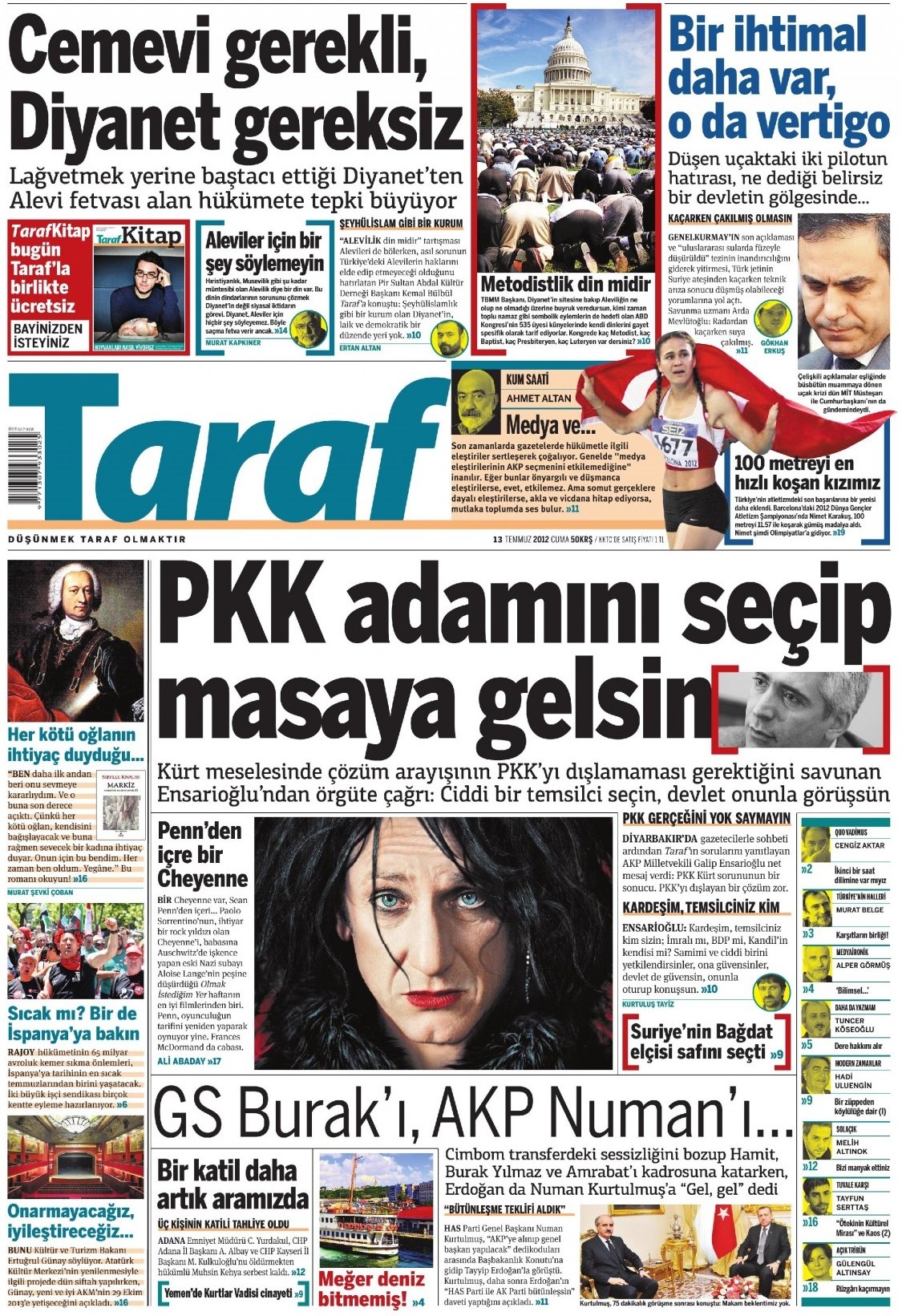
Taraf started printing in 2007 and primarily made a name for itself for its tough anti-military stance. For Turkish liberals at the time, this seemed like the most important battle to be won, and foreign observers routinely used adjectives like “courageous,” “plucky,” and “brave” to describe the paper’s anti-militarist crusade. Domestic critics denigrated it as the AKP’s convenient attack dog, something akin to the “useful idiot” liberal apologists who denied the existence of Lenin’s Soviet police-state terror in the 1910s and 20s. Taraf has been particularly instrumental in the Ergenekon and Balyoz coup plot investigations, claiming numerous scoops against the military in that case, (no matter that most of its anti-military material is widely understood to have been fed to it directly by the AKP government). As Jim Meyer described in a 2009 piece:
“Particularly with regard to the Ergenekon trial, Taraf has managed to frequently scoop the competition with reports (often leaked by the largely AK Party controlled national police force) which have embarrassed military officials […] ‘I don’t see journalistic achievement,’ said one experienced Turkish journalist. ‘They just gobbled up what the police intelligence was leaking them regarding Ergenekon.’”
Meyer’s analysis was written three and a half years ago, and since then the contradictions and evident absurdities in the coup plot cases – as well as the growing anti-democratic practices of the AKP government – have become more and more apparent. While Taraf still maintains its strong anti-military position, it has begun to abandon its previously timid approach to the ruling party and is now voicing tough criticism of various government tendencies. This became particularly clear in January, when lawyers for Prime Minister Erdoğan sued the paper’s editor Ahmet Altan for allegedly “[making] extremely deep insults with the intention of assaulting Erdoğan’s personal rights,” and pressed for 50,000 Turkish Liras in compensation. Evidently, the AKP government wants to keep Taraf on a short leash, but the paper’s continued criticism since then would suggest it has not yet been successful.
Meanwhile, on the same day as BirGün was observing Taraf’s apparent shift against the government, all media outlets were reporting on an upcoming AKP proposal to the Turkish parliament’s Constitution Conciliation Commission (which is currently attempting to put together a new national constitution). The Hürriyet Daily News reports that the proposed changes would “allow the government to limit press freedom in a variety of scenarios that include cases of ‘national security’ and ‘public morals.’”
Referring to the moves, Taraf’s July 14 front page headline story harshly criticised the AKP government for its “prohibitionist mentality.” It cited a 1976 European Court of Human Rights ruling, which stated that: “Freedom of expression […] is applicable not only to “information” or “ideas” that are favourably received or regarded as inoffensive or as a matter of indifference, but also to those that offend, shock or disturb the State or any sector of the population.” Underneath the main headline, the article pointedly said: “we hope this ruling inspires the AKP.”


 Turkey Book Talk