Ezgi Başaran on the new spirit of Islamism
October 8, 2024
Turkey Book Talk #229 – Ezgi Başaran, journalist and academic at St. Anthony’s College, University of Oxford, on “The New Spirit of Islamism: Interactions Between the AKP, Ennahda and the Muslim Brotherhood” (IB Tauris).
The book looks at the aspirations of Islamist actors in Turkey, Tunisia and Egypt after the Arab Uprisings from 2011 to 2013. Based on interviews with dozens of officials in all three countries at that time, it seeks to understand what motivated them, how they viewed each other, and whether they prioritised pragmatism or religious ideology.
Download the episode or listen below:
Read a transcript of the interview on Substack
Listen to Turkey Book Talk: iTunes / PodBean / Stitcher / Spotify / PlayerFM / Listen Notes
Follow : Instagram / Facebook / Twitter

Support Turkey Book Talk as a member on either Substack or Patreon. Members get a 35% discount on all Turkey/Ottoman History books published by IB Tauris/Bloomsbury, access to transcripts of every interview, transcripts of the whole archive, and links to articles related to the subject of every episode.
Turkey Book Talk #222 – Sami Kent on “The Endless Country: A Personal Journey Through Turkey’s First Hundred Years” (Picador).
The book paints a portrait of Turkey by combining accounts of key events from previous decades with Sami’s personal reflections on growing up learning about his paternal homeland from afar, before coming to work in the country as a journalist.
Download the episode or listen below:
Read a transcript of the interview on Substack.

Listen to Turkey Book Talk: iTunes / PodBean / Stitcher / Spotify / PlayerFM / Listen Notes
Follow : Instagram / Facebook / Twitter
Become a member on Substack or Patreon to support Turkey Book Talk. Members get a 35% discount on all Turkey/Ottoman History books published by IB Tauris/Bloomsbury, transcripts of every interview, transcripts of the whole archive, and links to articles related to each episode.
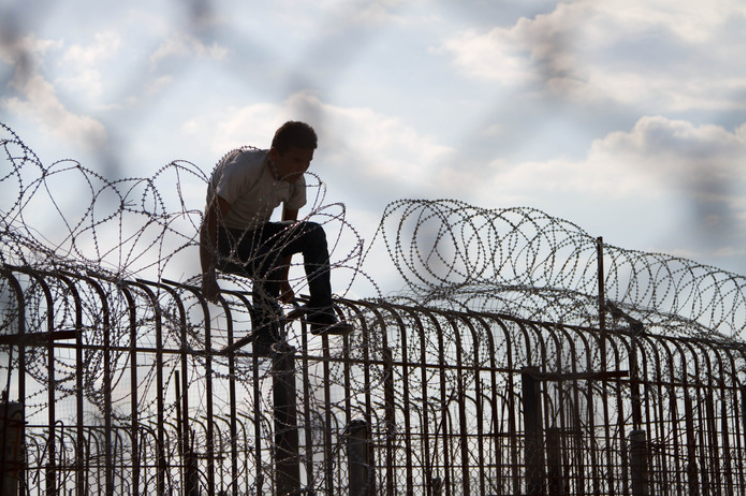
Turkey Book Talk #221 – Istanbul-based photojournalist Bradley Secker discusses his work on migration, LGBT+ asylum seekers in the Middle East and Europe, the difficulties of practicing journalism in Turkey and the broader state of photojournalism.
Bradley recently launched a Substack, in which he tackles various aspects of his work and the challenges of working in the industry.
Download the episode or listen below:
Read a transcript of the interview on Substack.

Listen to Turkey Book Talk: iTunes / PodBean / Stitcher / Spotify / Google Podcasts / PlayerFM / Listen Notes
Follow : Instagram / Facebook / Twitter
Become a member on Substack or Patreon to support Turkey Book Talk. Members get a 35% discount on all Turkey/Ottoman History books published by IB Tauris/Bloomsbury, transcripts of every interview, transcripts of the whole archive, and links to articles related to each episode.
Turkey Book Talk #218 – Emre Toros, professor of political science and dean of the communications faculty at Ankara’s Hacettepe University, on “Electoral Integrity in Turkey” (Edinburgh University Press).
The book weighs up the country’s democratic credentials after over two decades of rule by Erdogan’s party, both in terms of its electoral system and its broader institutional framework. It ultimately describes today’s Turkey as being in an ambiguous grey zone, neither straightforwardly democratic nor conventionally authoritarian.
Download the episode or listen below:
Listen to Turkey Book Talk: iTunes / PodBean / Stitcher / Spotify / Google Podcasts / PlayerFM / Listen Notes
Follow : Instagram / Facebook / Twitter

Become a member on Patreon to support Turkey Book Talk. Members get a 35% discount on all Turkey/Ottoman History books published by IB Tauris/Bloomsbury, transcripts of every interview, transcripts of the whole archive, and links to articles related to each episode.
Check out and sign up to the excellent Turkey Recap.
Turkey Book Talk #217 – Christopher Phillips, professor of international relations at Queen Mary, University of London, on “Battleground: Ten Conflicts that Explain the New Middle East” (Yale University Press).
The conversation explores the region’s fiendishly complicated geopolitical rivalries, as well as how Turkey’s push for greater influence in Syria, Iraq and Libya has reverberated on its ties with numerous other ambitious powers.
Download the episode or listen below:
Listen to Turkey Book Talk: iTunes / PodBean / Stitcher / Spotify / Google Podcasts / PlayerFM / Listen Notes
Follow : Instagram / Facebook / Twitter

Become a member on Patreon to support Turkey Book Talk. Members get a 35% discount on all Turkey/Ottoman History books published by IB Tauris/Bloomsbury, transcripts of every interview, transcripts of the whole archive, and links to articles related to each episode.
Check out and sign up to the excellent Turkey Recap.
Turkey Book Talk #216 – Seda Demiralp, professor of political science at Istanbul’s Işık University and non-resident scholar at the Middle East Institute in Washington DC, on what the recent surprise local election results mean for Turkish politics.
The conversation takes in what the main opposition Republican People’s Party (CHP) did right, what Erdogan’s Justice and Development Party (AKP) did wrong, the emerging challenge to the AKP posed by the hardline Islamist Yeniden Refah Party, the performance of the pro-Kurdish DEM Party, and the impact of Turkey’s economic woes.
Download the episode or listen below:
Listen to Turkey Book Talk: iTunes / PodBean / Stitcher / Spotify / Google Podcasts / PlayerFM / Listen Notes
Follow : Instagram / Facebook / Twitter


Become a member on Patreon to support Turkey Book Talk. Members get a 35% discount on all Turkey/Ottoman History books published by IB Tauris/Bloomsbury, transcripts of every interview, transcripts of the whole archive, and links to articles related to each episode.
Check out and sign up to the excellent Turkey Recap.
Turkey Book Talk episode #63 – VOLKAN YILMAZ, assistant professor of social policy at Istanbul’s Boğaziçi University, on “THE POLITICS OF HEALTHCARE REFORM IN TURKEY” (Palgrave Macmillan).
The book examines reforms in the country’s healthcare system under the AKP since 2003: What changed? What improved? What got worse? Who gained? Who lost?
Download the episode or listen below.
Subscribe to Turkey Book Talk : iTunes / PodBean / Stitcher / Acast / RSS

Here’s my review of the book from a couple of weeks ago.
Become a member to support Turkey Book Talk. Membership gives you full transcripts in English and Turkish of every interview upon publication, transcripts of the entire Turkey Book Talk archive, and access to an exclusive 30% discount on over 200 Turkey/Ottoman History titles published by IB Tauris.
Bilge Yeşil on the Turkish media, past and present
August 20, 2016
Turkey Book Talk is back after a one month hiatus.
We return with a good one: Bilge Yeşil speaks about her book “Media in New Turkey: The Origins of an Authoritarian Neoliberal State” (University of Illinois Press).
Download the episode or listen below:
Subscribe to Turkey Book Talk: iTunes / PodBean / Stitcher / Facebook / RSS
Here’s my review of the book.

If you like Turkey Book Talk and want to support independent podcasting, you can make a small or large monetary donation to the show via Patreon. Many thanks to current supporters Özlem Beyarslan, Steve Bryant, Andrew Cruickshank and Aaron Ataman.
Taraf newspaper and liberal disillusionment
July 15, 2012
On July 14, leftist daily BirGün included a piece discussing liberal daily Taraf’s recent turn away from the ruling Justice and Development Party (AKP) government. Prompted by Ahmet Altan’s July 13 editorial bemoaning the AKP’s departure from its earlier EU-minded liberal-reformist impulses – the latest in a series of articles critical of the government – BirGün described the shift with some incredulity. Taraf, the piece said, used to label government critics anti-democratic nationalists in thrall to regressive military tutelage, strongly supported a “yes” vote in the September 2010 constitutional referendum, hailed Prime Minister Recep Tayyip Erdoğan as a saviour of the Kurds, and openly recognised the “Armenian Genocide” on its front page. Recently, however, the paper’s criticism of the AKP’s authoritarian turn has increased significantly. Taraf’s move against the government could be seen as representative of disillusioned liberal Turkish opinion these days, but the apparent non-effect this has on opinion polls indicates just how tiny that liberal constituency actually is.
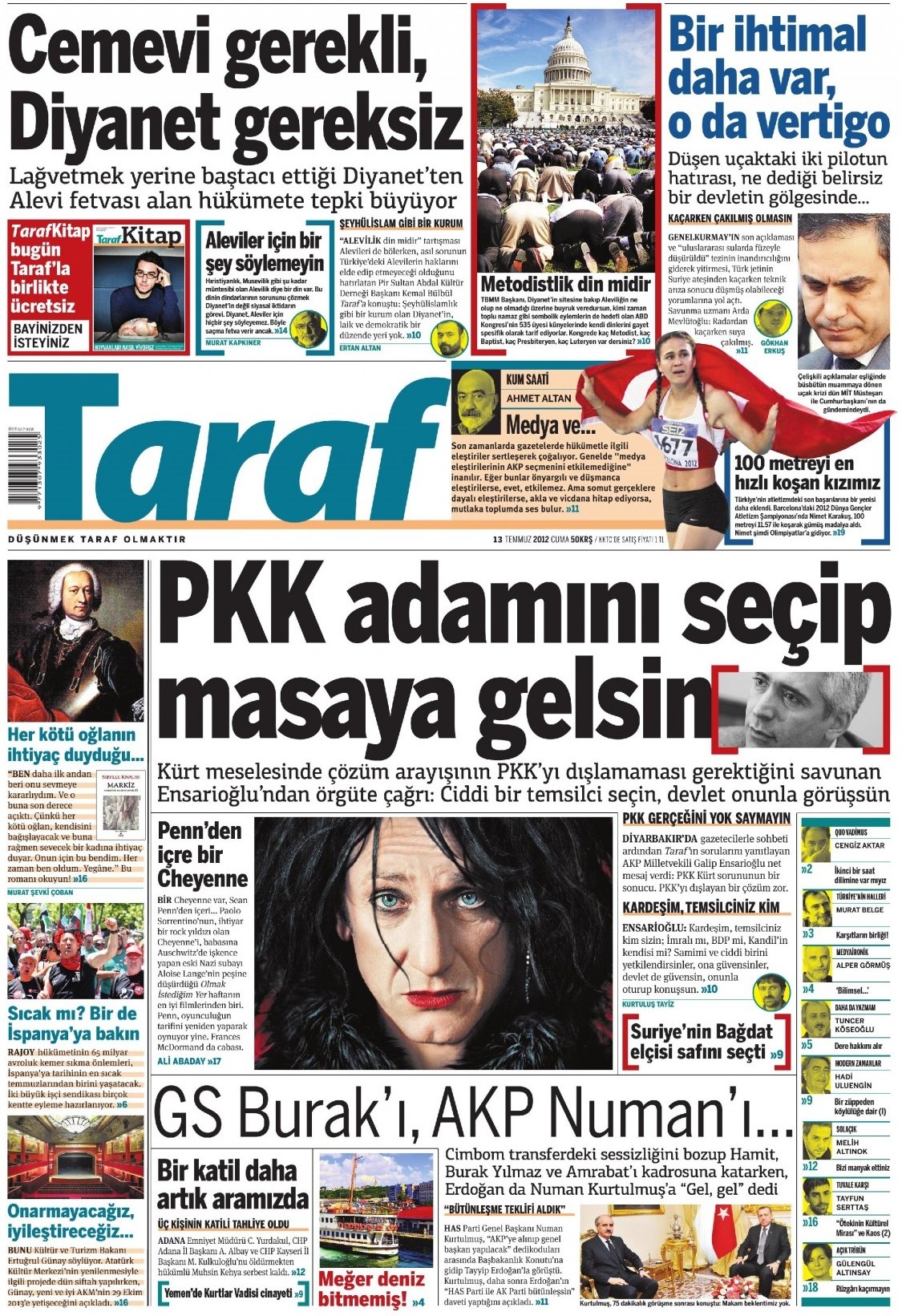
Taraf started printing in 2007 and primarily made a name for itself for its tough anti-military stance. For Turkish liberals at the time, this seemed like the most important battle to be won, and foreign observers routinely used adjectives like “courageous,” “plucky,” and “brave” to describe the paper’s anti-militarist crusade. Domestic critics denigrated it as the AKP’s convenient attack dog, something akin to the “useful idiot” liberal apologists who denied the existence of Lenin’s Soviet police-state terror in the 1910s and 20s. Taraf has been particularly instrumental in the Ergenekon and Balyoz coup plot investigations, claiming numerous scoops against the military in that case, (no matter that most of its anti-military material is widely understood to have been fed to it directly by the AKP government). As Jim Meyer described in a 2009 piece:
“Particularly with regard to the Ergenekon trial, Taraf has managed to frequently scoop the competition with reports (often leaked by the largely AK Party controlled national police force) which have embarrassed military officials […] ‘I don’t see journalistic achievement,’ said one experienced Turkish journalist. ‘They just gobbled up what the police intelligence was leaking them regarding Ergenekon.’”
Meyer’s analysis was written three and a half years ago, and since then the contradictions and evident absurdities in the coup plot cases – as well as the growing anti-democratic practices of the AKP government – have become more and more apparent. While Taraf still maintains its strong anti-military position, it has begun to abandon its previously timid approach to the ruling party and is now voicing tough criticism of various government tendencies. This became particularly clear in January, when lawyers for Prime Minister Erdoğan sued the paper’s editor Ahmet Altan for allegedly “[making] extremely deep insults with the intention of assaulting Erdoğan’s personal rights,” and pressed for 50,000 Turkish Liras in compensation. Evidently, the AKP government wants to keep Taraf on a short leash, but the paper’s continued criticism since then would suggest it has not yet been successful.
Meanwhile, on the same day as BirGün was observing Taraf’s apparent shift against the government, all media outlets were reporting on an upcoming AKP proposal to the Turkish parliament’s Constitution Conciliation Commission (which is currently attempting to put together a new national constitution). The Hürriyet Daily News reports that the proposed changes would “allow the government to limit press freedom in a variety of scenarios that include cases of ‘national security’ and ‘public morals.’”
Referring to the moves, Taraf’s July 14 front page headline story harshly criticised the AKP government for its “prohibitionist mentality.” It cited a 1976 European Court of Human Rights ruling, which stated that: “Freedom of expression […] is applicable not only to “information” or “ideas” that are favourably received or regarded as inoffensive or as a matter of indifference, but also to those that offend, shock or disturb the State or any sector of the population.” Underneath the main headline, the article pointedly said: “we hope this ruling inspires the AKP.”
[Published on openDemocracy (20th June 2012): http://www.opendemocracy.net/william-armstrong/turkey-as-test-case-in-multipolar-post-cold-war-order]
Much is made of Turkey’s ‘difference’ in the Middle East. Why is it being identified an inspiration to the region? Why is there talk of Turkey as a model for Egypt, and not the other way around? In a recent interview with Turkish Policy Quarterly, historian Bernard Lewis makes much of Turkey’s republican history of independence and self-criticism since the Ottoman era, which he says accounts for the country’s regional pre-eminence today. Whilst these differences are indeed significant, a reasonable case can be made that they were not nearly so pronounced as Lewis claims. In fact, after the Second World War, Turkey was no more immune to the hard choices that had to be made in a bipolar world order than other Eastern European and Middle Eastern states. As such, like many others, it was only ever nominally independent.The difference between Turkey and the other countries in the region, however, is that it was able to emerge much more quickly in the post-Cold War era, when states previously under Soviet influence became independent, and the ‘protection’ of those under U.S. sway was rendered unnecessary. This emergence can be ascribed to Turkey’s higher economic, educational, industrial and institutional development, as well as its important narrative of national sovereignty and proud republican history. Its regional pre-eminence today is therefore closely linked to its status as a pioneer of the new, multi-polar post-Cold War era. The sense that the country is now defining itself, as opposed to being defined by outsiders, is a crucial psychological hurdle.
For the duration of the Cold War, the Middle East was an object region acted upon by outside forces, rather than a subject acting for itself. In practice, this meant states being pulled into the influence of either the U.S. or the Soviet Union. Turkey was no different in this sense, and was considered by Washingtonan essential bulwark against communism on the south-eastern fringe of Europe. In order to anchor Turkey to the west, the U.S. bankrolled the Turkish military through the Truman Doctrine in the post-war era, and it was made a full member of NATO in 1952 (at the same time as Greece, the other subject state of the Truman Doctrine). U.S. support – tacit or otherwise – was crucial in the three military coups of 1960, 1971, and 1980, all of which helped to maintain the status quo order. Like so many others, during the Cold War period Turkey was barely democratic, with its western allies preferring a stable, reliable partner to one that genuinely reflected its people’s unpredictable wishes. The 1980 coup is particularly instructive, being seen by the U.S. at the time as necessary to prevent any danger of the country sliding towards communism, as the Turkish left was extremely mobilised throughout the 1970s. CIA Ankara station chief at the time, Paul Henze, is on record as saying that he cabled Washington – shortly after the coup had been carried out by the Turkish military – to say ‘our boys did it’. Gossip perhaps, but illuminating gossip.
The 1980 coup therefore illustrates the old Turkish model, and its similarities with the systems that have also characterised the Arab world in the recent past: U.S./western support for an essentially non-democratic state, in return for the guarantee of stability. Turgut Özal, who became Prime Minister in 1982, could therefore be seen as a kind of non-military Turkish version of General Pinochet. Coming to power shortly after an American-backed coup, Özal was pro-U.S., anti-communist, and neo-liberal – significantly opening up the Turkish economy to international market forces with U.S. support. It’s an interesting irony that in many ways it was these very reforms that helped prepare Turkey to develop economically in the post-Cold War era.
After the Soviet Union collapsed, it also – perhaps paradoxically – became increasingly clear that the old U.S.-dominant model had also become redundant, with much of the previous justification for U.S. support to stable but undemocratic regimes having been lost. Slowly, it became possible for new, popular movements to emerge in the region, and this goes some way to explaining both the revolts sweeping across the Arab world today as well as Turkey’s (less violent) development of a strongly independent government representing popular will. There are, however, significant differences that may legislate against post-Cold War Arab countries following the same trajectory as Turkey. Not least of these is the multi-ethnic, multi-linguistic, multi-confessional nature of most of these countries – none can really be considered ‘nation states’ in anything like the organically-evolving western European sense of the world. Turkey’s own early 20th century nation-building project relied on an enormous amount of violently imposed state-directed social reorganisation, essentially imitating the western model, (in terms of the uniform cultural, ethnic, linguistic, religious cohesiveness that was stressed). On its own terms, the Turkish model of modernisation was successful – taking a multi-linguistic, multi-ethnic population and forging out of it a unitary, monolingual, officially mono-cultural state. In the modern nation states of the Arab world, with their fragmented and multifarious social, ethnic, religious, linguistic, sectarian structures, it is difficult to see how the same results can be achieved in the early 21st century – or even how such results would be desirable. The new Middle East is perhaps more likely to be one where – instead of two great outside powers seeking to impose their influence and maintain an unthreatening stability – a regional struggle will play out between multiple competing local forces. This struggle will be based on old fissures that the old Cold War order had previously kept an uneasy lid on.
Europe, Turkey and historical amnesia
April 2, 2012
[Published on openDemocracy (27th March 2012): http://www.opendemocracy.net/william-armstrong/europe-turkey-and-historical-amnesia]
“In the first years after the war … Europeans took shelter behind a collective amnesia.” – Hans-Magnus Enzensberger.
In his robust case for a liberal Euro-scepticism, ‘A Grand Illusion?’ (1996), Tony Judt robustly debunked an oft-repeated myth about the post-war rebuilding project in western Europe. From the very start, rather than being part of a carefully planned attempt to reshape the continent by deliberately sabotaging nation-states from above, (with the eventual goal being to unite the entire continent under one umbrella European super-state), initial moves after the Second World War towards greater European cohesion were, in fact, the logical result of quite distinct national concerns. These concerns only converged in shared European projects by force of convenience. As Judt points out, post-war European cooperation was “a fortuitous outcome of separate and distinctive electoral concerns, economic interests, and national political cultures, it was made necessary by circumstance and rendered possible by prosperity.” In particular, the war of 1939-45 had the lasting consequence of giving the continent something else in common: “a shared recent memory of war, civil war, occupation, and defeat […] The shared experience of defeat points to another common European wartime experience: the memory of things best forgotten […] Hitler’s lasting gift to Europe was thus the degree to which he and his collaborators made it impossible henceforth to dwell with comfort on the past.”
Almost every European participant emerged from the Second World War having lost. The shared perception of a necessity for deliberate historical amnesia in post-war Europe, for forgetting the traumatic recent past, was thus one of the most significant points of convergence between nation states that helped legitimate the new European project. Cooperation was imperative, and part of this cooperation was the tacit agreement between nations as to the importance of ignoring their own roles in the madness of the war that had just ended. At the very most, if not forcibly ignoring, countries tended (or still tend) to absolve themselves of as much responsibility as possible, to trumpet exaggerated national myths of resistance to fascism. The phenomenon is observable in France, (formerly West) Germany, Belgium, Poland, Italy: such methods were considered something like an existential necessity, necessary in order for states to get over the Second World War as cohesive units. It is only since 1989 and the end of the Cold War that a more complex, honestly realistic picture of the European inheritance has emerged, and even now it’s clear that many countries are still far from willing to look their own troubled histories directly in the eye. The official French line, for example, shared by a majority of the French people, continues to exaggerate the significance and size of the French Resistance, and underestimate the completeness of Vichy France’s submission to fascism, and its horrendous consequences. There’s a salutary lesson to be taken from a charmed visit to Paris: its state of flawless architectural continuity was paid for at the price of submission to the Nazis.
In its capacity as a candidate country of the European Union, Turkey’s apparent refusal to come to terms with the Armenian “events” of 1915 is often cited as a clear example of why the country is unsuitable for membership. However, the opposite could well be true. Far from having to recognise these events as “genocide” in order to adhere to established European norms of historical account-settling, Turkey’s continued denial of the Armenian “events” should rather be seen as an advantage, recommending it as an entirely suitable European candidate. Following classic post-war European form, perhaps Turkey’s historical amnesia should be seen as one of the key criteria that it fulfils in its wish to be defined as an authentic European state!


 Turkey Book Talk