On Monday (Oct. 22), the Committee to Protect Journalists (CPJ) released a detailed report on the state of press freedom in Turkey, under the gloomy title: “Turkey’s Press Freedom Crisis – The Dark Days of Jailing Journalists and Criminalizing Dissent.” Although it seems like reports on the subject are released every month, this one received a huge amount of attention, both domestically and internationally. It describes the numerous instances of restrictions on media freedom, citing the familiar examples of the Ergenekon case, the endless prosecutions of journalists writing on Kurdish matters, the increasingly widespread practices of intimidation and self-censorship, as well as the ruling Justice and Development Party (AKP) government’s rising intolerance of dissent.
Bloomberg published a sensible commentary on the same day that the CPJ report was released:
“The committee had come under fire for reporting lower estimates of the number of jailed journalists than other human rights organizations. Turkey’s government has long maintained that only a handful of the journalists were charged with offenses related to their jobs, and because the CPJ hadn’t read all the indictments, it had erred on the side of caution.
“Now it has read the indictments and determined that 61 of the reporters and editors in detention are there because of things they wrote or said in the course of their work. In letters accompanying the report, the Turkish government disputes that characterization and asserts that it is striving to balance the need to prevent ‘the praising of violence and terrorist propaganda, and the need to expand freedom of speech.’
“What’s becoming all too clear during the Justice and Development Party’s third term in office is that despite its claims that the government is now liberalizing press laws and continuing the country’s march toward a European-style democracy, the opposite is happening. …
“Instead of fixing the legal system, the government has used it to repress opponents and intimidate the media. The “insult” laws, as well as the special anti-terrorism courts and laws, should be repealed. They are not worthy of a modern democracy, and they shouldn’t be a model for anyone.”
The report was widely covered in the Turkish media. The Oct. 23 edition of daily Taraf featured the report as its front page headline. It included an interview with Ragıp Zarakolu, a legendary figure in Turkish publishing, who has long written and published bravely on subjects that many others wouldn’t touch. He has spent a significant amount of time in prison over the years for things written or published, and he had some predictably doleful things to say:
“The fact that Turkey is found on these kinds of lists saddens me greatly. Turkey has to go beyond this, but in order to do this a change in mentality is necessary … In the existing system the state’s interests are always seen as more important than the citizen’s interests. For this reason, I don’t believe any changes can come in the end without a process of change in mentality. …
“I’ve been writing in the Kurdish press for 20 years. I witnessed the killing of a 72-year-old editor. Such things aren’t experienced any more. But should we be thankful simply for the fact that we’re not killed, or like Uğur Mumcu we’re not assassinated? Turkey is currently at the end of a 10 year process. But despite constant reforms and improvements being spoken of for 10 years, journalists are still in jail for political reasons, and there are still people who have been in prison for 30 years for political reasons. We have to examine this.”
While it’s imperative to identify the areas in which the current government has attacked press freedom, it’s also important to identify the deeper structural problems undermining freedom of expression in Turkey, too. (I touched on the issue a couple of months ago on this blog.) Also included in the CPJ report is an interview with journalist Yavuz Baydar, in which he discusses some of these problems:
“While the rules of the game in the media landscape remain unchanged, unreformed, what changes are the actors, new proprietors. Turkey’s media owners are – like drug addicts – dependent on the powers in Ankara because they are in all sorts of businesses, need approvals for growth and investments, etc., and therefore keep their media outlets either as weapons for extortion or, at best, at the service of governments. …
“The media owners of these outlets acting as ‘the coalition of the willing’ that openly act submissively to the government and security bureaucracy. I can only refer to a key meeting between the PM and all the media proprietors last autumn, during which media owners went as far as proposing themselves to the PM that they can build a “censor commission” among themselves, to be chaired by a cabinet minister. The PM declined the offer, but the message was taken well. In the case of Uludere, where 34 Kurdish smugglers were bombed to death due to a tragic mistake, there was a full blackout in that media for 17 hours while the news flow was instant and heavy in social media. This pattern of blocking is now the norm.”
A related piece by Baydar, called “Another Gloomy Report,” was published in Today’s Zaman on Oct. 21:
“The greatest source of censorship and increasing self-censorship today [is] the ‘unholy alliance’ between the proprietors of big media groups and the powers in Ankara – a deal that connects mutual greed in terms of money and propaganda. This [will] continue to pollute the climate of good journalism, and even if the government resolved the issue of ‘jailed journalists’ it would leave journalism under huge pressure …
“Turkey’s media, vibrant, diverse, still bold, keen on struggling for its independence, will remain easy prey for those with money and political power.”
Nevertheless, the most immediate threat to freedom of expression still comes directly from the government. Ali Özkaya, a lawyer for Prime Minister Recep Tayyip Erdoğan, was quoted in daily Akşam on Oct. 23, and his words should be alarming to any sentient observer:
“We have to underline that cases we’ve opened against press have been quite a deterrent; the wording of columnists has noticeably changed especially since 2003. Reporters and columnists do not exceed the dose when making criticisms anymore; insulting comments or columns have been reduced to minimum.”
Turkish dailies on the Gaziantep terror attack funerals
August 25, 2012
I came back to Istanbul this week, after spending three weeks at home in the UK. On my return I was greeted by airport newsstands full of papers with headlines focusing on the funerals of the nine “martyrs” killed in the recent terror attacks in the southern Turkish city of Gaziantep. Of course, I kept vaguely up-to-date with events while I was away, but the contrast between Turkey – currently in one of those periodic bouts of nationalist hysteria that always follow clashes with the Kurdistan Workers’ Party (PKK) – and Britain – which is still basking in the fuzzy, generous, inclusive afterglow of the London Olympics – was nevertheless striking.
Although there are serious doubts as to whether the PKK was actually responsible for this latest attack, the Turkish press did not hesitate in reverting to predictable form. For a flavour of the current mood, here is a selection of newspaper front pages from Thursday (Aug. 23), focusing on the previous day’s funerals.

Like many others, nationalist daily Sözcü showed a photo from one of the funerals, with a coffin wrapped in the Turkish flag in the foreground. The funeral was attended by various state heavyweights, including the leaders of all three main political parties, all of whom were shown in mourning in front of the coffin. Above this, a larger picture showed the face of one-year-old Almina Melisa, whose mother and father were both killed in the Gaziantep bomb. Addressing the political figures in the picture below, the headline challenged: “Almina, will she forgive you?”

Islamist daily Yeni Şafak’s main photo also showed the same funeral. The headline above read: “70 million people on the same side”.
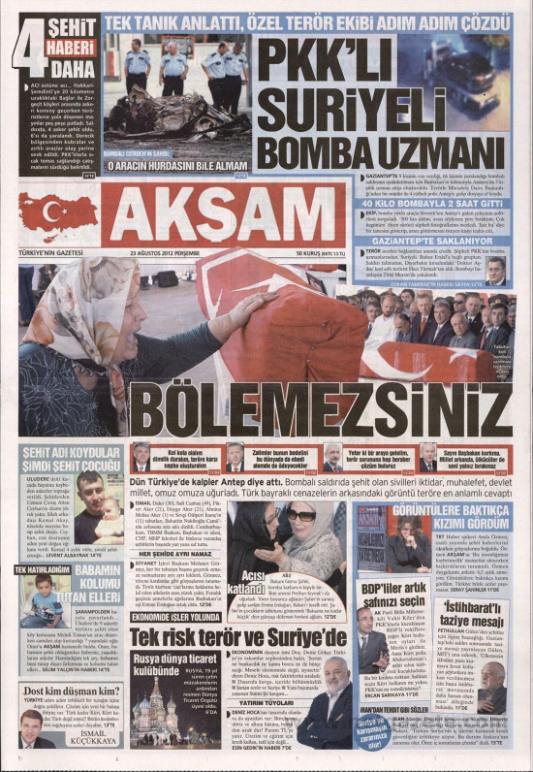
Daily Akşam: “You cannot divide”
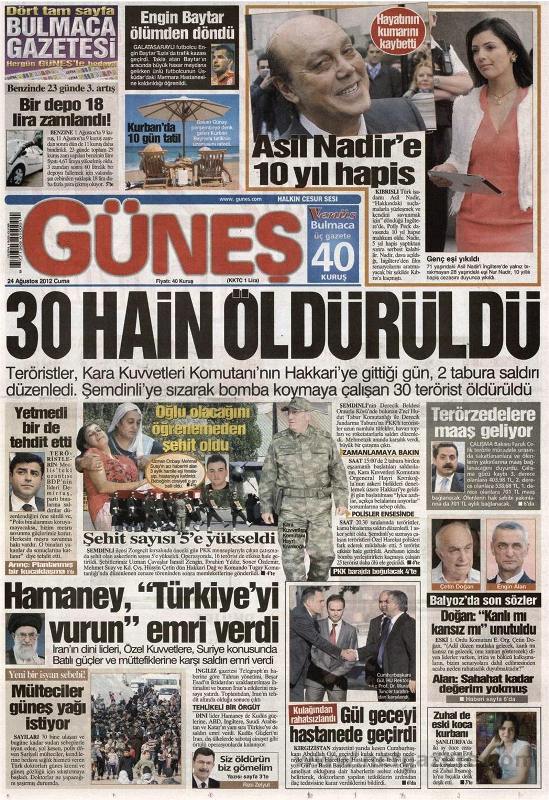
Finally, here is the reassuring front page of tabloid daily Güneş’s Friday edition. The headline referred to counter operations conducted against the PKK by the Turkish military in the southeastern province of Hakkari: “30 Traitors Killed”.


 Turkey Book Talk