(Some) Turkish newspapers report on the AKP Congress
October 2, 2012
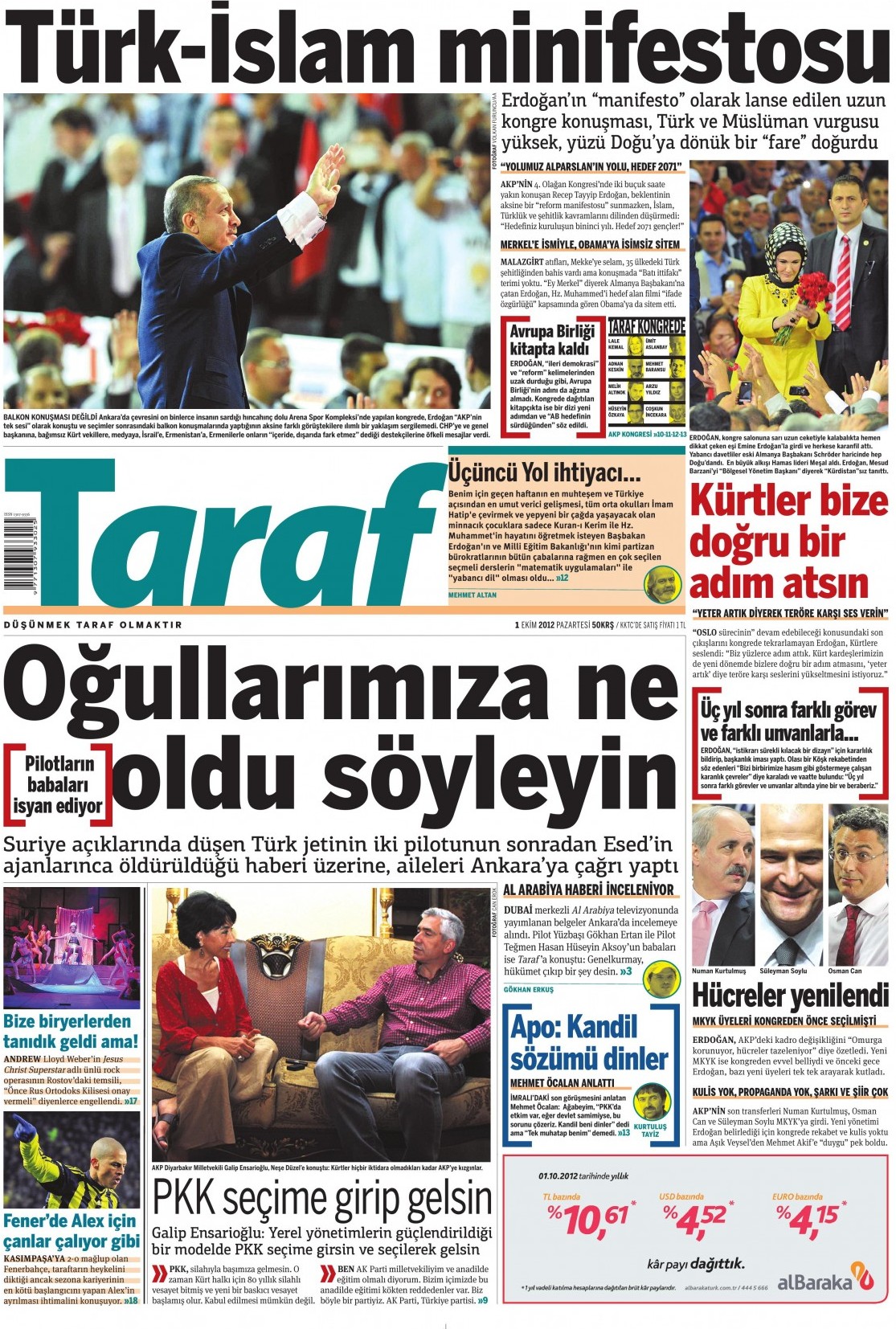
The ruling Justice and Development Party (AKP) held its key congress on Sunday (Sept. 30), the slogan of which was “Büyük Millet, Büyük Güç, Hedef 2023” (Great Nation, Great Strength, Target 2023). Throughout his emotional two-and-a-half hour speech, Prime Minister Recep Tayyip Erdoğan was in full neo-Ottoman mode. He told the 10,000 delegates packed into the Ankara arena that the government was following the same path as Sultan Mehmet II (the conqueror of Constantinople) and Selim I (“The Grim,” who expanded Ottoman territories to the east during the 16th century). He even went so far as to declare – tongue only half in cheek – that the AKP’s new target was 2071, linking the party back to the first Turkish Anatolian state-builders of the 11th century, 2071 being the 1,000th anniversary of Seljuk Turkish leader Alp Arslan’s entry into Anatolia.
It was a speech high in stirring rhetoric. The day after, government supporting newspapers fawned over the “renewal” and “refreshing” emphasis of a new “ustalık” (mastership) era. Daily Sabah focused on what it called the embracing, inclusive nature of Erdoğan’s speech and his words on the Kurdish issue: “Let’s draw a new roadmap together.” Zaman’s front page headline enthusiastically quoted a line from Erdoğan’s speech: “Come, let’s open a new page, let’s say ‘no to terror.’”

The contentious presence of Iraqi Kurdistan Regional leader Massoud Barzani at the congress was rather less trumpeted by Sabah and Zaman. He even gave a speech to the delegates, but the announcer in the arena refrained from using the word “Kurdistan” when introducing him. Indeed, rather than Barzani, it was Erdoğan’s words on the Kurds that received most attention in the pro-government press. This reminded me of one of Nuray Mert’s recent columns in the Hürriyet Daily News:
“The idea of the Ottoman Empire has induced a nostalgic longing for the days when Turkish sultans ruled diverse people in vast lands. For Ottomanists, the idea of the Ottoman Empire as a multi-ethnic haven for diverse cultures and populations is rather misleading, since the basic idea has always been to recall the times when diverse populations lived under ‘Turkish rule.’”
The conspicuously Islamic nature of the congress was also much discussed in the Turkish press – both by those approving and those dissenting. Beside its headline declaring “Great Strength Manifesto,” Islamist daily Yeni Şafak featured an admiring front page box quoting Hamas leader Khaled Meshaal, controversially (or perhaps not) invited to speak at the event: “‘You are not just the leader of Turkey, but also the leader of the Islamic world,’ Meshaal said, receiving extended applause from the crowd.” Indeed, when announced to the audience Mashaal received some of the loudest cheers of the day, (the EU dignitary who was introduced after him didn’t stand a chance!)
Liberal daily Taraf agreed that the congress constituted a Turkish-Islamic “minifesto,” but struck a rather more sceptical tone: “There was a strong Turkish and Muslim emphasis, a mouse with its face turned to the East was born,” (in Turkish, “a mouse was born” means that something underwhelming took place). The paper also noted plaintively that Erdoğan had failed to mention the European Union even once during his speech.
Meanwhile, seven national newspapers were refused accreditation to attend: Cumhuriyet, Sözcü, Evrensel, Birgün, Aydınlık, Yeniçağ, and Özgür Gündem. These publications have diverse sympathies: from left to right wing, from Turkish to Kurdish nationalism. The only thing shared by all is antipathy towards the government.
In response, Monday’s Cumhuriyet included a front page editorial titled “From Cumhuriyet to Public Opinion,” which said some unsurprisingly harsh things:
“Established six months after the founding of the Turkish Republic, our newspaper has been published for 88 years. During periods in the past when democracy has been suspended by the ruling powers our newspaper has been closed down, but outside of this we have always published under the principles of freedom of the press, in the name of people’s right to know. In 21st century Turkey, our newspaper is now exposed to censorship by the ruling powers.
“We will not stay quiet in the face of the anti-democratic implementations applied against us that violate both the constitution and the law.”
The piece went on to detail two constitutional and legal articles that it alleges the congress ban violated: Article no. 69 of the Turkish constitution, which states that internal political party activities, arrangements, and workings must not run counter to the principles of democracy; and Article no. 93 of the Law on Political Parties, which states that decisions taken and actions performed by party central administrations and affiliated groups must not run counter to the principles of democracy.
The International Press Institute’s Turkish National Committee issued a statement about the issue on the day of the AKP Congress, on behalf of the Freedom for Journalists Platform, an umbrella group representing local and national media organisations in Turkey:
“The news that reporters and journalists from some press organs are not allowed to enter the AK Party’s Congress is very worrying.
“Monitoring this historical event of the ruling government party on the spot and transferring it to its readers and viewers are primary duties of news media.
“We have previously protested the accreditation limitations at other institutions. But now, it is very disappointing that the same accreditation is being applied by a political party whose existence depends on democracy.”
Yeni Şafak and ‘the world’s richest Jew’
September 20, 2012
It is not particularly gratifying to scratch around the dregs of the Turkish press, but here’s the latest sludge I have been able to dredge up from the bottom of the barrel.
Islamist daily Yeni Şafak’s front page headline on Monday Sept. 17 focused on the reported recent meeting between Turkish Prime Minister Recep Tayyip Erdoğan and a “famous Jewish businessman.” The businessman, Ronald Lauder, was apparently sent as an intermediary by Israel to try to help restore its broken relations with Turkey. Following the meeting, Yeni Şafak’s headline stated: “The world’s richest Jew was the mediator.”

Perhaps I’ve become desensitized to this kind of thing after reading so many Turkish newspapers, but such casual playing on lazy Jewish stereotypes seems mild now that I write it down. Far worse examples can be found elsewhere every day (the front page of my favourite daily Akit recently included a graphic of a serpent sliding through a Star of David alongside that day’s requisite story about Israel). However, what was particularly striking to me about Yeni Şafak’s headline was that it came at a time when much of the Muslim Middle East was in violent uproar against the (similarly squalid) film produced in America, “The Innocence of Muslims.”
You only have to do a quick search on Google or YouTube to easily find thousands of articles and videos insulting Christianity (and Christians), Judaism (and Jews), or Islam (and Muslims). None of it is very nice, but thank God the world’s Jews don’t rise up in violent protests every time an offensive headline or story appears in a Turkish or Arabic newspaper.
Press freedom in Turkey and Sözcü newspaper
September 7, 2012
I’ve been meaning to write something about press freedom in Turkey with reference to daily newspaper Sözcü for quite a while. Then, a couple of days ago, I caught sight of the back page of the paper’s Sept. 4 edition and, like a gift, my primary material was there waiting for me.
The page carried the headline “Turkey’s daily sunshade,” and sarcastically described itself in the top corner as “the kind of journalism that Tayyip wants.” This was in reference to Prime Minister Recep Tayyip Erdoğan’s recent request for the Turkish media “not to exaggerate terror incidents.” The mock stories written underneath therefore contained nothing but praise for the Justice and Development Party (AKP) government and all its wonderful achievements. One was about how the monster of inflation had been miraculously defeated, another was about how Istanbul’s chronic traffic problem had been eradicated (by the way, I can tell you from bitter experience that it hasn’t), another featured a mother who had happily heeded Erdoğan’s advice that all women should give birth to “at least three children,” another described how Syrian refugees had started naming their new born babies “Tayyip” in honour of the heroic Turkish PM.

In fact, the page was relatively mild compared to the populist tub-thumping Sözcü (“spokesman” or “mouthpiece” in English) usually serves up. Its front page typically features some kind of outraged headline about the latest treachery committed by betrayers of the Turkish nation. A short, choleric editorial in the bottom left corner is included every day under the subtle title “Tokmak” (“hammer” or “mallet” in English – apt enough), invariably fuming about some latest disgrace and usually pointing the finger directly at the AKP government. The tone does not get much higher throughout the remaining 19 pages. Recently, the paper has been having almost daily seizures about the government’s Syria policy and its backing for the anti-Assad opposition. These are mostly prompted by fears about how such a policy may facilitate some kind of autonomous Kurdish region stretching from northern Syria to northern Iraq, and conceivably into southeastern Turkey – anathema to the kind of nationalist gallery that Sözcü plays to.
As far as circulation figures go, Sözcü has certainly been one of the undeniable success stories in the Turkish newspaper roster over the last couple of years. When it started printing just over five years ago, it sold around 60,000 copies. This figure has risen steadily ever since, and the paper recently announced it had hit national sales figures of 300,000, making it the fifth-highest selling daily newspaper in the country.
With regard to the state of freedom of expression in today’s Turkey, Sözcü is certainly an interesting phenomenon to consider. Surely, in contrast to the many recent suggestions that freedom of expression is under attack in the country, doesn’t the existence of such a paper indicate that the range of perspectives available on Turkish newsstands is healthily broad? Well, not exactly – the condition of the Turkish media has more fundamental problems that must be taken into account.
In its annual Press Freedom Index for 2011, released in January this year, the Paris-based Reporters Sans Frontières (Reporters Without Borders, or RSF) ranked Turkey 148th out of 179 countries worldwide, down from 138th in 2010. This was the fifth year in succession that Turkey had slipped down the RSF rankings. Over 100 Turkish journalists are currently in jail, a figure higher than China. The number of journalists sacked or sued for what they have written, reported, or even drawn, climbs by the month, and many journalists and editors freely admit to practicing self-censorship to avoid trouble.
One of the most significant and much-discussed episodes took place in September 2009, when Doğan Publishing, then the largest media group in Turkey, was hit with over $3.2 billion in fines for tax irregularities by the Turkish treasury (equivalent to more than four fifths of the combined market value of Doğan Holding and Doğan Publishing).The hugely excessive size of the fines seemed to suggest government disapproval of the group’s newspapers’ reporting of an embezzlement scandal at the “Deniz Feneri” Islamic charity in Germany. It was the biggest charity corruption case in German history, and Doğan newspapers alleged that billions of dollars raised by the charity had somehow found their way into AKP coffers back in Turkey. After the fines were levied, Doğan’s media outlets significantly toned down their reporting of the scandal, as well as their broader criticism of the government. A number of their anti-AKP columnists were sacked, and many of their newspapers were sold off in order to pay the exorbitant fine, which was subsequently lessened after appeal.
There are numerous other examples of similarly shady processes being undertaken by the government. Their effectiveness can perhaps be attributed to one of the more fundamental flaws in the country’s media landscape. As Svante E. Cornell wrote in Turkey Analyst back in January 2010, this is the fact that the Turkish media is overly dominated by large holding companies:
“As a result, major newspapers and television channels are owned by firms with broad and substantial economic interests. For many, winning government tenders is a chief objective. This means that owners of media outlets seldom see these as their main preoccupation, but often as assets they can use for leverage – either by using their assets to pressure incumbents to win favors – or by appeasing the powers that be.”
Those organs wishing to maintain good business relations with the government must toe the line. However, there are still many who simply don’t care about such things, and Sözcü is perhaps the most prominent print example of that today. The case of Emin Çolaşan is a neat symbolic example to consider here. Çolaşan used to write for daily Hürriyet – part of the Doğan media empire – before he was fired in 2007 after 22 years’ service. His sacking was believed to be because of his fierce criticism of the AKP government. Within weeks of leaving Hürriyet, Çolaşan was picked up by Sözcü, where he now writes a reliably bellicose daily column. Evidently, Sözcü doesn’t have quite the same concerns about offending the AKP government that Hürriyet now has.
Still, there is far more to a free and healthy press than simply having a few columnists in certain newspapers feeling free to throw as many tantrums about the government as they want. A well-functioning Fourth Estate should, through rigorous investigative reporting, effectively hold whatever government is in power to account. Unfortunately, there is precious little evidence of this in Turkey’s press landscape. In an excellent piece on “The Deteriorating State of Media Freedom in Turkey,” again in Turkey Analyst, Gareth Jenkins has described this parlous situation thus:
“Unlike in many other countries, Turkish newspapers are dominated not by reporters but by columnists. With a few notable exceptions, journalistic standards in Turkey have always been very low. Little attempt is made to substantiate news reports, with the result that rumor and gossip are often given equal status to undeniable facts … The situation is arguably even worse amongst the columnists, most of whom merely react to something they have heard or read elsewhere in the media without trying to investigate or assess its veracity. The result is that most columnists generate more sound than sense, using invective rather than reasoning to make their voices heard.
… Nor does Turkey have a tradition of investigative journalism. What passes for investigative journalism – and which today mostly appears in book form rather than in newspapers or on television – tends to consist of a compendium of reports and rumors selected to support the author’s preconceptions; and is riddled with the same lack of substantiation that characterizes newspaper and television news reports.”
Sözcü, perhaps unsurprisingly, exemplifies suchshallow prioritizing of reactive opinion over genuinely thoughtful, reflective, investigative writing. Over 50 percent of its “news” pages are filled with belligerent opinion columns from the paper’s popular commentators.
Some might take the overwhelming predominance of highly critical “rent-a-mouths” in almost all Turkish newspapers as proof of the Turkish media’s bustling vitality. However, while Sözcü may get away with its fierce daily anti-AKP invective, that’s a million miles away from contributing to a genuinely effective Fourth Estate. Ultimately, the latter’s development is of critical importance to the future direction of Turkish democracy.
Turkish dailies on the Gaziantep terror attack funerals
August 25, 2012
I came back to Istanbul this week, after spending three weeks at home in the UK. On my return I was greeted by airport newsstands full of papers with headlines focusing on the funerals of the nine “martyrs” killed in the recent terror attacks in the southern Turkish city of Gaziantep. Of course, I kept vaguely up-to-date with events while I was away, but the contrast between Turkey – currently in one of those periodic bouts of nationalist hysteria that always follow clashes with the Kurdistan Workers’ Party (PKK) – and Britain – which is still basking in the fuzzy, generous, inclusive afterglow of the London Olympics – was nevertheless striking.
Although there are serious doubts as to whether the PKK was actually responsible for this latest attack, the Turkish press did not hesitate in reverting to predictable form. For a flavour of the current mood, here is a selection of newspaper front pages from Thursday (Aug. 23), focusing on the previous day’s funerals.

Like many others, nationalist daily Sözcü showed a photo from one of the funerals, with a coffin wrapped in the Turkish flag in the foreground. The funeral was attended by various state heavyweights, including the leaders of all three main political parties, all of whom were shown in mourning in front of the coffin. Above this, a larger picture showed the face of one-year-old Almina Melisa, whose mother and father were both killed in the Gaziantep bomb. Addressing the political figures in the picture below, the headline challenged: “Almina, will she forgive you?”

Islamist daily Yeni Şafak’s main photo also showed the same funeral. The headline above read: “70 million people on the same side”.
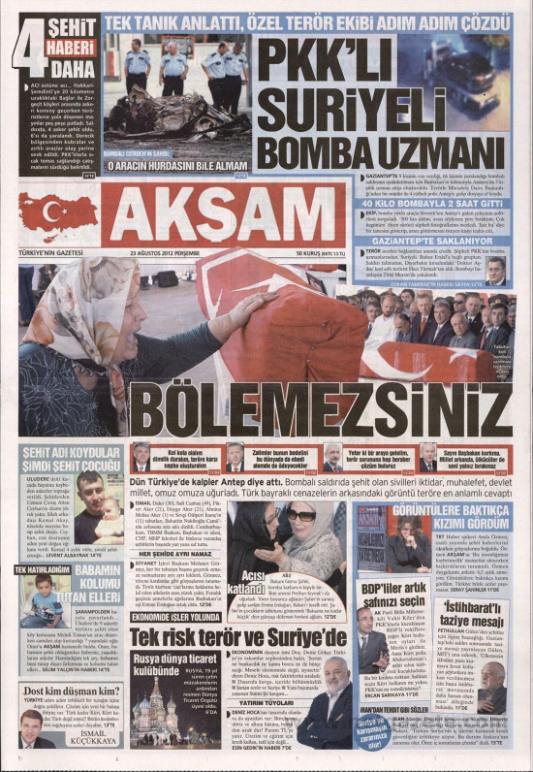
Daily Akşam: “You cannot divide”
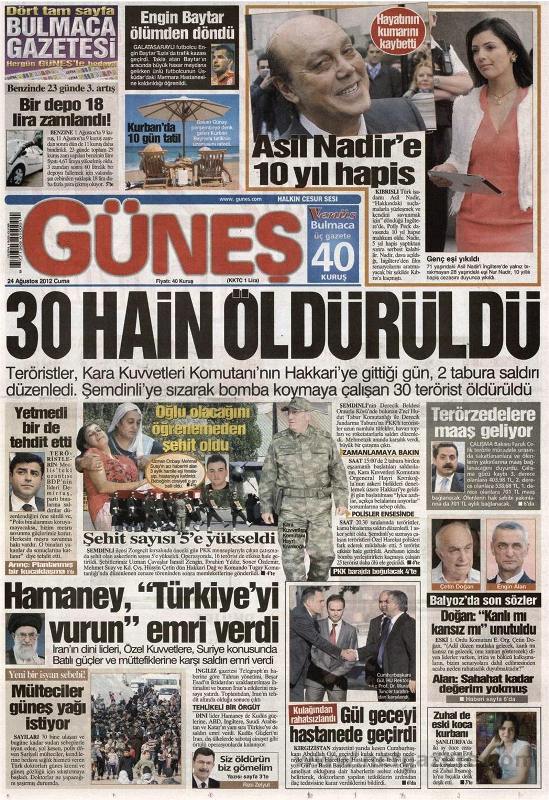
Finally, here is the reassuring front page of tabloid daily Güneş’s Friday edition. The headline referred to counter operations conducted against the PKK by the Turkish military in the southeastern province of Hakkari: “30 Traitors Killed”.


 Turkey Book Talk