Rift with Gülen movement exposes rise of ‘Erdoğanist’ media
December 16, 2013
The spat between Prime Minister Recep Tayyip Erdoğan and the movement of Islamic preacher Fethullah Gülen has seen tension between erstwhile allies in the Turkish media boil over into open hostility. Among many other things, the public drawing of swords – ostensibly over the closure of private examination schools (dershanes) – has exposed the extent to which PM Erdoğan has successfully built himself a support network of personally loyal media outlets. This network was already clear to see, but its guns have never before been so openly turned on the Gülenists.
Of particular note is the staunchly pro-Erdoğan line taken these days by daily Akşam, which was among the assets seized from Çukurova Holding by the state-run Savings Deposit and Insurance Fund (TMSF) over debt issues in May. After the seizing of Akşam, former editor-in-chief İsmail Küçükkaya was fired and the TMSF appointed a former Justice and Development Party (AKP) deputy in his place, while major changes were also made to the paper’s wider editorial team. Its previously centrist tone changed immediately, and Akşam became one of the most reliable supporters of the government throughout the summer’s Gezi Park protests. After the prep school polemic exploded, Akşam again rallied behind Erdoğan, taking its place alongside Sabah, Star, Türkiye, Yeni Şafak, Yeni Akit, Takvim, and Habertürk, in the ranks of pro-government newspapers launching unprecedented attacks on the Gülen movement. As with the others, this is clear simply from the number of front page headlines repeating whatever belligerent words the prime minister said on the subject on the previous day.

Echoing Erdoğan: “No step back from dershane reform”
Although the new editorial board shifted Akşam’s position months ago, it was actually only sold to businessman Ethem Sancak last month, (along with TV station SkyTürk360, also seized from Çukurova Holding). Sancak once described himself as being “lovesick for the prime minister,” and openly declared that he had “entered the media sector to support Erdoğan.” He previously bought daily Star and news station Kanal TV back in 2006, transforming them into firmly pro-AKP voices before selling them on soon afterwards. Both processes resemble the way that Sabah, one of Turkey’s top-selling newspapers, was sold to the prime minister’s son-in-law in 2007, since when it has taken perhaps the most unswervingly pro-Erdoğan line of all mainstream newspapers. Through such moves, Erdoğan has gradually built up a media base completely loyal to himself, without which he would never have been able to achieve a position of such authority in the country. It has been a conscious effort; the bitter power struggles that have marked Erdoğan’s political career have convinced him of the need for a reliant and disciplined media support network, and the intertwining interests of business and political elites in Turkey allowed this network to be cultivated. This new, rigidly “Erdoğan-ist” media base has been more apparent than ever during the row with the Gülen movement.
The AKP government has sought to take the sting out of the dershane issue, announcing that the “transformation” of prep schools into private schools doesn’t have to be completed until September 2015 (conveniently after the three upcoming elections). The electoral effects of the Erdoğan-Gülen rift are still being speculated on, but it’s clear that although a detente has been declared for now, the knives will be even sharper when they inevitably come out again.
‘Important statements from the prime minister’
November 11, 2013
The title will be familiar to any follower of news in Turkish. Every day, “news” stories consisting of unedited transcripts of words spoken by Prime Minister Recep Tayyip Erdoğan are published online under that headline by the major newspapers. The recent storm over Erdoğan’s opposition to mixed-sex student accommodation was only the latest example showing that Turkey’s entire news agenda is increasingly becoming subject to the whims of his unpredictable tongue. He opens his mouth and whichever subject he has chosen then dictates the national conversation. When the media is so completely dependent on politicians, how can be expected to hold those same politicians to account?
This problem cuts across the internet, the television, and the printed press. It almost feels like an act of rebellion when a TV station chooses not to cut to a live broadcast of any public utterances from “The Master.” I only came to Turkey in 2009, so I can’t say whether this has always been the case, but I suspect that the situation has only deteriorated of late. The fact is that you can’t get much safer than a “news” story simply providing a transcript of words spoken by the prime minister. What’s more, depressingly, I’ve been told that these articles usually get the most “hits” for websites. This fixation on Erdoğan’s every word is not only extremely distorting, but also exacerbates the bizarre cult of personality that has developed around him amongst his supporters.
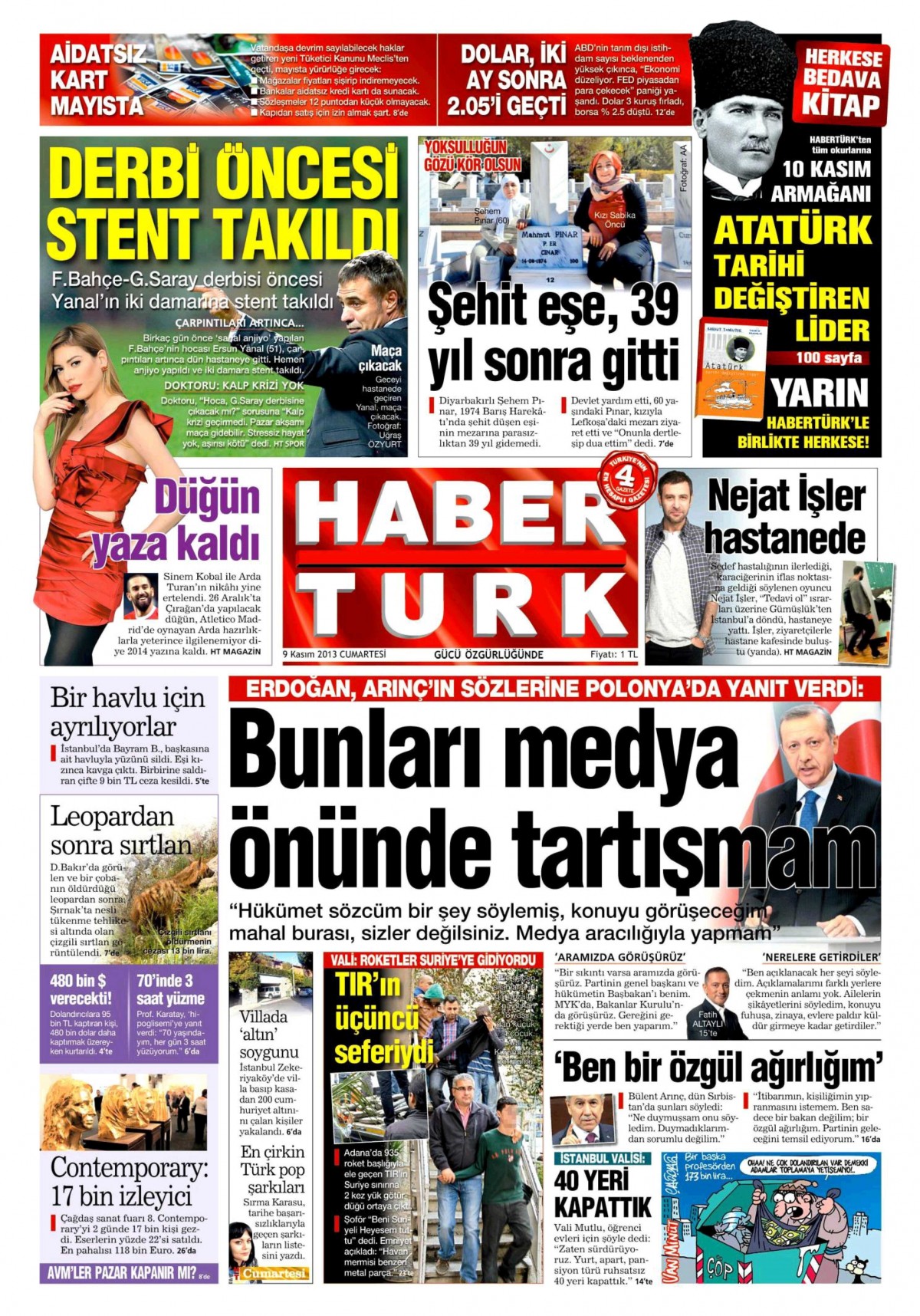
Habertürk parroting the prime minister on Nov. 9. With unintended irony, the headline quotes Erdoğan’s response to Deputy PM Bülent Arınç’s criticism of the mixed-sex student housing debate: ‘I don’t discuss these things in front of the media.’
But while this obsequiousness is lamentable, those official pronouncements in fact are very important. The centralization of decision making is so chronic that Erdoğan’s words, whatever they are, really do have the power to shape the agenda of the country, decide the laws that then get passed, and at what speed. As Adana Governor Hüseyin Avni Coş said shortly after Erdoğan’s utterances on co-ed housing: “We see the prime minister’s words as orders.” Policy is increasingly being shaped on an ad-hoc basis around Erdoğan’s statements; the centralization of power around him now is such that there is a genuine justification for reporters broadcasting and publishing every single thing he says. The vicious cycle is thus reinforced.
That’s why the controversy that is periodically caused by the firing of prominent critical columnists from newspapers often misses the point. Many people’s understanding of news seems to be little deeper than a “who said what?” bish-bash-bosh, responded to by a flood of commentary. As I wrote in my last post, few seem to value deeper investigative reporting, and none ever mention the inherent problem with “stories” consisting of nothing more than an indiscriminate transcript of a minister’s speech. Editors who are encouraging “Important statements from the prime minister” articles are contributing to this dangerous imbalance. Far from the media being a check on power, PM Erdoğan’s tongue is the driving force behind the media.
Commentary vs. Reporting
October 10, 2013
I’ve been meaning to post about the imbalance between undervalued journalists and overvalued commentators in the Turkish media landscape for a while. The aftermath of the Gezi Park protests saw an unprecedented purging of critical columnists from various newspapers, but such bloodspilling tends to receive attention only when it is a recognisable, big name figure who has been fired. Although it’s less discussed, intense pressure is also being exerted on the few embattled investigative reporters working these days, and in the long run this pressure may prove even more damaging to the country’s fourth estate than the silencing of some columnists.
A recent controversy involving daily Radikal reporter İsmail Saymaz illustrated this pressure with particular clarity. Saymaz had written a series of pieces in the aftermath of the killing of Gezi protester Ali İsmail Korkmaz in the Central Anatolian city of Eskişehir, about which he received an extraordinary email from the provincial governor in the early hours of Oct. 2. In the email, Governor Azim Tuna demanded that the “dishonourable” Saymaz stop his “vile and inglorious” reporting, adding that he “shouldn’t forget the underground” (after death), where they would both meet each other in the end.
Usually, pressure from the authorities doesn’t come so openly. Saymaz has done some excellent work in Radikal, but for him – like most others – there are plenty of untouchable subjects. He himself learnt that back in 2010, when he was charged with “interfering in the judicial process” over stories he had written on the notorious arrest of Erzincan’s chief prosecutor, İlhan Cihaner, an arrest that was widely seen as part of the government’s moves to combat the “deep state.” Shortly before being charged, Saymaz had published a book about the Gülen movement’s involvement in the prosecution of the Ergenekon coup plot case, and ended up facing charges that could have lead to 45 years in jail. Such cases seem to have had the desired effect; the major news organisations’ reporting of issues such as Ergenekon, official corruption, and the Gülen movement, has become increasingly tame, if not non-existent. As Saymaz himself has said, “We, as reporters, both censor our minds and bite our tongues while we are reporting.” Without a rigorous media doing its bit to hold the authorities to account, can it be surprising when the government behaves with such impunity?
The lack of corruption exposure in the Turkish media was also recently indicated after Milliyet published an interview with Ateş Ünal Erzen, the opposition Republican People’s Party’s (CHP) mayor for the Istanbul district of Bakırköy. In the interview, Erzen indirectly admitted to systematic corruption in his municipality, which caused a tiny stir before dropping off the agenda completely. The fact that the revelation effectively came as a result of a slip of the tongue, the handwringing that followed it, and the lack of any deeper subsequent investigation, all point to the Turkish media’s ineffectiveness when it comes to investigating corruption. It’s probably also worth mentioning again here the much-cited example of Hürriyet halting its reporting on the Deniz Feneri charity embezzlement scandal, after being landed with a multi-billion dollar tax fine in 2009. Through such measures, the investigative potential of journalists at major Turkish news outlets has been steadily hollowed out.
The emphasis on commentary over proper reporting should be considered in this context. Columns are indeed cheap and easy to churn out, but the prioritising of columnists over reporters is not just an economic calculation; opinions are not only cheaper, they are also less dangerous than deep reporting, less threatening than labour-intensive original journalism. Everyone has an opinion, and almost anyone can write out their views in a few hundred words, (and looking at the standard on offer, almost anyone does). This range of columnists in the Turkish media allows pro-government voices to claim with a straight face that the continued existence of the popular and rabidly anti-AKP commentary-heavy Sözcü, for example, is proof of the healthy variety of journalism on offer. Not only does this argument ignore the countless cases of sackings and news manipulation based on direct pressure from the authorities, but it also fails to address the crippling government-imposed handicaps on serious investigative journalism.
Of course, (here’s the usual disclaimer), it’s important not to look back on an imagined halcyon age of journalism in Turkey. Things have often been much worse: Jenny White recently described a visit to the offices of Milliyet in the 1990s, when she found that the paper was surviving on a grant from the state, which was handing “black lists” to the paper’s owners about who should be fired and promoted from the editorial staff. But while it’s true that things have never been perfect, it’s alarming to see the heavy hand of the amorphous deep state simply replaced by a similarly overbearing civilian authority.
Concerns about the health of the Turkish media are well-justified, but many expressions of this concern fail to appreciate that infringements on press freedom don’t just involve restrictions on what ten-a-penny columnists can write about. Equally damaging, if not more so, are restrictions on what can be reported, and the depth to which journalists can probe sensitive issues. The cacophony of news commentary in Turkey, while indicative of a vibrant and energetic society, does not in itself make for a healthy fourth estate.
‘Dear Prime Minister Erdoğan’: CPJ delivers fresh media freedom letter to government
September 18, 2013
On Sept. 17, the Committee to Protect Journalists (CPJ) hand delivered its latest letter to Turkey’s Ministry of Justice, expressing the group’s deep concern over the “continued press freedom crisis in Turkey.”
The CPJ had previously published a long and detailed special report on media freedom in Turkey in October 2012, and this latest letter, addressed to Prime Minister Recep Tayyip Erdoğan, explains how the difficulties described in that report remain unresolved. It also discusses the increasingly oppressive environment in the aftermath of the summer’s anti-government Gezi Park protests, paying particular attention to the fact that open threats from officials have become worryingly commonplace, which “emboldens zealous prosecutors to go after critics.”
The letter doesn’t much dwell on the issue of ownership and conflict of interest – by no means the be all and end all, but certainly a crucial issue that must be addressed if improvements are to be made. Other than that, it makes for a good primer on the biggest challenges to freedom across all media in today’s Turkey: imprisoned journalists and associated legal irregularities, the inappropriate use of anti-terrorism laws, censorship and self-censorship, gag orders on sensitive issues, and the threats being issued by government figures with increasing brazenness. Below are some of the most salient points made in the CPJ’s letter:
“While the restrictive laws and prosecutions are central to the media crisis in Turkey, so too is the atmosphere fostered at the top levels of government. When top officials use the term ‘terrorists’ to describe critical journalists they send a disturbing message that could cause others to take action …
“With traditional media under pressure, the Internet, including social media, has become an important outlet for free expression in Turkey. But recent official comments, including threats to restrict the online flow of information, cause concern …
“Time and again, history has proven that, at times of unrest, a well-informed society has a better capacity to restore and heal itself. The government of Turkey ought to encourage a vibrant debate, a diversity of opinions, and independent reporting on news events crucial to the public …
“In mid-June, with tensions running high, you publicly accused the international media of biased coverage of the Gezi Park events, singling out CNN International, the BBC, and Reuters. Before a supporters’ rally, you said the foreign media ‘fabricated news,’ The New York Times reported. ‘You portrayed Turkey differently to the world,’ you reportedly said, referring to international media. ‘You are left alone with your lies.’ We find your suggestion that international coverage was part of a plot to subvert your government highly disturbing.
“In late June, Ankara Mayor Melih Gökçek launched a spurious and inflammatory campaign on Twitter against local BBC reporter Selin Girit, labeling her a traitor and a spy in apparent disagreement with the BBC’s coverage of the protests.
“Gökçek created a critical hashtag ‘#ingiltereadınaajanlıkyapmaselingirit,’ which in English means ‘Don’t be a spy in the name of England, Selin Girit’ and urged his followers to popularize it on Twitter. Girit received ‘a large number of threatening messages’ in response to the mayor’s actions, the BBC said in a statement.
“CPJ is also alarmed by reports of numerous firings and forced resignations of critical columnists, editors, and reporters, and in apparent retaliation for their coverage of the Gezi Park protests. According to our colleagues at the Turkish Union of Journalists, an independent media association that documents attacks on the press, at least 22 journalists were fired and another 37 were forced to quit their jobs over their coverage of the anti-government protests. As a result of direct or indirect government pressure, media owners have dismissed many popular journalists and the absence of their voices has been conspicuous.”
The letter can be read in full here.
Growing anti-Iranianism in the pro-AKP media
July 8, 2013
Not so many years ago, a strategic partnership between Turkey and Iran seemed to be developing into one of the region’s more unexpected modern developments. Turkey was vaunted as a mediator in negotiations between the West and Iran over the latter’s nuclear program, and the relationship was reinforced by crucial oil and gas sales from Iran to Turkey. Those days feel rather long ago. The two countries now find themselves at loggerheads backing opposite sides of the bloody civil war in neighboring Syria, with fears of a regional sectarian conflagration steadily turning into an apocalyptic reality. A marker of the Syrian crisis’ deleterious effect on the Turkey-Iran relationship came with the diplomatic spat that followed the deployment of NATO Patriot missiles on Turkey’s southern border earlier this year, which lead the Iranian army’s chief of staff to declare that the move could be a prelude to “world war.” Less spectacular, but also very important, is Iran’s clear unease with Turkey’s delicate ongoing peace process with the Kurdistan Workers’ Party (PKK), which involves the rebel group withdrawing its militants from Turkish soil to their bases in northern Iraq. Tehran is concerned that the withdrawal could result in the militants joining forces with the Party of Free Life of Kurdistan (PJAK), which is the PKK’s offshoot in Iran.
The schism between Turkey and Iran widened to such an extent that Patrick Cockburn recently described relations between the two as “poisonous,” and this is increasingly being reflected in the rising levels of anti-Iran sentiment in Turkey’s Islamist press. In addition to countless pieces targeting Iran for supporting the al-Assad regime in Syria , it has also been striking to see the AKP media include Iranians among the dark “outside forces” stoking the recent Gezi Park protests, supposedly out of discomfort with Turkey’s economic success. In the early days of the demonstrations, it was eagerly reported in all government-supporting media outlets that an “Iranian agent” had been arrested on suspicion of being a “provocateur” behind protests in Ankara. It later emerged in more sceptical news organisations that the individual concerned, Shayan Shamloo, was in fact a rapper who was living in Turkey as a refugee.
Soon afterwards – in one of those truly befuddling Today’s Zaman stories – Abdullah Bozkurt wrote a column titled “Iran plays a subversive role in Turkey,” in which he argued with a straight face (pardon the pun) that Iran was using the protests to infiltrate Turkey with spies disguised as LGBT people in an attempt to bring down the government:
“Recent protests exposed, among other things, the depth of Iranian infiltration into Turkey … [During the protests] about a dozen Iranian agents who were trying to turn rallies into violent anti-government demonstrations were caught by the police… Since it is difficult to distinguish legitimate non-Muslim minority or LGBT (lesbian, gay, bisexual and transgender) people from spies, Iranian intelligence often uses them as a cover to infiltrate Turkey and third countries.”
However weird, Bozkurt’s column wasn’t an outlier in pointing the finger at Iran for Turkey’s problems. Indeed, Zaman and Today’s Zaman have recently been publishing a steady stream of articles and columns critical of negative Iranian influence in the region, and it’s probably also worth noting here that the Today’s Zaman editor, Bülent Keneş, wrote a book on Iran’s links to international terrorism last year.
Much of the Iran-bashing in the Turkish press goes hand in hand with pieces on Turkey’s Alevi minority. The Alevis are an offshoot of Shiism, (distinct from the Alawites in Syria), and have historically been associated by some in Turkey as dangerous fifth columnists with divided loyalties to Iran. Indeed, that association goes back as far as Bosphorus bridge-commemorated Sultan Selim the Grim, whose decision to kill tens of thousands of Alevis was taken during a military campaign against the Persian Safavid Empire in the 16th century.
Some of the most enthusiastic and unpleasant examples negatively associating Alevis with Iran come from the extreme Islamist daily Yeni Akit. For two consecutive days in June, for example, Yeni Akit carried front page headline stories claiming that Iranian authorities had invited Alevi religious leaders across the border to visit Ayatollah Khamenei in an attempt to foment sectarian war in Turkey. The headline of the first day’s story, “Iran is playing with fire” (İran, ateşle oynuyor), was a stomach-turning play on the Turkish term for “flame” (ateş), in reference the fire often used in Alevi rituals. Of course, it should be stressed that Yeni Akit is far from representative of majority sentiment in Turkey, but it probably isn’t quite as marginal as most people like to think. In fact, a few months ago Erdoğan even put two of its writers – including editor-in-chief Hasan Karakaya – on his “Wise Men Commission,” charged with the august task of repeating whatever he said about the ongoing Kurdish peace process.
It all adds up to a worrying picture. With the Syrian crisis having exploded into a wider geopolitical struggle splitting the region on sectarian lines, it’s increasingly clear that the growing schism between majority-Sunni Turkey and majority-Shia Iran is more than just a temporary trend.
‘Gezi Park protests fuelled by foreign media’
June 13, 2013
One of the saddest aspects of the Turkish government’s response to the Gezi Park protests has been its line that the demonstrations are all a part of a “foreign plot” to bring down Turkey. As with everything else, Prime Minister Recep Tayyip Erdoğan fired the starting pistol, singling out the phantom international “interest rate lobby” as being behind the unrest. Since then, leading government figures have been falling over themselves to slander the protests as part of a “foreign conspiracy” by forces “jealous of Turkey’s economic success.” Economy Minister Zafer Çağlayan said “foreign circles” were trying to “undermine the country’s progress” through the protests: “This is totally an attempt to create a foreign hegemony on Turkey, but we are no fools.” EU Minister Egemen Bağış stated: “It is interesting to have such incidents in Turkey when … economic and development figures are at their best levels. The interest rate lobby and several financial institutions are disturbed by the growth and development of Turkey.” Foreign Minister Ahmet Davutoğlu said a deliberate propaganda operation was being conducted by the international media to tarnish Turkey’s image. Delusional? Yes. Seductive for a sizable portion of the Turkish electorate? Undoubtedly.
Overturning every stone only to find a nefarious foreign plot hidden underneath is one of Turkey’s less attractive national pastimes. Considering the past 200 years of the country’s history, it’s understandable, if not excusable. The current government was supposed to have broken with this paradigm. It had opened the country out to its region – both Europe and the Middle East – and was open-minded about doing business abroad and attracting investment for domestic infrastructure projects. The old embattled Turkish borders seemed to be opening to the world. However, the government’s reaction to the Gezi protests has laid bare all its latent insecurity and resentment, which has been most clear in the verbal attacks on the international coverage of the events. While mainstream domestic media has been brought (almost) completely under the thumb of the authorities, one gets the impression that the AKP’s open anger at the international media is now a kind of reflex action, indicating its frustrated inability to control what is being reported. The BBC must have been exaggerating the scale of the protests, as it wasn’t showing a penguin documentary.
Pro-government news outlets have been keen to assist in framing this paranoid narrative. While it was certainly no secret before, the Gezi protests have exposed the full extent of AKP control over the state news agency, Anadolu Ajansı, which has carried some utterly ridiculous The Onion-like headlines about foreign plots and jealous foreign powers. Pro-government newspapers have also loyally joined in, here’s daily Sabah applauding the aforementioned Anatolia for “sending a missile” to Reuters and CNN, by tweeting that 3G services had been cut in London, preventing them from broadcasting coverage of the police operation on the anti-G8 protests. Which to believe: Reuters or Anadolu Ajansı?
I also feel that this embattled sense is probably compounded by the shock of having international media ask genuinely tough questions of Turkish government representatives. Not only does this surprise AKP figures conditioned to having it easy with domestic journalists, but it also reinforces the sense among many government supporters that the international media is now “out to get” it (and, by extension, bring Turkey down). CNN International’s Christiane Amanpour was criticised by many pro-government Turks, (and praised by many protesters), simply for asking (not unusually) tough questions of Erdoğan’s advisor İbrahim Kalın. In fact, she did nothing out of the ordinary, but it must have been striking for anyone accustomed to toothless “interviews” such as the one conducted by Fatih Altaylı with Erdoğan on June 2.
Still, although they may make no logical sense, countering conspiracy theories with rational facts is a fool’s errand. David Aaronovitch wrote in a recent book on the subject that conspiracists tend to be on the “losing side” and conspiracy theories are mostly an expression of their insecurity; it’s therefore both strange and sad that rumours of “foreign plots” behind Turkey’s protests are being spread by a government that won 50% in the last election.
Whither Turkey’s fourth estate?
May 1, 2013
Once again, Prime Minister Recep Tayyip Erdoğan managed to single-handedly dictate Turkey’s agenda, this time with comments made last weekend suggesting that ayran, rather than the alcoholic rakı, should be considered Turkey’s “national drink.” It was only the latest in the long list of examples demonstrating the same unfortunate point, which has become increasingly obvious throughout the current peace negotiations. Another little-mentioned illustration of the government’s authority over the media came early last month, when Erdoğan was asked at a press conference to comment on the sentencing of Fazıl Say, a day after the famous pianist was handed a 10-month jail term for tweeting anti-Islamic Omar Khayyam couplets. He simply brushed off the question, responding: “Do not occupy our time with such matters.” With hardly a voice of protest from those reporting the event, the prime minister was thus able to completely avoid answering a question on an awkward issue, despite the fact that it had grabbed headlines in both the domestic and international media. The episode chillingly highlighted not only the complacent mentality of the ruling authorities in Turkey, but also the necessary obsequiousness of the reporters attending the press conference. As fellow Turkey-watcher Aaron Stein has tweeted, Erdoğan “is the sun around which the Turkish media rotates.”
In a column written last December, the late Mehmet Ali Birand admonished his colleagues for asking genuflectory questions to elected officials. The examples he gave were as follows:
“Esteemed Prime Minister, you have an extremely correct Middle East policy. Are you going to take new steps in the next term?
“Esteemed Prime Minister, I also believe that the presidential system will solve Turkey’s problems. I know you also want this. Do you know why the opposition opposes it?
“You want to change the structure of the U.N. It’s true that the U.N. has a very anti-democratic structure. The vetoes of the five countries should be overcome. Do European leaders support you in this democratic demand of yours?”
As Birand went on to write, “Questions of this tone do not suit journalism. You are journalists. You do not need to butter up the PM. Your duty is to ask questions impartially and without losing your manners. Please don’t forget this.” Unfortunately, with a high-profile newspaper firing seeming to come every other week in Turkey, it’s hardly surprising that Birand’s words seem to have gone on deaf ears.

PM Erdoğan cuts a ‘Journalists’ Day’ cake with Turkish reporters aboard his official jet in January. (Photo credit: Anadolu Ajansı)
The situation in Turkey is worth comparing to the one prevailing these days in the U.K. Erdoğan’s casual batting away of the Fazıl Say question immediately contrasted in my mind with a now-infamous interview with London Mayor Boris Johnson that aired on BBC television last month. The interview coincided with the broadcast of an admiring Sunday evening documentary focusing on Johnson, but interviewer Eddie Mair pulled no punches, relentlessly posing uncomfortable questions about the London mayor’s integrity and previous professional misdemeanors. The exchange ended with Mair calling Johnson a “nasty piece of work,” while the latter simply squirmed in his seat opposite and offered barely a word of protest. He seemed to implicitly agree that this is what interviewers are there to do.
Viewed from Turkey, where reporters at news conferences feel obliged to “go soft” on whichever government figure is presented to them, the U.K.’s no-nonsense approach naturally seems healthier. But I’m not sure that either is flattered by the comparison. I really don’t want to be witness for the defense for politicians, but I’m suspicious of the pseudo-robust questioning demonstrated by some in the British media whenever an elected official is placed in front of them. There’s a hysterical, arm-waving phoniness about it, something forced and artificial; as if holding power to account is about little more than treating elected officials with barely concealed contempt, asking reductive yes/no questions, and then not waiting for an answer. I’d suggest that this is simply one unhappy symptom of the dangerous cynicism felt by an increasing number of Brits about the entire political process.
Needless to say, a robust and properly-functioning fourth estate is crucial for the health of any democracy. While the situation in the U.K. on this issue is certainly preferable to that in Turkey, it’s fair to say that neither gets the balance exactly right.
‘Insulting the religious beliefs held by a section of society’: Plenty of evidence in Turkish newspapers
April 19, 2013
Handing its 10-month jail sentence to Turkish pianist Fazıl Say on April 15, the Istanbul court stated that Say was guilty of “denigrating the religious beliefs held by a section of society” and had thus violated Article 216 of the Turkish Penal Code (TCK). Although “blasphemy laws” still officially remain in many states, they are now almost completely dormant in most democracies. The rare prosecutions that are attempted based on them almost always fail, either because of sensible legal interpretation or the fact that a guilty verdict would clash with legally enshrined principles of freedom of expression.
Say’s prosecution was based on his retweeting of couplets attributed to medieval Persian poet Omar Khayyam last year, including lines such as: “You say its rivers will flow with wine. Is the Garden of Eden a drinking house? You say you will give two houris to each Muslim. Is the Garden of Eden a whorehouse?” He also posted a personal tweet, stating: “I don’t know whether you have noticed or not, but wherever there is a stupid person or a thief, they are believers in God. Is this a paradox?” However misguided Article 216 may be, there can be little doubt that Say deliberately intended to “denigrate the religious beliefs held by a section of society.” Of course, deliberate insult should never be criminalized, but as it is considered legitimate grounds for prosecution in Turkey it’s worth asking why cases aren’t regularly opened against material published in certain Turkish newspapers. The fact is that there are a number of Turkish dailies with considerable reputations for directing abuse at religious, ethnic, and sexual minorities.
Yeni Akit has a considerable track record of targeting respected journalists for aggressive and persistent smear campaigns, including Cengiz Çandar, Hasan Cemal, Ahmet Altan, and Amberin Zaman. It has even recently been waging a bizarre campaign against the “deviant spirituality” of yoga. Although it and fellow hard-line Islamist newspaper Milli Gazete (affiliated to the minor Felicity Party) have both been fined on numerous occasions for slander and libel, they have never to my knowledge been prosecuted for “insulting a section of society.” That may seem odd after considering the following examples, dredged up on their websites by a simple search of the words “Christian,” “Jew,” “Alevi,” and “homosexual”:
– Milli Gazete’s April 18 front page headline focused on the “scandal” that the EU was “making the Turkish state pay” the costs for lighting non-Muslim places of worship “such as churches and synagogues.”
– On the same front page, it was also disbelievingly reported that New Zealand had become the latest country to legalise gay marriage. The article was headlined, “Your destruction is near,” and was accompanied on the printed page by a picture of two fossilised victims from Pompeii.
– The same paper also carried a headline story in January warning about the dangers of “Zoroastrian missionaries” spreading “terrorist propaganda” in Turkey’s southeast.
– Again Milli Gazete, this time declaring as its Jan. 8 front page: “Here’s the Jewish mind.” The story was about Jewish religious jewellery being sold by a U.S.-based company, which donated some of its profits to the Israeli army.

Milli Gazete, Jan. 8, 2013: ‘Here’s the Jewish mind’
– On the same day that Milli Gazete was warning about “the Jewish mind,” Yeni Akit reported news of an old church in the Black Sea province of Giresun making “Christian propaganda.” Despite the fact that the church had been converted into a library in 2001, the article bemoaned that crosses and Stars of David were still to be found inside the building, “blurring young minds.”
– Yeni Akit on Feb. 3: “Support for perverts from the CHP and BDP,” regarding attempts in January by opposition deputies to reform the law stating that “dirty” and “deviant” homosexuality is legitimate justification for expulsion from the Turkish military.
– Yeni Akit: “The 19 Year Lie,” in which a host of slanderous claims were made about the massacre of over 30 Alevis in the central Anatolian town of Sivas in 1993.
On any given day you can open either Milli Gazete or Yeni Akit and be sure to find similar stories, written in the most unpleasant, insulting language. Should it really be surprising that Article 216 isn’t extended to these cases?
Even if the necessary sections of the Turkish penal code were reformed, they would still undoubtedly be liable to misuse through selective interpretation. However decent a country’s set of laws may be, and however enshrined they are in decent-sounding constitutions, problems generally come from the interpretation of those laws. If Article 216 was always applied as rigorously as it was against Say, then all the above examples would be investigated. In the end, the most important factor behind scandals such as the Say case is the mentality behind them, which is not something that can be transformed by a simple change in legal language.
Yet another international organisation has issued a report on Turkey’s dolorous press freedom record, with Amnesty International this week publishing “Decriminalize dissent: Time to deliver on the right to freedom of expression.”
The particular focus of this latest report is the “fourth package” of judicial reforms that was submitted to the Turkish parliament at the beginning of this month. The package follows a previous set of reforms that went into effect last July, and has been presented by the government as a move to deepen democracy and reduce the number of cases brought against Turkey at the European Court of Human Rights (ECHR). However, Amnesty says the package “fail[s] to make the necessary legislative amendments to bring national law in line with international human rights standards.” That conclusion is based on research including trial observations, the review of hundreds of criminal cases, and “interviews with civil society organizations, lawyers, academics, individuals under prosecution and public officials.”
A familiar charge sheet is presented by Amnesty regarding recent developments, including “the increasingly arbitrary use of anti-terrorism laws to prosecute legitimate activities including political speeches, critical writing, attendance of demonstrations and association with recognised political groups and organizations.”
The report continues:
“Government statements initially indicated that the ‘Fourth judicial package’ would seek to bring prosecutions of expression related offences in line with international human rights standards and the case law of the European Court of Human Rights. However, the draft law, currently before Parliament does not go nearly far enough. It proposes amendments to five offences frequently used in ways that violate the right to freedom of expression. The proposals leave on the statute a number of laws that directly limit the right to freedom of expression that should be repealed entirely. Other offences that threaten the right to freedom of expression through their overly broad wording are not brought into line with international standards on the right to freedom of expression under the current proposals. If passed by Parliament in its present form, the ‘Fourth judicial package’ would represent another missed opportunity to deliver genuine human rights reform.”
Voting on articles in the fourth judicial package is expected to start in parliament next week. The full PDF of the Amnesty report can be accessed here.
‘We made them apologize’: Israel-Turkey rapprochement
March 25, 2013
There was plenty of crowing in Turkish newspapers over the weekend, following Friday’s official U.S.-brokered apology from Benjamin Netanyahu for Israel’s killing of nine Turkish citizens on board the Mavi Marmara in 2010. Below is a flavour of some of the less sophisticated front page reactions available on newsstands March 23.
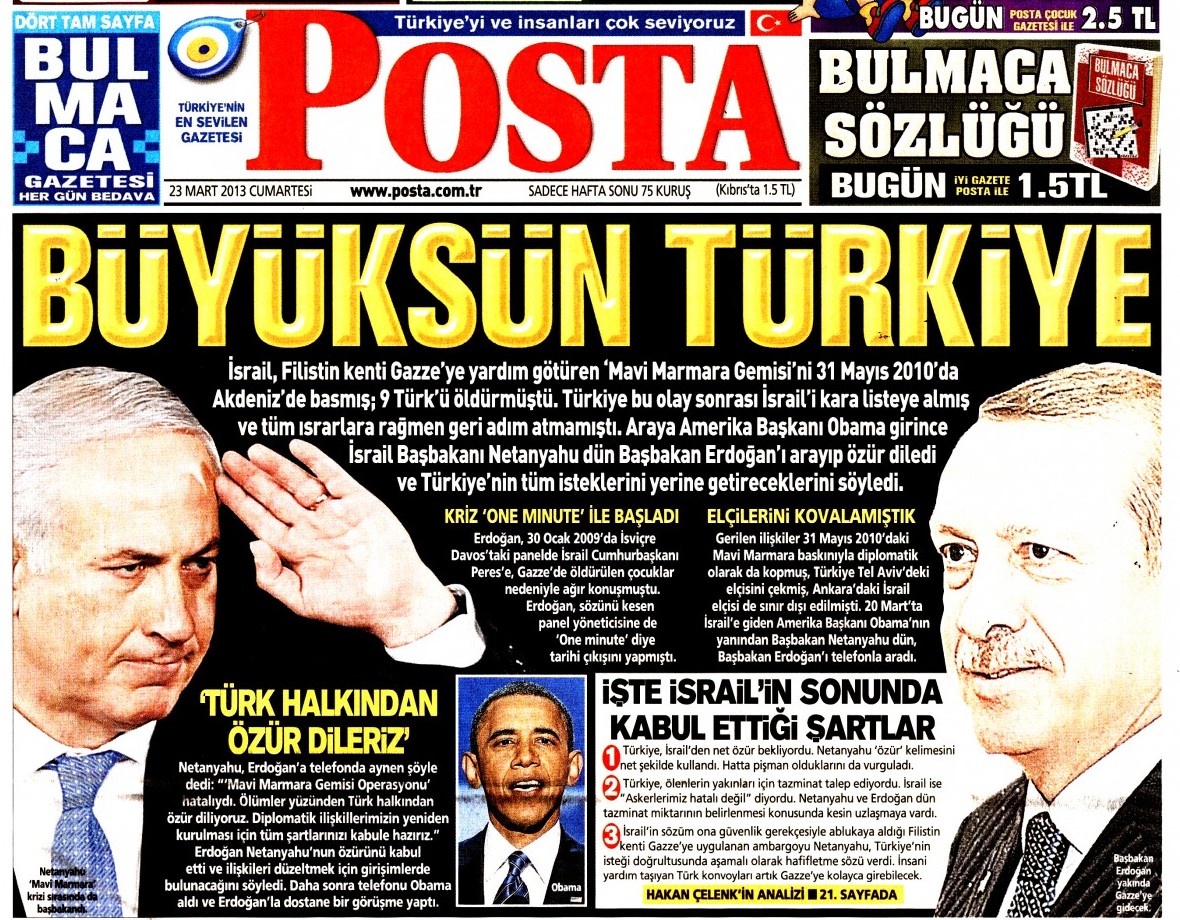
A subtle combination of words and images here from the tabloid Posta. Headline: ‘You are great Turkey’

Yeni Şafak: ‘For the Gaza martyrs: We made them apologize’ (Compare with Star from the same day: ‘He made them apologize’)
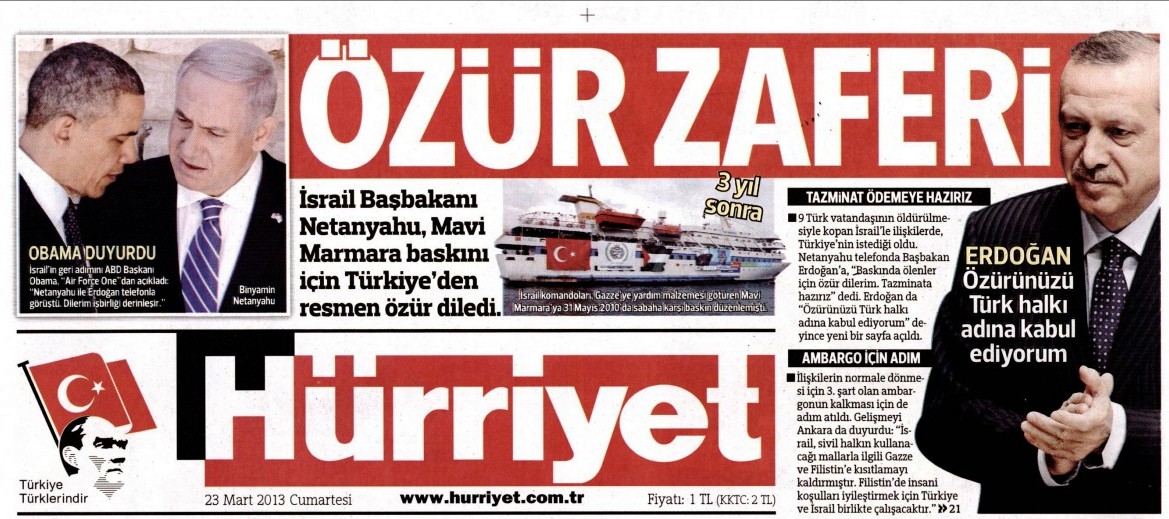
Hürriyet: ‘Apology victory’
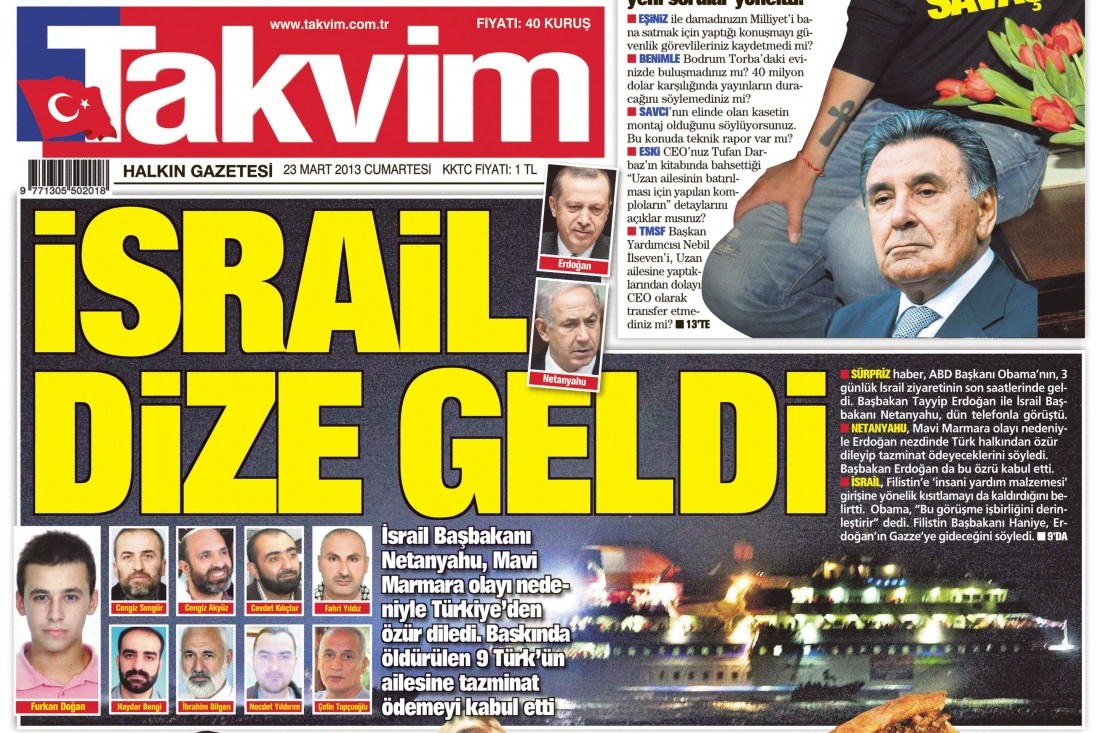
Takvim: ‘Israel came to heel’

And the view from the orthodox left, March 25’s Sol: ‘Kiss, make up, go to war’, referring to Obama’s pressuring of Netanyahu to apologize, assisted by Turkey and Israel’s apparently similar perspectives on the Syrian civil war.


 Turkey Book Talk