Özge Samancı on ‘Dare to Disappoint: Growing up in Turkey’
October 12, 2016
Özge Samancı talks to Turkey Book Talk about her bestselling graphic memoir “Dare to Disappoint: Growing up in Turkey” (Farrar Straux Giroux). It’s a charming book and everyone I know who has read it raves about it.
Download the podcast episode or listen below.
Subscribe to Turkey Book Talk : iTunes / PodBean / Stitcher / Facebook / RSS
Here’s my review of the book from a few months ago.

Many thanks to current supporters Özlem Beyarslan, Steve Bryant, Andrew Cruickshank and Aaron Ataman.
Shadi Hamid on ‘Islamic exceptionalism’
June 4, 2016
Brookings Institution senior fellow Shadi Hamid joins the pod to discuss his new book ‘Islamic Exceptionalism: How the Struggle Over Islam is Reshaping the World’ (St Martins).
Download the episode or listen below:
Subscribe to Turkey Book Talk: iTunes / PodBean / Stitcher / Facebook / RSS
And here’s my review of the book at HDN.

Support the podcast with a per episode donation via Patreon! Many thanks to current supporters Özlem Beyarslan, Steve Bryant and Andrew Cruickshank.
Cihan Tuğal on the fall of the ‘Turkish model’
April 16, 2016
Cihan Tuğal, a sociologist at UC Berkeley, chats about “The Fall of the Turkish Model: How the Arab Uprisings Brought Down Islamic Liberalism” (Verso), charting how Turkey went from a model “Muslim democracy” for the Middle East to an increasingly authoritarian state.
Download the podcast or listen below:
Subscribe: iTunes / PodBean / Stitcher / Facebook / RSS
Here’s my review of the book at Hürriyet Daily News.

Support the Turkey Book Talk podcast via my Patreon account. You can help me keep producing the podcast by making a monetary donation, big or small, on a per episode basis! Many thanks to current supporters Sera Aleksandra Marshall and Andrew Cruickshank.
Şakir Dinçşahin on the life and times of Niyazi Berkes, 1908-1988
February 20, 2016
Here’s my conversation with Şakir Dinçşahin about his book on the life and times of Turkish intellectual Niyazi Berkes.
Download the podcast, or listen below:
You can also now subscribe to the Turkey Book Talk podcast on Stitcher. Alternatively subscribe via iTunes or via PodBean.
Here’s my review of “State and Intellectuals: The Life and Times of Niyazi Berkes” (Rowman) at the Hürriyet Daily News.

If the issues discussed are your thing, check out this interview from last year with Andros Lamprou, who wrote an interesting book on the People’s Houses.
Also worth plugging this piece I wrote a couple of years ago on Mahmut Makal and his book “Bizim Köy” (Our Village), on his experiences as a teacher at a Village Institute in the 1940s.
Ryan Gingeras on ‘Atatürk: Heir to an Empire’
January 23, 2016
This week I spoke to author Ryan Gingeras on his new biography of Turkey’s founding father, “Mustafa Kemal Atatürk: Heir to an Empire” (Oxford University Press).
Or just listen here:
Here’s an edited transcript of the interview.
And here’s my review of the book (which is highly recommended).
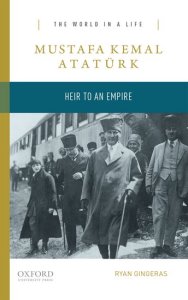
As I mentioned in the podcast, here’s a link to an interview I did with Ryan last year about another of his books, “Heroin, Organized Crime, and the Making of Modern Turkey.”
Subscribe to the Turkish Book Talk Podcast via PodBean, or via iTunes.
I should say that the two things in the title are unrelated.
My interview this week was with Toni Alaranta of the Finnish Institute of International Affairs, discussing his new book “National and State Identity in Turkey: The Transformation of the Republic’s Status in the International System” (Rowman). In the book, Alaranta traces how the entrenchment in power of authoritarian political Islam in Turkey after 2002 was critically aided by the West’s misguided search for a “moderate Muslim democracy” after the end of the Cold War and the 9/11 terror attacks.
Read the interview at the Hürriyet Daily News here.
And read my review of the book here.
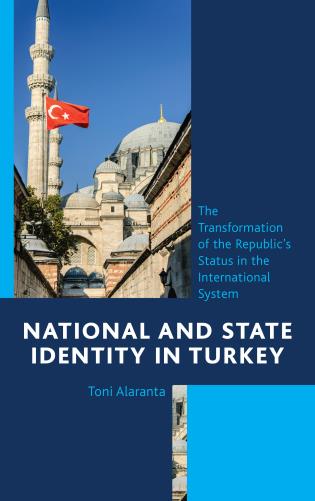
This also marks my first step into the world of podcasting. From now on I’ll be publishing these author interviews in audio as well as written form, through my new podcast “Turkey Book Talk.” The podcast will include some extra parts that didn’t make the written edit, as well as some fancy music, etc.
Click here to listen to the first episode (a work in progress as I’m still figuring out the best host, player, etc).
To subscribe to the feed, visit my PodBean page.
Please spread the word to anyone you think may be interested, and do get in touch with any suggestions on how I can improve the podcast!
Social engineering in Turkey from Atatürk to Erdoğan
May 30, 2015
This week I spoke to Alexandros Lamprou, discussing his new book “Nation-Building in Modern Turkey: The People’s Houses, the State and the Citizen.”
The People’s Houses (Halkevleri) were established in 1932 by Turkey’s single-party regime to plant roots for modernising and secularising reforms in towns across the country. Almost 500 Houses were opened until their closure in 1951, and the traditional view has tended to see them as homogeneous institutions propagating reforms strictly according to Kemalist state ideals. Lamprou’s research showed a far more ambiguous picture, with diverse local conditions across Turkey profoundly altering the work of the People’s Houses.
Here’s the interview with Lamprou in the Hürriyet Daily News.
And here’s my review of the book, in which I explore the limits of such social engineering campaigns – from the early Turkish Republic to today.
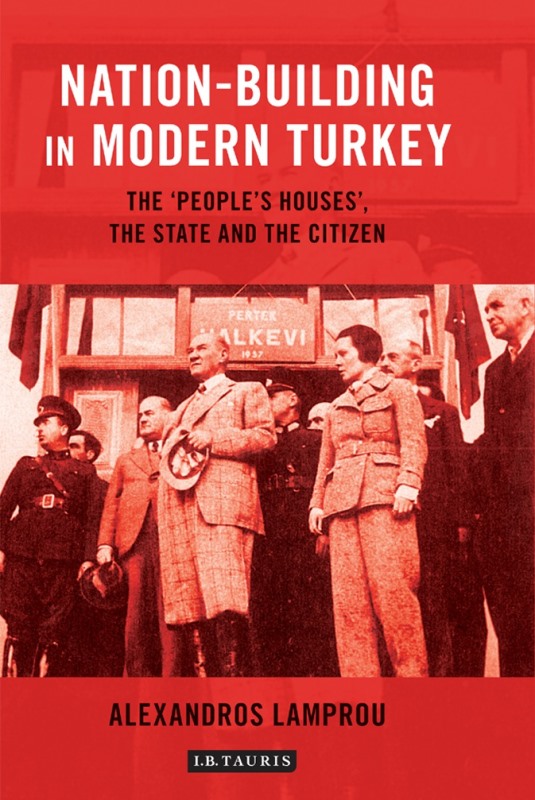
For those interested in these things, here’s a link to my interview from last year with Mahmut Makal in Bülent Journal. Makal worked as a teacher in a central Anatolian Village Institute, which like the People’s Houses were opened to accelerate the modernization of traditional society. Makal’s books on life as a village teacher describe the uphill struggle to spread reforms in the harsh conditions of rural Turkey in the 1950s, and he was actually jailed by the authorities at the time for painting too bleak a picture.

As a final note, the publisher I.B. Tauris have provided a discount code for online purchases of Lamprou’s book. Details are at the bottom of the review and the interview.
‘Insulting the religious beliefs held by a section of society’: Plenty of evidence in Turkish newspapers
April 19, 2013
Handing its 10-month jail sentence to Turkish pianist Fazıl Say on April 15, the Istanbul court stated that Say was guilty of “denigrating the religious beliefs held by a section of society” and had thus violated Article 216 of the Turkish Penal Code (TCK). Although “blasphemy laws” still officially remain in many states, they are now almost completely dormant in most democracies. The rare prosecutions that are attempted based on them almost always fail, either because of sensible legal interpretation or the fact that a guilty verdict would clash with legally enshrined principles of freedom of expression.
Say’s prosecution was based on his retweeting of couplets attributed to medieval Persian poet Omar Khayyam last year, including lines such as: “You say its rivers will flow with wine. Is the Garden of Eden a drinking house? You say you will give two houris to each Muslim. Is the Garden of Eden a whorehouse?” He also posted a personal tweet, stating: “I don’t know whether you have noticed or not, but wherever there is a stupid person or a thief, they are believers in God. Is this a paradox?” However misguided Article 216 may be, there can be little doubt that Say deliberately intended to “denigrate the religious beliefs held by a section of society.” Of course, deliberate insult should never be criminalized, but as it is considered legitimate grounds for prosecution in Turkey it’s worth asking why cases aren’t regularly opened against material published in certain Turkish newspapers. The fact is that there are a number of Turkish dailies with considerable reputations for directing abuse at religious, ethnic, and sexual minorities.
Yeni Akit has a considerable track record of targeting respected journalists for aggressive and persistent smear campaigns, including Cengiz Çandar, Hasan Cemal, Ahmet Altan, and Amberin Zaman. It has even recently been waging a bizarre campaign against the “deviant spirituality” of yoga. Although it and fellow hard-line Islamist newspaper Milli Gazete (affiliated to the minor Felicity Party) have both been fined on numerous occasions for slander and libel, they have never to my knowledge been prosecuted for “insulting a section of society.” That may seem odd after considering the following examples, dredged up on their websites by a simple search of the words “Christian,” “Jew,” “Alevi,” and “homosexual”:
– Milli Gazete’s April 18 front page headline focused on the “scandal” that the EU was “making the Turkish state pay” the costs for lighting non-Muslim places of worship “such as churches and synagogues.”
– On the same front page, it was also disbelievingly reported that New Zealand had become the latest country to legalise gay marriage. The article was headlined, “Your destruction is near,” and was accompanied on the printed page by a picture of two fossilised victims from Pompeii.
– The same paper also carried a headline story in January warning about the dangers of “Zoroastrian missionaries” spreading “terrorist propaganda” in Turkey’s southeast.
– Again Milli Gazete, this time declaring as its Jan. 8 front page: “Here’s the Jewish mind.” The story was about Jewish religious jewellery being sold by a U.S.-based company, which donated some of its profits to the Israeli army.

Milli Gazete, Jan. 8, 2013: ‘Here’s the Jewish mind’
– On the same day that Milli Gazete was warning about “the Jewish mind,” Yeni Akit reported news of an old church in the Black Sea province of Giresun making “Christian propaganda.” Despite the fact that the church had been converted into a library in 2001, the article bemoaned that crosses and Stars of David were still to be found inside the building, “blurring young minds.”
– Yeni Akit on Feb. 3: “Support for perverts from the CHP and BDP,” regarding attempts in January by opposition deputies to reform the law stating that “dirty” and “deviant” homosexuality is legitimate justification for expulsion from the Turkish military.
– Yeni Akit: “The 19 Year Lie,” in which a host of slanderous claims were made about the massacre of over 30 Alevis in the central Anatolian town of Sivas in 1993.
On any given day you can open either Milli Gazete or Yeni Akit and be sure to find similar stories, written in the most unpleasant, insulting language. Should it really be surprising that Article 216 isn’t extended to these cases?
Even if the necessary sections of the Turkish penal code were reformed, they would still undoubtedly be liable to misuse through selective interpretation. However decent a country’s set of laws may be, and however enshrined they are in decent-sounding constitutions, problems generally come from the interpretation of those laws. If Article 216 was always applied as rigorously as it was against Say, then all the above examples would be investigated. In the end, the most important factor behind scandals such as the Say case is the mentality behind them, which is not something that can be transformed by a simple change in legal language.
Yeni Akit shaping the debate?(!)
December 6, 2012
It’s been a while since I last wrote about my favourite hard-line Islamic newspaper, Yeni Akit. It would be wrong to overemphasize Akit’s significance in the overall scheme of things, but a couple of its recent news items are certainly worth mentioning, and indicate that it might have rather more influence than many give it credit for(!)
On Nov. 22, Akit published a story headlined, “Immorality at High School,” containing photographs that it said showed teachers drinking alcohol with their students at a picnic. This photos were taken in the southern province of Antalya, (“known as a castle of the secularists,” according to the article), and were apparently uploaded to Facebook by one of the teachers. “It has been claimed that the teachers are members of the ‘Eğitim Sen’ union, which opposes the headscarf as well as classes on the Quran and the life of the Prophet,” Akit helpfully stated. The Antalya branch of the National Education Directorate opened an investigation into the 11 teachers upon the publishing of the story, but this was quickly dropped after it was established that the photos were in fact taken by a teacher at a family picnic three years ago, and that no students were present. Unbowed, on Dec. 2 Akit went on to publish a photo of a female teacher at the same Antalya school, part of a group at a bar celebrating a friends’ birthday (with glasses of beer on the table). “Do these photographs suit a teacher?” said the headline. However, rather than the Education Directorate setting up an inquiry, the teacher in question is now opening a legal case against Akit.
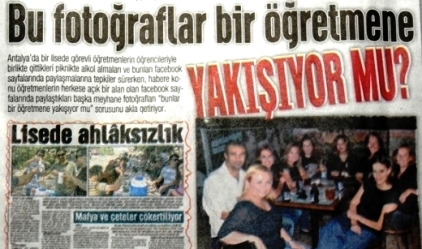
It’s worth mentioning these “photo scandals” because very recently Prime Minister Recep Tayyip Erdoğan used similarly tendentious photographs published in Akit to attack his political opponents. The pictures used by Erdoğan showed deputies of the pro-Kurdish Peace and Democracy Party (BDP) sitting around a table eating kebab, despite the fact that over 600 Kurdish prisoners were entering their 49th day on hunger fasts: “Lamb kebab for us, death fasts for you,” read Akit’s headline. On the same day (Oct. 30) Erdoğan told a meeting of his parliamentary party: “On one hand [they] are eating lamb kebab, on the other [they] are telling those in prison, ‘Die on hunger strike.’” In fact, it soon emerged that the photos had been taken two months before at the wedding of a BDP member in the southeastern province of Mardin.
Erdoğan’s harsh words got a lot of coverage at the time, (here’s the Reuters story on it), but the fact that his source was Yeni Akit obviously received rather less attention. Commentary suggesting that the prime minister is turning Turkey into an “Islamic state” is simplistic and misguided, (a piece in the Wall Street Journal last month claimed that he was “ramming Shariah law into practice.”), but it can’t be a good sign that he’s turning to Yeni Akit for rhetorical fodder to use against his opponents.
A competition for the ‘giant’ Çamlıca Mosque
August 1, 2012
In May, Prime Minister Recep Tayyip Erdoğan announced to the Turkish media his desire to see a “giant” mosque built on Istanbul’s Çamlıca Hill. In his latest “crazy plan” for the city, Erdoğan said he wanted it to be a mosque that could “be seen from everywhere,” and declared that construction would begin within two months. Çamlıca is situated on the Asian side of the city, and despite currently being the site of a number of enormous television and radio reception towers, the hill is one of Istanbul’s few remaining green, unpopulated spaces. On June 8 the Environment and City Planning Ministry announced that a 250,000 square metre area on Çamlıca Hill had been identified for the project.
The Turkish press is predictably divided along secular/religious lines on the issue. There are, however, a few voices amongst government-supporting newspapers questioning the necessity of a mosque when there are no residents nearby for it to serve. Such objections miss the point that a new mosque on Çamlıca would undoubtedly afford TOKİ developers a golden opportunity to roll up their sleeves in the area(!)

An appropriately crude impression of how a mosque on Çamlıca Hill might look.
Late in June, liberal daily Radikal featured an interview with Ahmet Turan Köksal, professor of architecture at Gaziantep’s Zirve University, to discuss modern tendencies in mosque-building and his thoughts on the Çamlıca plans. He is skeptical: “A mosque should be for the community, not for show. For me, being a mosque architect means only doing work that has a function for the community …. If they want to make a mosque like an Olympic stadium on Çamlıca Hill and want to show off to their friends and rivals, then I’m against this,” he said.
Nevertheless, at the beginning of July, Milliyet included an interview with architect “Hacı” Mehmet Güler, who said he had been charged by the prime minister to make preparations for the new mosque. Güler said it would be designed in a “classical style,” and – in a fine example of “Muslim modesty” – that plans were being drawn up to have it feature the world’s tallest minarets, even surpassing those of the Mosque of the Prophet in Medina.
Following this interview, the issue seemed to fall off the agenda. It was thus quite a surprise to find a number of Turkey’s religion-friendly newspapers recently carrying advertisements announcing: “Çamlıca is searching for its architect!” The advertisements appeal to architects to submit their design ideas, in a competition to find an architect for the new mosque.

The competition opened on July 23, and will be accepting submissions until Sept. 3. According to the website of the organization in charge of the project – the rather clumsily named “Association to Build and Maintain Istanbul Mosques and Educational-Cultural Services” – the winning design will be “suitable for Istanbul’s silhouette and texture, reflect the Ottoman-Turkish style, extend traditions to the future, add value to Istanbul, and become one of Istanbul’s symbols.” The winner, the association has announced, will be awarded the honour of designing the ‘Recep Tayyip Erdoğan’ as yet unnamed mosque, as well as 300,000 Turkish Liras in prize money.
As declared in advertisements for the ruling AKP at the last parliamentary elections, alongside a picture of a vatic looking Erdoğan: “It was a dream, it came true!”
[Hürriyet Daily News (15th June 2012): http://www.hurriyetdailynews.com/ataturk-an-intellectual-biography.aspx?pageID=500&eid=101]
M. Şükrü Hanioğlu – Atatürk: An Intellectual Biography, Princeton University Press, 2011, 280pp
One of the first things guaranteed to strike any newcomer to Turkey is the inescapability of Mustafa Kemal Atatürk – the statues, the portraits in every shop, the street names, the fact that every bookshop has an “Atatürk section,” the fact that every classroom has an “Atatürk Corner.” Whatever truth there is in the concern amongst secular Turks that the founder of the Turkish Republic’s memory is being eroded by a new religious order, it certainly – at least superficially – doesn’t feel that way to the Turkey neophyte.

Of course though, if that neophyte is going to stay for a longer stretch of time, he or she will sooner or later have to get a firmer handle on the Atatürk fundamentals, and Professor M. Şükrü Hanioğlu of Princeton University is the latest to take on the daunting task of producing a biography on the man. As Hanioğlu himself says in the preface to the book, it’s daunting because in Turkey: “For many years, the scholar who aspired to portray Atatürk as he really was resembled the pre-modern historian rash enough to attempt a depiction of the historical Jesus.” Though restricted in scope to the influences that shaped the “intellectual” character of its subject, (rather than filling in details of the personal life story), “Atatürk: An Intellectual Biography” is a sane, fair-minded primer to the ideological forces that shaped the “Father of the Turks.” Unlike so many titles in that “Atatürk section” of the local bookshops, it is resolutely a biography – not a hagiography.
The first step to challenging any holy text is to read it as a product of its historical context. The major objective of this book is to do the same with Atatürk, presenting him as an intellectual and social product of the late nineteenth and early twentieth century Ottoman Empire. The influences affecting the elites of the late Ottoman period are thus given ample space, demonstrating the essential continuity that Mustafa Kemal represented. Even though politically he was to become the symbolic figurehead of the sudden rupture between the old imperial order and the new republic, in crucial respects Atatürk was simply the inheritor of the late Ottoman reformist legacy. This historical continuity is one of the central themes that emerges from almost all serious contemporary historical writing on the period. Hanioğlu summarises:
“it is imperative to realize that Mustafa Kemal emerged from within a specific social milieu … many of the radical ideas destined to become central planks in his reform program were widely held in intellectual circles at the turn of the century … Despite the radical changes that it brought about, the Turkish transformation led by Atatürk was not a rupture with the Late Ottoman past but, in important respects, its continuation.”
While official Turkish historiography considers the founder of the TurkishRepublica kind of omniscient leader for all times, untrammelled by the age in which he emerged, this book paints a convincing alternative picture.
In this respect, the discussion of nineteenth century German military theorist Colmar van der Goltz’s idea of “the Nation in Arms” is particularly illuminating. Goltz held that a state’s military elite should be afforded an exalted role as the ultimate guide of society, a “superior position” being “the natural due of officers as a class.” Such ideas found fertile ground in the lateOttoman Empire, and Goltz was chosen to lead a restructuring of the Ottoman Royal Military in 1883-84. His theories had an obvious effect on the Committee of Union and Progress, (the group of military officers later known as the Young Turks), which swept to power in 1908, and were clearly significant in justifying the military’s later elite position in the Turkish Republic. Equally important to Ottoman thinking of the time – and consequently to Atatürk – was another German import, the concept of Vulgarmaterialismus:
“a vulgarized version of the doctrine of materialism, fusing popular notions of materialism, scientism, and Darwinism into a simplistic creed that upheld the role of science in society. The late Ottoman version of this materialism was a further simplification of the German original and a medley of highly disparate ideas.”
Hanioğlu remarks on the inherent irony of the self-contradictory, one-dimensional worship of scientific materialism by the era’s elites, a secular creed held on to with as much unquestioning zeal as the most pious of religious believers. The early republican fetish for the all-encompassing power of science was clearly a direct inheritance from this late Ottoman tendency.
Such oversimplification also gave rise to some of the more eccentric, often troubling republican intellectual predilections. The scientistic cult logically led to scientific racism and theories of exclusivist Turkish racial superiority, (the body of 16th century imperial Ottoman architect Mimar Sinan was exhumed in 1925 to confirm the brachycephalic shape of his skull, in order to prove beyond all doubt that he was, indeed, an ethnic Turk). It also fed into the aberration of the various Turkist language theories – which resulted in the brutal purging of all “foreign elements” in order to form a new “purified” Turkish language, with artificial replacements dredged up from ancient Turkic languages. In the words of Geoffrey Lewis, the reforms were a “catastrophic success,” and meant that Atatürk’s famous 36-hour speech of 1926 had already become unintelligible and had to be rendered into modern usage by 1963. There was also the new Turkish history thesis that found its way into official Turkish textbooks, which involved a comprehensive effort to prove that all ancient civilisations, including Greece and Rome, came from a central Asian Turkish wellspring. Despite obviously being nonsense, this revisionist interpretation of human history was seductive because it served a number of practical purposes. Firstly, it helped bypass the awkwardly religious Ottoman past; secondly, it helped pre-empt claims by rival nationalisms that Turks were latecomers to Anatolia; and thirdly, in the Turks’ mission civilisatrice, it also sought to solidify Turkey’s position as an integral part of the West, (although even this may have been a step down for some, with one contemporary text claiming that “Turks lived clothed during the stone age in 12000 BC, while Europeans reached that stage 5,000 years later.”) Atatürk never feels further from the figure of the high Enlightenment – and closer to his own, authoritarian age – than when we read of these quixotic social engineering projects. (I was struck recently when my neighbourhood plumber, Ali, while repairing some piping in my bathroom, began expounding something that sounded suspiciously close to the “Sun Language Theory.” I used to think of such things as being not much more than an eccentric footnote, representing the lunatic fringe of the early republican age, but perhaps I was being too generous.)
Nevertheless, despite the fact that it was personally one of his central intellectual pillars, Atatürk tended not to emphasise the more esoteric expressions of his Turkism until the future of the republic had been properly secured. Until this time, Hanioğlu stresses, Atatürk displayed an often underappreciated pragmatism as a politician. This is especially the case with regard to religion, which is far from the black and white picture that is often assumed. Atatürk was never averse to invoking Islam, particularly early on, when seeking to mobilise the masses in the struggle against the Allies and the non-Muslim populations, which were seen as a mortal threat to the very independence of the nation. Despite his contempt for communism, he also made use of a “purely rhetorical Socialism,” largely aiming to maintain the young republic’s alliance of convenience with theSoviet Union. “This pattern of dissimulation,” Hanioğlu writes:
“was undoubtedly part of a deliberate strategy to align the nationalists with the most powerful and broad-based ideologies of resistance, while obfuscating the exclusionary objectives of the movement. This ideological mishmash was crucial to Mustafa Kemal as he performed his difficult role as political leader, diplomat, and supreme military commander.”
Although he was the leading figure behind the abolition of the Ottoman Sultanate and, soon after, the Islamic Caliphate, this too was achieved in an extremely careful, gradualist way. As is often the case, what seems now like a sudden jolt and break with the past can, in many senses, be seen as merely the logical culmination of tendencies that had been developing for decades.
Westerners tend to view the Turkish adoration of Atatürk in rather narrow, technocratic terms, without understanding that the emotional resonance his image has across Turkish society couldn’t possibly be accounted for by his intellectual convictions alone. Like all icons, his image is still powerful in today’s Turkey because it has been effectively divested of all meaning, and the viewer can invest it with whatever symbolism he or she wishes to. As in any personality cult, Atatürk’s image must necessarily mean different things to different people. Depending on the context, Hanioğlu says, Atatürk “may be invoked in support of ideas that are étatist or liberal, nationalist or socialist, religious or scientistic, elitist or populist.” A westernised Turk on the Aegean coast might revere him for his secularizing, modernising vision, whilst a religious conservative in Central Anatolia can selectively ignore this, and instead place the emphasis elsewhere – perhaps instead respecting the strongman who successfully defended his homeland and gave the West a bloody nose. He probably sees no contradiction at all in praying five times a day while also passionately admiring Atatürk.
Shared by both caricatures is a veneration for the redeemer of the nation, and it is this aspect more than anything else that lends Atatürk the emotional impact needed to endure. This is the reason why detached and technical books like this, while welcome, can really only ever have a minor impact. The majority are guided by impulses rather less rational and rather more emotional. Atatürk himself understood that, even though it is this paradox that perhaps ultimately illustrates the limits of his ultra-rational, positivist intellectual convictions.
[Published on openDemocracy (11th May 2012): http://www.opendemocracy.net/william-armstrong/temporary-alliance-akp-fethullah-g%C3%BClen-and-religion-in-turkish-politics]
With the ‘Turkish model’ commonly cited as one of the inspirations for the revolts sweeping the Arab region, and with much speculation about the role of Islam in the newly emerging political systems in those countries, a closer look at religion’s potential future role in Turkish politics seems appropriate. Of course, it’s perilous to look into the crystal ball and make predictions about the medium to long term political future of any country, and this is particularly so in a place with such a volatile political landscape as Turkey. However, at the risk of inviting egg on my face at some point in the future, I would fairly confidently suggest that Turkey will not simply ‘evolve away’ from politicised Islam any time soon – as many hailing the apparent civilianisation of Turkish politics and liberalisation of the country’s economy often tacitly assume. With roots deeply planted – most notably through the Gülen movement of reclusive religious preacher Fethullah Gülen – it’s clear that religion will continue to play a significant role in Turkish political life, as in social life, for the foreseeable future. Whether its vehicle will remain the current ruling Justice and Development Party (AKP), however, is not quite so certain.
Much has been made of the role and importance of the Fethullah Gülen movement, or cemaat (‘community’), both inside and outside Turkey. It emerged as a significant force in the 1980s, initially coalescing around the personality of religious preacher Fethullah Gülen in the western Turkish city of Izmir. The movement now aims to promote conservative social values, with a soft, public face emphasising ecumenism, tolerance and inter-faith dialogue. Gülen now resides on a ranch in Pennsylvania, his cemaat having evolved into a multi-million dollar global network, sustained by donations from members and numerous commercial enterprises. It has been at least passively supported by the U.S. since the 1990s as an apparently moderate, relatively liberal expression of Islam. The Gülen movement is now active in 140 countries, with interests including boarding schools, universities, banks, media companies, newspapers, charities, and think tanks. There is also much evidence that its sympathisers have infiltrated into the higher positions of power within the Turkish police force. As the recently “wikileaked” Stratfor intelligence agency cable put it in 2009, the Gülen brotherhood is “perhaps the best-organized grass roots movement in Turkey … [with] a vast social and economic organization, intelligence assets, a global network”. The cable goes on to give an idea of how it sustains and expands itself:
“FGC [Fethullah Gülen Community] businesses advertise heavily on FGC media, while FGC-owned media runs human interest stories and profiles of FGC sympathisers, businesses and schools. FGC members and sympathisers take holidays in FGC-owned hotels and shop at FGC-owned stores and invest in FGC financial institutions. Graduates of FGC cramming schools funded by FGC businesses often serve as teachers in FGC schools overseas. Finally, FGC media, funded by FGC businesses, reacts sharply to any criticism directed at Fethullah Gulen.”
In a country in which conspiracy theories find such fertile ground, the growth of this far-from-transparent and apparently unaccountable religious movement is alarming for many secular Turks. It would be wrong, however, to automatically equate the Gülen movement with the current Islamist government of the Justice and Development Party (AKP), as many observers tend to do. In fact, the two have significantly different origins. The AKP, which was established in 2001 and has been in government since 2002, evolved out of the Sunni orthodox Milli Görüş/Nakshibendi school, which found primary expression in the various political parties established over the years by the late Islamist leader Necmettin Erbakan. The Gülenists, on the other hand, stem from the ‘Nurcu’ movement, whose origins go back to the late-Ottoman/early-Republican-era Islamic theologian Bediuzzaman Said Nursî. In contrast with the Nakshibendis, the Nurcus have always emphasised refraining from direct involvement in politics, and stayed largely non-partisan, their main aim being the rather more vague imana hizmet or ‘service to the faith’. Thus, the Gülen movement has only ever lent passive support to political parties over time, and it’s significant that this support was never extended to Erbakan’s Refah (Welfare) Party in the 1980s and 90s, out of the ashes of which the AKP emerged.
Both the Gülen movement and the AKP share socially conservative values based in Sunni Islam, and have therefore experienced a kind of alliance of convenience or symbiotic coexistence during the AKP’s term in power. The 2007 “e-memorandum” affair (in which the Turkish military attempted a “post-modern” coup similar to that of 1997), as well as the 2008 closure case at the Constitutional Court against the AKP for alleged anti-secular activities, brought the two even closer together. However, there are increasing signs of a growing divergence of interest. The din surrounding the recent reforms to compulsory education generally portrayed the developments as simply another round in the familiar secular-religious tug-of-war in Turkey. However, a more subtle interpretation was outlined in a recent piece by M. Kemal Kaya and Halil M. Karaveli, suggesting that the reforms were in fact – at least partly – the latest episode in the ongoing covert power struggle between the AKP and the Gülenists. Marked differences of opinion have also been apparent on such contentious topics as the recent Turkish football match-fixing investigation, the Kurdish question, and the continuing friction with Israel.
It would thus be wrong to consider the Sunni religious community in Turkey a homogenous whole. Inevitably, there are fissures and power struggles contained within it, and it seems reasonable to suggest that the outcome of these shifting allegiances will be the dynamic that determines the future direction of Turkish politics, rather than the divided and ineffectual secular opposition. The Gülen brotherhood now has roots deeply planted in many of the institutions of public life inTurkey, and its sensitivities must be taken into account by any political group hoping for electoral success. In a largely pious and conservative country, it seems clear that religion will continue to play a significant role in the political sphere in Turkeyfor a while yet. However, with recent indications of high-level schisms, far less clear is whether the AKP, or some other party that understands and is comfortable with this reality, will be the leading political force to harvest its energies.


 Turkey Book Talk