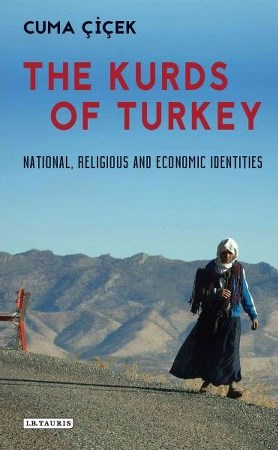
CUMA ÇIÇEK joins to discuss his book “THE KURDS OF TURKEY: NATIONAL, RELIGIOUS AND ECONOMIC IDENTITIES” (IB Tauris).
Download the episode or listen below.
Subscribe to Turkey Book Talk : iTunes / PodBean / Stitcher / Acast / RSS
Follow on Facebook or Twitter.
You may also be interested in an earlier episode with Mustafa Gurbuz discussing his book “Rival Kurdish Movements in Turkey: Transforming Ethnic Conflict” (Amsterdam University Press):
*SPECIAL OFFER* – Turkey Book Talk listeners can get a 33% discount plus free delivery on four titles published by Hurst – “The Circassian: A Life of Eşref Bey, Late Ottoman Insurgent and Special Agent” by Benjamin Fortna, “The New Turkey and its Discontents” by Simon Waldman and Emre Çalışkan, “The Poisoned Well: Empire and its Legacy in the Middle East” by Roger Hardy, and “Out of Nowhere: The Syrian Kurds in Peace and War” by Michael Gunter. Follow this link to get that discount from Hurst Publishers.
Finally, if you enjoy or benefit from the podcast and want to support it, click here to make a donation to Turkey Book Talk via Patreon!
Many thanks to my current supporters Özlem Beyarslan, Steve Bryant, Celia Jocelyn Kerslake and Aaron Ataman.
Mustafa Gurbuz on ‘rival Kurdish movements in Turkey’
March 12, 2016
The latest Turkey Book Talk podcast is with Mustafa Gürbüz, the author of “Rival Kurdish Movements in Turkey: Transforming Ethnic Conflict” (Amsterdam University Press).
Apologies for the delay in dropping this latest pod. I’ve had a technical nightmare.
Download the podcast or listen below.
Subscribe: iTunes / PodBean / Stitcher / Facebook / RSS
Here’s my review of the book at Hürriyet Daily News. Here’s the interview in written form.

Here’s another interview I did with him from last year about his research on the outlawed Kurdish Islamist militant group Hizbullah.
Finally, reposting my recent podcast with Frederike Geerdink discussing the Kurdish issue.
Frederike Geerdink on Turkey’s Kurdish question
February 5, 2016
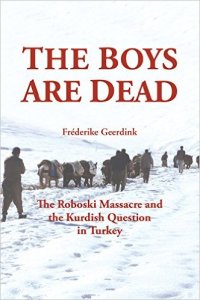
This week’s podcast is with Frederike Geerdink, author of “The Boys are Dead: The Roboski Massacre and the Kurdish Question in Turkey” (Gomidas).
We chat about her time as a journalist in the Kurdish-majority city Diyarbakır, her deportation from Turkey last year, and the troubled history/present of the issue in the wake of the collapse of the peace process last summer.
Download the podcast, or listen below:
Here’s my review of the book at Hürriyet Daily News.
Subscribe to the Turkey Book Talk podcast via iTunes or via PodBean.
Follow Frederike Geerdink on Twitter.
Added bonus: I’ve dug out this interview from last year with sociologist Cem Emrence, co-author of “Zones of Rebellion: Kurdish Insurgents and the Turkish State” – quite a thought-provoking book.
Michael M. Gunter on the Kurds of Syria in peace and war
October 24, 2015
My interview this week was with Professor Michael M. Gunter, author of “Out of Nowhere: The Kurds of Syria in Peace and War” (Hurst).

The slim book charts the Syrian Kurds’ rise to international profile since 2011, taking in their modern history under Ba’athist oppression, their development of “national conscience,” and ties between the PYD in northern Syria and the PKK in Turkey.
Download the interview in podcast form.
Please subscribe to the Turkey Book Talk Podcast via iTunes, via Podbean, or via Soundcloud.
Here’s the text of the interview at HDN.
And here’s my review.
Turkey and the PKK at another crossroads
July 25, 2015
This week saw some of the worst clashes between Turkish security forces and the Kurdistan Workers’ Party (PKK) since the (now ended?) peace process officially started over two years ago.
As a result my interview and review this week are sadly topical. I spoke to Cem Emrence, who co-authored a new title on the history of the Turkey-PKK conflict, “Zones of Rebellion: Kurdish Insurgents and the Turkish State.” It is a slim but rich book, elaborating a complex theory of path dependence that has limited the options of both the Turkish state and the PKK over three decades and ultimately led to stalemate.
Read the Q&A with Emrence in Hürriyet Daily News here.
And read my review of the book from earlier this week here.

And something completely different: In next week’s Times Literary Supplement I review a new English selection of the great Sait Faik’s stories. It’s only available in print form so you’ll have to seek out an actual real physical copy of the TLS if you’re interested in reading it.
Coverage of Ankara-PKK ‘peace process’ in the Turkish media
January 19, 2013
Peace talks are still ongoing between the Turkish state, representatives of the Kurdistan Workers’ Party (PKK), and PKK leader Abdullah Öcalan. It is likely that for any kind of peace to be secured they will have to go on for quite a while longer. Looking at the attitudes adopted by the Turkish media over the course of the “İmralı process” has been illuminating, particularly the reporting of the Jan. 17 funeral ceremonies in Diyarbakır of the three female Kurdish activists who were recently shot dead in Paris.
The government’s previous “Kurdish Opening” in 2009 came to an abrupt end after the controversy that followed the release of a group of PKK militants at the Habur border crossing and their welcoming back by huge crowds in Diyarbakır. Any comparable scenes carried the danger of enflaming Turkish nationalist sentiments and posed a risk to the latest dialogue process. Thus, in the lead up to the funerals most in the mainstream media were in agreement that they represented a significant test. On the morning of the ceremonies, dailies Vatan, Yeni Şafak, and Yeni Asya all featured front page headlines quoting the words of Prime Minister Recep Tayyip Erdoğan saying that the day would be a “Samimiyet sınavı,” or “Sincerity test.”
The ongoing process is extremely delicate. It’s easy to forget that although public support for the current PKK talks is significantly higher than it was in 2009, suspicion of the talks is still widespread. It was therefore interesting to observe how none of the major TV stations covered the ceremonies live in any detail on the day, despite the fact that they were attended by tens of thousands of people. As with much coverage of the Kurdish issue, (the Uludere/Roboski massacre in December 2011, for example), it is likely that this low key coverage had been “suggested” to the major media organizations by the government, acutely aware of the need to avoid scenes similar to those in Habur in 2009. Tellingly, Deputy Prime Minister Bülent Arınç had the following to say at a media event on Thursday: “The media’s support is so pleasing for us. I know and I see this support. … Eighty percent of media groups are lending their support. They are conducting positive broadcasts and contributing to the process. I hope this continues.” Still, in a column the next day titled “Peace is difficult with this media,” daily Vatan’s Rüşen Çakır had some critical things to say about this mentality:
“Television stations who didn’t show the ceremony yesterday failed the ‘sincerity test.’ In fact, they didn’t even sit the test … In the name of not making mistakes, or avoiding possible crises, or not annoying the government, they chose not to do anything at all … During the latest İmralı process, our media sees only one side as having to take steps – and all of these steps set according to what the government wishes – which itself sabotages the road to peace.”
In the event, Jan. 18’s newspapers exhaled an audible sigh of relief that the day passed without “provocation or sabotage” from either the mourners or the Turkish security forces. In contrast to the relative silence of the TV stations, the majority of the next day’s papers featured the funerals as front page headline stories, showing pictures of the crowds gathered in Diyarbakır and striking a noticeably optimistic tone. Many focused on a makeshift sign that one man was carrying at the ceremonies: “There is no winner from war; there is no loser from peace.”
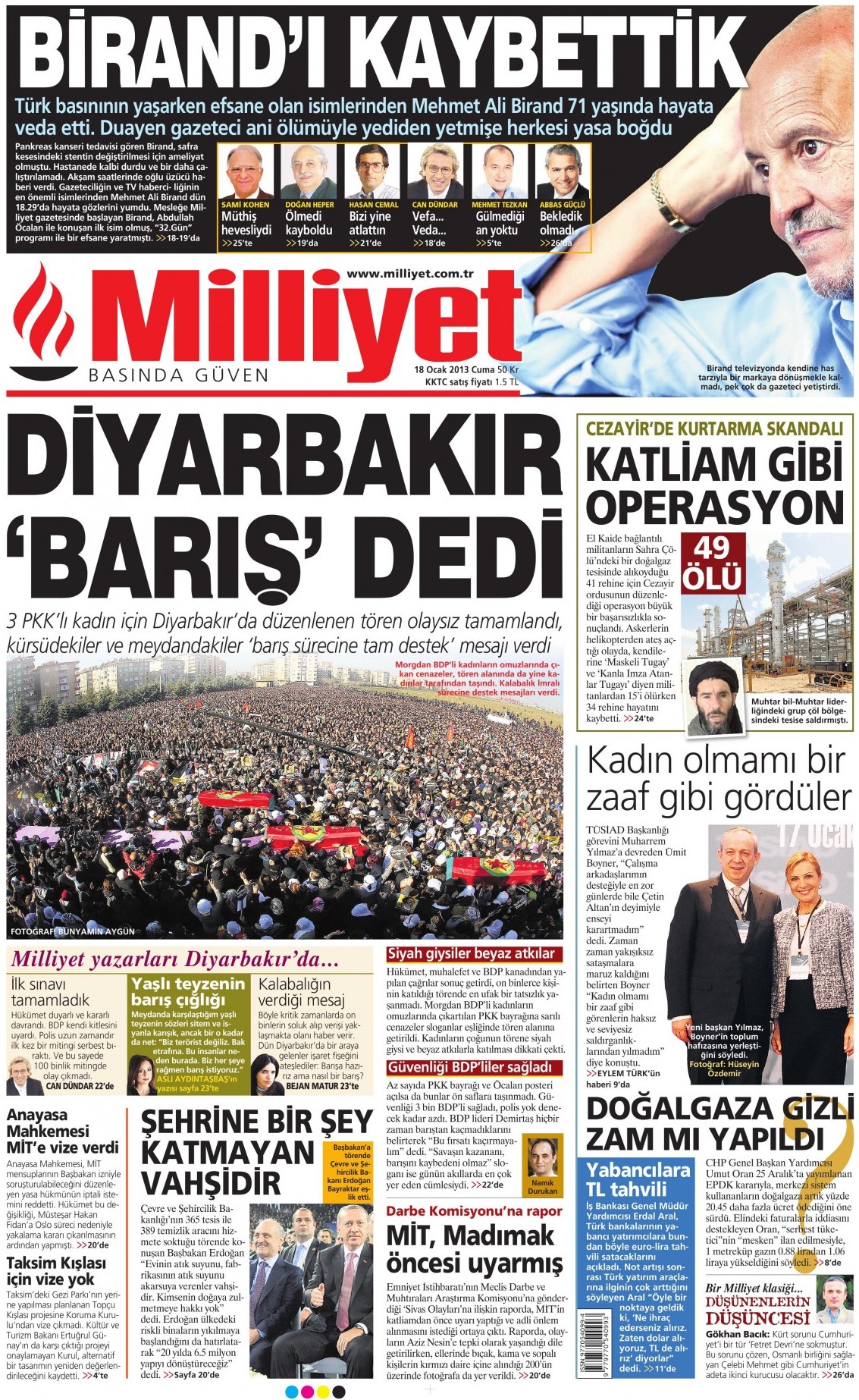
The front page of Milliyet on Jan. 18: ‘Diyarbakır said peace’
That the funerals passed peacefully was a relief not only for the government but also for the Peace and Democracy Party (BDP), which shares grassroots with the PKK. At the moment, both the Justice and Development Party (AKP) government and the BDP have a common interest in continuing the talks. For the process to come to a successful conclusion – still a long way off – this shared interest will need to persist for a while yet.
‘Bring back capital punishment, end this business’
November 14, 2012
Recently, Turkish Prime Minister Recep Tayyip Erdoğan has repeatedly expressed his opinion that Turkey should consider reinstating capital punishment “in certain situations.” He first brought the issue up at a meeting of his Justice and Development Party’s (AKP) deputies on Nov. 3, in reference to Abdullah Öcalan, the convicted leader of the outlawed Kurdistan Workers’ Party (PKK), and has returned to it on a number of occasions since. “Right now a lot of people in public surveys say that capital punishment should be reintroduced … It is legitimate in certain situations,” Erdoğan said. “Yes, the death penalty was removed from Europe, but has it left America, Japan and China? Then there is a justified cause for the death penalty to remain.”
Capital punishment was abolished by Turkey in 2002, just prior to the AKP’s accession to power in the general elections of that year. Although no execution had been carried out by the Turkish state since 1984, an official end to the practice on the Turkish law books was seen as one of the key steps in Turkey’s EU accession process, which was then entering its most energetic period. The decision was fairly controversial at the time, as PKK leader Öcalan was captured and sentenced to death by the Turkish authorities in 1999. With the abolition of capital punishment, this sentence was commuted to life imprisonment, and Öcalan has since been held in a remote prison on İmralı Island in the Marmara Sea. With the recent spike in clashes between the Turkish security forces and the PKK, Erdoğan’s words on capital punishment should be interpreted in terms of the government’s failure to solve the Kurdish question – populist sentiments aiming to deflect nationalist criticism that he has made too many concessions to Kurdish rights with little to show in return.
The most striking newspaper coverage of the issue I saw came from popular pro-government daily Sabah, the newspaper with the fourth highest circulation nationally. Its Nov. 13 front page carried the bold headline “Bring back capital punishment, end this business.” These were the words of Fatma Çınar, the mother of one of the 17 soldiers killed in the recent helicopter crash in the southeastern province of Siirt, speaking at her son’s funeral. The crash was not a result of direct clashes with the PKK, but it was enough for PM Erdoğan to frame it as taking place within “much intensified, multi-dimensional” military operations in the region.

The return of the issue to the national debate has predictably raised eyebrows among those parts of the media who retain forlorn hopes that Turkey’s EU accession process can still be revived from its current moribund state. Opposition Republican People’s Party (CHP) deputy Rıza Türmen, who worked for 10 years at the European Court of Human Rights, wrote in Milliyet on Nov. 13: “Capital punishment is banned according to the third section of the European Union’s founding principles, and the lifting of capital punishment is a precondition for membership of the EU and the European Council … Is leaving the EU process what the prime minister actually wants?” Meanwhile, Taraf editor Ahmet Altan’s disillusionment continued on the same day: “We’ve gone from a country that celebrated with enthusiasm the opening of ‘full EU membership negotiations,’ to one with a prime minister – like a funeral undertaker – shouting ‘hang them, hang them’ at every opportunity.” A response even came from the murky corridors of the EU itself, with Peter Stano, the spokesman for Enlargement Commissioner Stefan Füle, stating: “Our position on this is quite clear. Countries wishing to be a member of the EU cannot practice capital punishment. If capital punishment comes, the EU goes.”
Meanwhile, the hunger strikes of 700 Kurdish prisoners today entered their 64th day. Despite the increasing urgency of the situation, Erdoğan has so far ignored calls to directly engage in finding a solution. He even spent Nov. 12 in his hometown of Rize, receiving an honorary doctorate from the newly-established “Recep Tayyip Erdoğan University” (it’s sometimes difficult to tell in Turkey that you’re not reading The Onion). His words on capital punishment have certainly been an effective tactic distracting some attention away from the critical situation of the strikers. However, like the Peace and Democracy Party’s (BDP) recent remarks about erecting a statue of Öcalan, they have hardly done much to help create an atmosphere congenial to a solution.
Cihan news agency accused over Şemdinli report
November 7, 2012
The hunger strikes of 682 Turkish prisoners are entering their 57th day. The way that they – and the broader issues related to them – are being reported by media outlets known to be close to the ruling Justice and Development Party (AKP) clearly reflects the direction that the government’s Kurdish policy has recently taken.
With the government’s “Kurdish initiative” apparently having run out of steam, the conflict between the Turkish security forces and the outlawed Kurdistan Workers’ Party (PKK) has become increasingly bloody over the last 12 months, and chances for a political solution seem to be ever more remote. The latest bloody incident in south-eastern Turkey took place in the Şemdinli district of Hakkari province on Nov. 4, when a car bomb targeting a military vehicle killed 11-year-old boy Faris Demircan and wounded 26 others. Although there was no immediate claim of responsibility, the PKK is widely thought to be behind the blast.
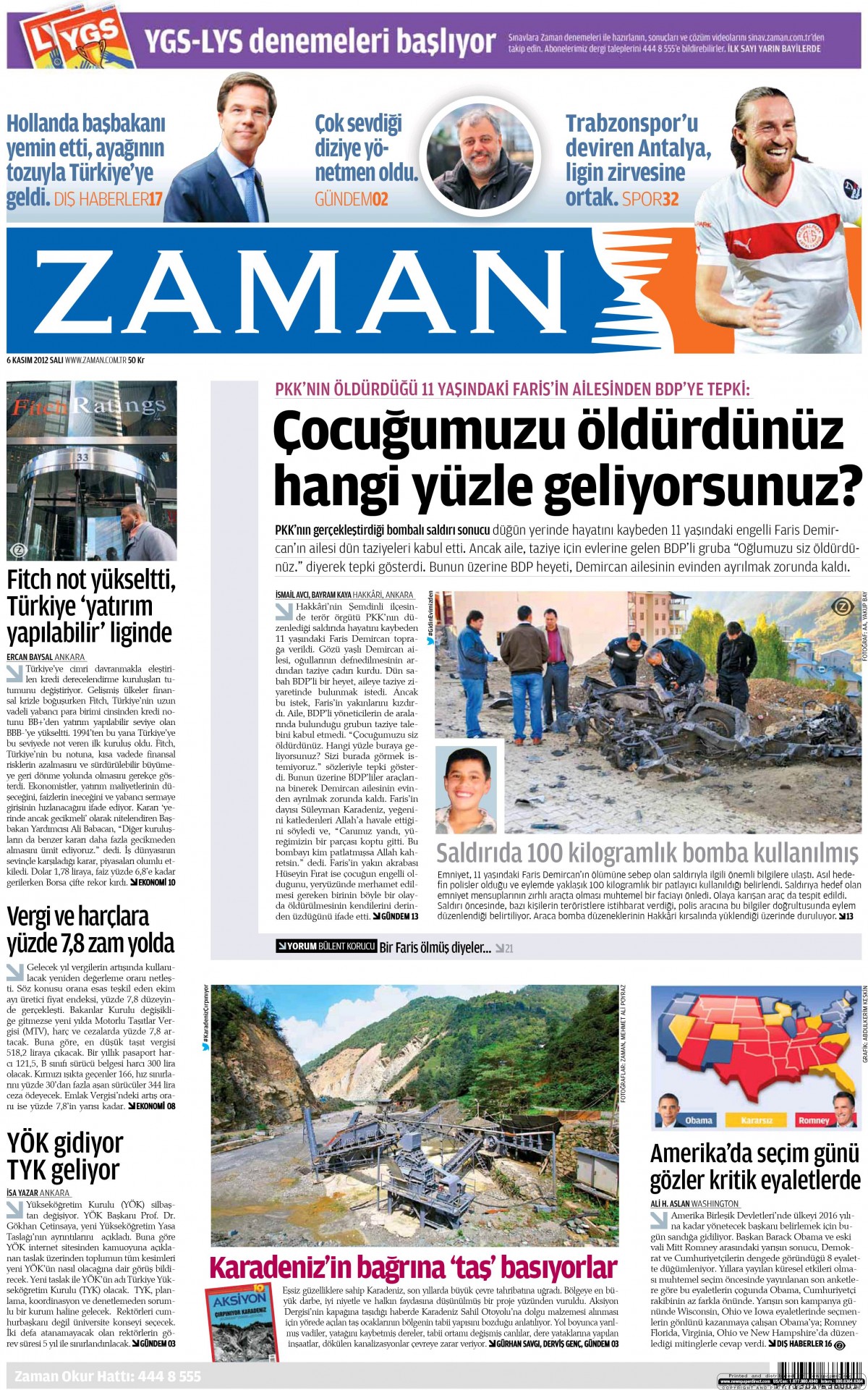
On Nov. 5, the Gülen-affiliated Cihan news agency reported that pro-Kurdish Peace and Democracy Party (BDP) Hakkari deputy, Esat Canan, tried to visit the family of the deceased to offer his condolences, but was refused entry to the family home. However, no sources were referenced and no quotations on the incident from the family were included in the report. What’s more, no other news agencies mentioned this and local media in the area reported quite the opposite, saying that Canan had in fact been welcomed in to “share the pain.”
Those known to be close to the government, or the Gülen movement, were the only national newspapers to feature Cihan’s story. Zaman included it as their main front page story, under the headline: “Family of 11-year-old Faris respond to the BDP: ‘You killed our child, how dare you come here’”.
Star included the same story on its front page, alongside news claiming that local traders in Şemdinli were closed in protest against the incident. The headline read: “Şemdinli’s shutters closed against the PKK.”

Strongly Islamist daily Yeni Şafak carried a front page headline declaring: “BDP driven from the door”, included under which was a subtle subtitle: “God damn them.” Popular pro-government daily Sabah also featured the same story at the bottom of its front page under the headline: “You murdered my son.”
BDP deputy Canan has written a formal letter of complaint – which I have read (anybody interested can contact me) – to Cihan news agency about its “baseless” report. In the letter, he says that his visit was in fact accepted by the family of the deceased, and he claims that Cihan’s news was written without any examination of the area and without any correspondent on the ground. He demands a retraction and an apology, warning that he will exercise his full legal rights to pursue the case if he does not receive one.
Turkish dailies on the Gaziantep terror attack funerals
August 25, 2012
I came back to Istanbul this week, after spending three weeks at home in the UK. On my return I was greeted by airport newsstands full of papers with headlines focusing on the funerals of the nine “martyrs” killed in the recent terror attacks in the southern Turkish city of Gaziantep. Of course, I kept vaguely up-to-date with events while I was away, but the contrast between Turkey – currently in one of those periodic bouts of nationalist hysteria that always follow clashes with the Kurdistan Workers’ Party (PKK) – and Britain – which is still basking in the fuzzy, generous, inclusive afterglow of the London Olympics – was nevertheless striking.
Although there are serious doubts as to whether the PKK was actually responsible for this latest attack, the Turkish press did not hesitate in reverting to predictable form. For a flavour of the current mood, here is a selection of newspaper front pages from Thursday (Aug. 23), focusing on the previous day’s funerals.

Like many others, nationalist daily Sözcü showed a photo from one of the funerals, with a coffin wrapped in the Turkish flag in the foreground. The funeral was attended by various state heavyweights, including the leaders of all three main political parties, all of whom were shown in mourning in front of the coffin. Above this, a larger picture showed the face of one-year-old Almina Melisa, whose mother and father were both killed in the Gaziantep bomb. Addressing the political figures in the picture below, the headline challenged: “Almina, will she forgive you?”

Islamist daily Yeni Şafak’s main photo also showed the same funeral. The headline above read: “70 million people on the same side”.
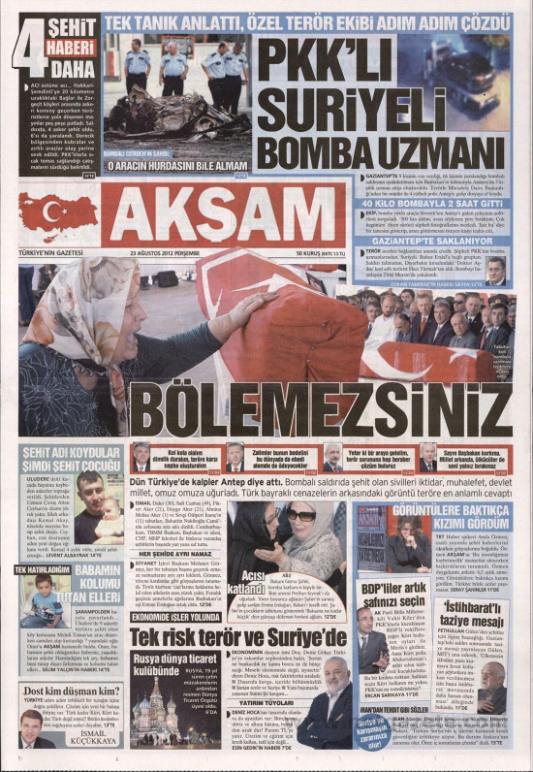
Daily Akşam: “You cannot divide”
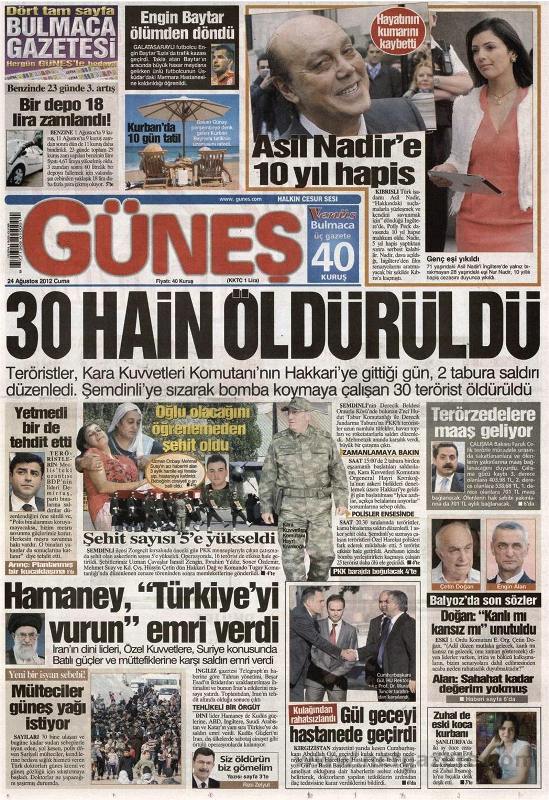
Finally, here is the reassuring front page of tabloid daily Güneş’s Friday edition. The headline referred to counter operations conducted against the PKK by the Turkish military in the southeastern province of Hakkari: “30 Traitors Killed”.
Gentrification in Tarlabaşı, Istanbul
September 28, 2011
The noise of Tarlabaşı never stops. Street cats cry incessantly during the day and fight each other at night; street hawkers struggle with creaky wooden carts around the winding alleyways, crying out their wares of breakfast poğaças or carrying wooden boards full of fresh simits on their head; housewives call out of windows to the nearest greengrocer and lower baskets on string for goods, in summer groups of them in floral headscarves sit out all day gossiping on the pavement; children don’t sleep until the early hours, screaming as they play hop-scotch or kick footballs around; during Ramadan traditional drummers and singers pass every building, waking everyone up to break the fast before sunrise; for me, the chaotic street market each Sunday is one of the most colourful parades of human activity Istanbul has to offer. Taksim Square – with its shiny malls, modern cinemas, and thronging restaurants and bars – is considered the commercial and cultural “heart” of the city, but it takes just two minutes to pass down from the smart pedestrian boulevard of Istiklal Caddesi, cross the six-lane duel-carriageway Tarlabaşı Boulevard, and arrive in the impoverished backstreets of Tarlabaşı itself. In two minutes it feels like you’ve crossed into a different world. With the Turkish economy booming and Istanbul developing at such a rapid pace, it’s a world coming under serious threat.
Tracing the history of Tarlabaşı illustrates the fluctuating fortunes of Istanbul’s minorities over the past 200 years. Situated on the European side of the city, across the Golden Horn from the old town, the area was originally home to prosperous non-Muslims. The sturdy stone houses were built for Greeks and Armenians – lower-middle class artisans, small tradesmen, and merchants – whose economic prospects waxed even as the Ottoman Empire’s waned over the course of the nineteenth century. Istanbul’s Armenians were largely untouched by the tragedy engulfing their eastern Anatolian kin during the First World War, and its Greeks were exempt from the wholesale population exchanges that took place between the states of Greece and Turkey during the 1920s, but the situation of minorities became increasingly precarious during the republican years of the twentieth century. Official discouragement found expression in the punitive “Varlık Vergisi” (Wealth Tax) aimed at Turkey’s minority groups in 1942, and in the 1950s pogroms were organised against the Greeks of Istanbul, after which the vast majority moved swiftly away. Many of Tarlabaşı’s grand buildings were left empty and unaccounted for, and an area that was already going to seed went into accelerated decline. At the same time, rapid industrialization meant that significant numbers of Turks were moving into urban areas, and many found homes in the unoccupied but decaying townhouses of Tarlabaşı. In 1990, further waves of migration took place, this time of Kurds from eastern Anatolia – fleeing economic deprivation and the intensifying civil war in Turkey’s south-east. Thus, right in the centre of Istanbul, something of the atmosphere of an Anatolian village has been recreated in Tarlabaşı. But that isn’t the whole of it – alongside Kurdish migrants can be found Arab and African refugees, Roma (gypsies), Zaza-speaking Kurds, itinerant foreign language teachers living on the cheap, and even pockets of transsexuals (many of whom ply a trade in the seedy brothels along Tarlabaşı Boulevard). At a time when most of Turkey has become a state-sponsored monoculture, Tarlabaşı seems to reclaim something of the anarchically multicultural heritage of Anatolia.
“Gentrification” has taken place in all major cities striving to modernise, (it seems as inevitable as the carbon-copy Starbucks cafes popping up everywhere), and it’s already happened in many areas of Istanbul. Hard to believe now, but thirty years ago Istiklal Caddesi itself was a down-at-heel backwater; only relatively recently has it been pedestrianised, tidied up, reintroduced to its picturesque “nostalgic” tram line, and lined with the gleaming chain stores. There have been murmurings of tension in nearby Tophane, where the traditional inhabitants find themselves surrounded by growing numbers of small art gallerys, boutiques, and fashionable bars. Cihangir, on the opposite side of Istiklal, has become a chic enclave for expats and young professionals. Such examples follow a more typical, ‘organic’ process of gentrification; that planned for Tarlabaşı, however, is exactly that – planned. In 2005, an ‘Urban Renewal Act’ (Law 5366) passed through the Turkish parliament authorizing municipalities to work with private building companies to ‘regenerate’ areas of Istanbul. The historic Roma district of Sulukule, also on the European side, was one of the first declared an ‘Urban Renewal Area’. Eventually almost 1000 families were evicted from their homes and given new – unaffordable for most – apartments 45km away. The majority of these people have since become homeless and the area’s historic fabric has been ripped out, gradually replaced by more faceless modern apartment blocks. In 2006 Tarlabaşı was also chosen as a renewal area, and the contract for the project was awarded to GAP Inşaat, a subsidiary of Çalık Holding, the CEO of which is the son-in-law of the Turkish Prime Minister. Plans were soon released for the redevelopment of a 20,000 m2 area, a total of nine “building islands”. The website for the project (www.tarlabasiyenileniyor.com) is full of “before” and “after” pictures: photos of out-at-elbows back streets teeming with scruffy children and shady-looking men (the present Tarlabaşı), are contrasted with digitally-generated images of urbane, be-suited couples strolling down spotless, wholesome avenues (the projected Tarlabaşı). It must all look rather seductive to the prospective flat-buyer, but two major concerns persist: will the area’s historical character be preserved? and – perhaps more pressingly – will current residents go the way of Sulukule’s?
Tarlabaşı is an incredibly charismatic place. Its buildings are unique examples of late nineteenth century Ottoman Levantine architecture, elegant four and five storey stone townhouses with slim bay windows jutting out above the street. Clearly most haven’t been touched since being built – the majority are filthy, stained black with dirt, and some are now nothing more than shells, thick carpets of weeds and stumps of struggling trees behind a crumbling façade. Sanitary conditions in many places are primitive. It’s obvious that the area desperately needs improvement, but GAP Inşaat’s project goes beyond simple renovation, to what looks like a radical reimagining of the entire area’s fabric. A four-storey underground car park is planned, and whilst the developers insist that most buildings will be preserved, questions remain about what form this preservation will take. Many fear that Tarlabaşı’s unique historical character will be irredeemably destroyed by the changes. Mücella Yapıcı, from the Union of Chambers of Turkish Engineers and Architects, claims that “the cultural and historical heritages of Tarlabaşı are going to be sacrificed to financial benefits of some people or companies.” Appeals have been made to UNESCO and the European Court of Human Rights, but look unlikely to halt developments that are, ultimately, in the hands of the elected municipality. Whatever happens, current residents will undoubtedly be priced out by the new plans. In August 2010 the holding company claimed that agreements for purchase had been reached with 70% of the owners of houses in the area, and that apartments are being offered in a brand new suburban development to those evicted from Tarlabaşı. This development is almost two hours away by public transport in a little–known satellite city, Kayabaşı. Aside from the cultural jolt of having to move from Tarlabaşı to alien high-rise apartment blocks, miles away from where some have worked for years, it’s unlikely that many could afford the 1000TL upfront price and 309TL monthly mortgage payments for the cheapest apartments anyway, (let alone commuter costs).
It’s easy to sentimentalise from a distance. The fact is that amongst Istanbullus, Tarlabaşı is a no-go area, notorious for crime, poverty, violence, illiteracy, and overcrowding. At night the women leave their spots on the pavement and organized gangs move in. These problems won’t be solved by the municipality’s plans, but they will be moved elsewhere, which is probably what is wanted. My neighbour, Ozan, has lived with his family in the same building (which he owns) for 40 years and is under no illusions, “you have to be careful,” he says, “there are thieves all around here at night, life isn’t perfect.” But he’s tied to the area, working twelve hours a day, six days a week in a cheap restaurant just a five minute walk away, “our life is here, where else could we go?” Many people have already left, and a lot of the seedy bars, shops and brothels along Tarlabaşı Bulvarı have already closed down, making it look even more forlorn than before. Significant numbers have decided to stay on anyway, despite their houses being sold and expropriation procedures being threatened. The municipality has given no clear updates since last year, and a project that was due to be completed in 2010 rolls on without any end in sight. Threat of eviction hangs over the area like the sword of Damocles, but right now it’s difficult to see how it could be entirely vacated without the use of force, as – make no mistake – Tarlabaşı still teems. I’ve lived there for over a year, and if anything the population has increased in that time. I write this on a sultry weekday afternoon and the street outside my flat is as raucous as it has ever been. As Ozan says simply: “we don’t want to go anywhere.” Whether they want to or not, the decision may well be out of their hands, but – for the time being at least – Tarlabaşı remains stubbornly defiant.


 Turkey Book Talk