Turkish newspapers weigh up the Middle East’s ‘new balances’
November 24, 2012
In the wake of the Nov. 21 ceasefire between Israel and Gaza, there has been much talk of the changing power balances in the Middle East. The leading role played by Egypt and its new president, Mohamed Morsi, in brokering the ceasefire is being interpreted by many as Egypt’s reintroduction as a major regional player. Meanwhile, the crisis was another litmus test for the “rising Turkey” thesis, and Turkey’s apparent marginalization during the process seems to have once again exposed the gap between Foreign Minister Ahmet Davutoğlu’s ambitious rhetoric and the reality. While diplomacy to secure a ceasefire was still ongoing, Tim Arango wrote in The New York Times:
“Turkey’s stature in the Middle East has soared in recent years as it became a vocal defender of Palestinian rights and an outspoken critic of Israel and pursued a foreign policy whose intent was to become a decisive power in regional affairs. But as Gaza and Israel were once again shooting at each other, Turkey found that it had to take a back seat to Egypt on the stage of high diplomacy … Ersin Kalaycioglu, a professor of international politics at Istanbul’s Sabanci University, [says]: ‘Turkey is pretty much left with a position to support what Egypt foresees, but nothing more.’”
In a similar piece, Foreign Policy described “all the hype about Turkey’s aspirations to be a regional power broker” as “overblown”:
“They embraced the principles, themes, and language of anti-Israeli sentiment so common in the Arab world, but without any nuance that would allow them to continue to play in the Arab-Israeli game. The Egyptian, Jordanian, Qatari, and even Saudi governments, for example, have a long history of engaging in very public criticism of Israel, but have always managed to keep lines of communication open to manage regional crises and look out for their interests. Not so the Turks who seemed to relish burning bridges with the Israelis.”
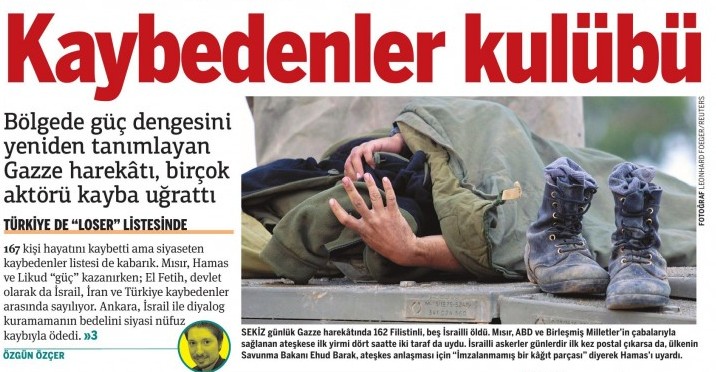
In the Turkish press, Nov. 23’s Taraf weighed up the new regional balances, considering those who gained and those who lost from the conflict. It placed Turkey in the “Loser’s Club,” under a headline saying: “Egypt in, Turkey out”: “The closing of all dialogue channels with Israel has been paid for diplomatically. According to many foreign observers, by only keeping ties with Egypt, Turkey has lost much of its persuasiveness in such issues.”
Perhaps unsurprisingly, other pro-government newspapers remained fairly quiet on the issue. Only Kerim Balcı put a brave face on it in Zaman, arguing that Egypt’s mediator role was more natural in an issue like Israel-Palestine:
“Yes, Turkey should wish to take part in efforts to solve any clashes that occur in the region, and indeed the world. However, in this zeal, other international actors should never be left out of the circuit. On the issue of Hamas, Egypt’s entry to the circuit is not a virtue, it’s a duty.”
These words might be more convincing if Turkey hadn’t already made such a big play of being a potential mediator, particularly in conflicts such as that between the Israelis and the Palestinians.
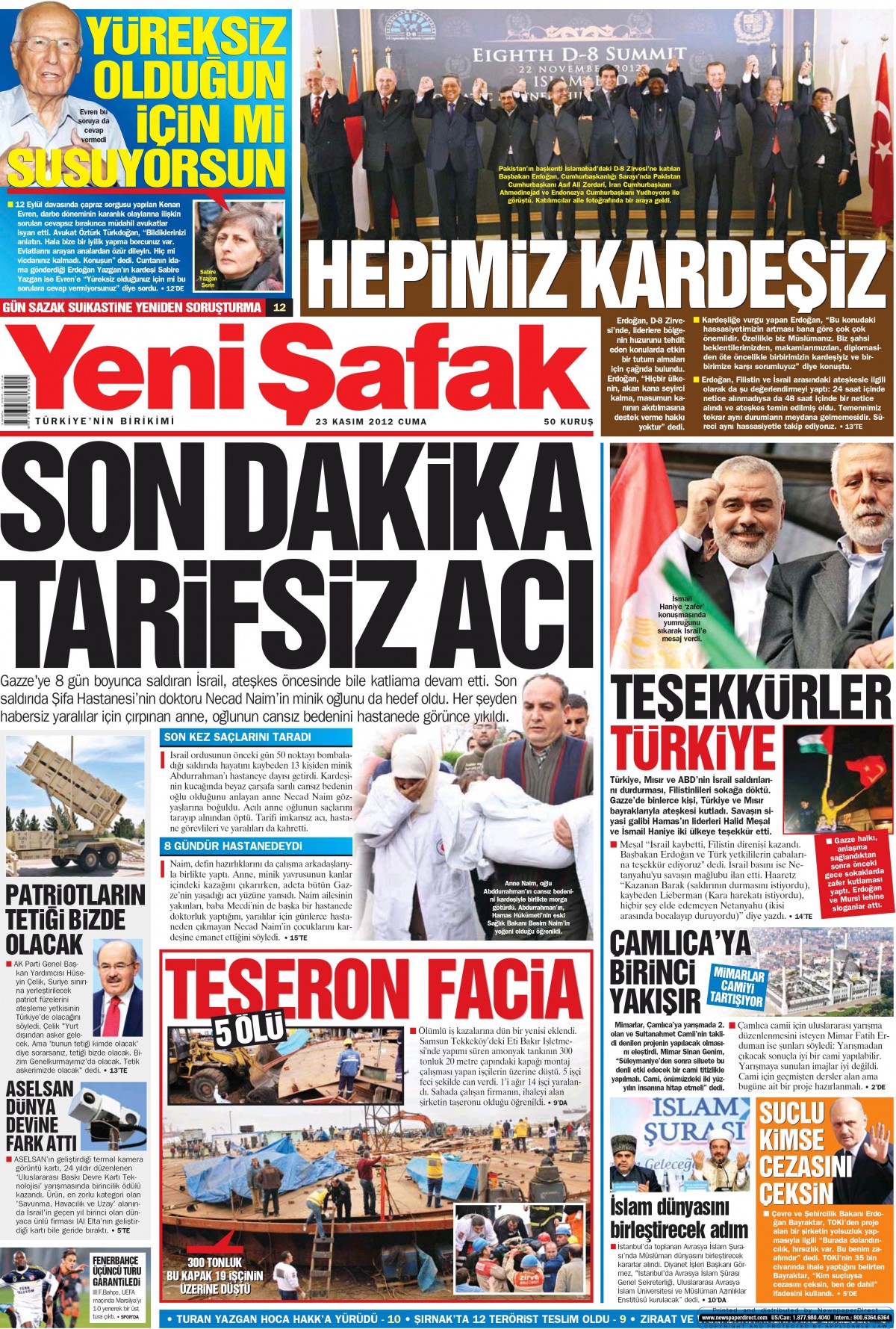
Conservative Islamist daily Yeni Şafak seems to be offering its readers a comforting fictional parallel universe. Alongside the requisite headline story about Israel’s “eight-day long massacre,” its Nov. 23 front page featured a box titled “Thank you, Turkey,” focusing on some marginal quotes from Hamas leader Khaled Mashal thanking the efforts of Turkish officials. It went further the next day, boldly stating in a similar front page box: “Without Turkey it wouldn’t have happened,” referring to the ceasefire process.
Meanwhile, just a day after being widely praised for his role in the ceasefire, Egyptian President Morsi was being criticized from all sides for his domestic move to assume sweeping new powers, leading to violent clashes in central Cairo. The rapid shift from praise to condemnation was striking. Indeed, while Egypt may – in Foreign Policy’s phrase – have taken over from Turkey as the Middle East’s latest “it” country, it has quickly discovered that this is not an easy role to play.
‘Bring back capital punishment, end this business’
November 14, 2012
Recently, Turkish Prime Minister Recep Tayyip Erdoğan has repeatedly expressed his opinion that Turkey should consider reinstating capital punishment “in certain situations.” He first brought the issue up at a meeting of his Justice and Development Party’s (AKP) deputies on Nov. 3, in reference to Abdullah Öcalan, the convicted leader of the outlawed Kurdistan Workers’ Party (PKK), and has returned to it on a number of occasions since. “Right now a lot of people in public surveys say that capital punishment should be reintroduced … It is legitimate in certain situations,” Erdoğan said. “Yes, the death penalty was removed from Europe, but has it left America, Japan and China? Then there is a justified cause for the death penalty to remain.”
Capital punishment was abolished by Turkey in 2002, just prior to the AKP’s accession to power in the general elections of that year. Although no execution had been carried out by the Turkish state since 1984, an official end to the practice on the Turkish law books was seen as one of the key steps in Turkey’s EU accession process, which was then entering its most energetic period. The decision was fairly controversial at the time, as PKK leader Öcalan was captured and sentenced to death by the Turkish authorities in 1999. With the abolition of capital punishment, this sentence was commuted to life imprisonment, and Öcalan has since been held in a remote prison on İmralı Island in the Marmara Sea. With the recent spike in clashes between the Turkish security forces and the PKK, Erdoğan’s words on capital punishment should be interpreted in terms of the government’s failure to solve the Kurdish question – populist sentiments aiming to deflect nationalist criticism that he has made too many concessions to Kurdish rights with little to show in return.
The most striking newspaper coverage of the issue I saw came from popular pro-government daily Sabah, the newspaper with the fourth highest circulation nationally. Its Nov. 13 front page carried the bold headline “Bring back capital punishment, end this business.” These were the words of Fatma Çınar, the mother of one of the 17 soldiers killed in the recent helicopter crash in the southeastern province of Siirt, speaking at her son’s funeral. The crash was not a result of direct clashes with the PKK, but it was enough for PM Erdoğan to frame it as taking place within “much intensified, multi-dimensional” military operations in the region.

The return of the issue to the national debate has predictably raised eyebrows among those parts of the media who retain forlorn hopes that Turkey’s EU accession process can still be revived from its current moribund state. Opposition Republican People’s Party (CHP) deputy Rıza Türmen, who worked for 10 years at the European Court of Human Rights, wrote in Milliyet on Nov. 13: “Capital punishment is banned according to the third section of the European Union’s founding principles, and the lifting of capital punishment is a precondition for membership of the EU and the European Council … Is leaving the EU process what the prime minister actually wants?” Meanwhile, Taraf editor Ahmet Altan’s disillusionment continued on the same day: “We’ve gone from a country that celebrated with enthusiasm the opening of ‘full EU membership negotiations,’ to one with a prime minister – like a funeral undertaker – shouting ‘hang them, hang them’ at every opportunity.” A response even came from the murky corridors of the EU itself, with Peter Stano, the spokesman for Enlargement Commissioner Stefan Füle, stating: “Our position on this is quite clear. Countries wishing to be a member of the EU cannot practice capital punishment. If capital punishment comes, the EU goes.”
Meanwhile, the hunger strikes of 700 Kurdish prisoners today entered their 64th day. Despite the increasing urgency of the situation, Erdoğan has so far ignored calls to directly engage in finding a solution. He even spent Nov. 12 in his hometown of Rize, receiving an honorary doctorate from the newly-established “Recep Tayyip Erdoğan University” (it’s sometimes difficult to tell in Turkey that you’re not reading The Onion). His words on capital punishment have certainly been an effective tactic distracting some attention away from the critical situation of the strikers. However, like the Peace and Democracy Party’s (BDP) recent remarks about erecting a statue of Öcalan, they have hardly done much to help create an atmosphere congenial to a solution.
Cihan news agency accused over Şemdinli report
November 7, 2012
The hunger strikes of 682 Turkish prisoners are entering their 57th day. The way that they – and the broader issues related to them – are being reported by media outlets known to be close to the ruling Justice and Development Party (AKP) clearly reflects the direction that the government’s Kurdish policy has recently taken.
With the government’s “Kurdish initiative” apparently having run out of steam, the conflict between the Turkish security forces and the outlawed Kurdistan Workers’ Party (PKK) has become increasingly bloody over the last 12 months, and chances for a political solution seem to be ever more remote. The latest bloody incident in south-eastern Turkey took place in the Şemdinli district of Hakkari province on Nov. 4, when a car bomb targeting a military vehicle killed 11-year-old boy Faris Demircan and wounded 26 others. Although there was no immediate claim of responsibility, the PKK is widely thought to be behind the blast.
On Nov. 5, the Gülen-affiliated Cihan news agency reported that pro-Kurdish Peace and Democracy Party (BDP) Hakkari deputy, Esat Canan, tried to visit the family of the deceased to offer his condolences, but was refused entry to the family home. However, no sources were referenced and no quotations on the incident from the family were included in the report. What’s more, no other news agencies mentioned this and local media in the area reported quite the opposite, saying that Canan had in fact been welcomed in to “share the pain.”
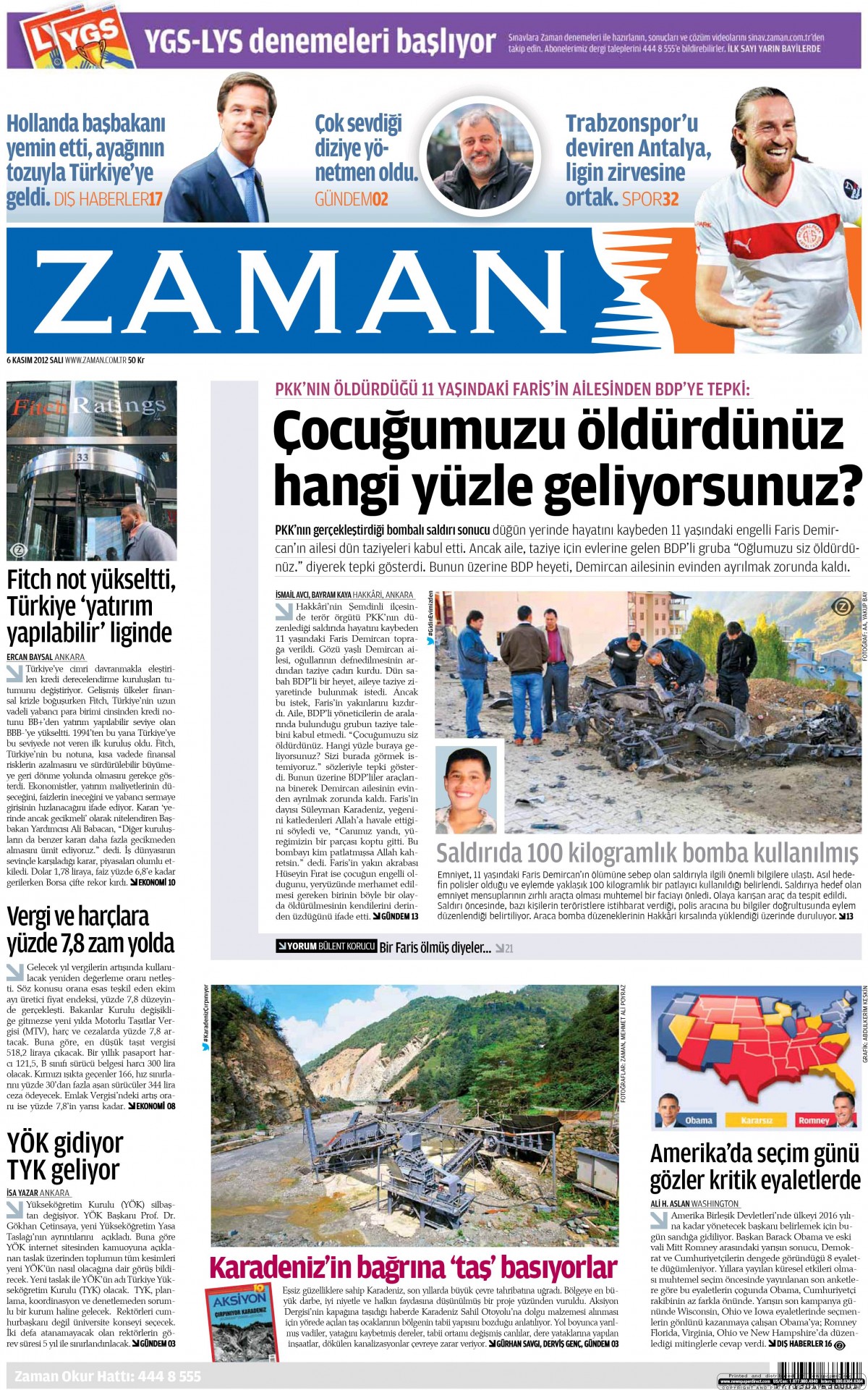
Those known to be close to the government, or the Gülen movement, were the only national newspapers to feature Cihan’s story. Zaman included it as their main front page story, under the headline: “Family of 11-year-old Faris respond to the BDP: ‘You killed our child, how dare you come here’”.
Star included the same story on its front page, alongside news claiming that local traders in Şemdinli were closed in protest against the incident. The headline read: “Şemdinli’s shutters closed against the PKK.”

Strongly Islamist daily Yeni Şafak carried a front page headline declaring: “BDP driven from the door”, included under which was a subtle subtitle: “God damn them.” Popular pro-government daily Sabah also featured the same story at the bottom of its front page under the headline: “You murdered my son.”
BDP deputy Canan has written a formal letter of complaint – which I have read (anybody interested can contact me) – to Cihan news agency about its “baseless” report. In the letter, he says that his visit was in fact accepted by the family of the deceased, and he claims that Cihan’s news was written without any examination of the area and without any correspondent on the ground. He demands a retraction and an apology, warning that he will exercise his full legal rights to pursue the case if he does not receive one.


 Turkey Book Talk