Travel notes – Mardin
January 21, 2012
You can make out Mardin from far away on the long western approach road, perched as it is on top of a mountain overlooking the Mesopotamian plains. As you get closer the box-like homes become clearer, nestled alongside the pencil-like minarets, towers, and domes, all built of the same pale honey-coloured limestone. It’s a striking, eerily timeless-looking place, but look out to your left and the present comes crashing back into view. Carved ominously into the soil of a smaller hill just outside the town are large white capitals, clearly spelt out for all comers to see, “Ne Mutlu Türküm Diyene” (How Happy to Call Yourself a Turk): a warm welcome from the Turkish military. The dolmuş I was travelling in passed countless army barracks and check points, and we were stopped twice by gendarmes asking for identity papers. A castle, originally Roman, sits on top of the mountain above the town, but whilst most Turkish towns make a landmark of their castle – charging a couple of lira for what is invariably the most spectacular view of a place – Mardin’s castle is absolutely closed. The Turkish army are its current occupants, the latest in a long line trying to establish hegemony in this ancient spot.
Close to the Syrian and Iraqi borders, the area has been a complex mixture of Arabs and Kurds for millennia, and during the 1980s and 1990s it was one of the hottest in the conflict between the Turkish government and the Kurdish rebel group, the PKK. It is also known as the Tur Abdin (“Servants’ Plateau”) plain, the historic motherland of the Syriac people of south-east Anatolia. Syriac Christians have lived in Tur Abdin for 1600 years, originally retreating there to escape Byzantine persecution. They were thus able to maintain their ancient liturgies, still performed in Aramaic (the language Christ would have spoken), and the nearby 5th century monastery of Deyr ul-Zafaran (“Monastery of Saffron”) remained the spiritual centre and seat of the patriarch of the Syriac Orthodox Church until 1932. The 20th century, however, proved to be the most cataclysmic in their history, when the Syriacs became one of the less remembered casualties of the upheavals that erupted in eastern Anatolia at the end of the Ottoman Empire. From 200,000 Anatolian Syriacs in the 19th century, their numbers fell to around 70,000 by 1920. A significant portion of those remaining left the area during the unrest of the 1980s and 1990s, caught in the crossfire between the Turkish government and the PKK. Today the community numbers no more than a few thousand. The landscape is thus scattered with decaying monasteries and deserted villages, and – like most towns in these parts – Mardin is also still home to the obligatory, rotting, untrumpeted Armenian church.
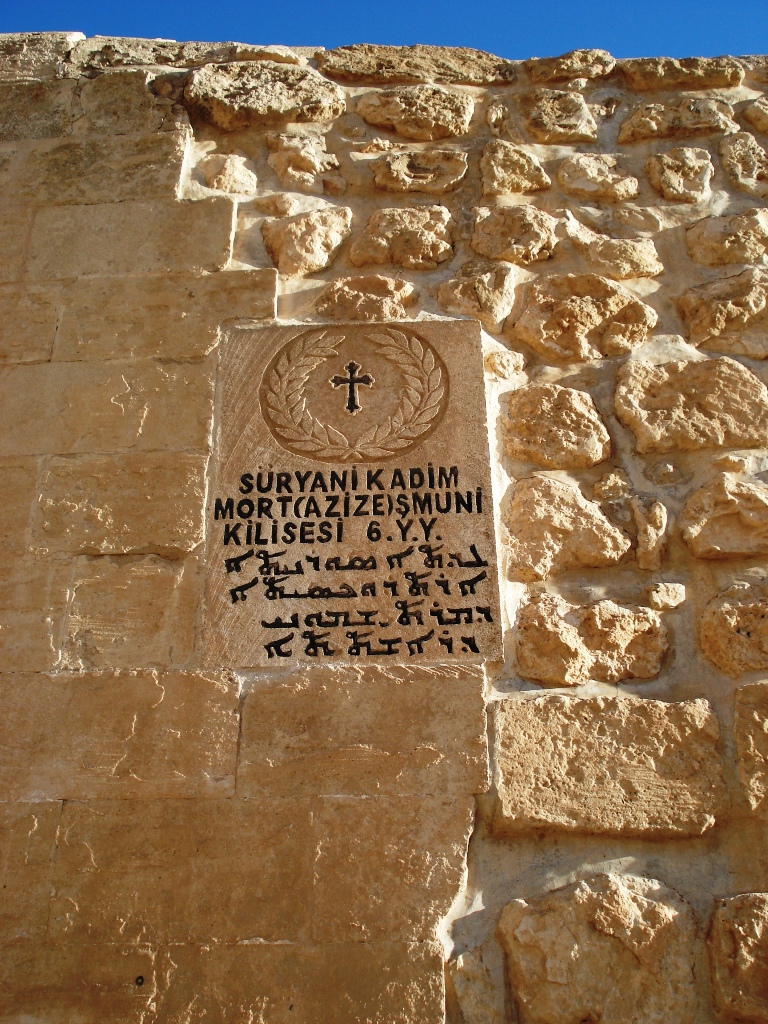
The municipality’s official tourist leaflet carries the headline: “Mardin: where the call to prayer echoes within the sound of church bells.” It’s a nice line, but the only church bell still ringing in the town is that of the 15th century Kırklar Kilisesi, or “The Church of the 40 Martyrs”, and a rusty old bell it was too. A caretaker called Musa rings it to announce prayers at regular intervals throughout the day, and potters around to keep an eye on things and answer questions whilst it’s open to visitors. Of the eleven churches still standing in Mardin, the Kırklar Kilisesi is the only one still open for services, and Musa told me that church numbers have been steadily dwindling, “definitely down from 10 years ago.” The flock now totals “about 80 families, around 400 people.” During my visit a family of three wandered in to the church. The father told me they lived in northern Syria, and that they were in Mardin as tourists, searching for the old family home that had been deserted a hundred years ago “because there was big problem.” Musa himself was of an extremely morose disposition, hardly able to look such comers and goers in the eye, but occasionally bursting out in fits of uncontrollable hysterics. There is in fact an uneasy coyness about most of the Syriacs I met. Put it down to an over-active imagination, but I couldn’t help wondering if it was the weight of such a tormented history weighing down upon them. Amongst all the dry facts and figures recounting seismic demographic change, it’s perhaps easier to ignore the mental effects wrought on those left behind than the physical.
Even one so well travelled as British historian Arnold Toynbee described Mardin in the 1920s as “the most beautiful town in the world,” Indeed, it has been experiencing something like a touristic renaissance more recently, with the (relatively) improved stability of the area helping to stimulate a renewed interest from visitors, mostly Turkish. A florescence of newly renovated boutique hotels can be found tucked away down the rabbit-warren backstreets that tumble down from the main central street. During my visit I stayed in the splendid “Kasrı Abbas”, converted from a large old mansion on the hillside: rooms with ornate carvings and multi-domed roofs opening onto wide open courtyards, offering panoramic views across Mesopotamia to the Syrian border. The backstreets themselves have similarly benefited from the rejuvenation, impossibly evocative and seemingly untouched for hundreds of years (despite their deliberate tidying up). It all feels slightly uncomfortable though, as if many things remain unsaid, much still remains unconfronted. The number of tourists will doubtless continue to rise, but they will probably be condemned to look at dead relics, unresurrectable remnants. Daily Radikal carried a front page story earlier this month about an apparent “return of the Syriacs”, reporting that a number of the families who migrated from Tur Abdin since the 1980s have returned. But the evidence looks pretty slender to me. It seems more than doubtful that anything like a return to the same number as previously lived in the area could ever be possible. The ties have been irreversibly cut.

Mardin perhaps bears comparison with another ancient and contested site, Jerusalem. But whilst I expect Jerusalem would confound because of the sheer intractability of its present day conflicts, Mardin does so because of precisely the opposite. Here, perhaps more than anywhere else in Turkey, (and that’s saying something), one gets the crushing, debilitating impression of lost, dead history. But although dead, it’s history that casts a long shadow. Unlike the myriad remnants of ancient civilisations across Anatolia, Mardin’s sense of lost history is of critical importance to the present: it paints the present day into a corner. You feel that the past has been forcibly forgotten, ignored, at most whispered about uncomfortably. It’s as if a door has slammed shut, but is still creaking uneasily. It all leaves quite an impression, but not a particularly pleasant one.
“Turkey”, Andre Falk (1963)
January 7, 2012
A little while ago I came upon one of those old, forgotten, po-faced, unintentionally hilarious English-language travel guidebooks on Turkey. Simply called “Turkey”, it was published in 1963, written by a splendidly-named “Andre Falk”, surely one of the great travellers of Anatolia. I can only say that I wish today’s Lonely Planet guides were written like this.
Falk on Istanbul:
What is one to think of the local mosques, shapeless, dull and unimaginative, looking like asthmatic tortoises decorated by what might be pencils, rockets or phallic symbols?
The Golden Horn is not and probably never has been anything but a stagnant backwater, a sump full of floating vegetable waste at the foot of bare mounds.
The Grand Bazaar remains the biggest in the world, and probably was once the most exciting. But after numerous fires (its last layout dates from 1889 – the worst of periods) it is now the ugliest junk market to be found between East and West […] Let us move on. Everybody knows that the only places for decent shopping are in Rome and Paris…
On Ankara:
It takes an effort of the imagination to realise that this ultra-modern city was created from nothing. You take it for granted that you can live there without contracting malaria.
A gypsy caravan rotting in the backyard of an air-conditioned government building: that is more or less the picture of Ankara.
There is little life in public places, nothing to invite you to stroll about after office hours. Severe, ill-paid officials lock up files of state secrets in their briefcases and hurry off along avenues named after flowers for a game of loto with a colleague from the next department. Suffering diplomats stifle a yawn over the bridge table while the ladies are eagerly engaged in gossip. At the municipal restaurant the din of the musical medleys annoys the secret service agents who are straining their ears to listen to the diners’ conversations. A city you must see, of course, but a brief visit is enough.
On Anatolia:
It is a harsh, even brutal land, where nature and man combine to form a scene of extraordinary harshness.
From north to south you find carelessness, absence of style and no attempt at elegance […] Concrete, disinfectant, prison smells, grey buildings with the paint peeling off, such are the provincial hotels revealing the bad workmanship put into them. The restaurants are like canteens and the dining rooms like feeding troughs.
On Turks:
When a Turk says no, he raises his eyebrow, throws his head back and gives you a stony stare, as if he would like to see you fall dead at his feet. Such behaviour does not make for easy relations between men, but at least it is clear.
His endurance and his lack of imagination make the Turkish infantryman a redoubtable soldier: ‘the most reliable and the most obedient in the world’, wrote T.E. Lawrence, who had fought him in Arabia […] To tell the truth, it is rather a terrifying sight meeting Turkish soldiers.
Fortunately rugby is unknown in Turkey, for it would turn to a massacre.
The higher reaches of Turkish society are probably, man for man, more brilliant than their western counterparts, and this is all to their credit, for the intellectual professions are meanly rewarded […] When you meet a professor, a librarian or a hospital doctor, you are greatly touched when you learn the real incomes of these disinterested men.
The humble folk of the Anatolian mountains and plains are capable of generous and sometimes touching hospitality toward those who know how to behave properly, or towards those in genuine distress. But such a welcome is always tinged with suspicion. The foreigner is no longer the undesirable he was, but they still do not want him and he is automatically suspect […] There is no doubt ample historical justification for this distrustful turn of mind. We will merely add that it does not ease the task of the traveller, who bears no responsibility for the Ottoman Debt and cannot tiptoe about for weeks on end, hoping to make people forget about the Treaty of Sevres.
On politics:
A democratic politician speaks in different tones when addressing the Council of Europe to when in his constituency accusing the republican opponent of being uncircumcised.
On republican reforms:
Atatürk wanted to dress his Turks like Westerners. Apart from a slender few, all he did was to turn them into a lot of old tramps.
If revolutions have their necessities and progress has its demands, beauty still has its claims which one would like to see less disregarded by modern Turkey.
The effort to effect a complete revolution was asked for from the most conservative and static of peoples […] Left to himself, it seems, the Turk would only want to do one thing: remake his bed and go to sleep on it. Perhaps this is why, as soon as he gets home, the first thing he does is to don his house pyjamas.
On minibuses:
They say quite rightly that the drivers of these boneshakers are good; the reason is simple, the others are all dead.
On travel:
A plague on those archaists who dip their mandarins’ brushes in the pot of local colour and go off to the banks of the Ganges or the Nile to utter literary bleatings over the photogenic qualities of the squalid.
It is a frequent misfortune that when you reach your destination on a pilgrimage into the past all you find is fragments of pillars buried under weeds. The ideal journey is one which leaves you with the illusions of your imagination unbroken and arrives at no destination.


 Turkey Book Talk