‘Important statements from the prime minister’
November 11, 2013
The title will be familiar to any follower of news in Turkish. Every day, “news” stories consisting of unedited transcripts of words spoken by Prime Minister Recep Tayyip Erdoğan are published online under that headline by the major newspapers. The recent storm over Erdoğan’s opposition to mixed-sex student accommodation was only the latest example showing that Turkey’s entire news agenda is increasingly becoming subject to the whims of his unpredictable tongue. He opens his mouth and whichever subject he has chosen then dictates the national conversation. When the media is so completely dependent on politicians, how can be expected to hold those same politicians to account?
This problem cuts across the internet, the television, and the printed press. It almost feels like an act of rebellion when a TV station chooses not to cut to a live broadcast of any public utterances from “The Master.” I only came to Turkey in 2009, so I can’t say whether this has always been the case, but I suspect that the situation has only deteriorated of late. The fact is that you can’t get much safer than a “news” story simply providing a transcript of words spoken by the prime minister. What’s more, depressingly, I’ve been told that these articles usually get the most “hits” for websites. This fixation on Erdoğan’s every word is not only extremely distorting, but also exacerbates the bizarre cult of personality that has developed around him amongst his supporters.
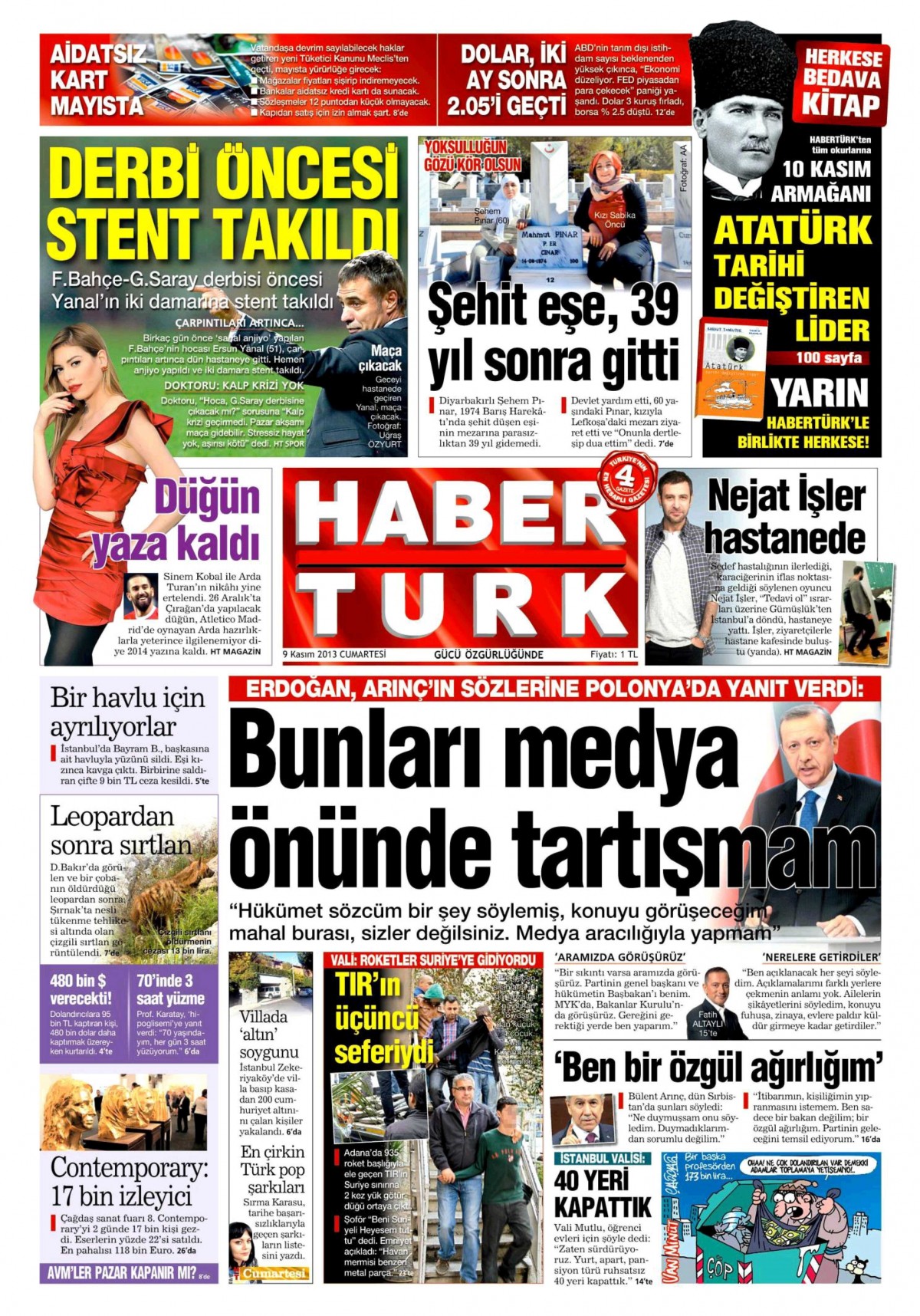
Habertürk parroting the prime minister on Nov. 9. With unintended irony, the headline quotes Erdoğan’s response to Deputy PM Bülent Arınç’s criticism of the mixed-sex student housing debate: ‘I don’t discuss these things in front of the media.’
But while this obsequiousness is lamentable, those official pronouncements in fact are very important. The centralization of decision making is so chronic that Erdoğan’s words, whatever they are, really do have the power to shape the agenda of the country, decide the laws that then get passed, and at what speed. As Adana Governor Hüseyin Avni Coş said shortly after Erdoğan’s utterances on co-ed housing: “We see the prime minister’s words as orders.” Policy is increasingly being shaped on an ad-hoc basis around Erdoğan’s statements; the centralization of power around him now is such that there is a genuine justification for reporters broadcasting and publishing every single thing he says. The vicious cycle is thus reinforced.
That’s why the controversy that is periodically caused by the firing of prominent critical columnists from newspapers often misses the point. Many people’s understanding of news seems to be little deeper than a “who said what?” bish-bash-bosh, responded to by a flood of commentary. As I wrote in my last post, few seem to value deeper investigative reporting, and none ever mention the inherent problem with “stories” consisting of nothing more than an indiscriminate transcript of a minister’s speech. Editors who are encouraging “Important statements from the prime minister” articles are contributing to this dangerous imbalance. Far from the media being a check on power, PM Erdoğan’s tongue is the driving force behind the media.


 Turkey Book Talk